




TL;DR: AI in customer success helps teams scale by turning customer data into actionable insights. This guide highlights practical AI use cases, including health scoring, onboarding automation, sentiment analysis, and early risk detection, that show how teams can improve decision-making, reduce churn, and drive better customer success outcomes.
Customer success teams don’t lose customers because they don’t care. They lose them because they can’t see early warning signs. By the time disengagement is obvious, there’s often little or no time to recover the relationship.
AI-powered tools, including AI chatbots and AI agents in customer service, are transforming how customer success teams deliver both proactive support and instant, 24/7 assistance while reducing manual effort.
According to McKinsey & Company, AI-powered customer engagement systems can improve customer satisfaction by 15–20% while reducing service costs by up to 30% through predictive analytics and personalized experiences.
In this blog, you’ll learn how AI improves customer success, key use cases, how to integrate it effectively, and the common mistakes to avoid when implementing AI.
Where AI makes the biggest impact in customer success
Customer success has moved beyond closing tickets. Today, it’s about making the right decisions at each stage of the customer journey, using data that reveals how customers engage with your product.
As customer data grows more complex, AI unifies product usage, support interactions, sentiment, and renewal indicators in one place.
Instead of reviewing each input separately, teams get a clearer view of what needs attention and why.
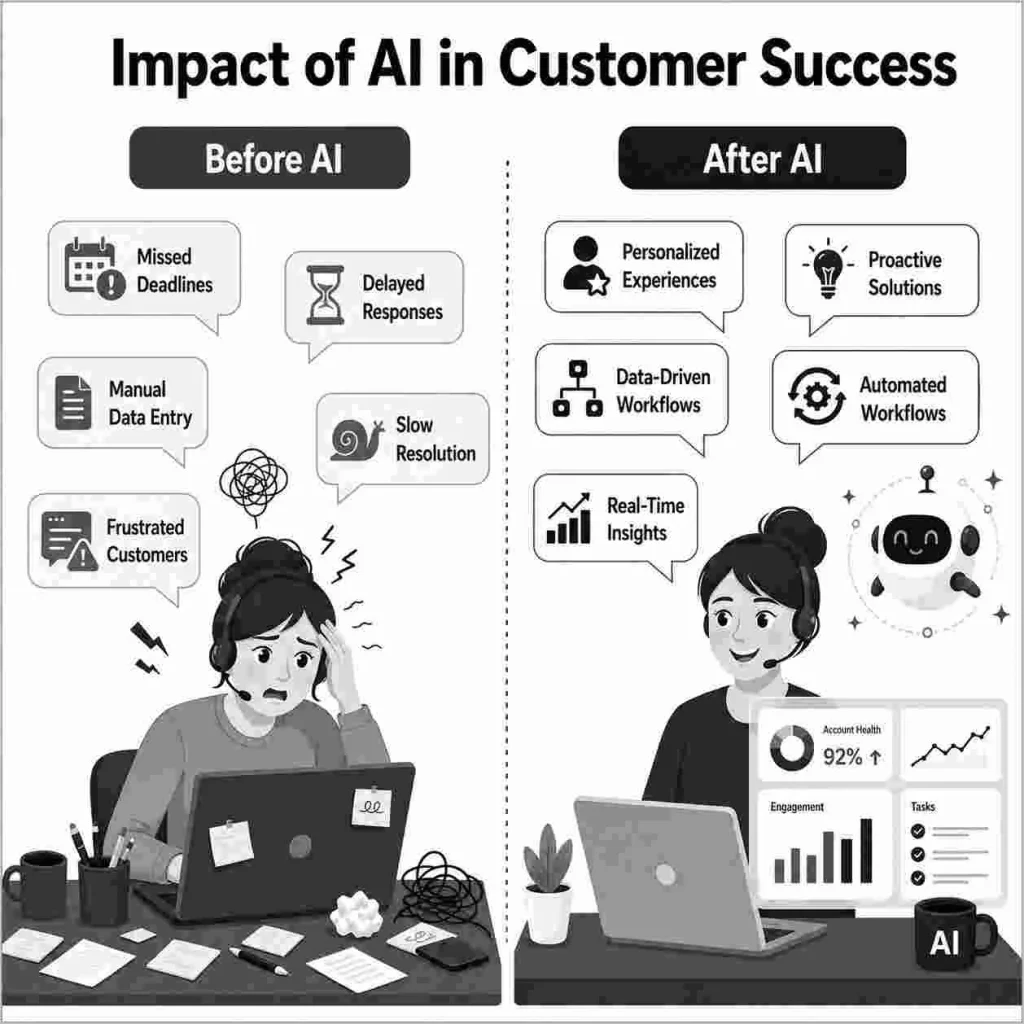
By applying AI in customer success, teams can:
- Deliver more personalized experiences: Use customer data to tailor interactions, recommendations, and support based on individual needs.
- Identify issues early and take proactive action: Detect declining engagement or adoption issues before they impact retention or renewals.
- Enable data-driven workflows: Use unified customer insights to guide onboarding, retention, and account management decisions more effectively.
- Automate repetitive customer success work: Eliminate manual tasks like follow-ups, updates, and routing so teams can focus on high-value engagement.
- Access real-time customer insights: Continuously track usage, engagement, and support signals to gain visibility into customer activity and behavior.
- Resolve issues faster with better context: Improve response and resolution times using automation, connected customer history, and AI-assisted guidance.
- Enhance customer satisfaction: Use AI-driven analysis to identify and address gaps in customer interactions, improving satisfaction and building stronger relationships.
Integrating AI into support workflows enables customer success teams to act proactively, improve the customer experience, and drive higher retention.
10 Best AI use cases in customer success for modern support teams
AI delivers the greatest impact when it is integrated into core customer success workflows.
From onboarding and customer health monitoring to workflow automation and personalized engagement, AI helps teams scale support, increase efficiency, and strengthen customer relationships more effectively.
The following use cases show how businesses can apply AI in customer success to drive proactive engagement and long-term customer growth.
1. Reducing onboarding friction with smart guidance
Customer onboarding often becomes challenging when users struggle with setup processes, feature configurations, or understanding how to realize value quickly.
With AI, customer success teams can improve onboarding experiences by analyzing customer behavior in real time.
It identifies where users drop off, skip steps, or experience friction, then automatically delivers contextual guidance, walkthroughs, and recommendations tailored to their progress.
This enables businesses to:
- Accelerate time-to-value
- Increase customer lifetime value
- Improve product adoption
- Increase customer retention
By making onboarding more adaptive and personalized, AI helps customers become successful faster with less manual intervention from support teams.
2. Tracking customer health and surfacing early risk signals
Traditionally, customer success teams rely on manual reviews and disconnected customer data to evaluate account health. This often delays the identification of disengaged customers until renewal periods approach.
AI continuously analyzes product usage, engagement trends, support interactions, and lifecycle data to generate dynamic customer health scores, detect churn risks early, and alert teams before issues escalate.
As organizations adopt agentic AI in customer experience, these systems can go beyond analysis by automatically recommending and initiating timely actions to improve customer outcomes.
This allows teams to identify at-risk customers earlier, improve retention planning, deliver proactive support, and strengthen long-term account health.
Example:
If product usage declines while support tickets increase, AI recognizes the pattern, lowers the account’s health score, and alerts the assigned customer success manager with actionable insights.
This helps teams intervene early and resolve concerns before renewal conversations begin.
3. Automating repetitive customer success workflows
Customer success teams often spend significant time managing repetitive operational tasks such as follow-ups, reminders, status updates, and customer check-ins.
AI-powered workflow automation helps streamline these routine activities by automatically triggering actions based on customer behavior, lifecycle stage, or predefined conditions.
This enables teams to minimize manual workload, ensure consistent customer communication, reduce response times, and focus more on strategic customer engagement.
4. Delivering personalized experiences at scale
As customer bases grow, maintaining personalized engagement across every account becomes increasingly difficult through manual processes alone.
According to Salesforce, 73% of customers expect companies to understand their unique needs and expectations.
AI email automation enables customer success teams to personalize interactions at scale by analyzing customer behavior, onboarding progress, feature usage, and engagement history.
Based on these insights, AI can recommend relevant features, tailor onboarding experiences, and optimize customer outreach according to each customer’s needs and lifecycle stage.
With AI-driven personalization, businesses can improve engagement, increase feature adoption, enhance customer satisfaction, and strengthen long-term retention.
5. Prioritizing high-value accounts and revenue opportunities
Determining which accounts need immediate attention and which are most likely to expand or renew is a common challenge for customer success teams.
AI analyzes engagement trends, product usage patterns, support history, and account behavior to identify high-value customers, potential expansion opportunities, and accounts with strong growth potential.
With these insights, customer success managers can focus on high-impact accounts, prioritize revenue opportunities, improve renewal planning, and allocate their efforts more strategically.
6. Analyzing customer intent, sentiment, and feedback at scale
Customer feedback is often scattered across emails, surveys, chats, reviews, and support conversations, making it difficult to consistently identify recurring concerns or shifts in customer sentiment.
AI helps teams analyze customer interactions across multiple channels at scale by identifying intent, sentiment, tone, and recurring feedback patterns.
These patterns may be overlooked when analyzed manually, but AI provides deeper visibility into customer concerns and expectations before they impact the overall experience.
AI-powered sentiment analysis enables teams to improve communication quality, respond with better context, identify recurring customer pain points, and make more informed customer success decisions.
7. Mapping customer journeys to improve lifecycle visibility
Customer interactions occur across multiple touchpoints, including onboarding, support, product usage, and ongoing engagement.
Without a connected view, it can be difficult for customer success teams to understand how these experiences influence the overall customer lifecycle.
AI unifies customer interactions into a complete customer journey view, making it easier to identify onboarding gaps, recurring issues, engagement drop-offs, and product adoption barriers.
This gives customer success teams the visibility needed to reduce friction, improve lifecycle experiences, identify recurring support challenges, and guide smoother customer progression.
Example:
A support team reviews a customer journey from signup to feature activation and notices repeated support tickets after a skipped setup step.
By identifying this recurring pattern, the team improves onboarding guidance to reduce friction earlier in the customer lifecycle.
8. Providing consistent customer experiences across touchpoints
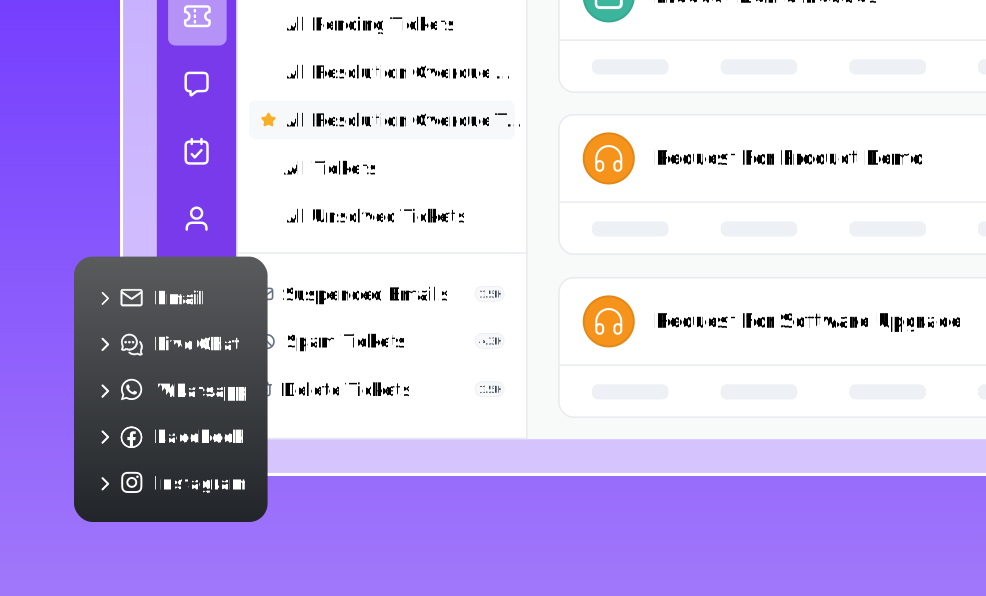
Customers engage with businesses through different channels, including email, live chat, support portals, onboarding flows, in-app support, and self-service options.
When these interactions remain disconnected, customers may need to repeat information, experience inconsistent support, or encounter communication gaps across teams and channels.
By creating a shared customer context, AI enables teams to:
- Unify customer interactions across channels
- Deliver consistent guidance and recommendations
- Provide connected support across all interactions
This creates smoother transitions between touchpoints, improves coordination across teams, and delivers a more connected omnichannel customer experience.
9. Reducing wait times with AI-powered self-service
During onboarding, setup, and ongoing product usage, delays in resolving common customer questions can interrupt workflows and create unnecessary friction.
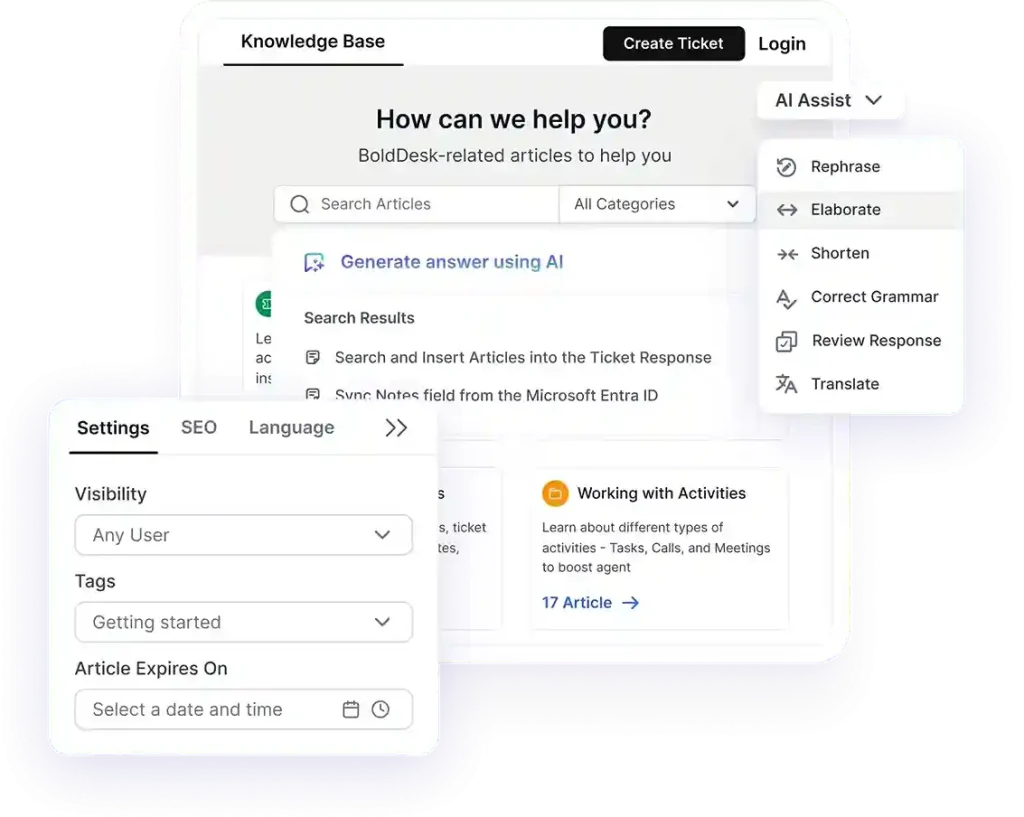
AI-powered self-service helps customer success teams:
- Understand customer intent and search behavior
- Surface relevant knowledge base articles instantly
- Deliver contextual in-app support during onboarding or product usage
- Guide customers toward resolution without agent involvement
By enabling customers to find answers faster, businesses can reduce support volume, improve customer satisfaction, and create smoother customer experiences across critical lifecycle stages.
KAMI Workforce’s customer success team uses BoldDesk’s AI-powered knowledge base to improve efficiency.
By automatically surfacing relevant knowledge base articles and delivering contextual support, the team reduces support wait times, minimizes repetitive tickets, and enables customers to resolve issues independently.
10. Strengthening trust through data security and privacy
As AI becomes increasingly embedded in customer success operations, maintaining strong data security and privacy is essential for building lasting customer trust.
AI-powered platforms support these efforts through secure data handling, intelligent access controls, real-time threat detection, and continuous monitoring of customer interactions.
They can identify suspicious activity, automate privacy workflows, and reduce risks without compromising service quality.
By combining automation with transparent data practices, businesses can protect sensitive information, ensure compliance, and strengthen customer confidence across the entire journey.
Common mistakes customer success teams make when using AI
Many teams adopt AI expecting faster workflows and better customer outcomes, but poor implementation often creates more complexity instead of real value.
Below are some of the most common mistakes customer success teams make and how to avoid them.
Automating workflows without clear customer outcomes
Teams often automate onboarding emails, follow-ups, and customer interactions without first identifying which activities actually improve retention, adoption, or renewals. This usually leads to more automation but very little improvement in customer outcomes.
Solution: Define clear customer success goals before introducing automation so AI supports actions that directly improve retention, onboarding, or customer engagement.
Choosing AI tools that disrupt existing workflows
Some AI tools operate separately from existing systems and processes, forcing teams to switch between platforms or manage disconnected workflows.
Instead of improving efficiency, this often creates more manual work and lowers adoption across teams.
Solution: Implement AI-powered customer success tools that integrate smoothly with your existing help desk software, customer data, and workflows.
Treating AI setup as a one-time process
Many teams assume AI systems will continue working effectively after the initial setup. But as customer behavior, products, and workflows evolve, outdated automation and insights quickly become less useful and less accurate.
Solution: Regularly review and refine AI workflows to keep them aligned with changing customer behavior and business needs.
Over-relying on AI without human oversight
Without clear collaboration guidelines, teams may rely too heavily on AI recommendations or ignore them altogether. This can lead to inconsistent decisions, reduced accountability, and poor customer experiences.
Solution: Define where AI supports decision-making and where human judgment is still required. Establish clear approval and escalation workflows so teams can act on AI insights without losing oversight.
Limiting AI to chat interactions instead of core workflows
Many teams use AI only for chat or ticket responses while keeping onboarding, renewals, health monitoring, and account reviews fully manual. This limits the overall impact of AI across customer success operations.
Solution: Integrate AI into broader customer success workflows. Use it to analyze customer data, identify risks, surface insights, and support decisions across the entire customer lifecycle.
Using AI without clear customer communication
Customers may not always realize when AI is being used in support interactions, recommendations, or guidance.
According to Salesforce, nearly 75% of consumers want to know when they’re communicating with an AI assistant.
Without transparency, this can create confusion and reduce trust in the overall customer experience.
Solution: Be transparent about where and how AI is used so customers understand how interactions, recommendations, and decisions are being supported.
How to implement AI in customer success without disrupting your team
Successfully adopting AI in customer success starts with a gradual and strategic approach. Instead of automating everything at once, focus on workflows where AI can deliver the most immediate value and improve team efficiency.
- Identify high-impact workflows: Start with repetitive tasks such as onboarding, churn prediction, ticket routing, or follow-ups that can benefit from AI automation.
- Connect customer data sources: Integrate support, product usage, CRM, and customer interaction data to give AI tools accurate and complete insights.
- Start with one use case: Begin with a single AI implementation before expanding to multiple workflows. This helps teams adapt more effectively.
- Define human approval points: Keep human oversight for sensitive interactions, escalations, and customer-facing decisions to maintain accuracy and customer trust.
- Track key performance metrics: Monitor metrics such as retention rate, response time, customer engagement, and customer satisfaction score (CSAT) to measure AI effectiveness.
- Review AI outputs regularly: Continuously evaluate AI-generated insights and recommendations to improve accuracy, quality, and customer experience over time.
How BoldDesk helps teams deliver AI-powered customer success
Today’s customers expect fast, personalized, and proactive support across all channels. BoldDesk helps teams meet these expectations with AI-powered automation, intelligent ticket management, and self-service capabilities.
With AI actions, teams can automatically trigger workflows, such as updating records or processing requests, directly from support interactions, eliminating manual steps.
By combining efficiency with personalized support, BoldDesk enables teams to deliver exceptional customer success experiences at scale.
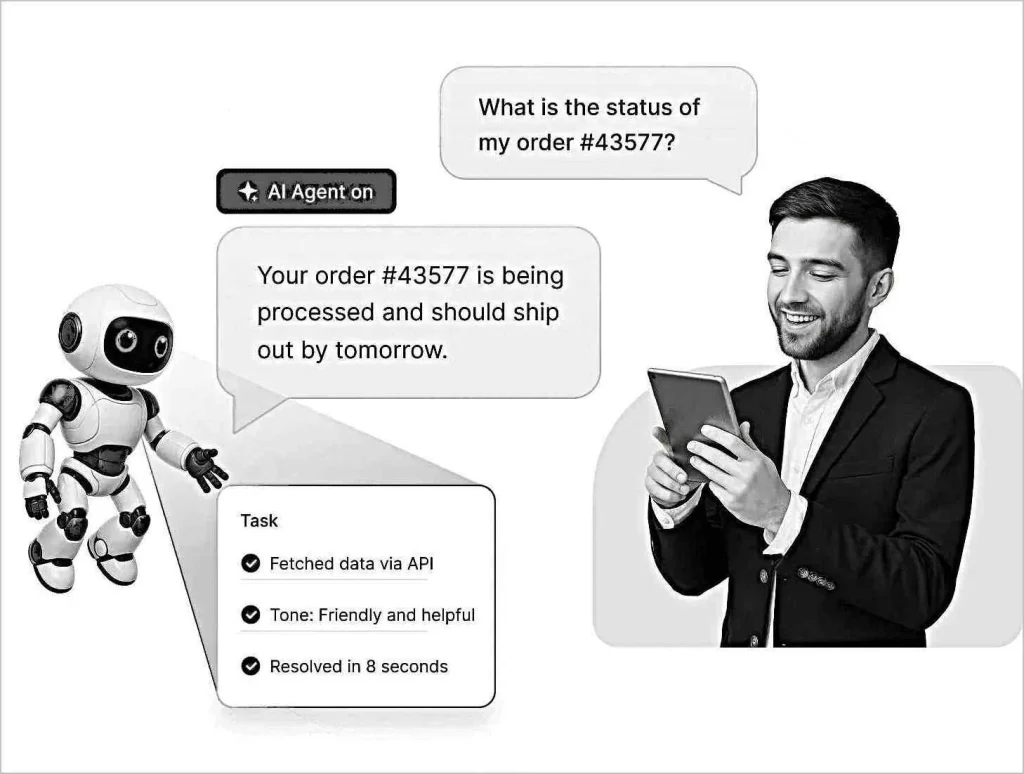
- Resolve common customer requests instantly: AI Agents handle routine inquiries automatically, improving response time while allowing teams to focus on higher‑value conversations.
- Assist agents in real-time: AI Copilot analyzes context and suggests replies, next actions, and knowledge references to improve accuracy and consistency.
- Preserve full customer context across interactions: AI brings together information from support tickets, conversations, and customer history to ensure every interaction is informed and personalized.
- Automate repetitive workflows: AI detects behavior patterns to trigger follow-ups, assignments, and updates automatically, reducing manual work.
- Keep humans in control of sensitive customer decisions: BoldDesk combines AI automation with approval workflows and escalation rules so teams can review sensitive actions, handle complex conversations, and maintain accountability during high‑impact customer conversations.
- Extract actionable insights from customer interactions: AI-powered reporting and analytics reveal patterns across support data, helping teams identify friction points and improve customer success outcomes.
By embedding AI directly into everyday support workflows, BoldDesk empowers customer success teams to eliminate manual bottlenecks, detect churn risk early, and manage customer interactions more proactively at scale.
Transform customer success with smarter AI-driven workflows
These use cases show how AI in customer success can help teams move faster, spot risk earlier, and deliver more consistent customer experiences.
From onboarding and health scoring to automation and self‑service, AI gives customer success teams the visibility they need to protect retention and scale effectively, without losing the human touch.
With BoldDesk, customer success teams can centralize operations and manage customer conversations more efficiently from a single platform.
Start your free trial to see how AI-powered help desk software helps your customer success team manage risk proactively, improve engagement, and support long-term growth.
Have questions or thoughts to share? Please leave your feedback in the comments section below; we would love to hear from you.
Related articles
- AI Agent Examples: 21 Real-World Use Cases Across Industries (2026)
- 7 AI Customer Support Implementation Mistakes and How to Fix Them
- AI-Powered Customer Support: Tips for Scalable Business Growth
FAQs
AI in customer success is the use of artificial intelligence to analyze customer data across the lifecycle, automate routine work, and help teams act proactively to reduce churn and improve long-term customer value.
Traditional customer support tools focus on responding to tickets and requests after issues occur.
AI in customer success takes a proactive approach by analyzing customer engagement and behavior to predict needs, identify risks, and guide teams before problems escalate.
Yes, AI is designed to support customer success managers by handling repetitive tasks and data analysis, while humans remain responsible for relationships, judgment, and complex interactions.
No, teams of all sizes can benefit from AI by automating manual work, gaining better visibility into accounts, and scaling customer success efforts without adding headcount.
AI drives customer churn reduction by identifying early warning signs in behavior and engagement, enabling teams to intervene proactively with timely support and relevant guidance before issues escalate.
The biggest challenges teams face when implementing customer success AI automation include poor data quality, disconnected systems, over-automation, data privacy concerns, and inaccurate or unmonitored AI outputs.