

 In this page

TL;DR: AI agent use cases that deliver value fastest in customer support include password resets, order tracking, refund processing, ticket routing, subscription changes, and appointment scheduling. The requests are high-volume, low-judgment, and are resolved end-to-end without human involvement. Requests involving negotiations, policy exceptions, or sensitive customer situations generally require human oversight.
Businesses are under pressure to do more with less while customers expect faster, more personalized service. As workloads grow, many teams struggle to scale without adding costs and complexity.
According to IBM, 83% of executives expect AI agents to significantly improve process efficiency by 2026, reflecting growing interest in autonomous systems that can analyze information, make decisions, and take action.
AI agents in customer service help address these challenges by automating tasks, supporting decision-making, and streamlining operations across industries.
In this guide, you’ll discover 21 real-world AI agent examples and see how organizations use them to improve customer service, operations, and business efficiency.
AI Agent use cases that deliver value fastest
Many organizations start by automating high-volume, repeatable requests that follow clear workflows and require minimal human intervention.
| Use case | Typical request | AI action | Human involvement | Time to value |
| Password resets | Account access issues | Reset credentials | Rarely required | High |
| Order status requests | Shipping and delivery inquiries | Retrieve order data | Rarely required | High |
| Refund requests | Returns and billing issues | Process refund requests | Sometimes required | High |
| Routing and triage | Ticket categorization and assignment | Categorize, prioritize, and route tickets | Not typically required | High |
| Subscription updates | Plan changes and cancellations | Update account details and plans | Rarely required | Medium |
| Appointment scheduling | Booking and rescheduling requests | Schedule or modify appointments | Rarely required | Medium |
These use cases are often the best starting point for AI adoption because they offer clear business value, measurable efficiency gains, and well-defined workflows that are easier to automate.
Common types of AI agents
Different types of AI agents are designed to handle specific roles, from customer interactions to background automation and decision support.
Most successful implementations combine multiple AI agent types to cover a wide range of business needs.

- Frontline AI agents: Handle first-contact interactions across chat, email, voice, or messaging channels. These agents answer common questions, track orders, resolve routine issues, and provide 24/7 support.
- Task-based or transactional AI agents: Execute specific actions on behalf of users, such as processing refunds, updating account details, scheduling appointments, or changing bookings across connected systems.
- Routing and triage AI agents: Analyze incoming requests, identify intent, and automatically route them to the right team, workflow, or AI system, reducing manual ticket sorting and speeding up resolution.
- Decision support AI agents: Analyze data, rules, and context to recommend next steps or optimal outcomes. These agents support human teams with insights into faster, more accurate decision-making.
- Proactive AI agents: Act before users reach out by monitoring behavior, usage patterns, or system signals. They can trigger alerts, send reminders, or initiate outreach to prevent issues before they escalate.
In practice, organizations often deploy multiple AI agent types together, creating a coordinated system that automates tasks, improves efficiency, and delivers consistent experiences at scale.
Comparison table for the industry-specific AI agent examples
Common AI agent examples include customer support agents, recommendation agents, fraud detection agents, and workflow automation agents used across industries such as SaaS, ecommerce, finance, healthcare, and manufacturing.
Here’s a summary of the examples of AI agents across major industries, with the measurable value they offer.
| Industry applications | AI agent examples | Value delivered |
| Customer support |
|
Faster resolutions, 24/7 support, and higher customer satisfaction |
| E-commerce |
|
Higher conversions, fewer abandoned carts, personalized experiences |
| Healthcare |
|
Better patient support, reduced admin work, proactive care |
| Manufacturing |
|
Reduced downtime, efficient logistics, optimized operations |
| Finance |
|
Strong security, faster decisions, improved customer trust |
| Education |
|
Personalized learning, automated grading, and faster student service |
| Marketing |
|
Better targeting, increased conversions, and dynamic personalization |
Intelligent Support Powered by AI — Free!
Deliver instant responses and resolve customer queries quickly with advanced AI-driven tools.

21 Real-world AI agent examples across industries
So, what does this look like in practice? Here are the most effective examples of agents in AI across major industries.
AI agent examples in customer support
Customer support today is no longer just about resolving issues; it’s about delivering fast, seamless, and personalized experiences across channels.
Customer support AI agents make this possible by handling repetitive inquiries, recommending solutions, predicting customer needs, and supporting human agents behind the scenes.
These agents operate 24/7, reduce response times, and ensure consistent service quality at scale.
1. Customer service AI agents
Customer service AI agents autonomously manage customer interactions to deliver faster, more consistent support at scale.
They understand customer intent, answer common questions, and perform AI actions across support systems with minimal human involvement.
Common use cases for customer service AI agents include:
- Answering FAQs across chat, email, and messaging channels
- Checking order, delivery, or ticket status in real-time
- Routing customer requests to the right team or workflow based on intent and urgency
- Assisting human agents with suggested replies, summaries, and next-best actions
By operating 24/7, customer service AI agents ensure timely support during peak demand, reduce operational costs, and allow human agents to focus on complex or high‑value issues, helping organizations scale support while maintaining consistent service quality.
2. Smart routing agents
Smart routing agents, also known as ticket triage agents, automatically analyze incoming support requests using advanced natural language understanding.
These agents identify the core issue, such as billing, account access, product usage, or troubleshooting, and route the request to the most appropriate team or automated workflow.
By intelligently sorting, prioritizing, and assigning tickets, smart routing agents eliminate manual triage and significantly reduce resolution times.
3. AI call center agents
AI call center agents enhance voice support by adapting in real time during customer conversations. They can detect urgency, frustration, or intent based on a caller’s tone and language and adjust responses for empathy and speed.
These agents can summarize previous interactions, process refunds or credits, schedule pickups, and update records all within a single call, creating a smoother, more efficient customer experience.
Real-world AI agent example in customer support
Thrive Market uses an AI agent called Olive to handle member support conversations.
According to Sierra’s customer case study, the agent resolves member questions without human intervention and helped improve case resolution by more than 50%, while AI-handled interactions reached nearly 90% customer satisfaction in early 2025.
Discover help desk for customer service
AI agent examples in ecommerce
AI agents in ecommerce help brands personalize shopping journeys, forecast demand, recover abandoned carts, and keep product availability aligned with customer demand.
4. Personalized product recommendation agents
E-commerce companies use product recommendation agents to analyze browsing behavior, purchase history, and customer preferences, delivering highly relevant suggestions at the right moment.
These AI agents deliver highly relevant product suggestions at key moments in the customer journey, including:
- On product listing and detail pages
- During checkout
- In post‑purchase or follow‑up emails
By presenting the right products at the right time, recommendation agents increase average order value, improve conversion rates, and enhance the overall shopping experience.
5. Demand forecasting agents
By analyzing historical sales data, seasonal trends, and external factors such as promotions or market conditions, these agents generate reliable demand predictions.
Their insights inform:
- Inventory planning and stock availability
- Delivery timelines
- Customer-facing updates when shoppers ask about product availability
As a result, businesses reduce stockouts, avoid overstocking, and provide more reliable, accurate availability and delivery information to customers.
6. Cart abandonment recovery agents
Cart abandonment recovery agents monitor customer behavior to identify when customers leave items in their cart without completing a purchase.
When abandonment is detected, these AI agents trigger timely re-engagement actions, such as:
- Contextual reminder messages
- Personalized incentives or discounts
- Follow‑ups via email, SMS, or chat
By reaching customers at the right moment with relevant messaging, these agents help recover lost sales and significantly improve conversion rates.
Real-world AI agent example in ecommerce
AI agent examples in healthcare
AI agents in healthcare help automate patient interactions, support clinical workflows, and reduce administrative burden across hospitals and clinics.
These autonomous agents support both patient-facing service and internal clinical operations.
7. Virtual health assistants
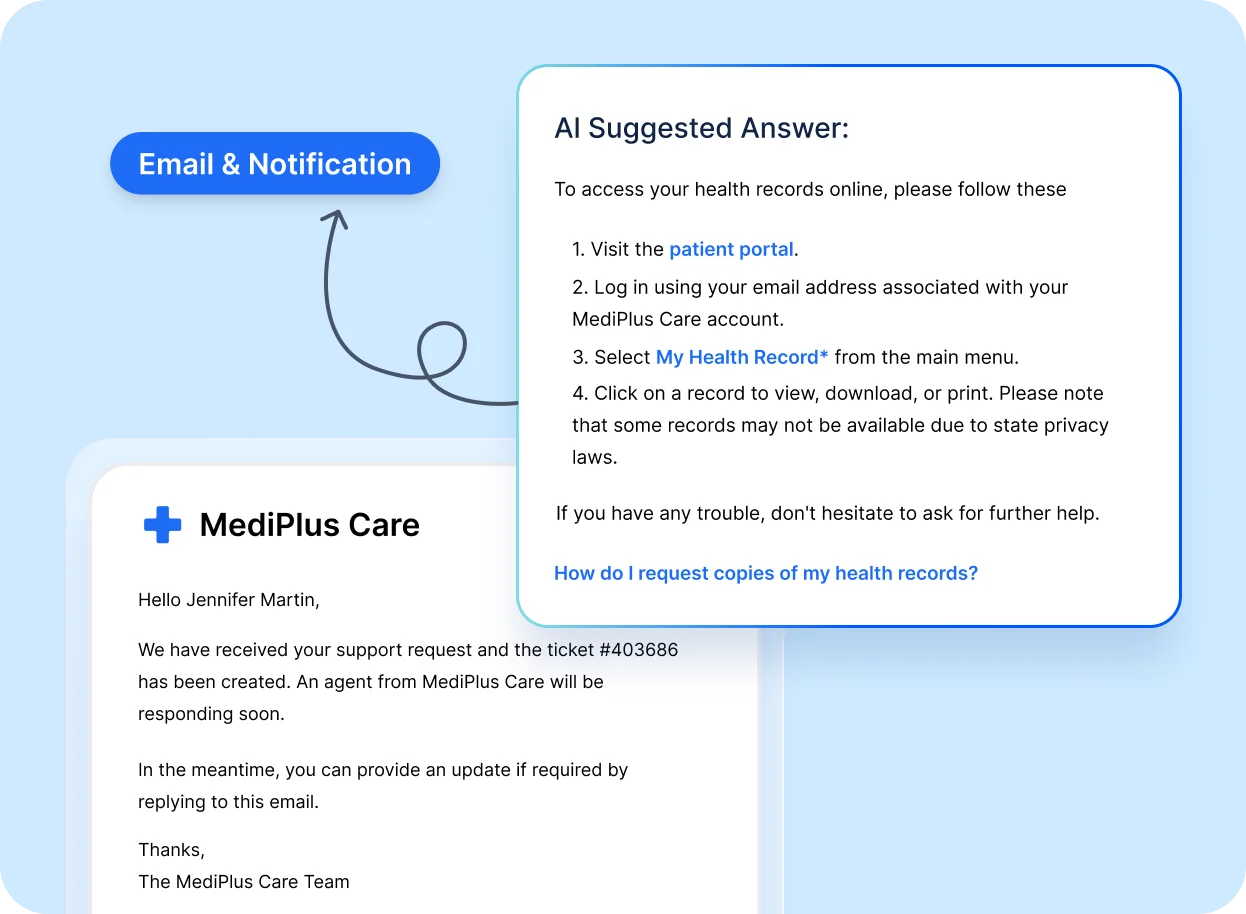
Serving as round-the-clock virtual receptionists, intelligent health assistants help patients to:
- Schedule appointments
- Check symptoms
- Manage medications
- Get answers to common health questions
They reduce the need for in-person visits and long wait times, making healthcare services more accessible and efficient while ensuring patients receive consistent, accurate information anytime.
8. Predictive analytics agents
In healthcare, predictive analytics agents analyze previous patient records to forecast upcoming requirements.
They analyze historical interaction patterns to anticipate increases in symptom-related inquiries or appointment requests, helping staff prepare for higher demand.
9. Clinical documentation agents
These AI-powered agents assist healthcare providers by transcribing and structuring clinical notes from voice or text inputs, significantly reducing administrative burden.
For healthcare providers, this translates to faster record updates, fewer errors, and more efficient follow-up communications with patients, allowing staff to focus more on direct patient care.
A study published by NCBI in 2019 shows that AI agents can automate up to 89% of clinical documentation tasks, significantly improving healthcare provider efficiency.
Real-world AI agent example in healthcare
Mayo Clinic researchers developed MedEduChat, an EHR-integrated AI agent that provides patients with personalized prostate cancer education using information from their health records and validated clinical sources.
Discover help desk for healthcare
AI agent examples in manufacturing
Operational AI agents are powering the next generation of smart factories and automated workflows.
These AI agent examples improve efficiency, detect defects early, optimize production schedules, and keep supply chains running smoothly, helping manufacturers stay competitive in a fast-changing market.
10. Predictive maintenance agents
According to HSO research in 2023, AI agents can predict equipment failures with 95% accuracy, significantly reducing downtime and repair costs by up to 40%.
Unexpected equipment failures can halt production and raise costs. AI agents monitor sensor data like vibration, temperature, and sound to detect anomalies and predict failures early.
11. Supply chain optimization agents
Managing logistics, demand, and supplier coordination is complex. AI supply chain agents analyze these factors to forecast demand and simulate scenarios accurately.
They recommend optimal procurement and distribution strategies that improve efficiency, reduce costs, and enhance overall responsiveness.
12. Inventory management agents
Maintaining optimal stock levels requires constant balancing. Inventory AI agent examples help businesses by:
- Tracking inventory in real time
- Analyzing sales trends and lead times
- Predicting restocking needs with precision
They automate ordering processes to prevent both stockouts and overstocking, improving product availability while reducing storage costs.
Real-world AI agent example in the manufacturing industry
Apollo Tyres developed an agentic AI Manufacturing Reasoner that connects machine data, operational systems, APIs, and other data sources.
The agent analyzes manufacturing processes and machine information to help teams identify inefficiencies and make data-driven operational decisions.
AI-driven customer support in the automotive sector is not just about automation. It also requires accurate, empathetic, and timely assistance.
To align your support strategy with industry expectations, explore these essential do’s and don’ts of automotive customer support that help balance technology with customer satisfaction.
AI agent examples in finance
For financial institutions, AI agents are transforming both customer service and internal operations.
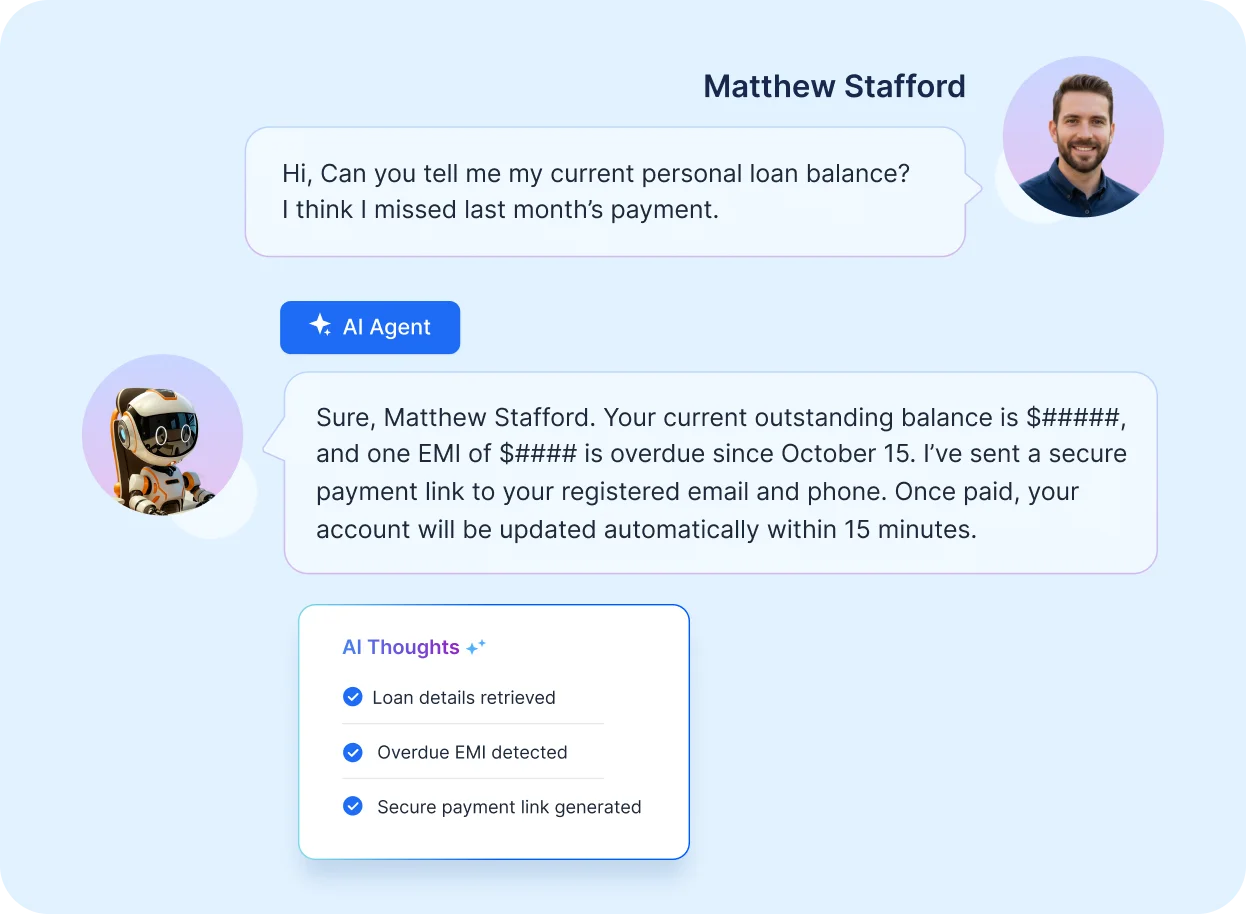
In finance, AI agents provide real-time account updates, guide customers through loan applications, and answer complex queries instantly.
13. Fraud detection agents
Financial fraud happens in milliseconds, demanding instant action. AI-powered security agents monitor transactions in real time, using anomaly detection and behavioral analysis to flag suspicious activity immediately.
They enable financial institutions to:
- Respond quickly to suspicious activity
- Reduce financial losses
- Enhance customer trust and security
14. Regulatory compliance agents
Keeping up with changing financial regulations is tough. AI compliance agents monitor transactions, generate reports automatically, and flag regulatory risks proactively.
They automate compliance workflows, reduce manual effort significantly, and help institutions avoid costly penalties.
15. Loan processing agents
Loan-processing AI agents speed up approvals by analyzing credit scores, income data, and risk factors in seconds. They automate evaluations and decisions, improving turnaround times and customer experience.
In finance, examples of agents in AI also provide real-time account updates, guide customers through loan applications, and instantly answer complex queries, transforming both service and operations.
Real-world AI agent example in the finance industry
Bank of America’s Erica is an AI-powered virtual financial assistant that helps customers manage accounts, monitor spending, answer banking questions, and receive personalized financial insights.
According to Bank of America, more than 20 million clients used Erica nearly 200 million times during the fourth quarter of 2025.
Discover help desk for finance
AI agent examples in education
AI agent examples in education make learning smarter and student services more accessible.
They help students learn at their own pace, assist teachers with admin tasks, and enhance student services by handling admissions, fees, and enrollment efficiently.
16. Student support agents
Students often need assistance outside regular office hours. School AI agents provide 24/7 support by answering questions related to admissions, deadlines, campus services, and more.
Using natural language processing, they understand student inquiries contextually and deliver timely, accurate support.
17. Course recommendation agents
Choosing the right courses can be overwhelming, so education AI agents analyze a student’s interests, academic history, and career goals to recommend personalized learning paths.
These agents use intelligent recommendation algorithms to enhance engagement, ensure academic fitness, and support long-term success.
18. Assessment and feedback agents
AI assessment and feedback agents automate grading, deliver instant, tailored feedback, and analyze learning patterns to identify student challenges.
They recommend targeted resources to support adaptive learning, guiding educators toward mentoring and tailored instruction.
Real-world AI agent example in education
The College of Professional and Continuing Education at Hong Kong Polytechnic University developed an Agentic AI Assistant for student IT services.
The system answers support questions and can proactively perform simple IT tasks, extending student support beyond basic information retrieval.
Discover help desk for education
AI agent examples in marketing
Within marketing operations, AI agent examples take personalization to the next level by using real-time data and predictive intelligence to engage customers with the right message at the right time.
These agents don’t just automate campaigns; they plan, optimize, and execute strategies that drive conversions and loyalty.
19. Lead qualification agents
Turn every website visitor into a qualified lead with AI-powered conversational agents. These autonomous SDRs engage prospects 24/7, ask smart qualifying questions, and instantly schedule demos.
Integrated with your CRM, they log lead details automatically and accelerate the buyer journey from first click to conversion.
20. Campaign optimization agents
Maximize ROI with AI agents that continuously monitor and optimize campaigns in real time. They analyze live performance data, click-throughs, conversions, engagement, and instantly adjust budgets, targeting, and creatives for better results.
If an agent underperforms in one region, the agent reallocates spending and deploys a new variation on the spot, ensuring every dollar works harder.
21. Journey orchestration agents
Deliver personalized experiences at scale with AI agents that design and manage entire customer journeys. They detect behaviors like sign-ups, purchases, or inactivity and trigger the right message through the most effective support channel.
Whether re-engaging dormant users or nurturing new customers, these agents adapt in real time to keep engagement high and retention strong.
Real-world AI agent example in marketing
Dayuse uses AI agents within its customer journeys to generate personalized campaign content using customer information such as booking history, preferred language, and wish-listed hotels.
According to a Braze customer case study, one repeat campaign saw an additional 23% uplift after the company moved to the agent-based approach.
How BoldDesk AI agent powers customer service across industries
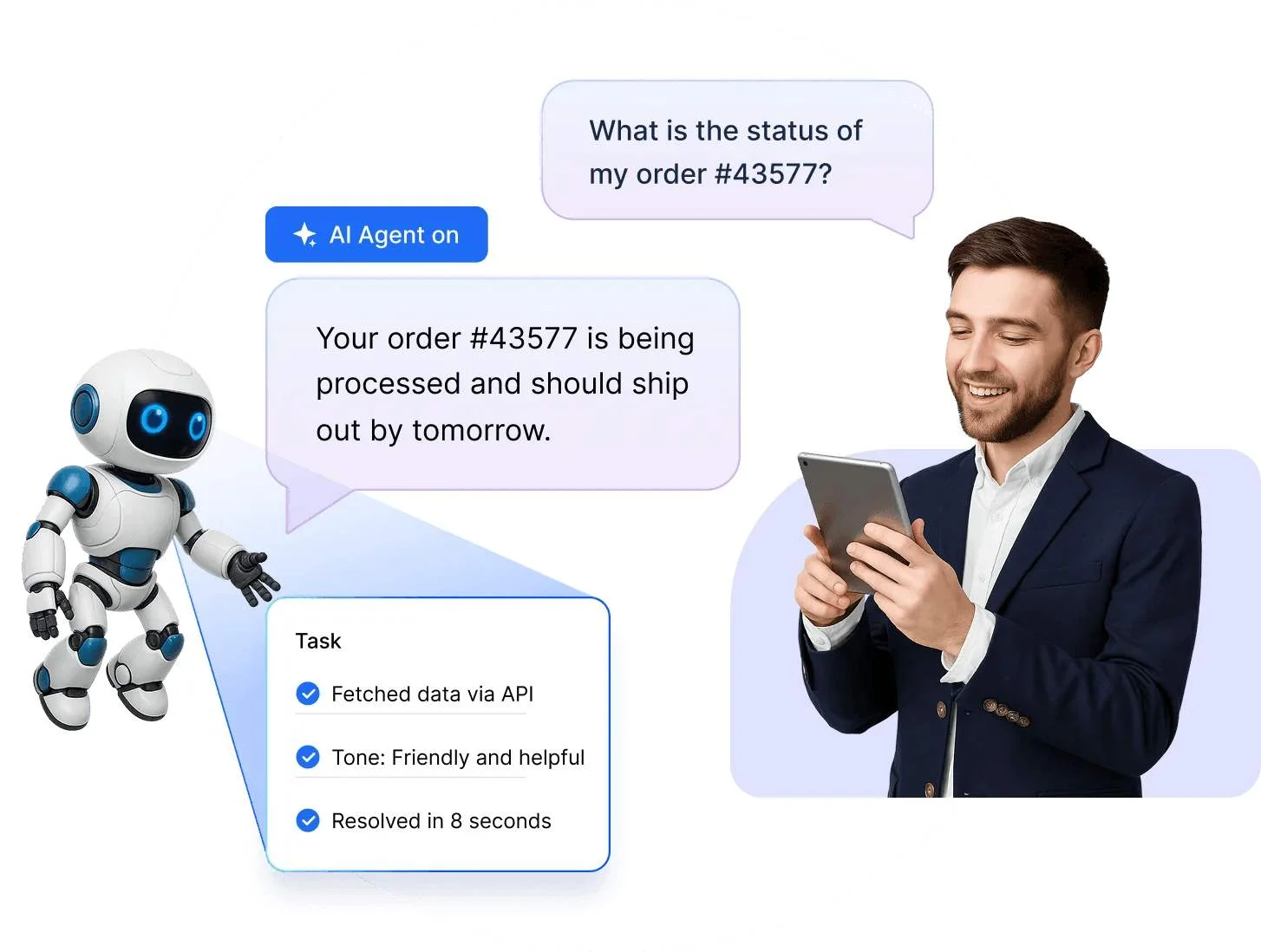
BoldDesk AI agent is an autonomous digital support assistant designed to deliver fast, accurate, and always-on customer service.
It understands customer intent, identifies the most effective resolution path, and completes real actions across your systems, helping support teams from different industries resolve issues faster while reducing manual effort.
Here’s how BoldDesk AI agent delivers measurable impact:
-
Understands intent and context to grasp what customers actually need.
-
Selects the best resolution steps for faster problem-solving, including escalations to human agents when necessary.
-
Retrieves accurate answers from your knowledge base and documentation.
-
Executes tasks automatically, including checking order or ticket status, updating customer records, and triggering backend workflows via AI Actions.
-
Learns from interactions to improve accuracy and reliability over time.
By resolving up to 70% of routine inquiries automatically, BoldDesk AI Agent frees support teams to focus on more complex cases.
BoldDesk’s AI Agent supports multi‑agent systems, allowing multiple specialized AI agents to work together across customer support workflows. Each agent handles a specific role, such as intent detection, routing, knowledge retrieval, or task execution, while sharing context to ensure consistent resolutions.
These agents can be customized by role, tone, and data sources, and deployed seamlessly across chat, email, and messaging channels. Together, they help teams scale support efficiently, reduce response times, and maintain high‑quality customer satisfaction at lower operational cost.
Turning AI agent examples into action across service and operations
AI agent examples are already transforming customer support and operations by automating routine tasks and enabling faster, data-driven decisions across industries.
To succeed, organizations must design AI agent workflows carefully, with the right data access, human oversight, and safeguards to ensure accuracy, compliance, and ethical use.
AI‑powered help desks such as BoldDesk leverage autonomous agents to resolve a majority of routine queries automatically, improving speed and efficiency at scale.
Ready to build an AI agent that can elevate your customer support strategy? Start your 15-day free trial to see how BoldDesk helps teams build smarter, faster, and more responsive customer experiences.
Have questions or insights to share? Leave a comment below, we’d love to hear from you.
Related articles
- 7 Best Ways to Utilize AI for Customer Experience
- How to Build an AI Agent that Solves Customer Support!
- 9 Best Ways AI Can Improve Help Desk Management
Frequently Asked Questions
AI agents can reason, make decisions, and take actions autonomously, while chatbots typically respond to predefined rules or scripted prompts. Unlike chatbots, AI agents integrate with business systems, execute workflows, and continuously improve through learning models.
For a deeper comparison, read our guide on AI agents vs chatbots.
Yes, AI agents can integrate with external systems such as CRMs, ERPs, databases, and APIs to complete tasks end-to-end. This enables agents to retrieve data, update records, automate workflows, and perform real actions across business systems.
AI agents are designed to augment, not replace, human agents. They handle repetitive, high‑volume tasks such as FAQs, status checks, and routing, while human agents focus on complex, sensitive, or high‑value interactions.
This hybrid approach improves efficiency and customer satisfaction without losing the human touch.
AI agents learn and improve by analyzing past interactions, feedback, and new data using machine learning techniques. Over time, they refine decision-making, increase accuracy, and adapt to changing user needs and business goals.
Before deploying AI agent examples, businesses should define clear use cases, ensure access to accurate data, and design workflows with human oversight. It’s also important to consider security, compliance, and ongoing monitoring to maintain accuracy, transparency, and ethical use as the AI agent learns and evolves.
Successful AI agent deployments depend on more than the technology itself. Organizations should start with an up-to-date knowledge base, accurate data sources, clear access permissions, and well-defined escalation rules. Human oversight is also important for monitoring performance, reviewing decisions, and handling situations that require judgment or policy interpretation.
AI agents work best on repetitive, rules-based tasks, but human agents remain essential for handling exceptions, complex escalations, policy disputes, negotiations, and sensitive customer situations. A hybrid approach allows AI agents to manage routine requests while human teams focus on cases that require empathy, critical thinking, or discretionary decision-making.