






TL;DR: Repeated “item missing” tickets may seem like routine support requests, but they often reveal hidden ecommerce fraud signals that lead to refund misuse and revenue loss. This blog explains how support teams can identify suspicious patterns across orders, customers, and delivery claims to detect fraud early without slowing down support operations.
What looks like a simple complaint is often the earliest warning sign of organized fraud. When these issues repeat across customers, addresses, or orders, support teams are often the first to notice the pattern.
This makes them critical to early ecommerce fraud detection, long before chargebacks and losses begin to escalate.
Capital One Shopping Research estimates ecommerce merchant fraud losses reached USD 115.3 billion in 2024 (excluding indirect costs like support labor and tools).
Support teams don’t directly lose money because they resolve Item Not Received (INR) tickets. They lose money when recurring patterns are treated as isolated issues.
This article explains how ecommerce support teams can uncover revenue-critical risk signals early, without increasing agent workload or impacting SLA targets.
What ecommerce fraud signals look like in support operations
Ecommerce fraud signals in support tickets are repeatable patterns across customers, addresses, orders, Stock Keeping Units (SKUs), timing, or outcomes.
These signals may indicate fraudulent activity such as refund fraud or friendly fraud instead of a one-off delivery issue.
These patterns often represent support-level fraud, where exploitation first surfaces through everyday customer complaints.
Routine issue vs. fraud signal: How to find the difference
Support teams do more than just resolve tickets, they also uncover patterns. What appears routine in isolation can become a fraud signal when it repeats or behaves unusually across multiple cases.
The table below helps identify this shift and shows how everyday tickets can turn into actionable risk insights.
| Aspect | Routine issue | Fraud signal |
|---|---|---|
| What it is | A normal customer issue caused by delivery, product, or service problems | A recurring or suspicious behavior pattern that may indicate fraudulent behavior |
| Frequency & trend | Happens occasionally and independently | Repeats across customers, orders, addresses, or time periods |
| How teams investigate it | Reviewed and resolved as a single ticket | Requires analysis across multiple tickets or accounts |
| Customer intent | Intent is typically legitimate (e.g., help, clarification, resolution) | Behavior may indicate suspicious activity or manipulation (e.g., gaming refunds, taking over accounts) |
| Typical examples | One damaged item request or delivery delay inquiry | Multiple “item not received” claims or repeated no-return refund requests |
| Key indicators | Matches known patterns and standard customer journeys | Shows anomalies such as unusual timing or repeated data points |
| Business impact | Minimal operational or financial risk | High impact, linked to revenue loss, chargebacks, or policy misuse |
| Recommended action | Resolve through standard support workflows | Flag patterns, tag intelligently, and escalate to fraud/risk teams for review |
Recognizing these differences helps support teams investigate suspicious behavior more consistently while keeping legitimate customer issues fast and frictionless.
Key fraud signals ecommerce support teams should watch for
In ecommerce, fraud often appears through customer support interactions long before it becomes visible in financial reports or chargeback data.
Repeated complaints, unusual refund behavior, and account inconsistencies can all reveal patterns of abuse that support teams are uniquely positioned to identify early.
By recognizing these signals during everyday interactions, businesses can strengthen ecommerce fraud detection and reduce preventable losses.
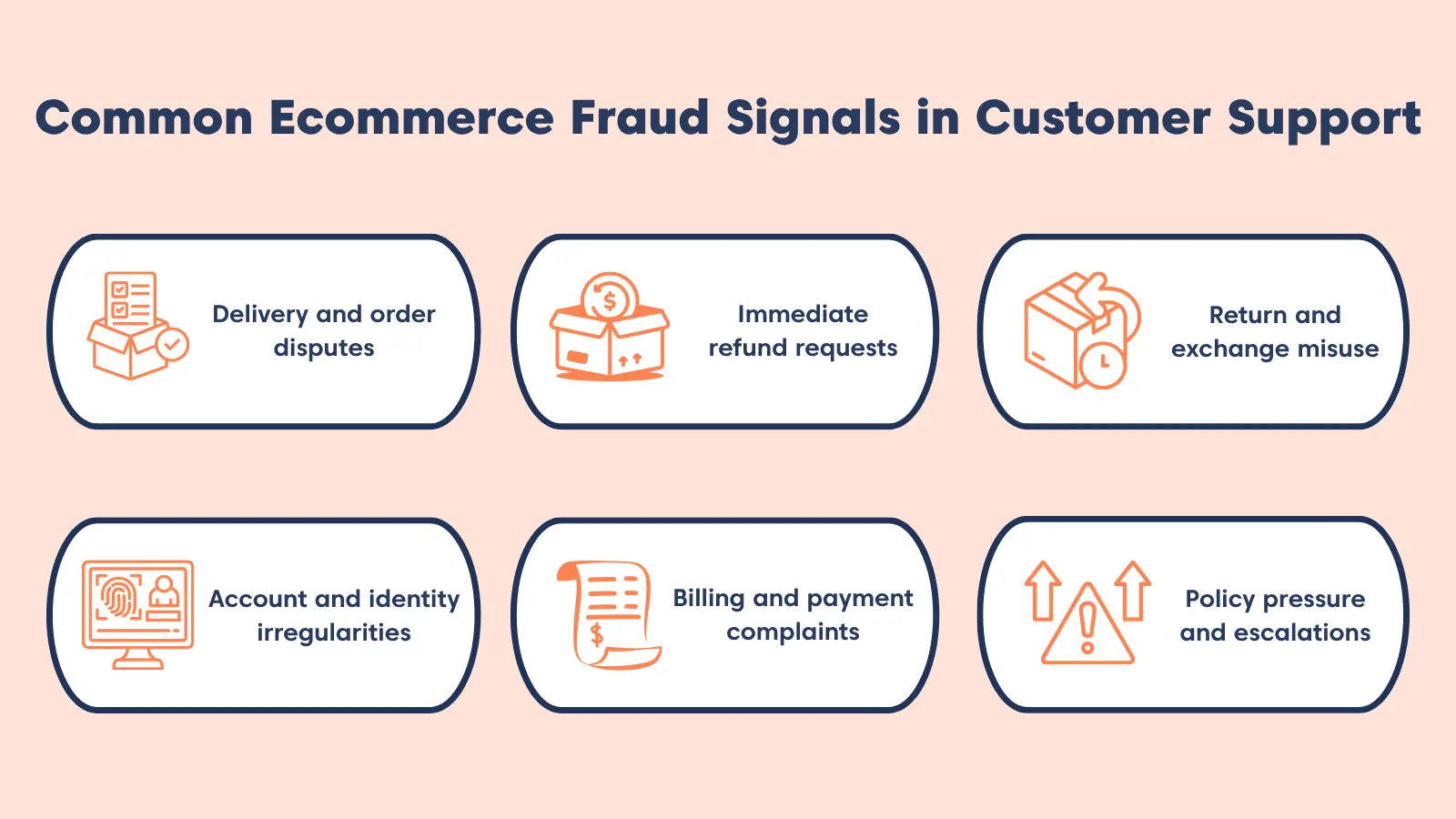
Below are common fraud patterns that support teams can identify across everyday customer interactions:
Delivery and order disputes
Claims involving missing packages, incorrect items, or non-delivery are common in ecommerce support. Identifying repeated disputes tied to the same customer or account can indicate elevated fraud risk.
Suspicious patterns often emerge when customers continue reporting delivery issues despite confirmed shipments or repeatedly raise disputes across multiple orders.
When these requests consistently lead to refunds or replacements, fraudsters may begin exploiting support workflows intentionally.
Immediate refund requests
Some customers approach support interactions with an immediate demand for refunds without allowing time for investigation, troubleshooting, or replacement options.
Fraud concerns increase when customers repeatedly push for compensation regardless of issue type or continue escalating requests until refunds are granted.
Over time, this pattern may indicate intentional misuse of refund policies rather than legitimate dissatisfaction.
Return and exchange policy misuse
Support teams frequently handle exceptions involving damaged products, incorrect shipments, or late returns. Repeated policy exceptions can become a warning sign of fraudulent activity.
Fraud risks rise when customers consistently return high-value items, dispute the condition of returned products, or seek approvals outside standard return processes.
When these behaviors repeat across multiple orders or accounts, they often point to organized misuse rather than isolated incidents.
Account and identity inconsistencies
Fraud indicators often surface during support-assisted account updates or verification requests.
Frequent changes to shipping addresses, contact details, or payment information can signal suspicious activity.
Repeated identifiers across tickets (such as email domains, phone numbers, or addresses) further increase concern.
Because support teams interact directly with customers, they are often the first to detect inconsistencies before they’re noticed by fulfillment or payment teams.
Billing and payment complaints
Complaints about unauthorized charges, duplicate billing, or disputed transactions can sometimes act as early indicators of friendly fraud.
In many cases, customers dispute legitimate purchases after receiving products or obtaining refunds through support channels.
A chargeback survey conducted by Chargebacks911 found nearly half of merchants report friendly fraud makes up 50% or more of their chargebacks.
When these complaints repeat across accounts, payment methods, or order histories, they often signal a higher likelihood of future chargebacks.
Escalation pressure and policy manipulation
Customer behavior during support conversations can also reveal potential fraud risks. Some individuals attempt to pressure agents by demanding urgent resolutions, refusing verification steps, or threatening escalations to secure refunds or policy exceptions.
While genuine frustration is normal in some cases, repeated escalation tactics across multiple interactions may indicate attempts to exploit agent discretion or bypass established support policies.
6 ways support teams identify and resolve fraud signals in ecommerce
In e‑commerce, fraud often emerges through repeated “item missing” complaints, refund requests, and delivery disputes that first appear in support interactions.
Using these signals for ecommerce fraud detection, teams can act early without slowing resolution speed.
By analyzing complaints as patterns rather than isolated tickets, ecommerce support teams can reduce losses while maintaining speed and trust across ecommerce customer service.
The strategies below show how support‑led workflows turn recurring missing item claims into actionable fraud signals, keeping support fast, fair, and scalable.
Detect repeating complaint behavior across tickets
Occasional item missing complaints are normal in e‑commerce support. They become an early fraud signal when the same claim repeats across related orders or customers.

At that point, the issue is no longer isolated; it reflects a behavioral pattern.
When ticket data is captured consistently, teams can quickly identify repeating behaviors across tickets, which allows teams to:
- Identify recurring issues like missing items or delivery disputes
- Connect tickets with customers, addresses, order IDs, or SKUs
- Surface complaints that repeat across multiple orders or short time periods
- Apply consistent handling to repeat claims using shared history and outcomes
Detecting repeat behavior quickly helps prevent losses from escalating, while ensuring legitimate customer issues continue to be resolved fairly and efficiently.
Real-life example:
A customer reports a missing item and receives a replacement. Two days later, another ticket appears for the same complaint, but with a different order ID, same delivery address, same product (SKU).
Because ticket data is captured consistently, related tickets become visible together, helping agents recognize the repeat pattern across orders and addresses.
With AI assistance, agents can instantly see prior complaints and outcomes in one place, giving them the context to decide whether to replace, investigate, or escalate.
Instead of issuing another automatic replacement, the ticket is routed for review.
Outcome:
Repeat behavior is identified early, losses are contained, and legitimate customers continue to receive fair support.
Identify cost-generating outcome patterns
One of the earliest signs of support-level suspicious activity is not what customers claim, but the outcomes they repeatedly receive.
Over time, repeated refunds, often driven by misuse or fraud, quietly drain revenue without triggering immediate chargebacks.
When teams review outcome patterns across tickets, they can intervene earlier, before losses grow.
By reviewing outcomes, timing, and ticket volume together, recurring patterns become easier for support teams to spot.
Support workflows can:
- Track refund and replacement outcomes across related tickets
- Highlight customer records with unusually high refund success
- Surface cases that repeatedly bypass reshipment or carrier investigation
- Flag sudden increases in complaints from the same customer or location
- Detect claims raised immediately after delivery confirmation
When outcome, timing, and volume signals are reviewed together, recurring patterns associated with higher‑risk customer behavior become easier for teams to identify during review.
Real-life example:
A customer reports an “item not received” issue and receives a refund. Over the next few weeks, the same customer submits similar claims on multiple orders.
Each ticket individually appears valid, and refunds are issued without escalation. When outcomes are reviewed together, teams notice:
- Repeated refunds tied to the same complaint type
- Short time gaps between claims
- Higher refund volume compared to typical customers
When outcomes and ticket volume are viewed together, recurring patterns become easier for teams to notice during review.
The system flags the account for review before chargebacks or escalations occur, enabling earlier, support‑led chargeback prevention.
Outcome:
Losses are identified early and controlled, while genuine customers continue to receive fast, fair resolutions.
Route and handle high‑risk claims differently
As patterns become visible across support interactions, routing becomes a critical safeguard. Handling repeats or high‑risk “item missing” claims the same way as routine requests increases fraud exposure.
It also adds unnecessary agent workload, whether those claims come from a ticket or an ecommerce live chat.
Targeted routing helps support managers apply deeper review only where patterns repeat, keeping low‑risk tickets fast and agents focused on meeting SLAs by enabling them to:
- Distinguish routine chatbot‑resolved requests from repeat or higher‑risk claims
- Identify high‑value orders and recurring delivery discrepancy issues across chat and email
- Direct elevated‑risk cases to dedicated review or risk queues
- Resolve low‑risk chatbot conversations instantly, without added friction
This approach keeps frontline support fast and focused, while ensuring experienced teams spend their time on the cases that matter most.
Apply targeted verification based on risk signals
Verification is most effective when it is triggered by early signals, not applied uniformly.
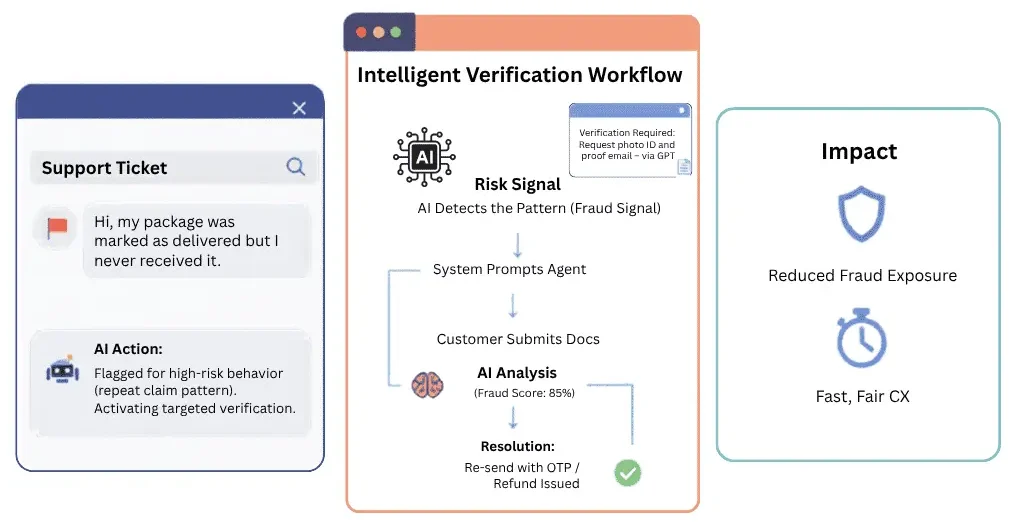
As patterns of behavioral clustering, outcome history, or timing anomalies emerge, selective verification becomes possible, protecting revenue while preserving a fast customer experience.
Intelligent verification workflows help teams:
- Request documentation or photos for repeat or higher‑risk claims
- Apply delivery confirmation or one-time passcode (OTP) checks
- Maintain consistent review standards across agents
- Ensure legitimate customer issues are resolved quickly
Together, selective routing and targeted verification reduce fraud exposure while preserving a fast, fair support experience.
Share support signals with operations and logistics
Not every INR ticket claim is fraud, because many are caused by fulfillment or delivery issues.
When the same problems repeat across orders or routes, ecommerce support teams can see whether it’s customer behavior or an operational issue.
This helps teams distinguish operational delivery failures from repeat fraud patterns, reducing unnecessary refunds and repeated escalations.
Use support insights to prevent future issues
Over time, early support signals become more than detection tools; they become preventive intelligence.
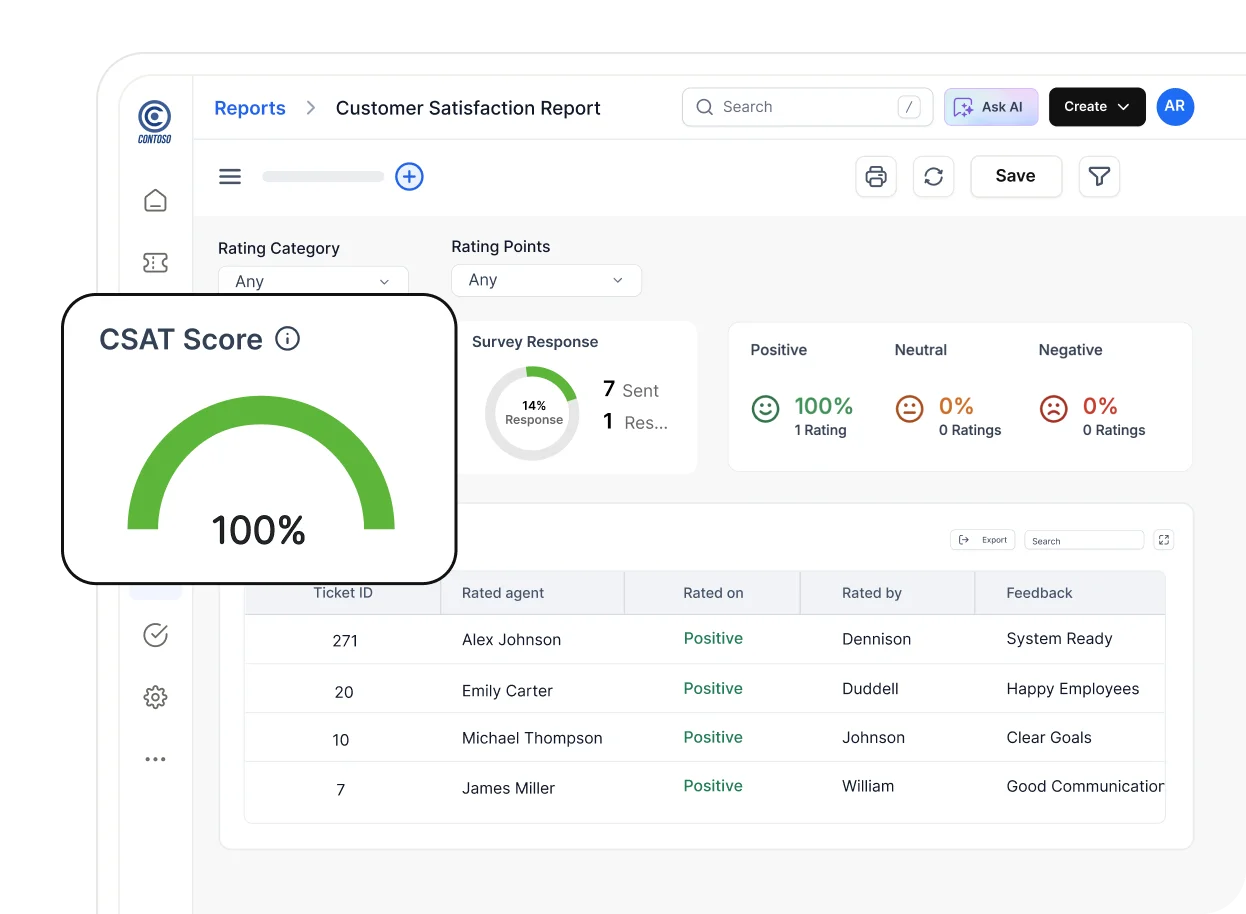
By reviewing trends across complaints, outcomes, and timing, teams can stop repeat issues before they reach fraud, refunds, or customer churn.
How support-led ecommerce fraud detection protects revenue and trust
When repeated fraudulent activity is hidden within routine support tickets, the effects quickly become apparent for support leaders.
This results in refund leaks, inconsistent agent decisions, and significant agent time wasted on addressing the same claims repeatedly.
TNS research finds 69% of outbound contact‑center decision‑makers say fraud impacting customer calls affects their company’s bottom line.
Identifying these signals early allows teams to protect revenue while improving customer satisfaction and scaling support intelligently.
Reduces refund fraud and revenue leakage
Repeat missing item complaints often lead to silent revenue loss through repeated refunds or replacements.
Identifying fraud signals early helps teams stop refund misuse before it compounds, without slowing legitimate resolutions.
Improves operational visibility
Without aggregated visibility, ecommerce customer support managers struggle to interpret repeat INR ticket claims.
They cannot easily determine whether these claims point to fulfillment issues or customers repeatedly exploiting exception handling.
This visibility helps operations and logistics fix root causes instead of reacting to individual tickets.
Protects genuine customers from stricter policies
When repeated abuse isn’t visible, teams often respond by tightening policies across the board, slowing agents down and reducing customer satisfaction.
Early fraud identification allows teams to apply additional checks only when risk appears, keeping experiences smooth for legitimate customers.
Turns support from a cost center into a risk intelligence layer
By surfacing fraud signals from everyday tickets, support teams move beyond resolution alone.
They turn support from a reactive cost center into an operational signal, helping leaders reduce refunds, protect SLAs, and improve consistency across agents.
How BoldDesk improves fraud detection in ecommerce support
As ecommerce support teams handle growing volumes of delivery disputes, refund requests, and return-related complaints, having the right visibility becomes critical.
Proper workflows also ensure consistent fraud review and faster decision-making.
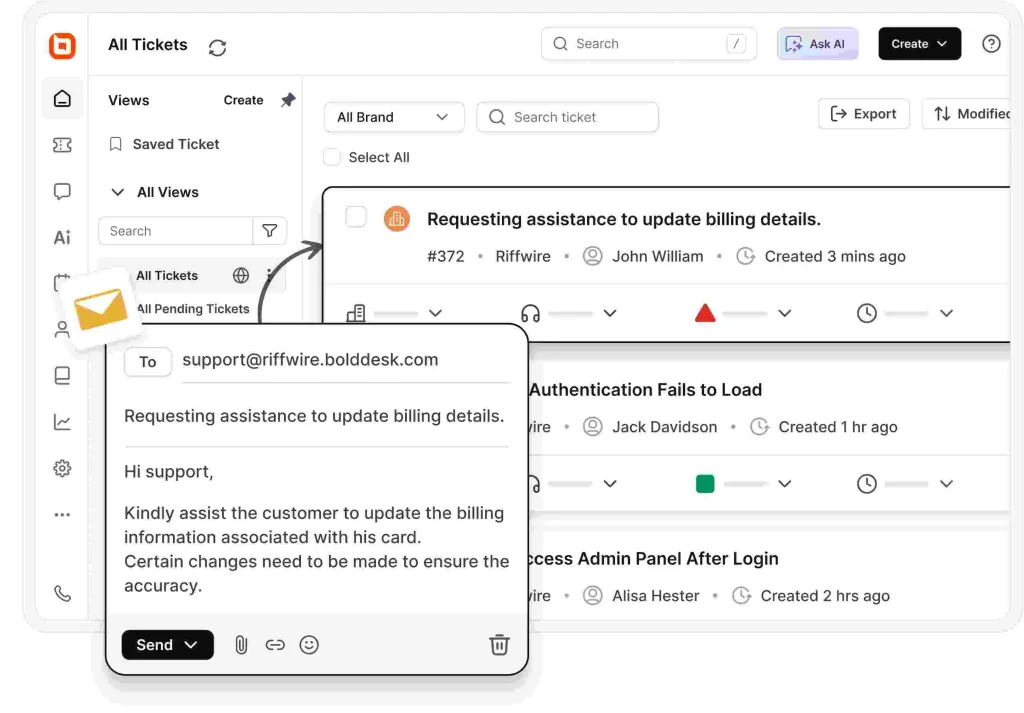
BoldDesk helps teams manage support interactions more efficiently through centralized ticketing, automation, reporting, and workflow visibility.
Centralize customer and order context
Support agents need more than a ticket to identify suspicious patterns. With BoldDesk, teams can capture and organize key data like order IDs, delivery status, refund history, and purchase activity.
This gives agents complete context during every interaction, making it easier to distinguish routine service issues from repeat fraud patterns.
Detect repeat complaint behavior faster
Fraud rarely appears as a single ticket, It usually emerges through repeated behavior over time. Structured fields, tags, and filters help support teams identify repeat delivery disputes, track refund-heavy accounts, and review complaint history before issuing refunds or replacements.
Instead of treating every ticket in isolation, support teams can spot recurring trends across conversations and take action earlier.
Automate high-risk ticket routing
Not every complaint needs escalation, but high-risk patterns should be reviewed carefully.
With workflow automation in BoldDesk, businesses can:
- Route repeat refund requests to senior agents
- Flag high-value order disputes for review
- Trigger internal review for suspicious claims
- Use ticket approvals for refund-related requests
This reduces unnecessary refund losses while helping legitimate customers receive faster support.
Improve collaboration between support and operations teams
Fraud detection often requires coordination between support, logistics, and operations teams.
BoldDesk helps teams collaborate through internal notes, shared ticket visibility, team assignments, and status tracking.
This makes it easier to investigate delivery disputes, verify fulfillment issues, and maintain consistent decision-making across teams.
Track fraud-related trends with reporting
Support data can reveal larger operational and fraud trends when analyzed consistently.
With BoldDesk reports and dashboards, teams can track refund trends, dispute patterns, and high-risk activities.
These insights help businesses reduce fraud exposure while improving support efficiency.
Connect support workflows with Shopify
For Shopify-based businesses, BoldDesk integrates directly with Shopify, giving agents quick access to order and customer details within the support workflow.
This allows teams to verify order activity faster and respond more confidently to potentially fraudulent claims.
Support teams are the first line of ecommerce fraud detection
E‑commerce fraud rarely starts with obvious warning signs. It often begins with small, repeatable behaviors that appear in support tickets.
By identifying these signals early, support teams can move beyond resolution and play a direct role in protecting revenue.
Start a free trial or book a live demo to see how BoldDesk helps ecommerce teams detect suspicious support patterns, automate high-risk ticket routing, and improve visibility across support operations.
How does your team handle these cases today? We’d love to hear your approach and share what other teams are doing.
Related articles
- Top 11 Ecommerce Help Desk Solutions in the Market
- 30+ Top Ecommerce Tools to Scale Your Online Business in 2026
- How Shopify and BoldDesk Integration Boosts Support Efficiency
Frequently asked questions
Support teams identify early fraud by analyzing patterns across tickets instead of treating issues individually. Common signals include repeat “item missing” claims, high refund success rates, complaints raised immediately after delivery, and similar issues linked to customers, addresses, or SKUs.
Support tickets often surface fraud before chargebacks or financial losses occur. Because customers contact support first, ticket interactions reveal early behavioral signals of friendly fraud, misuse, or refund abuse.
Chatbots and knowledge‑base self‑service improve resolution speed but can hide repeat abuse if unmanaged. When chatbot and self‑service interactions are tracked alongside agent tickets, teams gain full visibility into recurring claims and emerging risk patterns.
Teams reduce fraud by applying checks only when risk signals appear, not to every request. Using intelligent routing, targeted verification, and outcome tracking allows low‑risk tickets to resolve instantly while higher‑risk cases receive deeper review, protecting revenue without hurting customer experience.


