





TL;DR: Ecommerce help desks centralize customer inquiries, automate workflows, and support omnichannel communication. Tools like BoldDesk and Gorgias integrate with platforms such as Shopify to manage order issues, improve response times, and enhance customer experiences through AI, SLAs, and self service portals.
For any business that operates online, how you interact and support your customers throughout their journey is vital to their overall satisfaction, loyalty, and retention.
With the right ecommerce help desk software, businesses can say goodbye to low agent productivity and customer churn, as customer service teams will provide quick responses and effectively manage support operations.
E-commerce help desk functionalities like ticketing, 24/7 customer service, real-time responses, and automation ensure no more customer churn from long wait times and poor support experiences.
This article will examine the meaning, benefits, and top ecommerce help desk tools.
What is an ecommerce help desk?
An ecommerce help desk is a centralized platform that enables online businesses to manage all customer inquiries, complaints, and support requests across channels, including email, live chat, social media, mobile apps, and messaging.
It connects each request to relevant order data for faster, more accurate support and helps teams track, prioritize, and resolve issues without losing context.
Ecommerce helpdesk software comparison table
The following table summarizes the features and prices of the best ecommerce help desk software.
We selected the ecommerce help desks by reviewing top comparison guides and user‑rated platforms from sources like G2, which evaluate tools based on features, integrations, usability, and reliability, ensuring each vendor consistently appears as a strong, trustworthy option for ecommerce support.
| Ecommerce help desk | Features | Price | G2 ratings | Ecommerce integrations |
| BoldDesk |
|
Starts at $99/month (includes 5 agents + 500 free AI credits) | 4.5/5
⭐⭐⭐⭐⭐ |
|
| Re:amaze |
|
Starts at $26.10/agent/month | 4.6/5
⭐⭐⭐⭐⭐ |
|
| Tidio |
|
Starts at $24.17/month (100 billable conversations) | 4.6/5
⭐⭐⭐⭐⭐ |
|
| HappyFox |
|
Starts at $21/agent/month | 4.5/5
⭐⭐⭐⭐⭐ |
Shopify |
| Kustomer |
|
Custom pricing (contact sales for a quote) | 4.6/5
⭐⭐⭐⭐⭐ |
Shopify
|
| eDesk |
|
Starts at $39/agent/month | 4.5/5
⭐⭐⭐⭐⭐ |
|
| UVdesk |
|
Starts at $22/month for 2 agents | 4.3/5
⭐⭐⭐⭐⭐ |
|
| LiveAgent |
|
Starts at $15/agent/month | 4.5/5
⭐⭐⭐⭐⭐ |
|
| Gorgias |
|
Starts at $10/month for 50 tickets | 4.6/5
⭐⭐⭐⭐⭐ |
|
| Richpanel |
|
Starts at $69/agent/month | 4.7/5
⭐⭐⭐⭐⭐ |
|
| Zoho Desk |
|
Starts at $4/agent/month | 4.4/5
⭐⭐⭐⭐ |
|
Best ecommerce help desk tools
Every help desk tool has its unique functionalities that cater to businesses of different sizes and specific customer needs.
When choosing the best help desk software, consider your business size, budget, required features, and integration needs with your existing ecommerce platform.
Free Ecommerce Help Desk for Startups!
Get a fully functional help desk for your startup: automate workflows, manage tickets, and scale effortlessly.
Below are the top ecommerce help desk tools to consider.
1. BoldDesk
Best for growing Shopify and WooCommerce stores that want AI-powered support without managing multiple tools.
BoldDesk is a simple help desk software with many powerful functionalities that are a good choice for ecommerce customer service.
BoldDesk gives ecommerce teams an effective way to deliver great support by enabling self‑service, improving agent productivity, and simplifying workflows.
BoldDesk’s key features
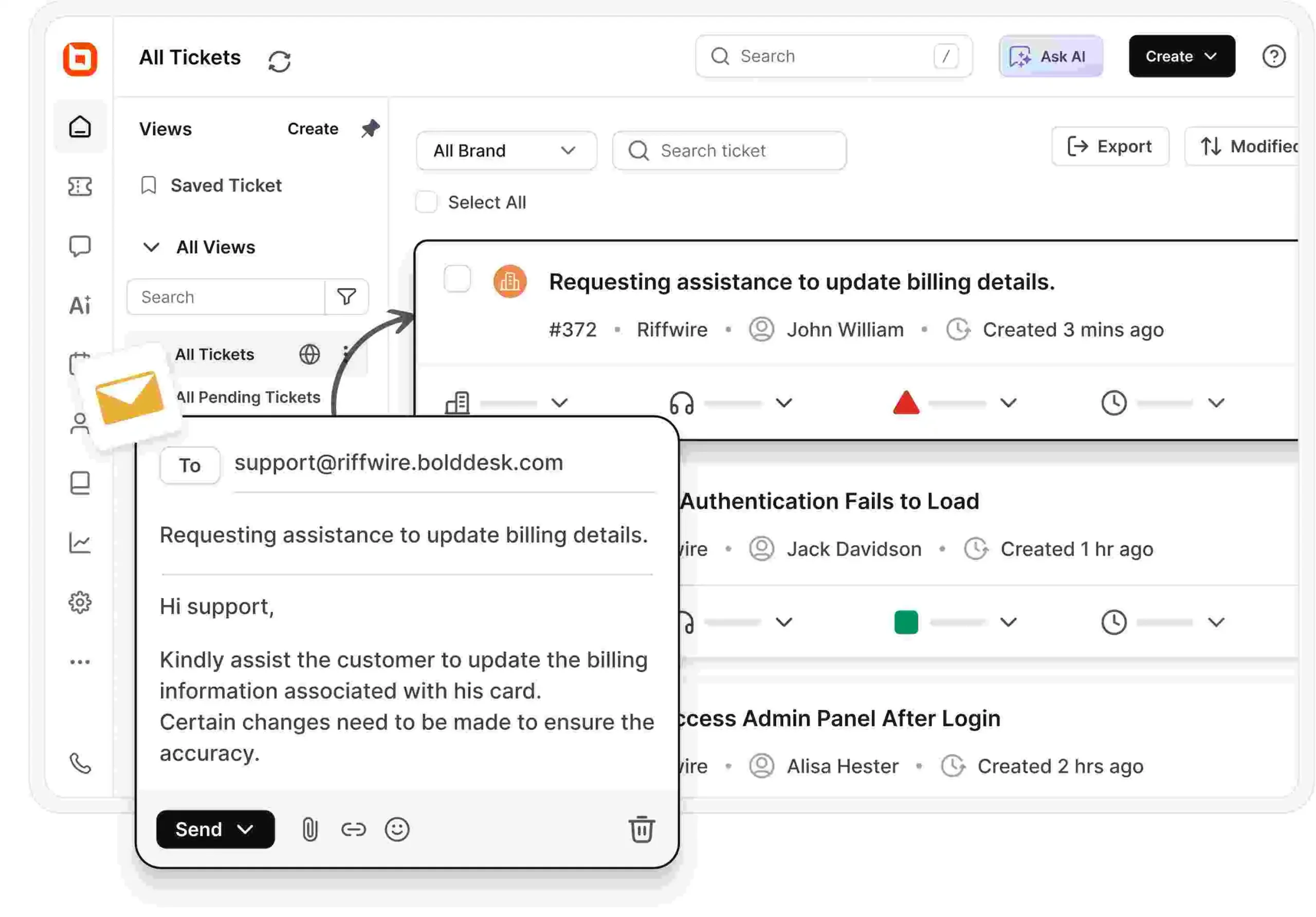
- Ticketing system: Converts order inquiries, refund requests, shipping issues, and customer questions into organized tickets for faster resolution.
- Workflow automation: Automatically routes ecommerce tickets, prioritizes urgent order issues, and triggers notifications to reduce response times.
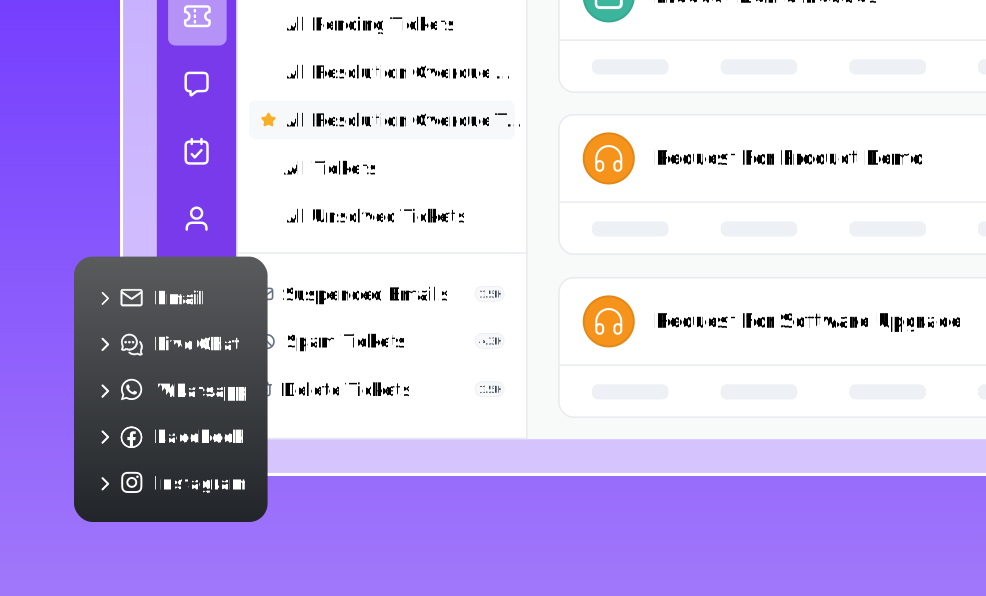
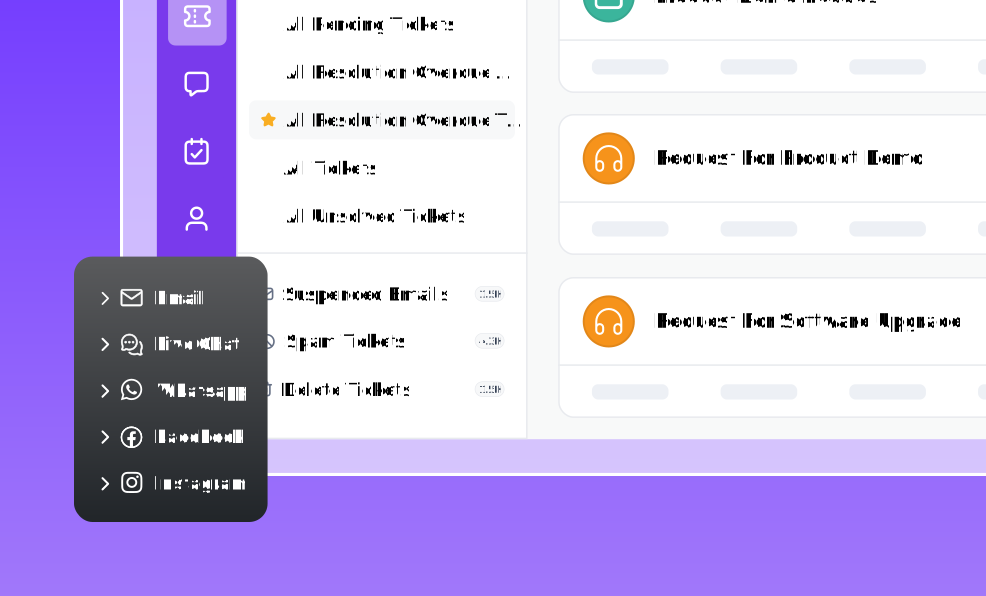
- Omnichannel customer service: Centralizes customer conversations from email, live chat, social media, WhatsApp, and other channels into a single workspace.
- Knowledge base software: Enables customers to find answers to common questions about orders, returns, shipping, and product information through self-service resources.
- AI-powered assistance: Helps support teams summarize conversations, generate responses, and automate repetitive customer service tasks.
- Ecommerce integrations: Connects with platforms such as Shopify to provide agents with customer and order information directly within the help desk.
Pros
- Cost-effective compared to many help desk solutions, especially for small and growing businesses.
- Built-in AI tools help agents work more efficiently by automating routine tasks, assisting with responses, and reducing manual effort.
Cons
- Advanced automation workflows may require additional setup time and training.
BoldDesk pricing plans
- Starts at $99 for 5 agents
- AI Agent: $20 for 1,000 AI credits (Add-on)
- AI Copilot: $20 per agent/month (Add-on)
- Free trial: 15 days
For a complete breakdown of pricing tiers, including features and AI add-ons, explore the full BoldDesk pricing details.
Need support for more agents? Let’s create a tailored solution just for you — speak with our experts today.
2. Re:amaze
Best for Shopify and direct-to-consumer ecommerce brands that need customer support, live chat, and self-service in one platform.
Re:amaze is an AI-powered ecommerce customer service platform designed specifically for online stores and retail businesses. It unifies customer conversations from email, live chat, social media, SMS, and voice into a single inbox, making it easier for support teams to manage customer interactions efficiently.
Key features
- Ticket formation
- Multichannel support
- Task management
- Security
Pros
- Centralizes customer conversations and order-related support in one workspace.
- Supports order management directly within support workflows, reducing resolution time.
Cons
- Can become expensive for larger teams.
Pricing: Starts at $26.10/agent/month
Free trial: 14 days
3. Tidio
Best for small to mid-sized ecommerce teams that want affordable AI features and a unified inbox.
Tidio is one of the ecommerce help desk ticketing systems that offers a single inbox where businesses can control customer inquiries for better support operations.
Key features
- Live chat
- AI
- Analytics
- Integration
Pros
- Offers multichannel features including email, chat, and integrations.
- Lower entry price for small teams (Starter, Growth tiers).
Cons
- Advanced features are available only on higher‑priced plans.
Pricing: Starts at $24.17/month (100 billable conversations)
Free trial: 7 days
4. HappyFox
Best for ecommerce teams that need automated ticketing workflows and built-in AI assistance.
HappyFox is a help desk solution that allows companies within the ecommerce industry to effectively use customer service tools.
This platform easily moves all incoming customer questions into tickets, which helps to smoothly automate recurring support tickets.
Key features
- Ticketing system
- Automation
- Assist AI
- Knowledge base
Pros
- Ticketing with automation and AI assistance.
- Efficient conversion of inquiries into automated tickets.
Cons
- Lacks built‑in marketplace integrations compared to other HappyFox alternatives.
Pricing: Starts at $21/agent/month
Free trial: 14 days
5. Kustomer
Best for growing and enterprise ecommerce brands that need a complete customer view and advanced support workflows.
Kustomer is an AI-powered customer service platform that combines help desk functionality with CRM capabilities. Designed for ecommerce businesses, it provides a unified customer timeline that brings together conversations, orders, purchases, and support history, helping agents deliver faster and more personalized support.
It also enables teams to manage refunds, cancellations, returns, and other order-related requests without leaving the platform.
Key features
- Customer timeline view
- AI-powered automation
- Omnichannel support
- CRM integration
Pros
- Provides a complete view of customer interactions and order history in one place.
- Allows agents to handle returns, refunds, and cancellations directly within support workflows.
Cons
- Better suited for growing and enterprise businesses than small support teams.
Pricing: Custom pricing (contact sales for a quote)
Free trial: Not available
6. eDesk
Best for ecommerce brands requiring centralized support across marketplaces and stores with AI-powered classification.
eDesk is an ecommerce help desk solution that brings all your customer support into one central location, which is easy for the end users.
It delivers customer support across channels, enabling tickets to be assigned to the support teams with the right skill set to handle a particular problem.
Key features
- Integration
- eDesk AI
- Knowledge base
- Live chat
Pros
- Built for ecommerce with centralized support across marketplaces and stores.
- Includes AI features for classification and suggested replies.
Cons
- Advanced reporting and custom fields require the Professional tier.
Pricing: Starts at $39/agent/month
Free trial: 14 days
7. UVdesk
Best for budget-conscious WooCommerce and Magento stores that need a customizable support platform.
UVdesk is a customer support platform designed to help ecommerce businesses manage customer inquiries across multiple channels.
It offers integrations with platforms such as Shopify, Magento, WooCommerce, BigCommerce, PrestaShop, and OpenCart, helping support teams access order information and respond to customers more efficiently.
Key features
- Ticket management
- Multichannel support
- Task management
- Security
Pros
- Supports both SaaS and open-source deployment options, providing flexibility for different business needs.
- Includes workflow automation and task management features that help teams handle support operations more efficiently.
Cons
- Can take time for new users to configure and customize fully.
Pricing: Starts at $22/month for 2 agents
Free trial: 30 days
8. LiveAgent
Best for online stores that want a budget-friendly omnichannel help desk with live chat and social media support.
LiveAgent is an easy and reliable ecommerce customer service software for online stores. By its definition, it takes care of all customer inquiries from different support channels in one place.
Key features
- Live chat
- Ticketing system
- Social media help desk
- Reporting
Pros
- Provides omnichannel support, including chat, ticketing, and social media.
- Budget‑friendly starting prices.
Cons
- Less ecommerce‑specific automation compared to other LiveAgent alternatives.
Pricing: Starts at $15/agent/month
Free trial: 30 days
9. Gorgias
Best for Shopify-centric ecommerce businesses needing AI-enhanced chat and sales-focused automation.
Gorgias is an AI-powered ecommerce customer experience platform that integrates with multiple ecommerce platforms, such as Shopify and Magento.
Key features
- Live chat
- AI
- Ticketing system
- Knowledge base
Pros
- Strong AI and live chat capabilities for sales and support.
- Automation for tagging and routing.
Cons
- AI automation still requires human review for some workflows.
Pricing: Starts at $10/month for 50 tickets
Free trial: 7 days.
10. Richpanel
Best for ecommerce brands that want AI-powered self-service, order management, and automated support resolution.
Richpanel is an ecommerce customer service platform that helps businesses reduce support workload through AI-powered automation and self-service experiences. It enables support teams to manage customer inquiries, returns, refunds, subscriptions, and order updates from a centralized workspace.
Key features
- AI customer service agents
- Self-service portal
- Unified inbox
- Order management
Pros
- Allows customers to handle order tracking, returns, exchanges, and common support requests through self-service.
- Offers deep ecommerce integrations and AI-powered ticket resolution.
Cons
- Pricing may be less suitable for very small businesses with limited support needs.
Pricing: Starts at $69/agent/month
Free trial: Not available
11. Zoho Desk
Best for small ecommerce businesses looking for a low-cost help desk solution.
Zoho Desk is an AI-powered customer support application that resolves support issues through features like Zia, process automation, and ticket management.
Key features
- Omnichannel
- Zia AI
- Security
- Customization
Pros
- AI‑powered support with Zia for sentiment analysis and automation.
- Lower entry pricing compared to most vendors.
Cons
- Less tailored for ecommerce‑specific needs like marketplace syncing.
Pricing: Starts at $4/agent/month
Free trial: 15 days
If your business operates on a subscription model or manages recurring customer relationships, you may also want to explore the best SaaS help desk software solutions designed for onboarding, customer retention, billing support, and churn reduction.
What are the essential ecommerce help desk features businesses should consider?
Several ecommerce help desk software selections contain various features, although these differences vary depending on the business type and size. They include:
- Ticketing system: Turns customer inquiries into organized tickets so teams can track, prioritize, and resolve issues efficiently. This ensures no request is missed and helps improve response times.
- Live chat: Provides real‑time support so agents can resolve questions instantly, improving response times and customer satisfaction.
- Strong knowledge base: Offers a customer self‑service library of FAQs, guides, and troubleshooting articles, empowering customers and support agents to find answers and resolve issues independently.
- Reporting and analytics: Tracks essential customer service metrics like response times, ticket volume, and customer satisfaction to help businesses identify trends and make informed improvements.
- Workflow automation and AI: Automates routine tasks like routing and categorization while AI assists with quick responses, summaries, and insights, reducing manual work and speeding up support.
- Smooth omnichannel support: Centralizes conversations from Facebook, Instagram, Telegram, email ticketing system, and SMS into one platform to ensure clients receive consistent service across all channels.
- Customization: Allows businesses to tailor their help desk to match their brand and support needs, creating a more consistent customer service experience for both customers and agents.
- Mobile support: Enables customers and agents to interact from any device, anywhere, using the mobile help desk. This flexibility improves responsiveness and overall service quality.
- Integrations: Connects the help desk with ecommerce platforms, marketplaces, and business tools to keep data synchronized and streamline workflows.
Many repetitive after-sales tickets, especially those related to returns, refunds, and order updates, stem from unclear communication and inconsistent handling processes.
Applying ecommerce-focused help desk do’s and don’ts streamlines responses, minimizes friction, and delivers a smoother, frustration-free customer experience.
Why do you need a help desk for your e-commerce business?
Every business has its own ways of operation with unique features and purposes. Its effectiveness depends on your team’s customer service approach. Look at the advantages listed below to see how an ecommerce help desk might assist your company.
- Simplifies support workflows: Ecommerce help desk software automates repetitive tasks, reducing manual work and helping agents focus on complex issues. This leads to faster, more efficient customer service.
- Enhances customer satisfaction: A practical ecommerce help desk ensures faster, clearer customer communication and real‑time ticket updates, creating smoother shopping experiences that lead to happier customers who make repeat purchases and recommend your brand.
- Reduces response time: Companies that utilize an ecommerce help desk minimize delays by enabling quick replies through features like canned responses, automated routing, and live chat, helping teams resolve issues on time.
- Improves agent performance: Ecommerce help desks equip agents with prioritization tools, knowledge resources, automation, and AI assistance so they can work more efficiently and deliver consistent, high‑quality support.
- Organizes support documentation: Centralizing FAQs and help articles in a searchable knowledge base reduces ticket volume, making it easier for customers to find answers independently.
- Scales with your business: As your ecommerce business grows, the help desk tool can expand with you as well, accommodating increased customer inquiries without compromising the quality of customer service.
If you’re running a small online business, you can also explore our guide to help desk software for small businesses to compare solutions built for growing teams.
Manage customer service with the ecommerce help desk software
As you consider upgrading your customer support, remember that a suitable ecommerce help desk can transform your approach to customer service, turning it from a necessary expense into a powerful tool for growth and customer retention.
With the correct help desk software like BoldDesk and approach, choosing outstanding support is achievable for ecommerce businesses of all sizes.
You can reach out to our support team for more information and start your free trial today to learn more about BoldDesk as your most effective and outstanding choice for your ecommerce help desk software.
Did you find this article interesting? Please provide your thoughts and suggestions in the section below.
Related articles
- Top 10 Free Help Desk Software and Ticketing Systems in 2026
- Online Customer Service [Best Ways to Improve It]
- 8 Easy Tips to Deliver Personalized Customer Service (2026)
FAQs
Online stores need an ecommerce help desk to streamline support operations, reduce response times, automate repetitive tasks, and provide customers with consistent service across channels such as email, chat, social media, and mobile apps.
This is especially important for order issues, returns, shipping updates, and refund management.
BoldDesk supports omnichannel communication (email, chat, WhatsApp, Facebook, Instagram, SMS), offers powerful automation, includes a multilingual knowledge base, integrates with tools like Shopify, Zapier, and MS Teams, and provides AI Agents and AI Copilot for faster resolutions.
BoldDesk integrates with Shopify to sync customer profiles, order history, and shipping details directly inside the help desk, allowing agents to respond with full context and manage refunds or order issues seamlessly.
They offer multilingual help desk capabilities, global communication channels, region-neutral messaging, time zone-aligned SLAs, and customizable self-service portals, ensuring inclusivity for worldwide shoppers.
Evaluate the following: channel coverage, automation and AI capabilities, platform integrations (Shopify, marketplaces, CRM), pricing model, reporting and analytics, self-service capabilities, scalability, and multilingual support.