

 In this page

TL;DR: Recent Gartner, Intercom, Zendesk, and Pega research shows widespread AI investment but limited mature deployment. Use the findings to build a credible business case for AI in customer service, plan a measured rollout, and design context-rich handoffs with clear access to human support. Then plug your own support data into BoldDesk’s AI ROI Calculator to estimate savings, ROI, and AI handling costs.
Most support leaders no longer need to argue that AI belongs in customer service. They need to argue for a specific deployment, with a specific number attached, in front of someone who has read the same headlines about AI projects that went nowhere.
As AI agents in customer service move from experimentation into real support workflows, the 2026 research points in one consistent direction: AI investment is close to universal, but mature deployment remains rare.
The deployments that work keep a human path open and preserve context when conversations move between AI and human agents.
Here is what recent research from Gartner, Intercom, Zendesk, and Pega found, and how to use it to build a credible business case for AI in customer service.
The pressure is real, but the deployment is not
Gartner surveyed 321 customer service and support leaders in October 2025 and found that 91% are under pressure to implement AI in 2026. That is the mandate side.
Intercom surveyed 2,470 support professionals in Q4 2025 and found the other side. 82% of senior leaders said their teams invested in AI for customer service in the previous 12 months, and 87% planned to invest in 2026. Only 10% said they had reached mature deployment.
So almost everyone is spending, and almost nobody has finished. That gap is the single most useful fact in your business case, because it reframes the question. You are not asking to be first. You are asking to be one of the few who actually get to the end.
The payoff for getting there is measurable in the same study. 87% of teams at the mature deployment stage reported improved metrics since implementing AI, against 62% overall.
And 66% of senior leaders at mature deployment were confident their support function is a value driver, not a cost center.
What the 2026 research says
Recent research points to four recurring themes: changing agent roles, ongoing AI maintenance, the importance of context, and the need to preserve customer trust.
Gartner: Roles shift, headcount mostly does not
The headcount question will come up in your budget meeting, so answer it with data before someone else answers it with a headline.
In the same Gartner survey, only 20% of service leaders had actually reduced agent staffing because of AI. The majority reported headcount holding steady while supporting more customers.
Gartner also predicts that by 2027, 50% of companies that attributed headcount reduction to AI will rehire staff for similar functions under different job titles.
What is changing is the shape of the role, reinforcing the need to decide when to use AI, humans, or both rather than treating automation as a replacement strategy.
More than 80% of organizations plan to transition agents into new roles, 84% plan to add new skills and adjust hiring profiles, and 58% aim to upskill agents into knowledge management specialists.
As Gartner’s Kim Hedlin put it, service organizations are entering a period where AI and human expertise must work in tandem.
Emily Potosky, Senior Director of Research at Gartner, was more direct on the replacement question: AI simply is not mature enough to fully replace the expertise, empathy, and judgment human agents provide.
Practical implication for your business case: Do not build it on headcount reduction. Build it on capacity, resolution speed, and the value of freeing senior agents for complex work. The research does not support a headcount story, and if you promise one you will be asked for it in twelve months.
Intercom: The work shifts to maintaining the AI
One finding in the Intercom study is easy to skip and expensive to ignore. 40% of teams reported that agents spend more time training and optimizing AI systems.
That is not a failure signal. It is the actual cost line most business cases leave out. Someone has to own knowledge base coverage, review escalated conversations, and correct the AI’s answers every week.
If you do not name that person and that time in your proposal, your first quarterly review will show a plateau you cannot explain.
Note also what leaders said they were optimizing for. Improving customer experience became the top 2026 priority for 58% of all teams, up from 28% the year before.
Cost reduction is no longer the headline justification, even internally. And 52% of organizations plan to scale AI beyond support in 2026, with nearly a third saying customer service teams are leading that effort.
A successful support deployment is now a template other departments copy, which is a legitimate argument for doing it properly the first time.
Zendesk: Context is the standard you are judged on
Zendesk’s CX Trends 2026 report surveyed more than 11,000 people across 22 countries, split between 6,182 consumers and 5,115 business respondents.
The continuity findings are the strongest in the whole body of 2026 research:
- 81% want agents to continue the conversation without backtracking.
- 74% are frustrated when they have to repeat information.
- 67% expect brands to tailor support based on prior interactions.
- 85% of CX leaders call memory-rich AI critical to building genuinely personalized journeys.
Transparency scores just as high. 95% of consumers expect an explanation for AI-made decisions, and 79% say plain-language reasoning is important.
Read those four continuity numbers together and the design brief writes itself. An AI agent that answers correctly but forces the customer to restate the problem when it escalates has failed the thing customers care most about. Accuracy is table stakes. Continuity is the differentiator.
Pega: Trust is the binding constraint
As organizations expand their use of generative AI in customer service, customer trust becomes an important part of the deployment decision.
Pega commissioned YouGov to survey 4,748 adults in the UK and US, with fieldwork from 4 to 13 November 2025.
The results are a useful corrective to any deck that assumes customers are eager for AI service:
- 64% are not very confident or not at all confident in how businesses use generative AI.
- 46% rarely or never get a successful outcome from AI-powered service interactions.
- 48% do not trust businesses using AI to completely handle their service interactions.
- 77% say they always or often get better outcomes dealing only with a human.
- 66% prefer human-led support, and just 2% want to interact exclusively with GenAI chatbots.
A Gartner survey of 3,566 B2B and B2C customers, published in August 2026, lands in the same place from the other direction.
87% of customers say companies using GenAI for customer service must provide access to a human agent, and when asked what would increase their willingness to engage with AI, the most common answer was the ability to switch to a human if needed.
Gartner’s Eric Keller advised that service leaders should not use GenAI as a mandatory first step for every issue.
Two more numbers from that survey are worth putting in front of your executive team. 50% of customers say interactions are easier when companies use GenAI, so the appetite exists where it works.
And customers are roughly three times more likely to use third-party GenAI tools such as ChatGPT, Gemini, or Copilot than a company-provided chatbot.
If your own AI experience is poor, customers will not go back to your phone queue. They will ask a general-purpose assistant about your product and get whatever answer it has.
What this means for your business case
The research is most useful when you translate it into clear claims, realistic expectations, and measurable requirements for your AI rollout.
| Research finding | What to claim | What not to claim |
| 91% under pressure, only 10% mature | You are closing an execution gap, not taking a bet | That you will be first to market |
| 87% of mature teams improved metrics, vs 62% overall | Returns concentrate at maturity, so fund the full rollout | That returns start in month one |
| Only 20% cut staffing; 50% expected to rehire by 2027 | Capacity and resolution gains, roles shifting | Headcount savings |
| 40% of agents spend more time optimizing AI | A named owner and weekly maintenance hours | That it runs itself |
| 81% want no backtracking, 74% hate repeating | Continuity as a design requirement with a metric | That accuracy alone is enough |
| 87% require access to a human | Escalation as a feature, tracked and reported | That deflection should approach 100% |
The strongest version of the pitch is short. Nearly every support organization is investing. One in ten has made it work.
The ones that made it work kept a human path open, carried context across it, and staffed the maintenance. We are asking to do those three things.
The four-stage deployment plan
A credible business case should explain not only why to invest in AI, but also how the rollout will move from preparation to controlled expansion.
| Stage | Duration | Objective | Exit criteria |
| 1. Knowledge readiness | Weeks 1–3 | Fix the knowledge base before connecting AI to it | Top 20 contact drivers each have a current, accurate article |
| 2. Contained pilot | Weeks 4–7 | One channel, one topic set, human exit always visible | Deflection stable for two weeks with no rise in reopened tickets |
| 3. Continuity build | Weeks 8–11 | Escalations carry full context to the human agent | Agents confirm they can act without asking the customer to repeat |
| 4. Controlled expansion | Week 12+ | Add channels and topics one at a time | Each addition holds its metrics for two weeks before the next |
Stage 1 is the one teams skip, and it is the reason the Intercom maturity number is 10% rather than 40%. An AI agent is a retrieval and reasoning layer over your content.
If the content in your AI knowledge base is thin, outdated, or duplicated, the AI will surface that faithfully.
Gartner’s finding that 58% of leaders want to upskill agents into knowledge management specialists is a signal that the market has worked this out.
The metrics that make the case credible
Vague reporting is what kills the second round of funding. Four metrics, defined the same way every month, are enough.
| Metric | Definition | Why it belongs in the business case |
| Deflection rate | Conversations handled by the AI agent without escalation to a human | The headline capacity number |
| Escalation rate | Conversations transferred from the AI agent to a human agent | Proves the human path is live, which 87% of customers require |
| Human hours saved | Time that would have been spent by human agents, handled by the AI instead | Converts deflection into a defensible cost figure |
| Reopened rate after AI resolution | Tickets that come back after the AI closed them | Catches false deflection, the number that quietly destroys trust |
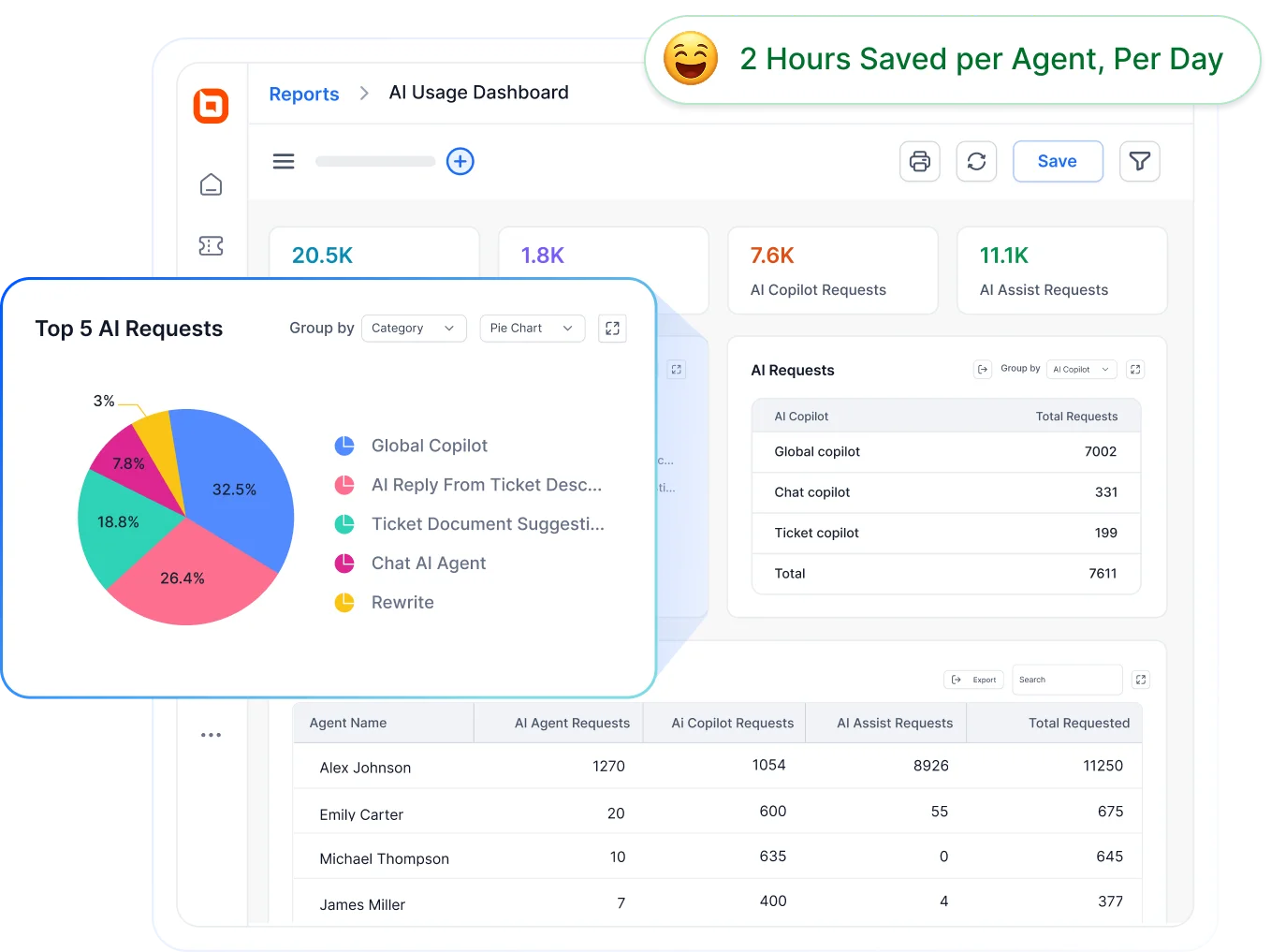
BoldDesk reports the first three natively in the AI Agent Performance Dashboard, which tracks Total Conversations, Deflection Rate, Escalation Rate, and Human Hours Saved, and lets you filter by handling type across AI Agent Handled, Transfer to Human Agents, and Human Agent Takeover.
Reporting escalation and deflection side by side is the honest presentation, and it is the one that survives scrutiny.
Put a number on it before the meeting
A business case needs a figure, and the figure needs to be reproducible by whoever challenges it.
The AI ROI Calculator takes your monthly conversation volume, agent count, cost per agent, and expected AI handling rate, then returns 3-year net savings, ROI percentage, cost per AI resolution, monthly AI Credits needed, and a year-by-year breakdown.
It is free and requires no sign-up, so you can run three scenarios: conservative, expected, and optimistic. Take all three into the meeting rather than defending a single optimistic number.
Model the conservative scenario at a handling rate well below the 70% default. The Intercom data says only 10% of teams reach maturity, so a first-year business case built on maturity-level deflection is the kind of promise that gets your second round of funding refused.
For a more detailed approach to measuring returns, see how to calculate chatbot ROI using cost per resolution, verified resolutions, total costs, and net savings.
Designing the handoff so the agent inherits the context
This is where the Zendesk and Pega findings converge into a single requirement: the customer must be able to reach a person, and that person must arrive already knowing the story.
A reliable handoff depends on four practical design choices:
1. Make the exit visible from the first message
A well-designed AI-to-human handoff should give customers a clear path to human support without forcing them through repeated failed AI interactions.
In BoldDesk, the Transfer to Agent action button makes this option available directly in AI responses.
2. Carry the conversation context into the handoff
The agent needs enough context to understand what the customer has already asked and what the AI has already attempted.
BoldDesk AI Agent hands complex cases to your team with full conversation context and a clear summary, reducing the need for customers to repeat themselves.
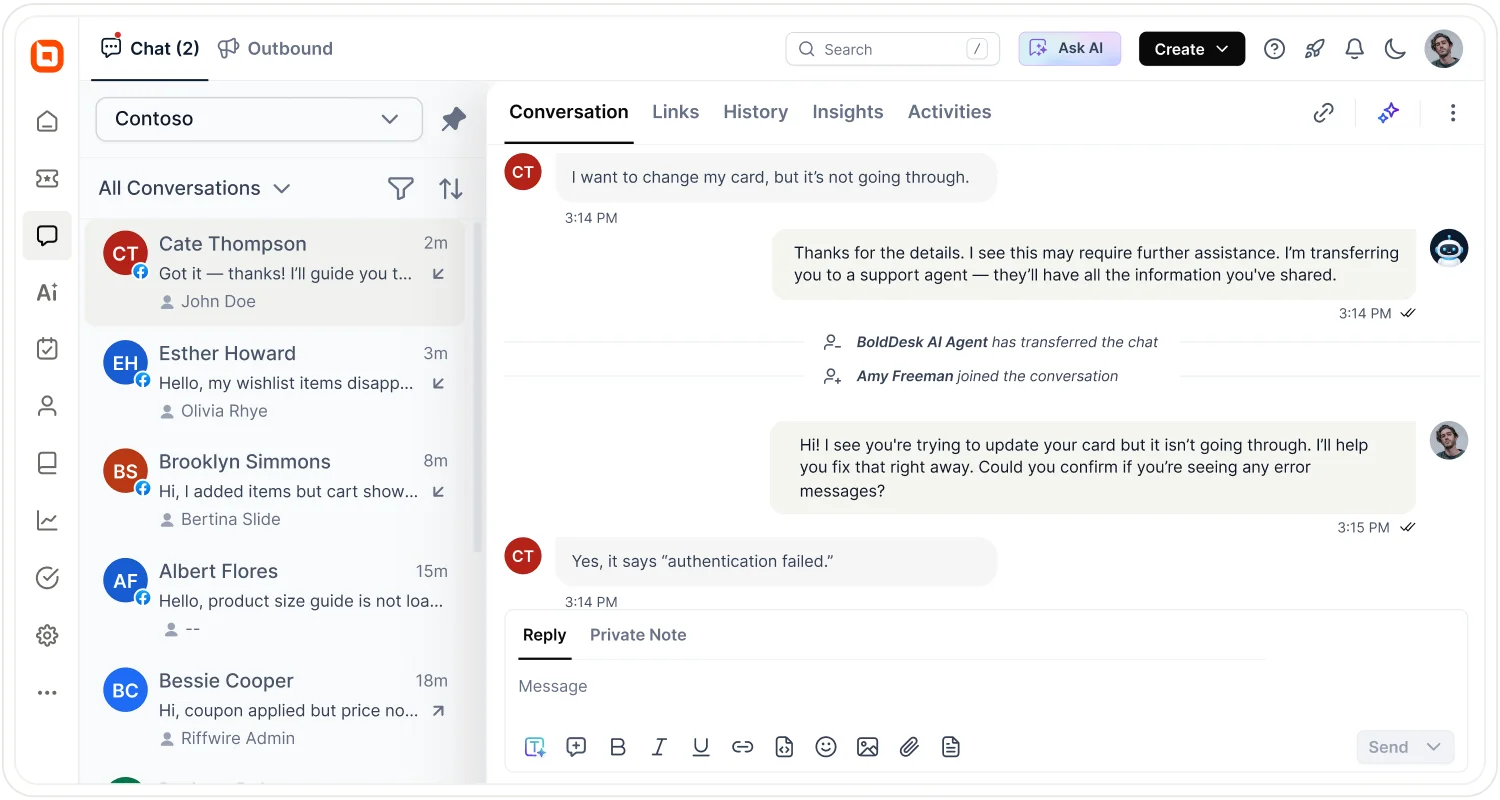
3. Tell the customer what changed
A one-line handover message closes the loop, and it maps to the 95% who expect an explanation for AI decisions.
4. Test the handoff timing
If your AI runs inside a workflow, a transfer requested mid-workflow can block the agent from replying until the workflow completes. Test that path before launch rather than discovering it in a live conversation.
Set the offline behavior deliberately too. When your team is offline, decide whether the AI keeps handling conversations or the customer gets a contact form that creates a ticket. Both are valid. Silence is not.
A 90-day rollout you can defend in a budget meeting
This phased rollout gives decision-makers a clear view of what will happen, who owns each stage, and what evidence will be available before further investment is approved.
| Days | Action | Owner | Evidence produced |
| 1–21 | Audit and rewrite the top 20 contact-driver articles | Knowledge owner | Coverage report |
| 22–49 | Launch AI agent on one channel, one topic set, human exit visible | Support lead | Baseline deflection and escalation |
| 50–77 | Instrument the handoff, review every escalation weekly | Support lead + knowledge owner | Reopened rate, agent feedback |
| 78–90 | Present results, request expansion scope | Support leader | Human hours saved, before/after resolution time |
Two hours a week of knowledge maintenance from a named owner is the line item most likely to be cut and most likely to be the reason it works. Protect it.
Build an AI customer service business case with your own numbers
The research gives you the argument, but your support volume, costs, and expected AI handling rate make the business case credible. Use the AI ROI Calculator to model conservative, expected, and optimistic scenarios, then validate the rollout against the one thing 87% of customers require: a working path to a human that carries the context with it.
BoldDesk gives you a practical way to test those assumptions before committing to a wider rollout. Its AI Agent can handle eligible conversations and escalate when human support is needed, while AI Copilot assists agents during more complex interactions.
The AI Agent Performance Dashboard helps you track AI metrics and human hours saved so you can compare actual results with the numbers in your business case.
You can evaluate these capabilities in a 15-day free trial with 100 AI Credits and no credit card required. If you want to discuss rollout, security, or procurement requirements first, book a BoldDesk demo.
Sources
- Gartner, “Gartner Survey Finds 91% of Customer Service Leaders Under Pressure to Implement AI in 2026”, 18 February 2026
- Gartner, “Gartner Predicts Half of Companies That Cut Customer Service Staff Due to AI Will Rehire by 2027”, 2 February 2026
- Gartner, “Gartner Survey Finds 87% of Customers Say Companies Using GenAI for Customer Service Must Provide Access to a Human Agent”, 4 August 2026
- Intercom, Customer Transformation Report, Q4 2025 survey of 2,470 support professionals
- Zendesk, “Contextual Intelligence Becomes the New Standard for Exceptional Customer Experience in 2026”, 18 November 2025
- Pega and YouGov, “Consumers Demand More from AI-Powered Customer Service, Says Research,” February 25, 2026
Frequently asked questions
The research does not support that as a plan. Gartner found only 20% of service leaders had actually reduced agent staffing because of AI and predicts 50% of companies that cut staff citing AI will rehire for similar functions under different titles by 2027.
What does change is the role: more than 80% of organizations plan to move agents into new roles and 84% plan to adjust skills and hiring profiles.
Intercom’s Q4 2025 survey of 2,470 support professionals found only 10% had reached mature deployment, even though 82% had invested in the previous 12 months. Among those at maturity, 87% reported improved metrics against 62% overall.
Partly. Gartner found 50% of customers say interactions are easier when companies use GenAI, but 87% say a human agent must remain available.
Pega’s YouGov survey found 66% prefer human-led support and only 2% want to deal exclusively with AI chatbots. The takeaway is not to avoid AI. It is to avoid making AI the only option.
Two things, from the data. Weak knowledge coverage underneath the AI, and a handoff that loses context: 74% of consumers are frustrated when they have to repeat information and 81% want the conversation continued without backtracking.
Deflection rate, escalation rate, human hours saved, and reopened rate after AI resolution. The first three quantify the gain. The fourth stops you from reporting a gain that is not real.