


 In this page

TL;DR: Effective AI-to-human handoff ensures customers receive the right support when automation reaches its limits. This guide covers the key escalation triggers, handoff design principles, performance metrics, and common pitfalls that help organizations deliver better customer experiences and reduce operational risk.
Autonomous AI agents are increasingly being used across customer service, IT, HR, and enterprise operations to automate tasks and improve efficiency.
As these systems become more capable, many organizations are also adopting AI agents in customer service to deliver faster, more personalized support experiences at scale.
However, AI is most effective when it knows when to involve a human. Without clear escalation paths, organizations risk poor customer experiences, compliance issues, and unresolved requests.
A well-designed AI-to-human handoff ensures complex, sensitive, or high-impact situations are transferred to the right person at the right time, improving trust, compliance, and overall business outcomes.
In this article, we’ll explore when AI agents should escalate to humans, common handoff triggers, warm vs. cold transfer patterns, best practices for designing effective escalation workflows, and how to measure handoff quality.
What is AI escalation design?
AI escalation design is the framework that determines when, why, and how an AI system transfers a task, conversation, or decision to a human.
It establishes the conditions for human involvement, defines escalation workflows, and ensures that complex, sensitive, or high-risk situations receive the appropriate level of oversight without disrupting the user experience.
Why seamless AI-to-human handoff matters in customer service
An AI-to-human handoff is one of the most important components of AI escalation design.
It ensures that conversations, tasks, or decisions are transferred to a human agent when confidence is low, risk is elevated, or human judgment is required.
A 2023 Salesforce State of the Connected Customer report found that 80% of customers believe AI-generated outputs should be validated by humans, while 89% want transparency about whether they are interacting with AI or a person.
This highlights the importance of well-designed AI escalation workflows that preserve trust and ensure human oversight when needed.
A seamless handoff is critical because it:
- Prevents customer frustration by ensuring customers don’t have to repeat information when a case is transferred.
- Improves resolution speed and accuracy by providing human agents with full conversation history and relevant context.
- Builds customer trust by escalating situations that require human judgment, empathy, or specialized expertise.
- Supports compliance and risk management by ensuring sensitive, regulated, or high-impact requests receive appropriate human oversight.
- Increases operational efficiency by allowing AI to handle routine inquiries while human agents focus on complex issues.
- Enhances customer satisfaction and outcomes by combining AI’s speed and scalability with human expertise, decision-making, and empathy.
Ultimately, the goal of AI escalation design is not to maximize automation at all costs, but to ensure every interaction is handled by the resource best equipped to deliver the optimal outcome.
When should an AI agent escalate to a human?
Effective AI systems are not designed to solve every problem independently. Instead, they are designed to recognize situations where human involvement is necessary and escalate accordingly.
The key principle is simple: AI should handle routine, repeatable tasks, while humans should handle situations that require critical thinking, discretion, accountability, or emotional intelligence.
The following are the most common triggers organizations should account for in their AI escalation design.
Low confidence or knowledge gaps
When an AI agent is uncertain about a user’s intent or lacks sufficient information to provide an accurate response, it should escalate rather than risk delivering incorrect guidance.
Example: A customer asks a highly specific product question that is not covered by the organization’s knowledge base.
Complex or non-standard requests
Not every customer issue fits neatly into predefined workflows. Requests involving exceptions, multiple variables, or unique circumstances often require human expertise and decision-making.
Example: A customer requests a billing adjustment that falls outside standard policies.
Sensitive or emotionally charged interactions
AI can detect sentiment, but it cannot fully replicate human empathy. When customers are frustrated, distressed, or facing a sensitive situation, human intervention can help preserve relationships and improve outcomes.
According to Qualtrics, 62% of consumers globally prefer human-assisted channels over automated interactions, highlighting the importance of escalating emotionally sensitive conversations to human agents.
Example: A customer expresses dissatisfaction after repeated service failures and is considering cancelling their account.
Compliance, security, or high-risk situations
Certain decisions carry legal, financial, regulatory, or security implications that require human oversight. In these cases, escalation helps ensure compliance and reduces organizational risk.
Example: A customer reports suspicious account activity that requires a fraud investigation.
Repeated failed resolution attempts
If an AI agent has attempted multiple solutions without resolving the issue, continuing the interaction can create frustration and erode trust. Escalating promptly prevents customers from feeling stuck in an automated loop.
Example: A support chatbot guides a user through several troubleshooting steps, but the technical issue persists.
By defining these triggers upfront, organizations can ensure AI agents know not only how to automate tasks effectively, but also when to step aside and involve the right human expert.
The result is a better balance between automation, customer experience, and risk management.
Warm transfer vs. cold transfer
Once a trigger is activated, the handoff can occur in one of two ways, and the method you choose shapes the customer’s experience.
| Cold transfer | Warm transfer | |
| What happens | The AI ends its part of the conversation and routes the customer to a human, who receives limited or no context | The AI briefs the human through a note, summary, or live introduction before or as the customer connects. |
| Best for | Low-complexity, low-emotion requests where speed matters most | Complex, sensitive, or emotionally charged situations where continuity of context changes the outcome |
| Customer experience | Faster to connect, but the customer may need to re-explain | Slightly slower to connect, but the customer rarely repeats themselves |
| Risk if done poorly | Feels like starting over; erodes trust quickly | Delayed connection if briefing isn’t automated |
Neither approach is inherently better. The key is choosing the right one: use a warm handoff for complex issues or distressed customers, and a cold transfer when a human agent can resolve the matter quickly without unnecessary effort.
Match the transfer type to the complexity and emotional weight of the conversation, and make sure your escalation criteria specify which type of transfer each trigger should use, not just that a transfer should happen.
Building an AI escalation design strategy: A step-by-step framework
An effective AI escalation strategy requires more than predefined rules. It requires a structured approach that ensures the right issues are escalated at the right time, with the right context and ownership.
The following five-step framework can help organizations design AI-to-human handoffs that are consistent, scalable, and customer-friendly.
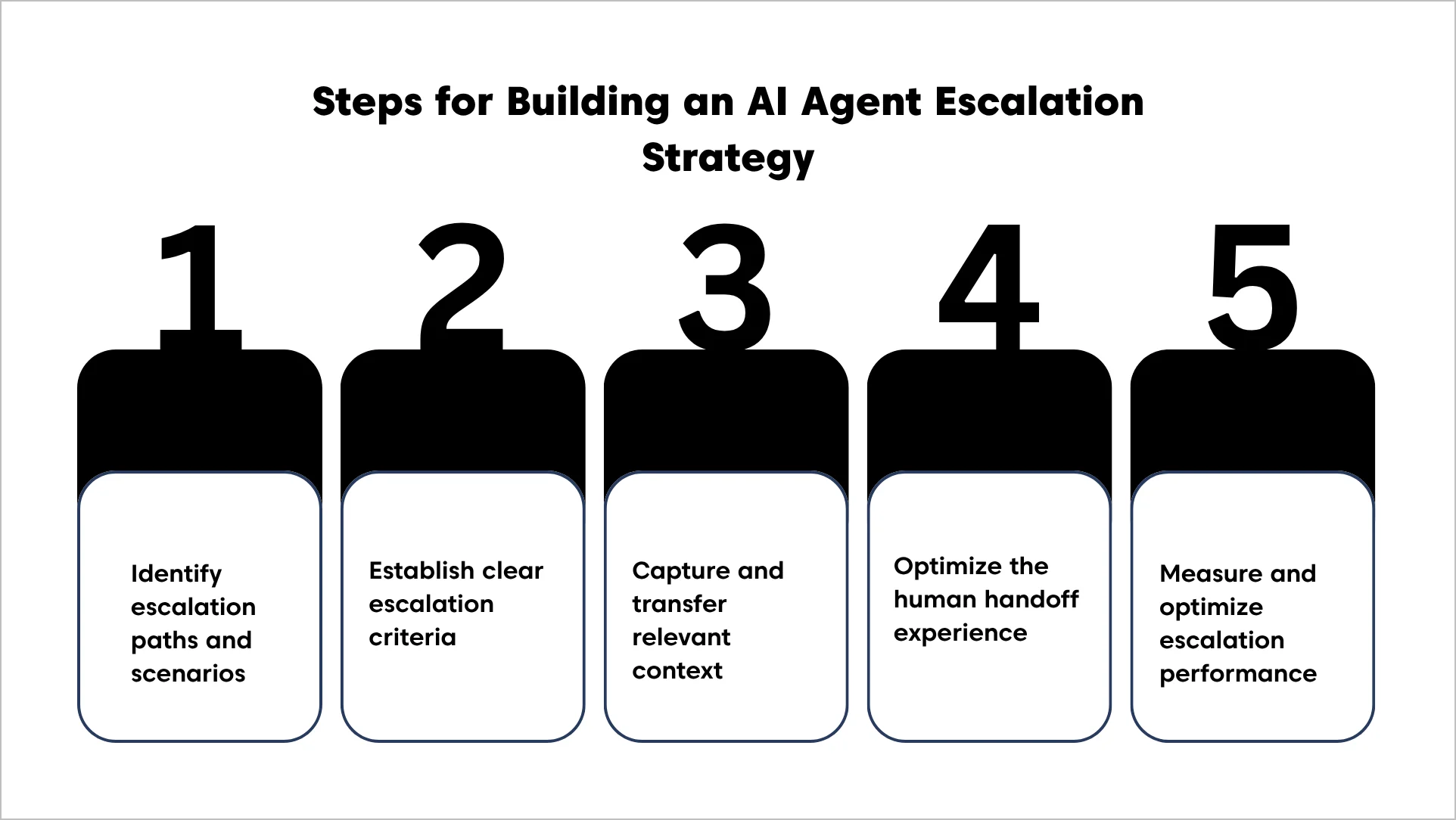
Step 1: Identify escalation paths and scenarios
Start by mapping the situations that should trigger human involvement. These may include complex requests, compliance-related issues, emotional interactions, unresolved cases, or high-risk decisions. For each scenario, define where the escalation should be routed.
Establishing clear ownership and routing rules is a core part of effective escalation management, helping ensure issues reach the right team or stakeholder without delays.
For organizations looking to build stronger escalation workflows, our guide on escalation management in customer support provides additional best practices.
Step 2: Establish clear escalation criteria
Define the specific conditions that trigger a handoff. These may include low confidence scores, multiple failed resolution attempts, negative sentiment, or direct requests for human assistance.
Clear escalation criteria make transfers consistent and predictable, and should define both the trigger and the appropriate handoff type, whether warm or cold.
Step 3: Capture and transfer relevant context
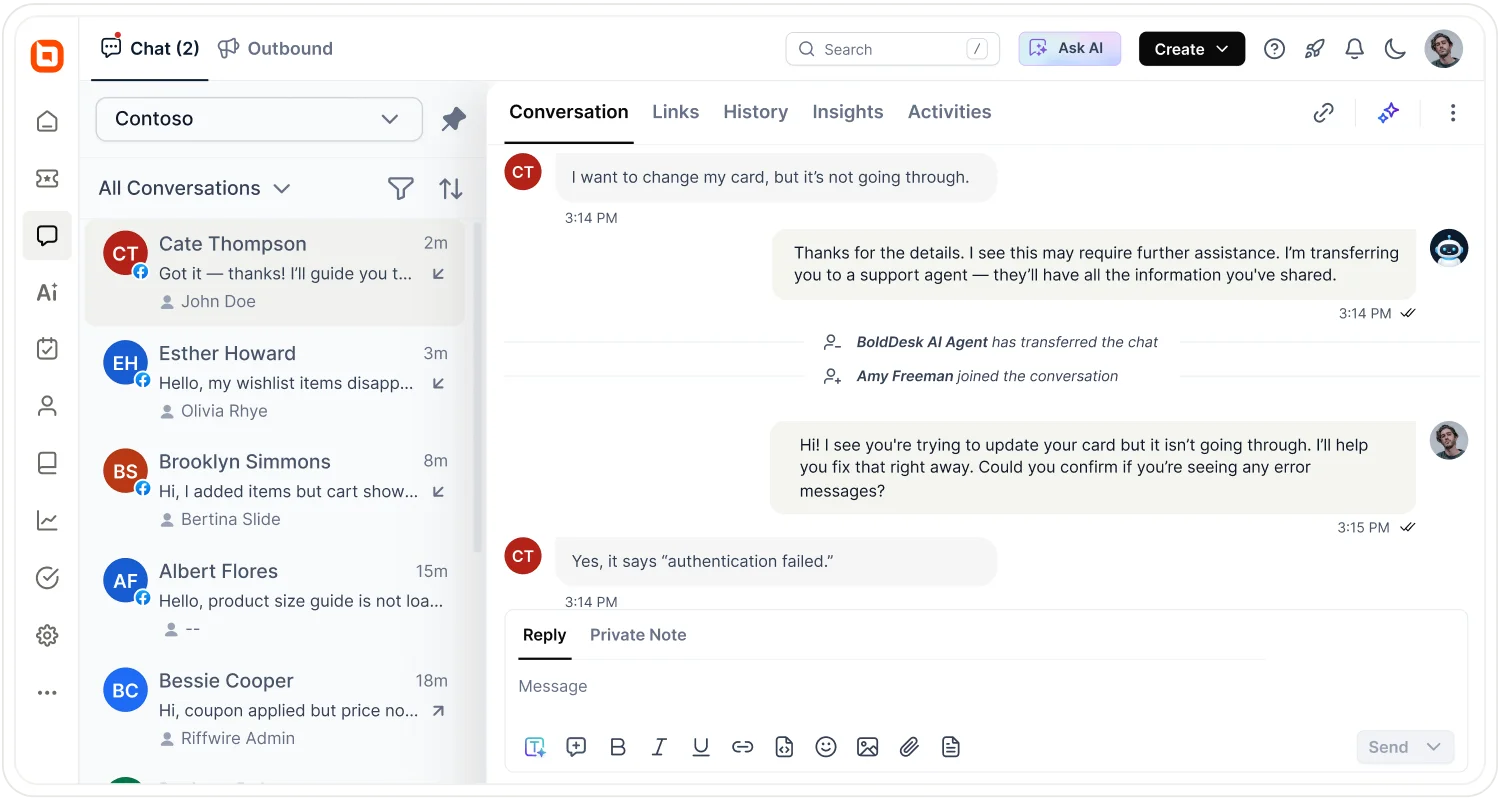
A handoff should never force customers to start over. Ensure the AI collects and passes key information such as conversation history, customer details, intent, and actions already taken before the escalation occurs.
Step 4: Optimize the human handoff experience
The quality of the handoff depends on both the AI and the receiving team. Human agents should have immediate access to the escalation reason, conversation context, and recommended next steps so they can continue the interaction seamlessly.
Step 5: Measure, analyze, and optimize escalation performance
Track metrics such as escalation rates, resolution times, customer satisfaction score, and context-transfer quality. Regular analysis helps identify gaps, refine escalation rules, and improve both AI and human performance over time.
A well-designed escalation framework ensures AI and human teams work together effectively, creating smoother experiences and better outcomes for customers and employees alike.
How to measure AI agent human handoff quality
The effectiveness of an AI-to-human handoff should be measured just as closely as AI performance itself.
Key metrics include:
| Metric | What it tells you |
| Escalation rate | The percentage of interactions transferred to humans. Track it alongside resolution and satisfaction data, as it is not a health metric on its own |
| First Contact Resolution (FCR) | How often issues are resolved after the handoff without additional follow-up |
| Average resolution time | The time required to resolve an issue after escalation |
| Customer satisfaction (CSAT) | Customer feedback on the overall support experience |
| Context transfer accuracy | How effectively conversation history and customer information are passed to human agents |
| Repeated escalations | Cases that bounce between AI and human teams, often indicating workflow issues |
Organizations should aim for the right balance, not the lowest escalation rate. Excessive automation can be just as harmful as excessive escalation.
Common AI agent escalation design mistakes to avoid
Even the most advanced AI agents can deliver poor experiences if escalation workflows are not carefully designed.
Effective AI escalation is not just about knowing when to hand off a conversation, but also how to make that transition seamless, timely, and customer-centric.
The following are some of the most common mistakes organizations should avoid when designing AI-to-human handoffs:
- Escalating too late: Keeping customers in an automated loop for too long can lead to frustration, lower satisfaction, and loss of trust.
- Escalating too early: Routing routine or easily resolvable issues to human agents increases costs and reduces the value of automation.
- Losing context during transfer: Customers should never have to repeat information they have already shared. A successful handoff should include conversation history, customer details, and prior actions.
- Using poor escalation rules and routing: Unclear escalation criteria or routing cases to the wrong team can create delays, inconsistent experiences, and inefficient resolution processes.
- Ignoring customer preferences: Customers should always have a clear and straightforward option to connect with a human when they prefer human assistance.
By avoiding these pitfalls, organizations can create smoother handoffs, improve customer satisfaction, and maximize the value of both AI automation and human expertise.
Does AI-to-human handoff look different by industry?
The escalation principles above are consistent across industries; what shifts is which situations count as “high-risk” and therefore warrant a lower tolerance for automation:
- E-commerce: Charge disputes, complex refunds, and fraud flags typically need a human regardless of AI confidence.
- Healthcare: Clinical triage, prescription refill denials, and anything touching drug interactions or emergency scheduling should route to a human by policy, not by AI judgment call.
- SaaS: Enterprise accounts, contract exceptions, and security-related requests usually warrant white-glove handling even when the AI could technically answer.
- Financial services and insurance: Hardship cases, disputes above a dollar threshold, and anything with compliance exposure need a documented, auditable human decision.
- Telecom: Service outages, contract or billing disputes, and account security changes typically warrant faster escalation given the volume and urgency involved.
If you operate in a regulated environment, define these categories with legal or compliance input before launch, rather than treating them as a trigger to adjust after a negative outcome.
Evaluating AI escalation capabilities: What to look for in a platform
Not all AI platforms provide the same level of escalation intelligence. When evaluating solutions, organizations should look for:
- Configurable escalation rules and workflows
- Confidence-based escalation capabilities
- Sentiment and intent detection
- Seamless context transfer to human agents
- Integration with CRM, help desk, and contact center systems
- Role-based routing and approval workflows
- Analytics and reporting for escalation performance
- Compliance, audit, and governance features
The right platform should make escalation an integral part of the customer journey rather than an afterthought.
Building trust and better outcomes with effective AI-to-human handoff
The success of an AI agent is not measured by how many interactions it handles alone, but by how effectively it recognizes when human involvement is needed. Well-designed AI-to-human handoffs ensure customers receive the right level of support for sensitive and high-impact situations.
By establishing clear escalation policies and seamless transfer processes, organizations can build trust, improve service quality, and create more reliable customer experiences.
BoldDesk AI Agent helps organizations balance AI automation with human expertise by resolving up to 70% of inquiries automatically. When a conversation requires a human agent, the full conversation history is carried into the same live chat or omnichannel inbox.
AI Copilot supports agents with drafted replies and summaries, while built-in reporting and analytics help track escalation metrics alongside automation performance. All of this is included at a flat rate with no per-resolution AI fees.
Ready to deliver seamless AI-powered support with human expertise when it matters most? Start your 15-day free trial and see how intelligent escalation workflows can elevate your customer service experience.
Related articles
- Human-in-the-Loop AI for Customer Service: When to Use It
- AI Customer Feedback Analysis: How to Turn Customer Insights into Action
- AI in Customer Success: 10 Practical Use Cases that Enhance Growth
FAQs
Governance ensures that AI escalation policies align with organizational standards, security requirements, and regulatory obligations. Strong governance frameworks define accountability, approval processes, audit trails, and oversight mechanisms for high-risk interactions.
Inadequate AI-to-human handoff processes can lead to customer frustration, longer resolution times, repeated information gathering, and inconsistent service experiences.
Poor handoffs may also increase operational, compliance, and reputational risks when critical context is lost during the transition.
A good AI-to-human handoff is timely, seamless, and context-rich. It should provide the human agent with the full conversation history, customer intent, and relevant information so the issue can be resolved efficiently without requiring the user to repeat details.
Confidence thresholds determine when an AI agent should escalate to a human. If the AI’s confidence falls below a predefined level, the interaction is transferred to ensure accuracy and reduce risk.
No. Even advanced autonomous AI agents can encounter uncertainty, exceptions, or high-risk situations that require human intervention. Escalation paths are essential for maintaining accuracy, accountability, and operational resilience.