

 In this page

TL;DR: Human-in-the-loop AI for customer service is a support model where AI handles routine work like routing, drafting replies, and summarizing tickets, while human agents review, approve, or override AI outputs on sensitive, complex, or high-risk cases.
Not every customer service task requires a human, and not every task should be automated.
A common challenge for modern support teams is deciding where automation creates efficiency and where human judgment protects customer experience, business risk, and brand reputation.
The hard part isn’t the technology. It’s drawing the line between the tickets AI can handle independently and the situations where a wrong answer would be more costly than a delayed one.
Teams that get human-in-the-loop (HITL) AI right don’t use human agents as a safety net. They establish governance rules, confidence thresholds, escalation triggers, and approval checkpoints that determine, ticket by ticket, when AI can proceed and when human review is needed.
In this blog, we’ll explain what human-in-the-loop AI is, how it works in customer service, and how support teams can use it to improve resolution quality, governance, and customer trust.
Use human-in-the-loop AI for customer service when:
- The request involves refunds, credits, or billing adjustments
- Customers need account access, verification, or recovery assistance
- Responses involve legal, financial, security, or compliance requirements
- AI confidence falls below established thresholds
- The situation requires policy exceptions or human judgment
- Customers are frustrated, escalated, or high value
- Errors could create financial, regulatory, or reputational risk
What is human-in-the-loop AI for customer service?
Human-in-the-loop AI for customer service is a support model where AI automates repetitive tasks while human agents review, approve, correct, or override outputs in complex, sensitive, or high-risk interactions.
Human oversight works best as an AI governance framework, helping support teams concentrate their attention on the requests where a wrong decision would be far more costly than a delayed one.
A HITL approach aligns with guidance from the NIST AI Risk Management Framework, which emphasizes documented human oversight and governance processes to manage AI risks and ensure responsible outcomes.
It also reflects the principles of the EU AI Act, which requires appropriate human oversight for certain AI systems to help prevent errors, reduce risks, and maintain accountability in decision-making.
How do human-in-the-loop, human-on-the-loop, and human-in-command differ in customer service AI?
The difference comes down to when and how people oversee AI-powered customer interactions:
- Human-in-the-loop (HITL): Agents review, approve, or intervene before AI completes sensitive actions such as compliance-related responses.
- Human-on-the-loop (HOTL): AI handles interactions independently, while agents monitor performance and step in when issues or exceptions arise.
- Human-in-command (HIC): Customer service leaders define the governance policies, escalation rules, and approval workflows that guide AI use.
Many customer service organizations use a combination of all three approaches, depending on customer impact, business risk, and regulatory requirements.
How human-in-the-loop AI for customer service works
As former CISA Director Jen Easterly noted, “AI, which is going to be the most powerful technology and most powerful weapon of our time, must be built with security and safety in mind.”
By setting clear governance policies for when automation proceeds and how decisions are validated, support teams create a more structured and reliable customer service process.
Here’s how human-in-the-loop AI works in customer service:
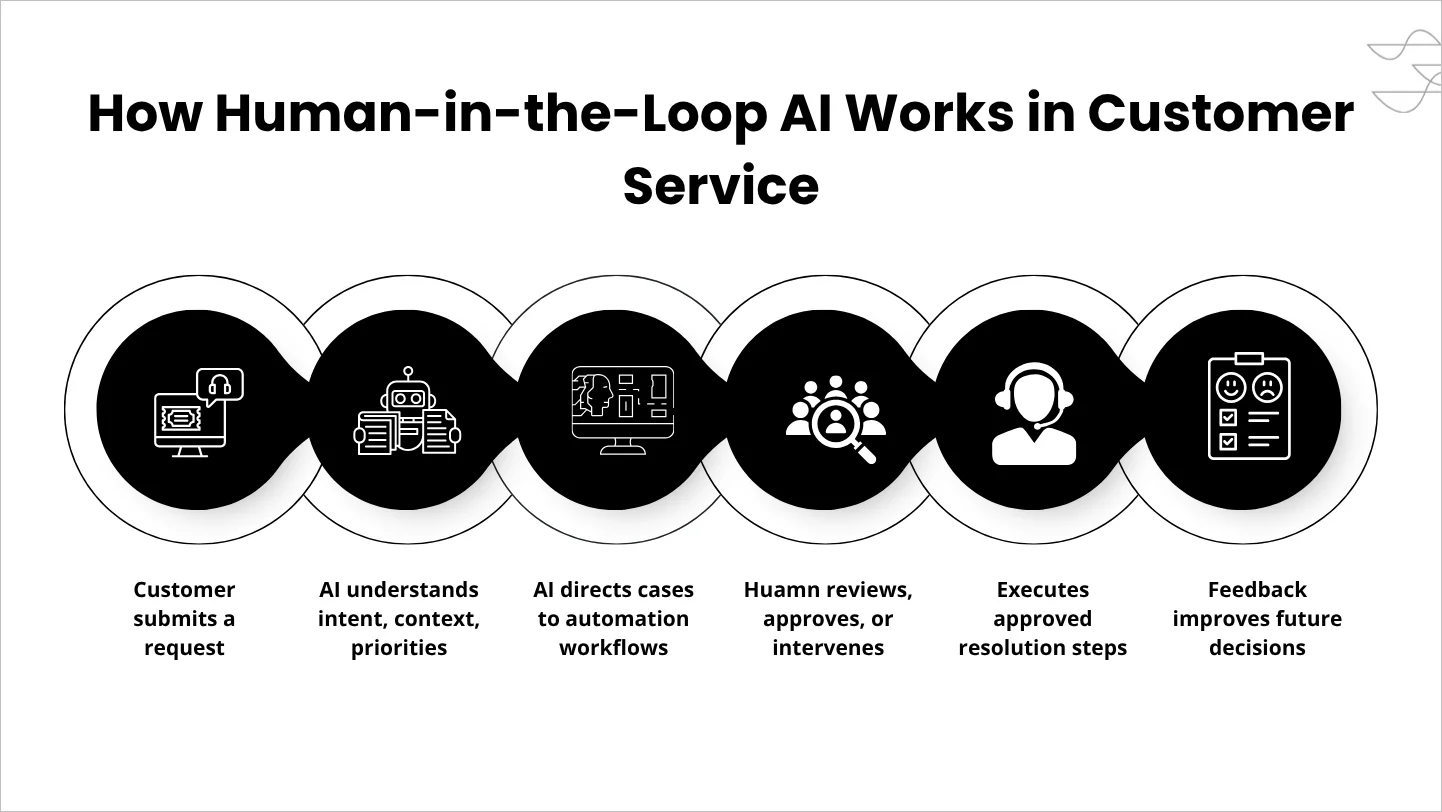
- Customer submits a request: A customer reaches out through a channel such as chat, email, or phone with a question or issue. The request enters the support system for processing.
- AI analyzes intent, context, and escalation signals: AI reviews the customer’s intent, conversation history, sentiment, and urgency. It also flags exceptions, account sensitivity, or signs of repeated frustration.
- AI routes the request to automation, review, or escalation: Standard, low-risk cases continue through automation. Unclear, sensitive, or high-impact issues are routed to an agent or approval queue based on rules, confidence scores, or escalation criteria.
- A support agent reviews, approves, or takes over: After evaluating the AI summary, suggested response, or escalation flag, the agent approves the action, edits the response, escalates the case, or takes over the conversation.
- Support agents carry out the approved resolution: The final action includes sending a reply, updating a ticket, processing a refund, approving account changes, or escalating the case. Agent review ensures the resolution fits the customer’s situation and company policy.
- Feedback improves future AI-assisted decisions: Agent edits, approvals, overrides, and escalation decisions become feedback signals for improving the support workflow. Over time, this feedback improves performance through workflow updates, knowledge base improvements, quality reviews, or model retraining where available.
Example of human-in-the-loop AI for customer service workflow
A customer reports that they can no longer access their account after changing devices.
- AI gathers relevant account details, reviews recent login activity, and recommends an account recovery path based on established support policies.
- Because restoring account access involves security and identity verification requirements, the workflow automatically routes the request for agent review before any changes are made.
- The support agent validates the recommendation and approves the recovery action before the customer’s access is restored. This keeps the human-in-the-loop concept intact while showcasing a different customer service use case.
Why customer support automation with human oversight matters
As of 2026, the question is no longer whether customer support teams should use AI, but how much autonomy it should have.
Successful support operations rely on AI and human collaboration to determine when automation can move quickly and when a person should step in to review the outcome.
According to Salesforce’s State of the AI Connected Customer research, 60% of consumers believe advances in AI make trust even more important.
In practice, agent review improves customer support automation in several ways:
- Reduce AI hallucinations and operational risk: Additional review helps identify inaccurate, unsupported, or conflicting outputs before they affect customers or business operations.
- Improve decision quality in complex situations: Requests involving exceptions, competing priorities, or incomplete information can be evaluated with greater context and judgment.
- Strengthen customer trust: Oversight helps ensure conversational AI responses align with customer expectations, especially in sensitive or high-impact interactions.
- Continuously improve AI performance: Reviews, corrections, and overrides provide valuable feedback that helps refine workflows, knowledge sources, and automation strategies over time.
Real-world example of HITL in action: Klarna
Klarna’s OpenAI-powered assistant handled roughly two-thirds of customer service chats and significantly reduced response times for routine inquiries.
However, in 2025, Klarna acknowledged that an automation-first approach had affected service quality and began reinvesting in human support, reinforcing the importance of combining AI efficiency with human oversight for complex and sensitive interactions.
Human-in-the-loop AI vs fully automated customer support
While organizations often frame automation strategies as an AI vs human customer service decision, human-in-the-loop AI shifts the focus from choosing between people and AI to determining where human oversight is needed.
The table below compares both approaches across key customer service capabilities to help identify where responsible AI adds the most value.
| Criteria | Human-in-the-loop AI for customer service | Fully automated customer support |
| Human involvement | Humans review, approve, modify, or take over interactions when needed. | AI handles interactions without decision validation. |
| Best suited for | Complex, sensitive, high-impact, or exception-based requests. | Routine, repetitive, and predictable customer inquiries. |
| Accuracy | Higher accuracy through human validation of uncertain responses. | Relies entirely on AI-generated outputs and predefined rules. |
| Compliance and risk management | Human oversight helps reduce compliance, legal, and policy risks. | Greater risk of errors in regulated or sensitive interactions. |
| Decision-making | AI assists, while humans make critical decisions when required. | Decisions are made automatically based on system logic. |
When should you use human-in-the-loop AI in customer service?
Customer service issues aren’t all created equal. Some can be handled through standard workflows, while others require closer review because the stakes, complexity, or potential impact are higher.
In these situations, human-in-the-loop automation helps support teams make better use of agentic AI capabilities such as routing without applying the same level of automation to every request.
Approving refunds, cancellations, and billing
AI brings customer history, order details, policy notes, and previous ticket context into view so agents can make faster, more informed decisions.
The agent makes the final approval to ensure the outcome is fair, compliant, and suitable for the customer’s situation.
Verifying account access and recovery requests
For access-related tickets, AI agents highlight suspicious activity, incomplete verification details, or recovery requests that need closer review.
A human agent verifies the request before restoring access, helping prevent fraud while keeping legitimate recovery requests moving.
Real-world example of HITL in action: Bank of America
Bank of America’s Erica virtual assistant helps customers manage accounts, answer questions, and complete routine banking tasks through conversational AI.
When customers need assistance beyond Erica’s capabilities, the assistant can connect them with specialists or initiate live chat with a human representative, helping maintain trust in sensitive account-related interactions.
Managing high-priority and SLA-risk tickets
AI-assisted routing highlights tickets nearing service level agreement (SLA) limits, urgent incidents, or requests from priority customers.
Human oversight ensures the case is assigned to the right owner, prioritized correctly, and resolved within the expected SLA timeline.
Reviewing sensitive or regulated responses
When a reply involves legal, financial, security, or sensitive information, AI-generated suggestions should go through human validation before being sent.
A human reviewer checks the wording, accuracy, and compliance risk before the response reaches the customer.
Best practices for building human-in-the-loop AI support workflows
Qualtrics’ 2025 Contact Center Trends research found that 61% of consumers prefer to complete tasks through human channels, while 74% would rather resolve an issue or get technical support with a human agent.
The following best practices help keep AI-assisted customer service fast, accurate, scalable, and well-governed.
Define clear roles for AI and support agents
For human-in-the-loop workflows to work effectively, organizations need clear guidelines for when automation should take the lead and when operational oversight is required.
Instead of making final decisions, AI helps reduce manual effort by organizing information and recommending next steps, leaving customer-impacting actions in the hands of support teams.
In practice, many organizations begin with a copilot approach, where AI assists agents by surfacing information and recommendations while humans remain responsible for decisions.
As workflows mature and confidence grows, some routine processes can move toward autopilot, where AI handles low-risk tasks independently under predefined governance rules.
Use AI confidence thresholds
AI confidence thresholds are predefined rules that determine when an AI-generated response or action proceeds automatically and when it needs human intervention.
Support organizations typically define confidence thresholds based on their risk levels, customer impact, and business requirements.
High-confidence responses (usually above 90%) are automated, while lower-confidence outputs (below 70%) are routed for human review.
By applying review only where the stakes are higher, support teams can automate routine work while ensuring important decisions receive the attention they deserve.
For example, organizations often establish escalation rules that require human review whenever AI confidence falls below a predefined threshold.
In BoldDesk, these tickets can be automatically routed through an L1-L2-L3 ticket escalation workflow, ensuring human review for higher-risk decisions.
Use trusted knowledge sources for AI responses
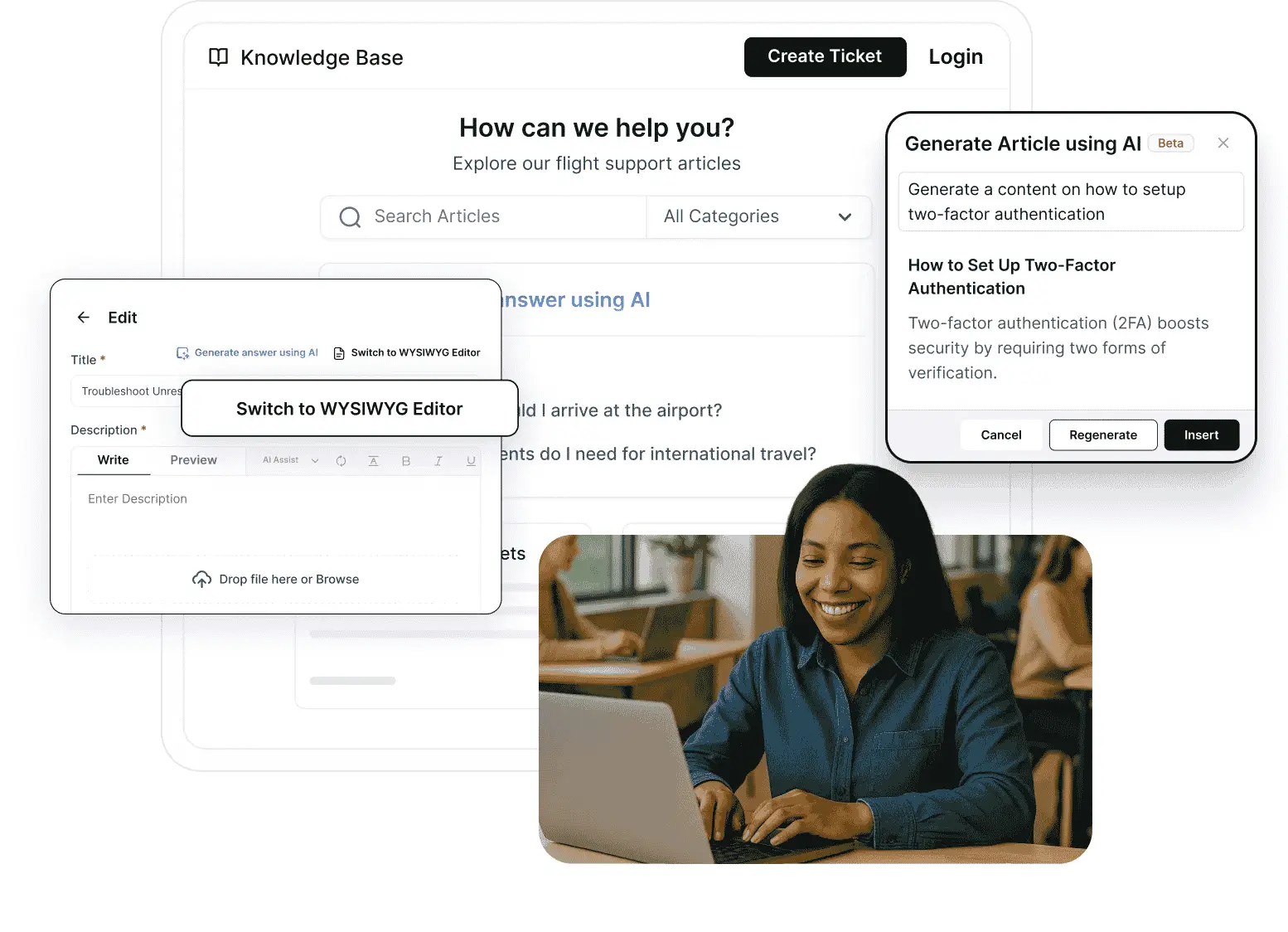
AI is only as reliable as the information behind it, which is why its responses should be rooted in approved knowledge base articles, policy documents, and previously resolved support cases.
When recommendations come from trusted sources with a proper knowledge management system, agents can review and validate them more quickly, reducing the risk of inconsistent, outdated, or misaligned responses.
This not only improves response quality and consistency but also makes it easier to scale risk-based automation without losing accuracy or control.
Train agents to avoid automation bias
Repeated exposure to AI suggestions leads to automation bias when agents over-trust the system and overlook errors.
To prevent this, agents should be trained to evaluate AI recommendations critically instead of approving them automatically.
Regular QA reviews, monitoring audit trails, and coaching help keep human oversight meaningful.
Build feedback loops into the workflow
Capture agent edits, approvals, overrides, escalations, and quality assurance findings as part of the workflow.
These interactions reveal where AI recommendations, routing rules, and knowledge sources can be improved while creating a clear audit trail of what the AI suggested, what decisions were made, and why.
This continuous feedback process reflects the principles of reinforcement learning from human feedback (RLHF), helping AI-assisted support become more accurate, reliable, and effective over time.
How to measure human-in-the-loop AI performance in customer service
Support teams should measure human-in-the-loop AI using performance metrics that show how well AI, agents, and workflows improve customer support outcomes.
Key metrics to monitor include:
- AI-assisted resolution rate: Measures how often AI helps resolve simple, repetitive, or low-risk customer requests using knowledge base content, FAQs, and configured workflows.
- First contact resolution (FCR): Indicates whether AI and agents have the context needed to resolve issues without repeated follow-ups. A strong FCR rate typically reflects effective AI governance and escalation management.
- SLA compliance: Reflects how well AI-assisted workflows help teams meet response and resolution commitments. Consistently meeting SLA targets suggests tickets are being prioritized and routed effectively.
- Customer satisfaction (CSAT) score: Reveals whether AI and human oversight are delivering a positive support experience. Strong CSAT score results indicate customers feel issues are resolved accurately, efficiently, and appropriately.
- Ticket resolution time: Shows how quickly support teams resolve customer issues from creation to closure. Improved ticket resolution times often indicate that AI-assisted summaries, routing, and agent guidance are helping teams work more efficiently.
- Deflection rate: Measures the percentage of customer inquiries resolved through self-service resources or AI-assisted channels without creating a support ticket or requiring agent involvement. Higher deflection rates can indicate that AI is successfully handling routine requests.
- Containment rate: Shows the percentage of interactions fully resolved within an automated channel, such as a chatbot or virtual agent, without escalation to a human agent. This evaluates how effectively AI resolves low-risk, repetitive requests while keeping more complex cases available for review.
Future-proof customer support with human-in-the-loop AI
As AI becomes a standard part of customer service, the challenge is no longer whether to automate, but where to apply operational oversight for the greatest impact.
Many organizations take a progressive automation approach, starting with human-reviewed workflows.
As performance and confidence improve, gradually expand AI autonomy to more routine interactions, allowing workflows to mature without introducing unnecessary risk.
The companies that succeed with AI will have the strongest decision governance framework, including approval checkpoints, review workflows, accountability rules, and human oversight for high-impact customer interactions.
BoldDesk helps support teams build that balance through AI-assisted approval workflows, agent oversight, and knowledge-driven support experiences.
Ready to improve support quality with human-in-the-loop AI? Start your free trial today and deliver faster, more accurate support.
Let us know what you think in the comments below.
Related articles
- Autonomous AI Agents: A Smart Way to Deliver Excellent Support
- AI-Powered Customer Support: Tips for Scalable Business Growth
- 9 Proven Ways to Improve Agent Productivity with AI in Customer Support
FAQs on HITL for customer service
Human-in-the-loop AI should be used for requests involving risk, uncertainty, sensitive data, billing, account access, escalations, or complex decision-making.
Human‑in‑the‑loop AI reduces service costs by automating routine tasks like ticket routing, freeing agents for higher‑value work. With human oversight, organizations boost productivity and reduce errors in customer interactions.
Risks of human‑in‑the‑loop AI in customer service include automation bias, slower approvals, inconsistent agent reviews, and scaling challenges as ticket volumes rise. These can be managed with clear guidelines, quality checks, and proper training.
Human-in-the-loop AI is better for workflows involving risk, emotion, compliance, or complex customer context. Fully automated support works best for simple FAQs and repetitive tasks.
Yes. The EU AI Act requires human oversight for certain AI systems, especially where decisions impact individuals. In customer service, oversight reduces risk, strengthens accountability, and supports responsible AI use.