


 In this page

TL;DR: The best knowledge base software helps businesses organize FAQs, help articles, and documentation in a centralized, searchable hub. We compared 12 leading solutions based on AI search, multilingual support, pricing, and ratings to help you choose the right platform for customer and internal support.
Customers expect fast, accurate answers, but many businesses still struggle with scattered documentation, outdated FAQs, and hard‑to‑search content, slowing resolution and increasing support volume.
As self-service becomes increasingly important, organizations need a reliable way to organize and surface information.
According to NICE’s Digital-First Customer Experience report, 81% of consumers want more self-service options, while only 60% of businesses believe customers prefer self-service support, highlighting a growing need for accessible knowledge and self-service experiences.
The best knowledge base software centralizes and organizes content, helping customers find answers faster while enabling support teams to scale self-service more effectively.
In this guide, we compare the best knowledge base software for 2026, covering features, pricing, and use cases, to help you choose the right solution for your business.
For a detailed overview of knowledge bases, check out our complete guide on knowledge bases.
What are the types of knowledge base tools?
Knowledge base systems come in two main categories: internal and external knowledge base software.
Each type serves a different audience and business objective, and many organizations use both together.
Internal knowledge base software
Internal knowledge base software is designed for employees to access company policies, processes, and technical documentation.
Examples include:
- Wikis (e.g., Confluence, Notion): Collaborative platforms for storing and updating internal documentation, project notes, and SOPs.
- Troubleshooting guides: Step-by-step instructions for IT or product teams to resolve technical issues internally.
- User manuals for internal systems: Detailed guides for internal tools and workflows, ensuring smooth onboarding and compliance.
External knowledge base software
External knowledge base software enables customers to find answers and resolve issues without needing to contact support.
Common formats include:
- FAQ pages: Provide quick answers to common questions in a structured Q&A format.
- Community forums: Enable peer-to-peer support, discussions, and idea sharing among customers.
- Customer self-service portals: Central repositories where users access FAQs, guides, and perform tasks like account updates or transactions.
- Product user manuals: Comprehensive documentation for customers to understand and use products effectively.
Knowledge base software can also be categorized by how it is delivered and licensed. These include:
- SaaS knowledge base software: Cloud-based solutions hosted and maintained by a provider, accessible through subscription models. Users can access the platform online without the need to install or manage it locally.
- Open-source knowledge base software: Platforms with publicly available source code that can be modified and self-hosted, giving businesses full control over knowledge base customization and deployment.
- Free knowledge base software: Tools that offer basic features at no cost, often suitable for small teams or projects but with limitations compared to paid or enterprise versions.
How to choose the best knowledge base system
With a wide range of self-service platforms and knowledge management tools available, choosing the right knowledge base system can be challenging.
The best solution should make self-service fast, intelligent, and easy to use, while ensuring accurate information is always accessible to users.
The following are the key factors to consider when selecting the best knowledge base software for your business needs.
- Search functionality: Choose a knowledge base with a powerful search engine that includes filters, autosuggestions, and typo tolerance to help users find accurate answers instantly.
- AI-powered assistance: Look for AI-driven capabilities such as intelligent recommendations and contextual search that predict user intent to deliver faster, smarter support.
- Content management: Go for an easy article management system with templates, version control, categorization tools, and a well-structured knowledge base architecture. These features enable teams to create, update, and organize articles effortlessly.
- Analytics and reporting: Select a system that provides detailed insights into article performance, search trends, and user behavior, including the knowledge base metrics, to help you optimize content.
- Multilingual support: If you serve global audiences, prioritize knowledge base software with built-in translation tools to deliver consistent and accurate answers across multiple languages.
- Integrations: Your knowledge base should integrate easily with help desk, contact management software, and other business tools to create a unified support ecosystem and speed up issue resolution.
- Mobile-friendly interface: Ensure the knowledge base software tools offer a responsive knowledge base design so users can access help anytime, anywhere, on any device.
- Role-based access control: Opt for a knowledge base solution with role-based permissions to protect sensitive information and compliance-ready security features by defining who can view, edit, or publish content.
- Customization and branding: Choose a solution that allows full customization of layouts, colors, and branding elements to reinforce your brand identity and create a professional self-service experience.
How we evaluated the knowledge base software tools
To create this list, we evaluated each knowledge base software solution based on factors that matter most to support, customer service, and IT teams.
We reviewed publicly available product information, pricing details, feature documentation, and customer feedback to ensure a balanced comparison.
Our assessment focused on:
- Core knowledge base features and ease of use
- AI-powered search and automation capabilities
- Content organization and customization options
- Multilingual support
- Reporting and analytics features
- Third-party integrations
- Customer reviews and ratings from platforms such as G2 and Capterra
- Pricing, scalability, and overall value for money
Disclosure: BoldDesk is our product, and we evaluated it using the same criteria applied to every other platform and highlighted both its strengths and limitations.
Comparison table of the top knowledge base software platforms
Whether you’re evaluating software or creating a knowledge base from scratch, choosing the right platform is one of the most important decisions for long-term self-service success.
The table below compares the leading platforms for 2026 to help you identify the best fit for your organization.
| Knowledge base tool and features | Starting price | Free trial duration | G2 reviews | Capterra ratings |
BoldDesk
|
$99/5 agents/month | 15 days | 4.5/5 | 5/5 |
Zendesk
|
$19/agent/month | 14 days | 4.3/5 | 4.4/5 |
Confluence
|
$5.42/agent/month | 7 days | 4.1/5 | 4.5/5 |
Document360
|
Contact Document360 | 14 days | 4.7/5 | 4.7/5 |
Notion
|
$10/agent/month | Contact Notion | 4.6/5 | 4.7/5 |
HubSpot Service Hub
|
$90/agent/month | 14 days | 4.4/5 | 4.4/5 |
Help Scout
|
$25/agent/month | 15 days | 4.4/5 | 4.6/5 |
Guru
|
$25/agent/month | Contact Guru | 4.7/5 | 4.8/5 |
Helpjuice
|
$249/30 agents/month | 14 days | 4.7/5 | 4.7/5 |
Nuclino
|
$6/agent/month | 14 days | 4.7/5 | 4.7/5 |
Bloomfire
|
Contact Bloomfire for pricing | Contact Bloomfire | 4.6/5 | 4.4/5 |
Slite
|
$10/agent/month | 14 days | 4.6/5 | 4.7/5 |
Note: Pricing, ratings, and features were reviewed and verified in September 2026 and are subject to change.
The best knowledge base solutions for your business
Below is a list of the leading knowledge base software tools evaluated for their ability to support self‑service, enable knowledge sharing, and scale customer support effectively.
1. BoldDesk
Best for: Teams looking to combine customer support and knowledge management in a single platform with predictable pricing.
BoldDesk is a modern knowledge base solution that helps customers find accurate answers fast while reducing support ticket volume.
As one of the top Zendesk alternatives, it combines an intuitive knowledge base software with built-in AI and seamless help desk integration.
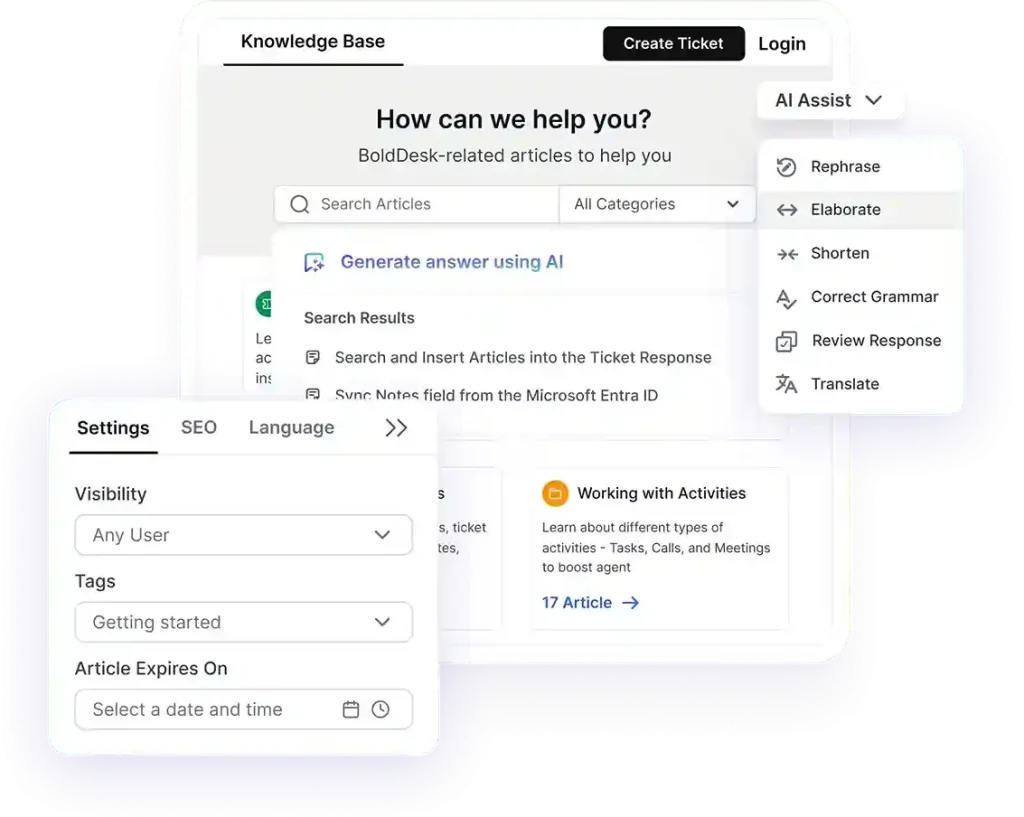
BoldDesk’s top features
- AI-powered self-service
- Deep integration
- Multilingual knowledge base
Why choose BoldDesk’s knowledge base software?
BoldDesk stands out as a strong Zendesk and Help Scout alternative because it focuses on solving support challenges rather than simply offering a list of features.
Here’s how BoldDesk’s knowledge base software helps teams improve customer support:
- Reduces ticket volume: AI Agent automatically suggests relevant articles, deflecting repetitive questions before they reach agents.
- Improves content discoverability: Powerful search and intelligent article suggestions ensure customers quickly find the right answers.
- Scales with your business: Unlimited articles, multilingual knowledge base, and structured organization make it easy to grow your help center.
- Keeps knowledge accurate: Collaboration tools, version control, and performance insights help teams continuously improve content quality.
- Delivers consistent experiences: Integrated help desk and knowledge base ensure agents and customers rely on the same source of truth.
Cons
- While it supports key integrations, some third-party connections may require Zapier or API-based configuration compared to more mature platforms.
Pricing
BoldDesk pricing provides access to the full feature set across all plans, including free AI credits at every tier with no hidden costs.
| No. of agents | Monthly price (USD) | Free AI credits (First 3 months) |
| 5 | $99 | 500 |
| 10 | $199 | 1,000 |
| 25 | $349 | 1,500 |
| 50 | $499 | 2,000 |
| 75 | $749 | 2,500 |
| 100 | $999 | 3,000 |
What users say on G2
“What I like best about BoldDesk is its simplicity and flexibility.” – Vinay B., Sales Executive, Small-Business
Simplify Support with Fast, Reliable Answers!
Supercharge your support team and delight customers with a powerful knowledge base. Exceptional customer service without the wait!

2. Zendesk
Best for: Enterprise support organizations requiring advanced workflows and a large integration ecosystem.
Zendesk Help Center software is part of Zendesk for Service and one of the best customer service software solutions.
Businesses comparing knowledge base solutions often review Zendesk pricing alongside its help center and self-service capabilities.
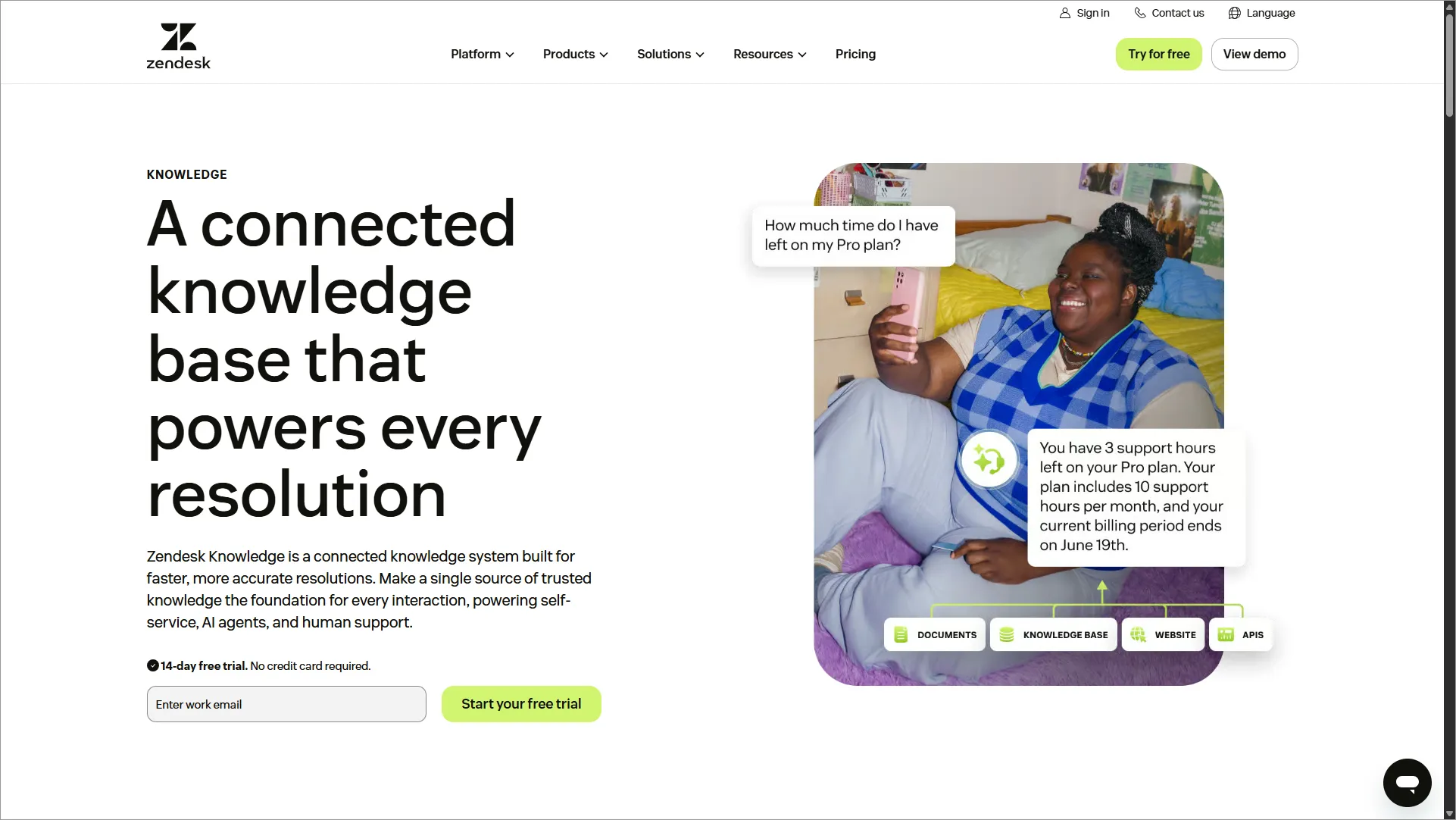
Top features
- Team collaboration and editing
- Reporting and analytics
- Roles and permissions
Pros
- Ecosystem with an advanced help center and ticketing integration.
- Integrations with popular business tools.
Cons
- Customization can be complex and requires technical expertise.
Pricing
| Plan | Pricing |
| Support Team |
|
| Suite Team |
|
| Suite Professional |
|
| Suite Enterprise |
|
What users say on G2
“What I like most is that it gives me a single place to manage all my internal IT requests.” – Sree K., Software Development Engineer in Test III Computer Software, Mid-Market
3. Confluence
Best for: Teams already invested in the Atlassian ecosystem and collaborative knowledge management.
Confluence is a collaboration and documentation tool developed by Atlassian to facilitate teamwork and knowledge sharing within organizations.
It integrates effortlessly with other Atlassian products, such as Jira, to streamline knowledge sharing with built-in collaboration and search.
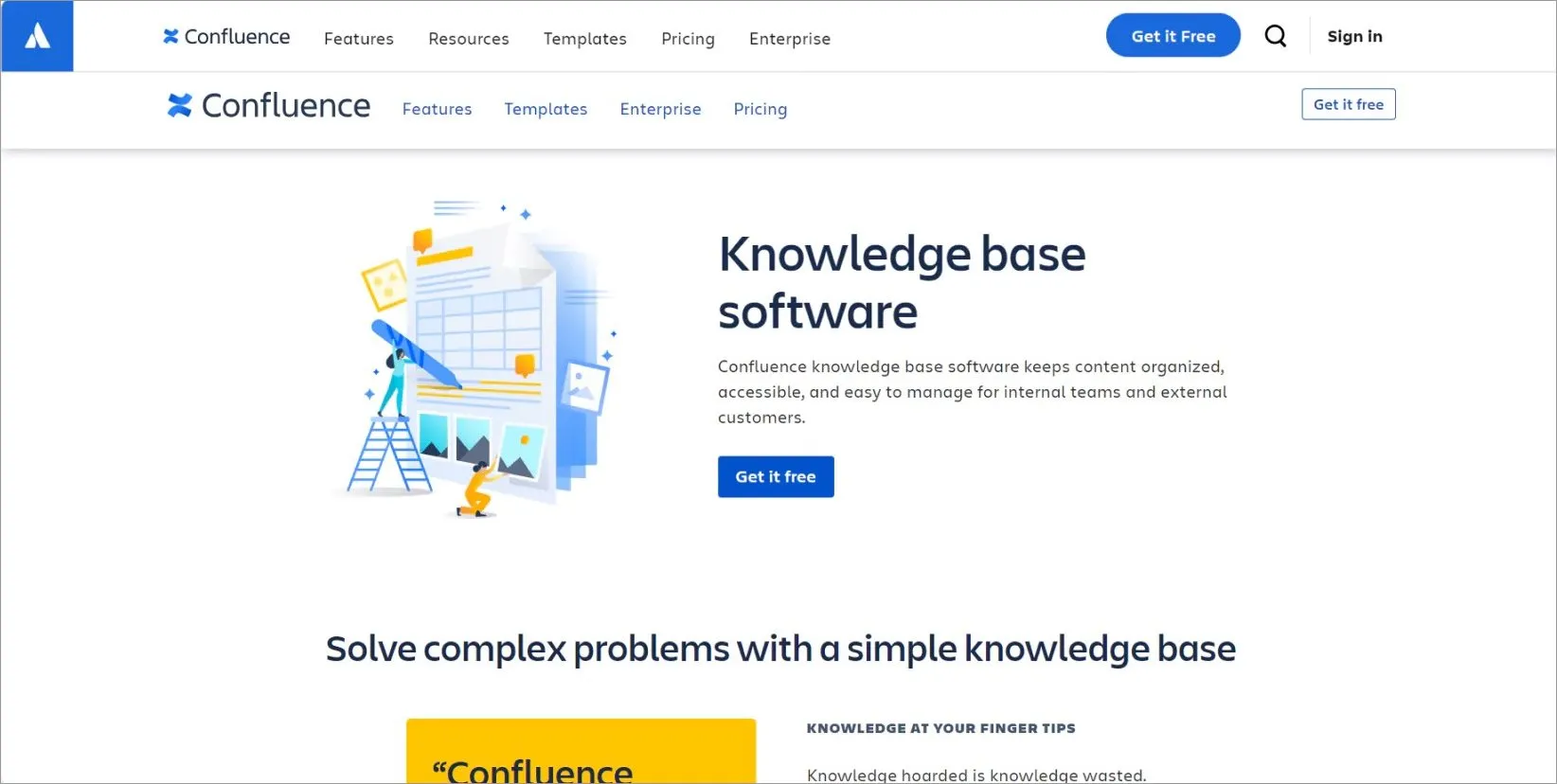
Top features
- Search and navigation
- Prebuilt templates
- Team collaboration and editing
Pros
- Integration with Atlassian tools like Jira and Trello.
- Flexible content organization with knowledge base article templates and macros.
Cons
- Less suited for external customer-facing knowledge bases.
Pricing
| Plan | Pricing |
| Free |
|
| Standard |
|
| Premium |
|
| Enterprise |
|
What users say on G2
“The best part about Confluence is that it provides a centralized and organized workspace for documentation, collaboration, and knowledge sharing.” – Karthick P., GTM Manager, Mid-Market
4. Document360
Best for: Organizations managing complex product documentation with advanced governance and version control.
Document360 is one of the best AI knowledge base platforms, empowering businesses to create and maintain documentation, FAQs, user guides, and tutorials.
The software is designed with a user-friendly interface, making it easy to use for both technical and non-technical users.
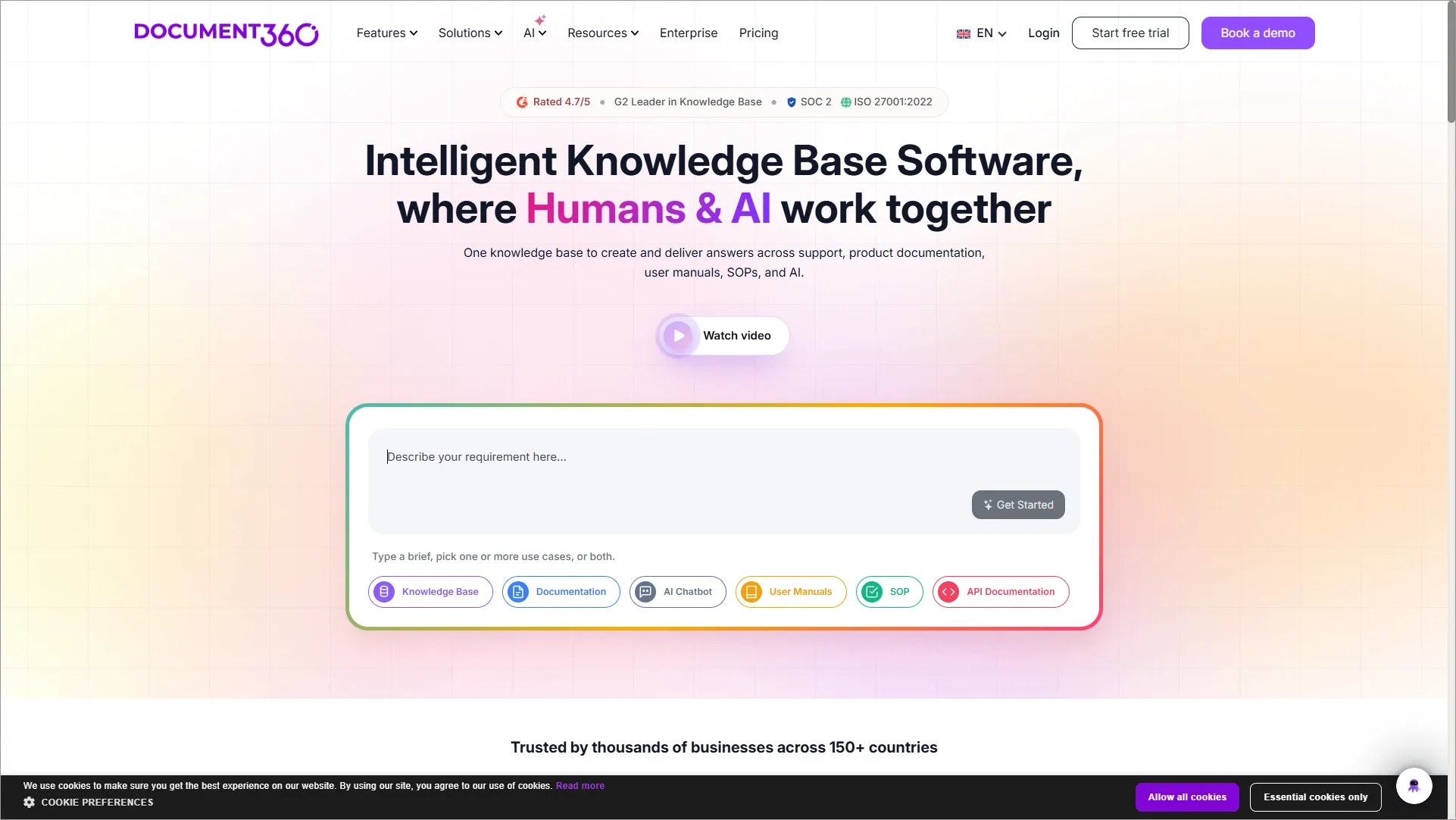
Top features
- Version control
- Reporting and analytics
- Team collaboration and editing
Pros
- Advanced analytics and version control for articles.
- Strong multilingual and SEO optimization features.
Cons
- Pricing can be high for small businesses.
Pricing
| Plan | Pricing |
| Professional |
|
| Business |
|
| Enterprise |
|
What users say on G2
“Beyond enabling you to easily create a professional-looking knowledge base, Document360 is continuously adding new capabilities.” – Julian W. Director, Product Documentation, Computer Software, Mid-Market
5. Notion
Best for: Teams centralizing documentation, collaboration, and project knowledge in one workspace.
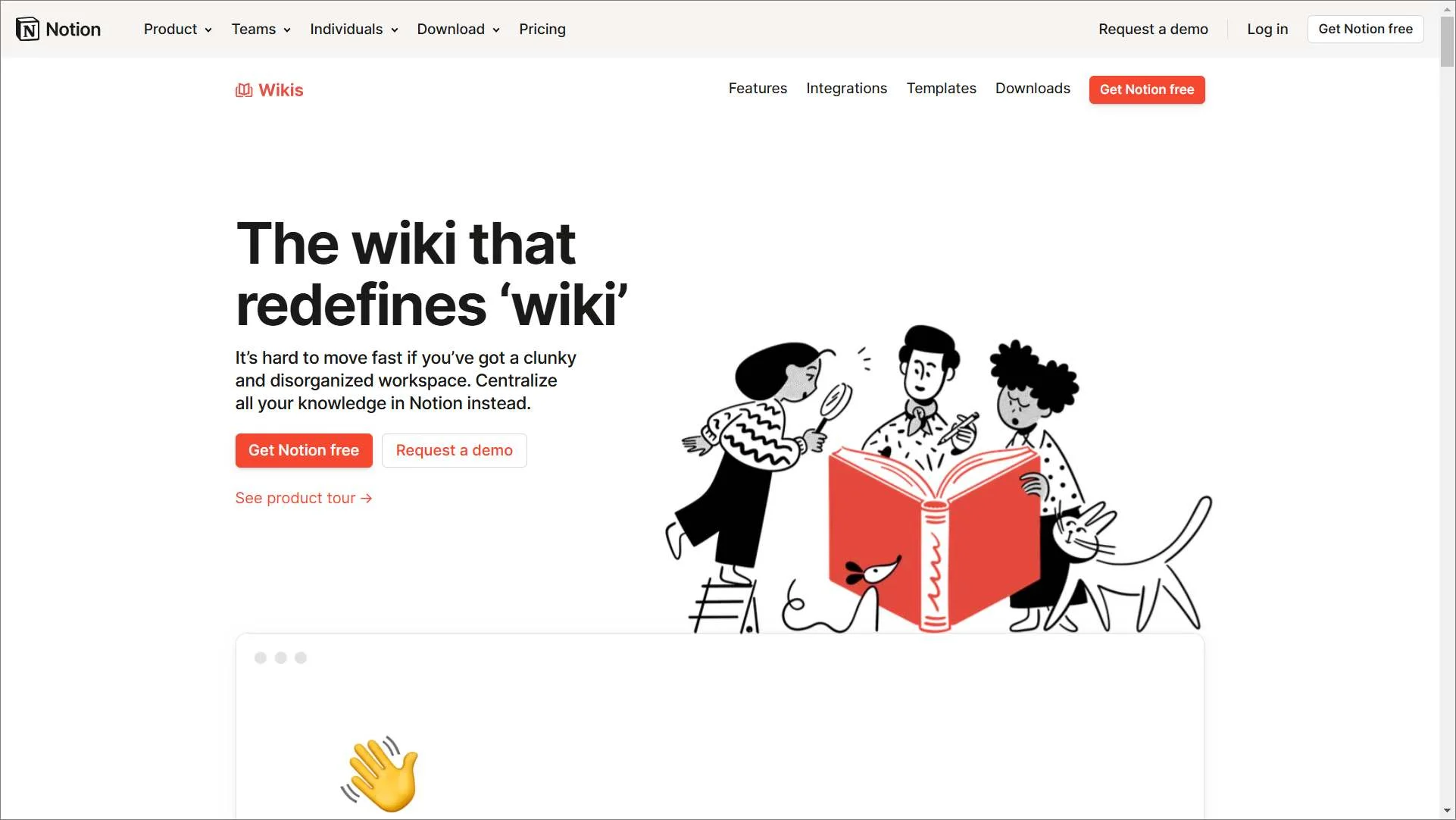
Notion is a multifunctional tool for users to create, manage, and organize content in a flexible and customizable workspace.
It features a block-based structure, enabling users to combine various types of content blocks such as text, images, databases, tasks, and more within a single page.
Top features
- Collaboration and sharing
- Roles and permissions
- Reporting and analytics
Pros
- Flexible and customizable for internal knowledge sharing.
- Easy-to-use interface with rich media support.
Cons
- Limited advanced search and analytics.
Pricing
| Plan | Pricing |
| Free |
|
| Plus |
|
| Business |
|
| Enterprise |
|
What users say on G2
“I like Notion because it combines documentation, task management, collaboration, and knowledge sharing in one place.” – Masampelly S., Associate Software Developer, Enterprise
6. HubSpot Service Hub
Best for: Businesses managing customer support and CRM operations within the HubSpot ecosystem.
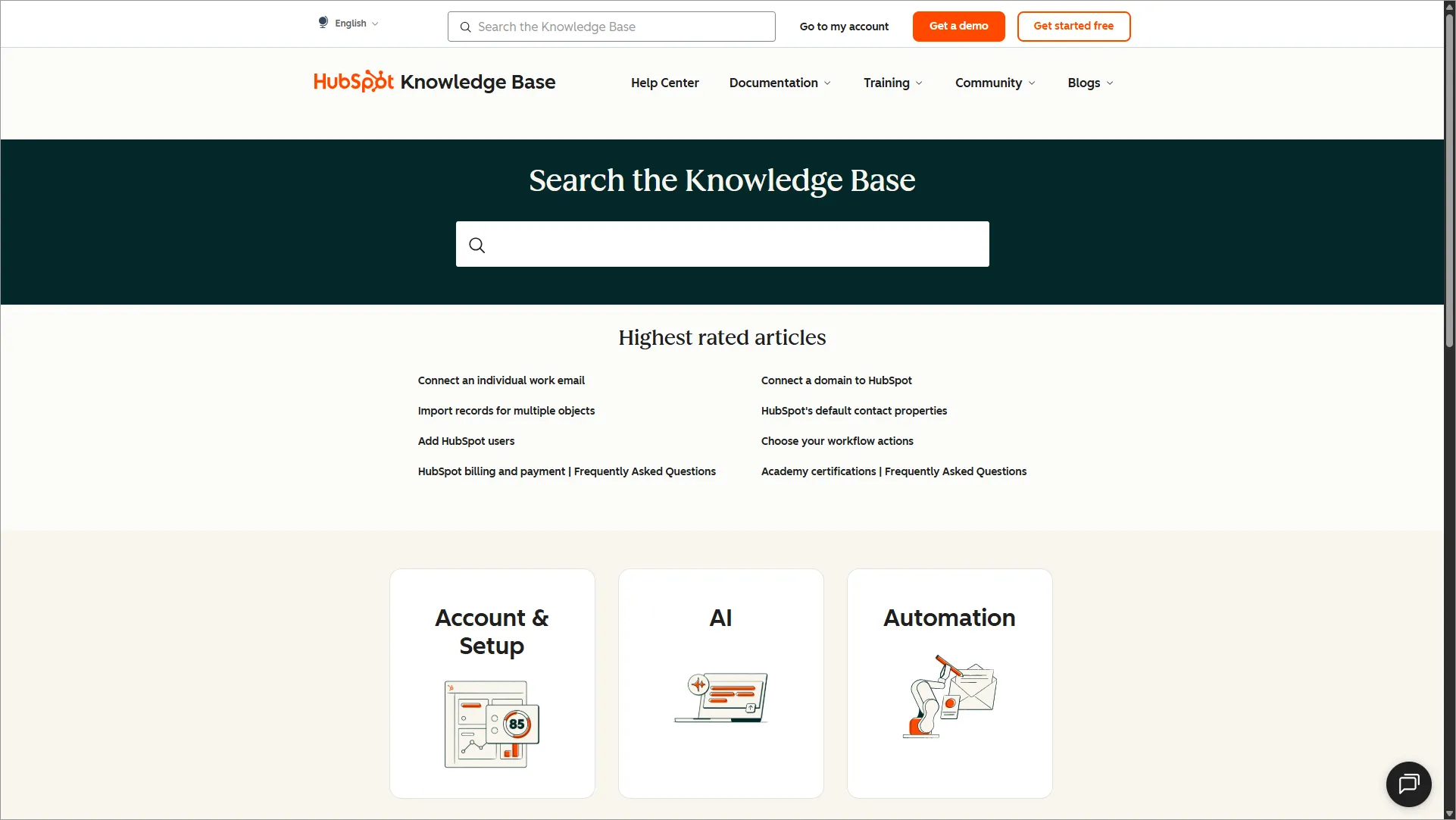
HubSpot Service Hub offers knowledge base software as part of its comprehensive customer service platform.
Its knowledge base software can be a good option for businesses of all sizes, especially those already using other HubSpot tools.
Top features
- Reporting and analytics
- Roles and permissions
- Team collaboration and editing
Pros
- Integrated with HubSpot CRM for a unified customer experience.
- Built-in automation and reporting tools.
Cons
- Knowledge base features are basic compared to specialized tools.
Pricing
| Plan | Pricing |
| Professional |
|
| Enterprise |
|
What users say on G2
“The Feedback survey makes it easy to track customer sentiment and implement quick custom surveys to target audiences.” – Charlotte, Senior Marketing Automation Specialist, Mid-Market
7. Help Scout
Best for: Customer support teams seeking a simple, customer-centric knowledge base experience.
Help Scout offers a knowledge base feature as part of its customer service platform. It is a great choice for businesses seeking a simple, user-friendly, and affordable knowledge base software solution.
It’s particularly well-suited for smaller companies and teams that value a straightforward approach with essential features. However, it might be unsuitable for very large businesses or those that require highly complex functionalities.

Top features
- Reporting and analytics
- Integrations
- Roles and permissions
Pros
- Simple, intuitive interface for small to mid-sized teams.
- Strong customer support focus with an integrated mailbox.
Cons
- Fewer advanced features like AI or deep analytics.
Pricing
| Plan | Pricing |
| Standard |
|
| Plus |
|
| Pro |
|
What users say on G2
“Its clean and effective interface, which is easy to use, and its shared inbox keeps the entire team organized while all features help resolve issues faster.” – Eklavya Y., Junior Software Engineer, Mid-Market
8. Guru
Best for: Businesses relying on AI-powered knowledge discovery across distributed teams and tools.
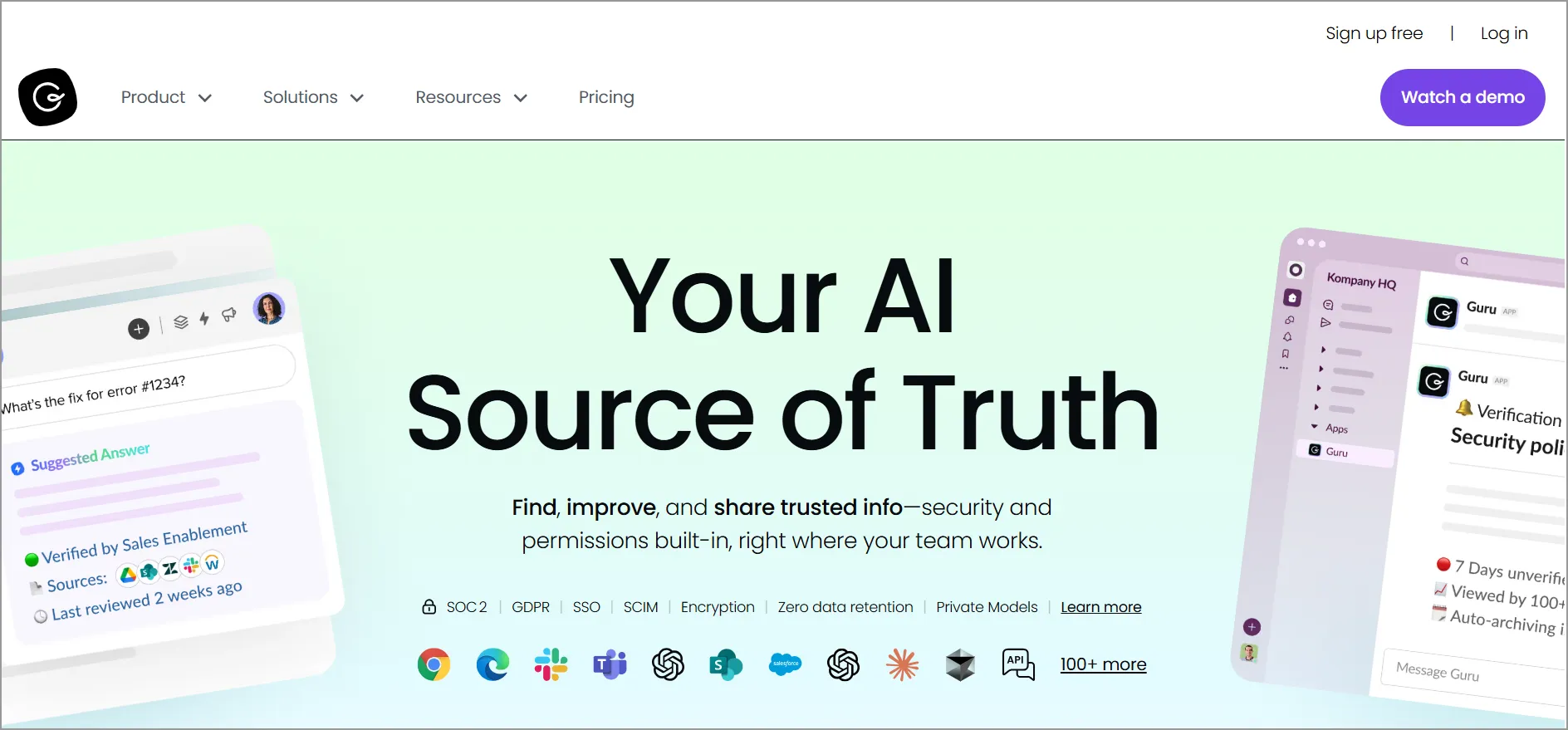
Guru offers a comprehensive knowledge management system that focuses on context, collaboration, and proactive recommendations.
Top features
- Collaboration features
- Roles and permissions
- Integrations
Pros
- The verification workflow ensures content accuracy.
- Integrates well with Slack and other collaboration tools.
Cons
- Not ideal for an external customer-facing knowledge base.
Pricing
| Plan | Pricing |
| Self-serve |
|
| Enterprise |
|
What users say on G2
“Guru makes it incredibly easy to access the right information at the right time.” – Shubham P., Software developer, Mid-Market
9. Helpjuice
Best for: Organizations prioritizing extensive customization and branding control for their knowledge base.
Helpjuice is one of the best knowledge base solutions that assists organizations in creating, managing, and sharing internal and external knowledge.

Top features
- Search functionality
- Collaborative content creation and management
- Analytics and reporting
Pros
- Branding options, custom themes, and layouts to match your company’s identity.
- Insights into article performance, search behavior, and user engagement for optimization.
Cons
- Fewer native integrations with third-party tools.
Pricing
| Plan | Pricing |
| Starter |
|
| Run-up |
|
| Premium limited |
|
| Enterprise |
|
What users say on G2
“It helps me keep health education and patient guidance content properly organized in one place.” – Ishan S., Manager and Dietician at Chaitanya Homoeo Clinic, Medical Store Owner, Content Creator, Hospital & Health Care, Small-Business
10. Nuclino
Best for: Teams looking for a lightweight and easy-to-adopt platform for internal knowledge sharing.
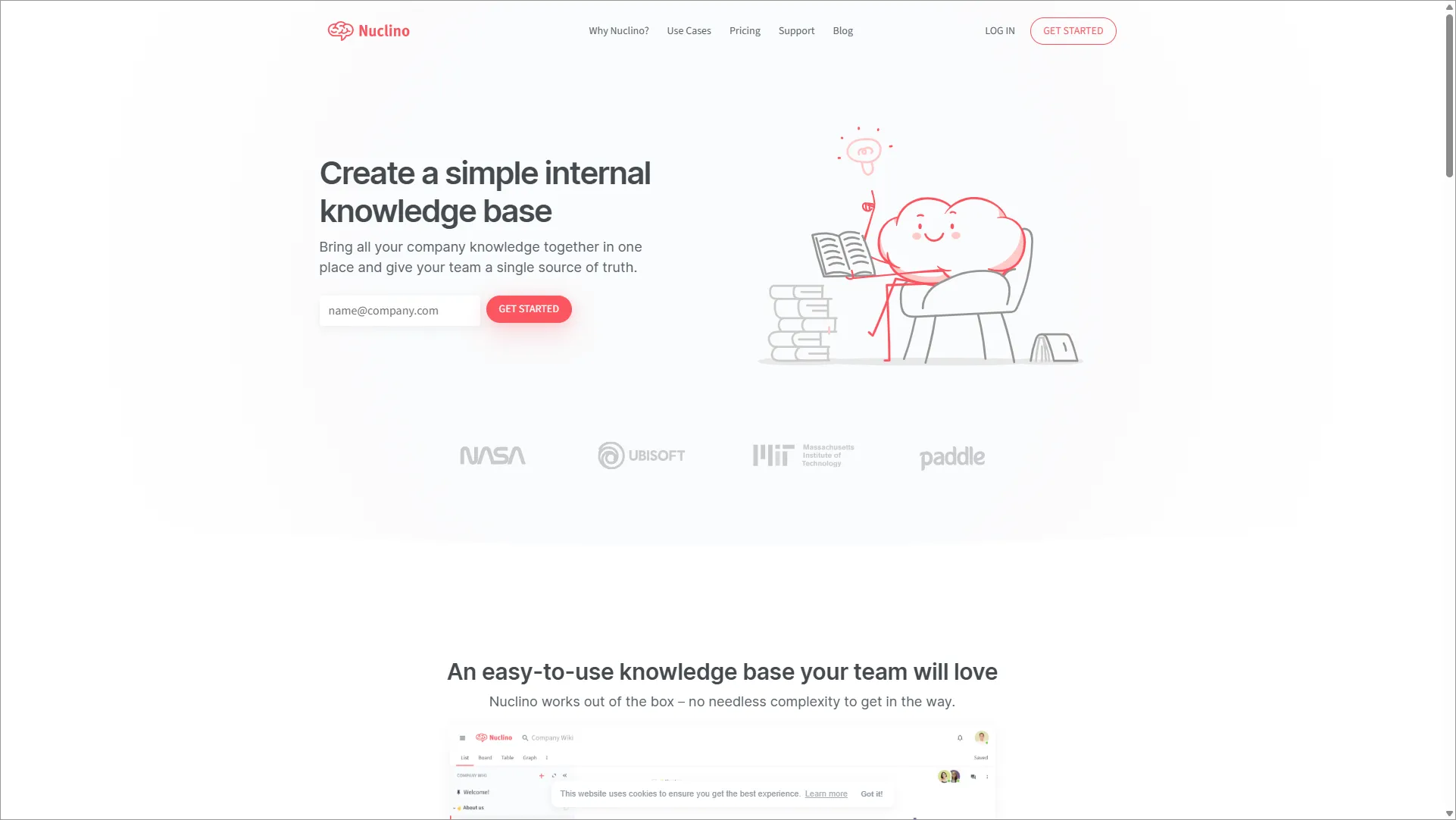
Nuclino is a web-based knowledge base software that positions itself as a unified workspace for teams to combine all their knowledge, documents, and projects together in one place.
It is known as the best free knowledge base software, making it easy for anyone to get started with the tool quickly.
Top features
- Simple, intuitive interface
- Drag-and-drop functionality
- Rich text editing
Pros
- Real-time collaboration and easy navigation.
- Affordable and simple to implement.
Cons
- Limited advanced knowledge base features, such as analytics or AI.
Pricing
| Plan | Pricing |
| Free |
|
| Standard |
|
| Premium |
|
What users say on G2
“Extremely User Friendly. Good integrations. Keeps things simple.” – Verified User in Non-Profit Organization Management, Small-Business
11. Bloomfire
Best for: Enterprises focused on AI-powered knowledge discovery and organization-wide knowledge sharing.
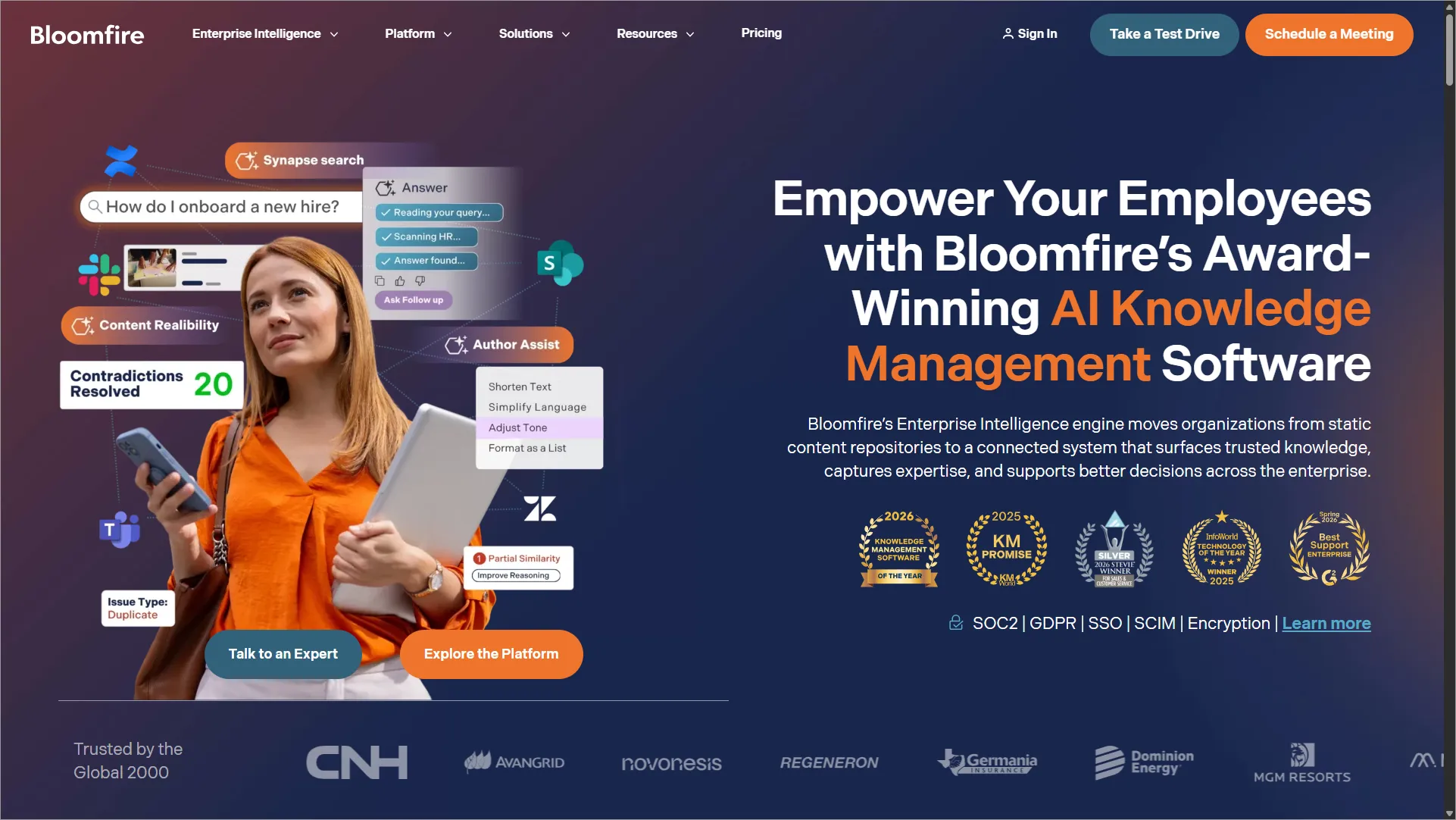
Bloomfire is a knowledge-sharing and collaboration tool that enables teams to organize, share, and leverage collective knowledge.
This knowledge management software leverages AI to optimize knowledge sharing and streamline access to critical information.
Top features
- AI-powered search and discovery
- Easy content creation and sharing
- Collaboration features
Pros
- Search capabilities with AI-powered indexing.
- Suitable for knowledge sharing across large teams.
Cons
- The interface can feel cluttered for new users.
Pricing
- Contact Bloomfire
What users say on G2
“I find Bloomfire to be a highly valuable resource that supports my work processes and provides guidance whenever I have uncertainties.” – Chyann m., Customer Service Rep or Sales, Enterprise
12. Slite
Best for: Remote and distributed teams collaborating on documentation and internal knowledge.
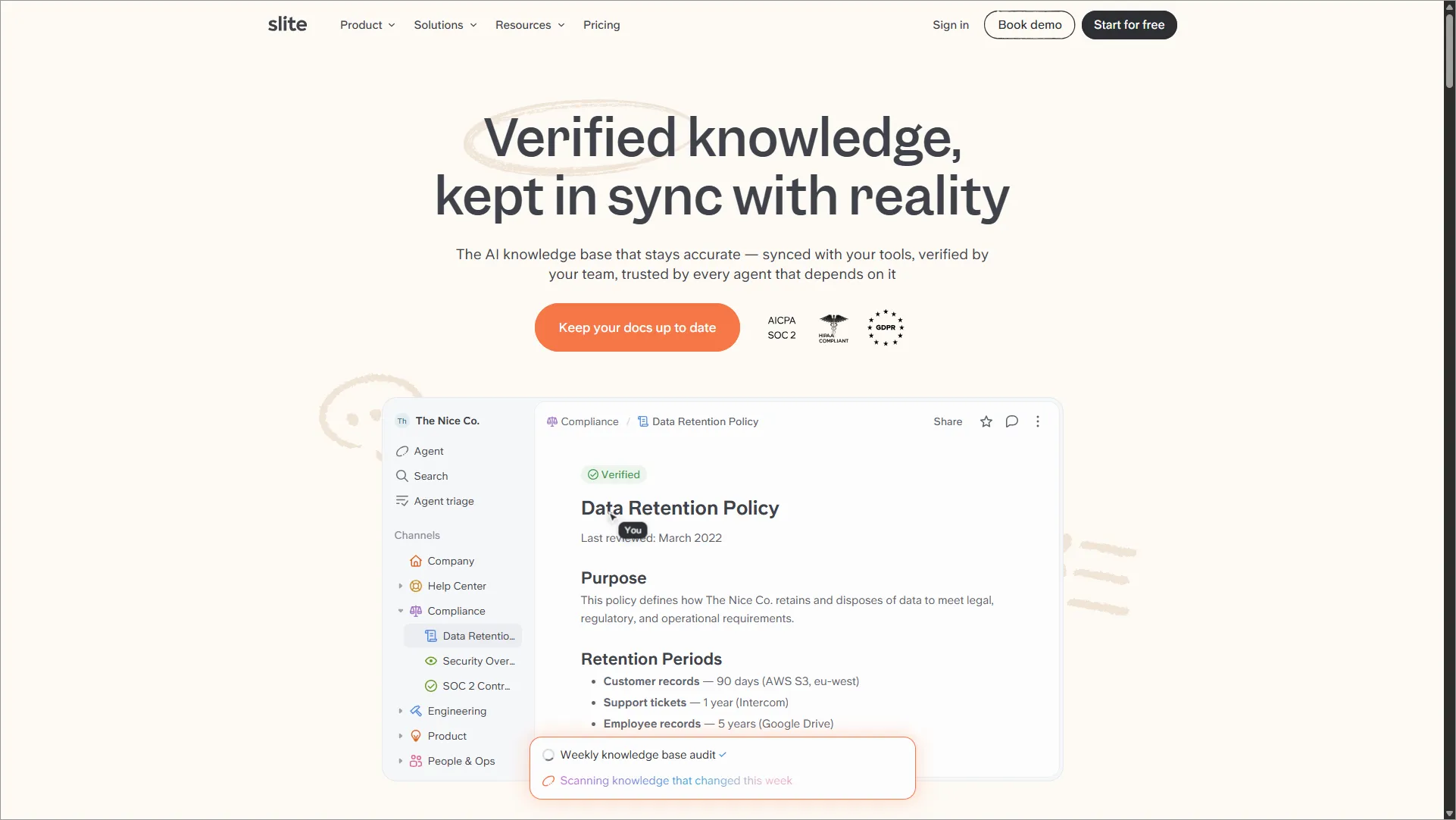
Slite is a popular knowledge base software that organizes and delivers knowledge instantly across teams. It is simple and easy to use, enabling end users to effortlessly create and manage content.
With Slite, teams can write and organize notes, create documents with rich formatting options, build knowledge bases, and set up shared channels for different projects or topics.
Top features
- Real-time collaboration
- Integrations
- Access control
Pros
- Clean, minimal interface for team documentation.
- Collaboration features with comments and mentions.
Cons
- Limited external KB functionality.
Pricing
| Plan | Pricing |
| Basic |
|
| Pro |
|
| Enterprise |
|
What users say on G2
“What I appreciate most about Slite is feeling that there is real thought put into knowledge management.” – Esteban F., Enterprise
Why is knowledge base software important?
Self-service is only effective when customers can quickly find accurate and relevant answers.
According to Gartner, 73% of customers use self-service during their support journey, yet only 14% of customer service issues are fully resolved through it.
This highlights the need for well-structured, searchable, and continuously maintained knowledge bases that help customers find the information they need without escalating to support.
The following are the key benefits of centralizing information and making it easily accessible:
- Enhances customer self-service: The best knowledge base software empowers customers to quickly find accurate answers independently, thereby eliminating wait times.
- Reduces support tickets: A well-structured knowledge base minimizes repetitive inquiries, enabling support teams to focus on complex issues and improving overall productivity.
- Provides 24/7 availability: Knowledge base software provides round-the-clock access to accurate information, ensuring customers in any time zone get instant support whenever they need help.
- Delivers cost-effective support: Through ticket deflection and a self-service knowledge base, you can reduce operational costs while maintaining high-quality customer support.
- Offers consistent information: A centralized knowledge base ensures customers and agents receive uniform, accurate answers, reducing confusion and building trust.
- Boosts efficiency: Support agents can quickly find verified information in the knowledge base, speeding up response times and improving resolution rates.
Empower your customers and team with the best knowledge base software
The best knowledge base system does more than store information; it empowers customers with instant answers, boosts team productivity, and supports long-term business growth.
Knowledge base solutions aren’t one-size-fits-all; they should align with your unique goals, workflows, and budget.
By understanding the various types of knowledge base software, their key features, and the benefits they offer, you can make informed decisions that enhance customer experiences and streamline internal operations.
Ready to take the next step? Explore the best knowledge base tool options and start building a smarter, more efficient support strategy!
Have suggestions or favorite tools? Leave a comment below. We’d love to hear from you!
Related articles
- How to Create and Manage Your Personal Knowledge Base
- SaaS Knowledge Base: Key Features, Best Practices, and Examples
- 20+ Top Knowledge Base Examples to Boost Self-Service Support
FAQs on the best knowledge base software
Knowledge base software provides the platform to store, organize, and deliver information, while a knowledge base management system ensures that content remains accurate and relevant.
The software is the tool, and knowledge management is the ongoing process that keeps information useful and accessible for customers and support teams.
Cloud-based knowledge base software is generally better for most businesses because it offers faster setup, automatic updates, scalability, and lower maintenance costs.
On-premises solutions may suit organizations with strict data control requirements, but they typically require more resources to manage and maintain.
High‑traffic knowledge base articles should be updated regularly, with full content reviews done at least quarterly.
The best knowledge base software for small businesses is one that is easy to set up, affordable, and supports self-service without heavy configuration.
Tools like BoldDesk, Nuclino, and Notion with built-in search, AI-assisted authoring, and a knowledge base reporting and analytics system are typically the best fit for small businesses with limited resources.
AI enhances search accuracy, automatically generates articles, suggests updates, and helps refine and organize content effortlessly, making your knowledge base smarter and faster.