


TL;DR: Customer communication is critical for delivering great experiences and driving retention. By using the right channels and applying best practices, businesses can streamline interactions, maintain consistency, and deliver faster, more personalized support that strengthens long-term customer relationships.
Customers today expect fast, clear, and consistent communication at every stage of the customer relationship.
Yet many customer-facing teams struggle to deliver seamless experiences across channels, leading to confusion, delays, and lost trust.
Customer communication refers to how businesses share updates, answer questions, and resolve issues across channels throughout the customer journey.
When done well, it reduces friction, builds trust, improves customer experience, and drives long-term loyalty.
In this guide, you’ll learn what customer communication is, why it matters, the most effective channels to use, and proven strategies to improve it and boost customer retention.
What is customer communication?
Customer communication is the structured exchange of information between a business and its customers across marketing, sales, support, and post‑purchase interactions.
Its goal is to provide timely, clear, and consistent information throughout the customer journey.
Why a customer communication strategy is important for businesses
A well-defined customer communication strategy ensures businesses deliver clear, consistent, and relevant messages across the entire customer lifecycle.
The following benefits highlight why a strong communication strategy is critical for success.
Improves customer experience
A strong strategy reduces confusion and friction by setting expectations, using the right channel for the right message, and keeping information consistent across teams.
This creates smoother interactions from onboarding to support.
Boosts customer satisfaction and retention
When customers can reach you easily and receive timely, helpful responses, problems get resolved faster, and customers feel supported.
Over time, this improves satisfaction and reduces churn caused by delays or mixed messages.
Reduces customer effort and support friction
When communication is clear, timely, and consistent, customers don’t have to work hard to get the help they need.
They don’t need to repeat information, switch between channels, or wait for clarification, and everything flows smoothly from the first interaction.
Builds trust and long-term relationships
Clear, reliable communication builds confidence in your brand, especially during high-stakes moments like outages, billing issues, or policy changes.
Trust increases repeat purchases and referrals, supporting long-term growth.
Types of customer communication channels
Customer communication channels allow businesses to connect with customers consistently across every stage of the journey, from sales and onboarding to support and retention.
By offering multiple options, businesses can meet diverse preferences, respond faster, and maintain clear, reliable communication across regions and time zones.
The following channels play a key role in delivering seamless customer communication:
Email communication
Email remains one of the most widely used channels for non-urgent communication. It is well-suited for detailed responses, follow-ups, and issue tracking.
With an email ticketing system, emails can be automatically converted into tickets, helping teams respond faster and track issues more efficiently.
Social media and community forums
Social media customer service channels enable businesses to engage with customers, respond to queries, and monitor brand mentions in real time.
Clients often follow companies on platforms such as Facebook, X (formerly Twitter), LinkedIn, and YouTube to stay informed, engage with businesses, and receive important announcements.
Community forums allow customers to ask questions, share experiences, and learn from other users.
They also help businesses identify recurring issues and provide guidance where customers are already discussing common questions.
These platforms are widely used for both customer engagement and support communication.
Live chat and messaging
Live chat enables customers to receive immediate support while browsing a website or using an app, making it ideal for resolving questions quickly.
This immediacy plays a critical role during decision-making.
According to Forrester, 50% of customers say that having a live person answer their questions while making a purchase is one of the most important features a brand can offer.
Messaging channels such as WhatsApp, Facebook Messenger, and Telegram support ongoing conversations, allowing customers to reach businesses through apps they already use.
Phone support
While digital channels offer convenience, many customers still prefer speaking to a real person when they need quick clarity or reassurance.
A phone conversation allows for real-time back-and-forth, making it easier to understand customer concerns, ask follow-up questions, and resolve issues faster.
It also helps support teams convey empathy and build stronger personal connections that are harder to achieve through text-based channels.
Customer communication tools that help teams stay connected
Businesses use different customer communication tools based on their size, industry, and customer needs.
Most organizations use multiple communication tools together rather than relying on a single platform.
Common customer communication tools include:
- AI support tools: Deliver instant answers for common questions using AI Copilot and AI Agents that automate responses and support agents in real time.
- Help desk software: Includes tools that centralize conversations from multiple channels, enabling agents to track, manage, and collaborate on requests more efficiently.
- CRM software: Stores customer history and context, enabling teams to personalize communication and prevent customers from repeating information.
- Knowledge sharing platform: Provides accurate, easily accessible information for customers and agents, improving customer communication and reducing repetitive queries.
- Customer feedback tools: Capture customer insights to identify communication gaps and improve messaging, processes, and overall experience.
- Social media monitoring tools: Track brand mentions and customer conversations, enabling teams to respond faster, manage reputation, and engage proactively.
Best practices to improve customer communication
Adopting proven methods helps businesses build stronger customer relationships, deliver consistent interactions, and improve satisfaction and retention.
Achieving these outcomes depends on how communication is executed day to day. The approaches below provide a practical framework for improvement:
Make every conversation connected across channels
Offering multiple channels alone isn’t enough. What truly matters is how well those channels work together.
According to Worldmetrics, 82% of customers say omnichannel experiences are key to how brands earn and keep their loyalty.
This highlights the importance of maintaining continuity across every customer touchpoint.
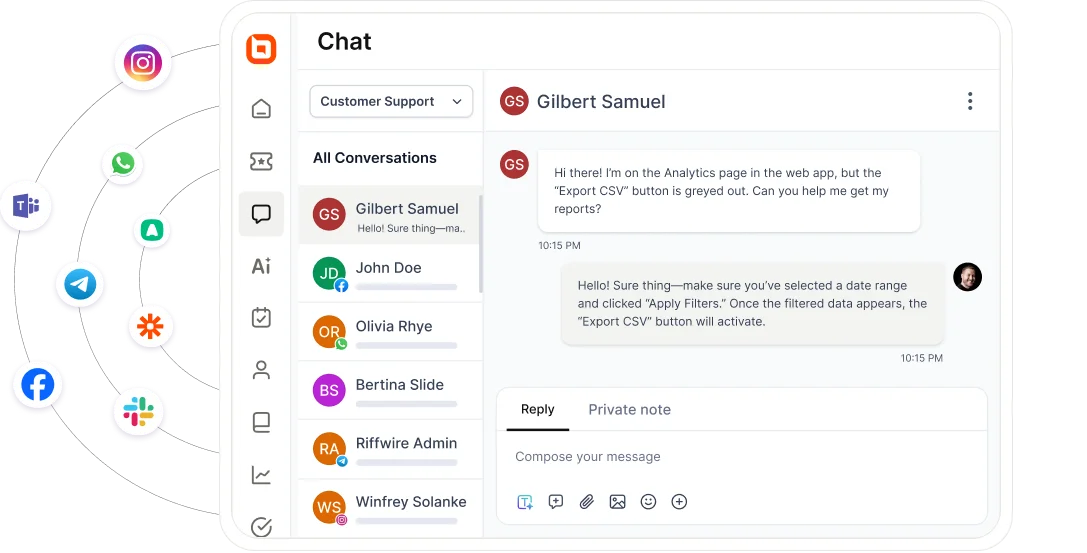
An omnichannel customer service approach ensures that conversations are unified and synchronized, so agents always have the full context of each interaction, no matter where it started.
Help desk tools support this by centralizing customer conversations across channels, making it easier for teams to deliver consistent responses.
Here’s how to do it:
- Identify the channels your customers use most.
- Offer consistent coverage across key touchpoints.
- Centralize conversations in an omnichannel inbox so agents have full visibility.
- Ensure interactions are synchronized across channels to maintain context.
- Track channel performance and focus on what delivers the best results.
Example: A customer starts a conversation via live chat and later follows up through email. With an omnichannel communication system, the agent can view the entire conversation history and respond faster without asking the customer to repeat details.
Communicate proactively
Customers don’t like being left in the dark, especially when issues affect them. Proactive communication reduces confusion and builds trust.
You can do this by:
- Sending advance notifications about downtime, maintenance, or service disruptions.
- Clearly communicating business hours and availability.
- Sharing updates on delays or ongoing issues before customers ask.
- Providing links to helpful resources like FAQs or knowledge base articles.
Example: If a payment outage affects customers, notify affected users before they contact support. Share expected resolution timelines upfront and continue providing updates until service is restored.
Personalize customer communication
Generic responses can make communication feel transactional. Personalization helps create more meaningful and efficient interactions.
To personalize effectively:
- Use the customer’s name naturally in conversations.
- Reference previous interactions or context when relevant.
- Adapt your tone and language to match customer understanding.
- Keep communication clear, simple, and easy to follow.
Collect and act on customer feedback
Customer feedback provides direct insight into what’s working and what needs improvement.
Acting on it is key to refining your communication strategy. Doing this requires you to:
- Collect feedback through surveys, ratings, or support interactions.
- Identify recurring issues or communication gaps.
- Use insights to improve messaging and processes.
- Track changes to ensure improvements are effective.
Example: A company notices repeated complaints about unclear setup instructions. They update their onboarding guide, reducing support requests and improving user experience.
Empower agents with strong communication skills and empathy
Your support team represents your brand in every interaction.
Strong communication skills and the confidence to handle customer concerns effectively are essential for delivering consistent experiences.
Focus on:
- Active listening to fully understand customer concerns.
- Responding with empathy and clarity.
- Using simple, jargon-free language.
- Maintaining timely and consistent responses.
- Communicating solutions with confidence and ownership.
Example: A customer raises a complaint about delayed service. The support agent listens carefully, acknowledges the issue, and clearly explains the next steps and confidently guides the customer toward resolution without escalation.
Offer self-service options
Giving customers easy access to the right resources is essential.
In fact, a Higher Logic study found that 79% of customers expect organizations to provide self-service support tools so they can find answers without contacting support.
Many customers prefer resolving common issues independently, making self-service a critical part of modern customer communication.
You can support this by:
- Creating a knowledge base with FAQs, guides, and tutorials.
- Updating content based on common support requests.
- Making resources easy to search and access.
- Linking self-service options within support interactions.
Track the right customer communication metrics
Determine which communication metrics matter most to your business and track them consistently to understand what’s working and where improvements are needed.
Some key customer communication metrics include:
- First response time (FRT): How quickly your team responds to an initial customer inquiry.
- Resolution time: The time it takes to fully resolve a customer issue.
- Customer satisfaction (CSAT): How satisfied customers are with their support experience.
- Customer effort score (CES): Indicates how easy it is for customers to get their issues resolved.
- Self-service success rate: Measures how often customers resolve issues independently using a knowledge base or help resources.
- Net promoter score (NPS): Evaluates customer loyalty and the likelihood of customers recommending your business.
Tracking these customer service metrics helps you identify bottlenecks, improve response efficiency, and continuously refine your customer communication strategy.
Real-world examples of effective customer communication
Successful customer communication looks different across industries, but the goal remains the same: provide timely, relevant, and consistent interactions that improve the customer experience.
Here are a few examples of how leading companies put these principles into practice.
Amazon: Using proactive communication to improve customer experience
Amazon demonstrates the value of proactive communication by setting clear expectations and keeping customers informed throughout the order lifecycle.
From order confirmation to shipping updates and delivery notifications, Amazon proactively communicates at every stage.
Customers receive real-time updates, tracking links, and delay alerts without needing to reach out for support.
Key takeaway: Proactive updates reduce uncertainty, build trust, and decrease unnecessary support requests.
Bank of America: Enhancing communication with AI and self-service
Bank of America uses its AI-powered virtual assistant, Erica, to handle a high volume of customer interactions each month.
Customers can quickly get answers to common questions, check account details, and perform simple tasks without waiting for a support agent.
When more complex issues arise, the conversation is seamlessly escalated with full context.
This combination of AI and human support helps the bank deliver faster responses, improve efficiency, and maintain a consistent communication experience.
Key takeaway: Combining AI with human support correctly helps businesses deliver faster responses without sacrificing service quality.
Airbnb: Building trust through personalized communication
Airbnb focuses heavily on creating personalized communication between hosts and guests.
Messages often include contextual details such as booking information, preferences, and tailored recommendations, creating a more human and engaging experience.
Personalized messages help guests feel informed and supported throughout their journey, strengthening trust and confidence.
Key takeaway: Tailored communication creates more meaningful customer experiences.
Master customer communication for long-term success
Strong customer communication is no longer optional; it’s a key driver of customer experience, satisfaction, and long-term growth.
Businesses that communicate clearly, consistently, and proactively are better equipped to build trust, reduce friction, and create lasting customer relationships.
As expectations evolve, improving customer communication doesn’t require complexity; just the right approach and the right tools to support it.
BoldDesk helps teams centralize conversations across channels, maintain consistent messaging, automate routing, and provide agents with full customer context for faster, more personalized communication.
Try BoldDesk with a 15-day free trial or request a live demo to see how it fits your workflow.
What strategies have worked best for your team? Share your thoughts in the comments.
Related articles
- Exceptional Customer Service Phrases for Better Communication
- 11 Best Live Chat Software for 2026: 14 Top Tools Compared
- How to Effectively Utilize Microsoft Teams for Customer Service
FAQs
Customer communication management is the process of creating, managing, and delivering communications across multiple channels throughout the customer lifecycle.
It includes the strategies, tools, and communication workflows businesses use to ensure consistent, personalized, and timely interactions.
Common customer communication mistakes include inconsistent messaging across channels, delayed or unclear responses, lack of personalization, and failing to listen to customer feedback.
These issues can lead to confusion, reduced trust, and poor customer experiences if not addressed proactively.
The biggest challenges in customer communication include inconsistent messaging across channels, slow response times, lack of personalization, and channel fragmentation.
Customer communication covers all interactions a business has with customers across the entire lifecycle, including marketing, sales, onboarding, and support.
Customer service communication is more specific and focuses only on support-related interactions, such as handling inquiries, resolving issues, and providing assistance after a purchase.
AI improves customer communication by automating responses to common queries, reducing response times, and ensuring consistent, accurate messaging across channels.
It also supports agents with real-time suggestions, conversation summaries, and insights from customer data, enabling more personalized and efficient interactions.