





TL;DR: Customer service phrases are proven statements that help support teams communicate with empathy, professionalism, and clarity. Explore 45 customer service phrases for greetings, problem-solving, apologies, and customer interactions, plus 14 phrases to avoid. Using the right language can improve customer satisfaction, trust, and overall support experiences.
Every organization’s success depends on the language used in customer interactions, as each conversation shapes how customers perceive the brand.
Consistency in customer service can be achieved by using clear, empathetic, and professional customer service phrases.
The impact of customer experience on customer loyalty is significant.
According to PwC’s 2025 Customer Experience Survey, 52% of US consumers say they stopped using or buying from a brand because of a bad experience with its products or services, while 29% stopped due to poor customer experience, whether online or in-person.
Even in the most straightforward support conversations, the right words and delivery can make the difference between a satisfactory interaction and an exceptional one.
Whether you’re a customer service manager training new agents, an experienced support professional, or a small business owner handling customer inquiries, using the right customer service phrases can help you communicate more effectively and build stronger customer relationships.
This blog features 45 customer service phrases to use in customer interactions, along with 14 common phrases that should be replaced with more effective alternatives.
What are customer service phrases?
Customer service phrases refer to verbal or written expressions used regularly by support agents to interact with customers.
These phrases create rapport and ensure customer satisfaction by conveying a commitment to providing quality service and resolving any issues.
These interactions might be over the phone, online, or in person.
45 Top customer service phrases to use
Here are some excellent customer service phrases to use in your everyday interactions with customers:
Greetings
In customer service, it is expected to use a cordial and polite greeting to express warm hospitality and eagerness to provide support.
This friendly customer service phrase can make customers feel welcome and inclined to discuss their issues.
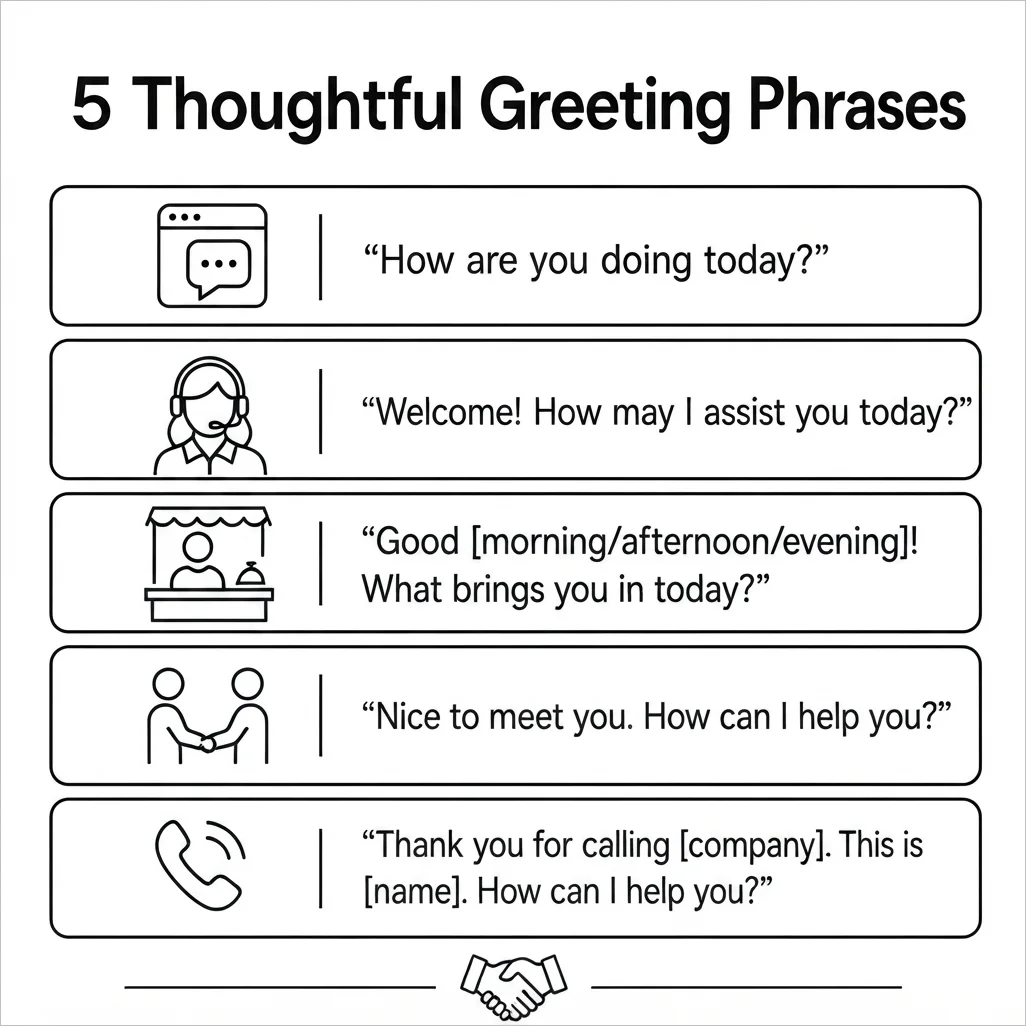
Asking about a customer’s well-being adds a personal touch and helps them feel appreciated.
A friendly greeting, even when customers are experiencing issues, establishes a positive tone for the conversation and fosters open communication.
Some of the common customer service phrases you can use to greet clients include:
1. “How are you doing today?”
2. “Welcome! How may I assist you today?”
3. “Good [morning/afternoon/evening]! What brings you in today?”
4. “Nice to meet you. How can I help you?”
5. “Thank you for calling [company]. This is [name]. How can I help you?”
Pro tips for greeting phrases
- Match the greeting to the situation: Skip small talk when customers are reporting urgent issues and move directly to assistance.
- Use contextual openings: Reference the customer’s order, ticket, or previous interaction when relevant.
- Set a service-oriented tone: Lead with how you can help rather than introducing yourself at length.
Acknowledging the issue
Acknowledge your customer’s frustration and be willing to work together to find a solution. This lets customers know that your team understands their situation.
It also reassures them that their concerns are taken seriously and that your agents are committed to helping resolve any issues.
The following are some customer service phrase examples to acknowledge the issue:
6. “I understand this must be [adjective]. Let’s work together to resolve it.”
7. “Thanks for bringing this to our attention.”
8. “I’m sorry you’re experiencing this issue. Let me help you with that.”
Pro tips to acknowledge customer issues
- Reference a specific detail immediately: Mention the exact error, order, feature, or event the customer raised to show you’ve understood the issue correctly.
- Separate facts from assumptions: Confirm what you know so far and avoid speculating about the cause until you’ve investigated further.
- Prioritize the customer’s main concern: Acknowledge the issue causing the greatest disruption before addressing secondary questions or complaints.
Offering a solution
The correct words can be your greatest ally while trying to solve a problem. They can ease stress, offer direction, and open the door to a resolution.
Letting customers know that you’re eager to help can set a positive tone for the interaction.
You can achieve this by telling customers that they have come to the right place, you are trustworthy, and you are ready to assist them in any way possible.
Once you have resolved their issue, end the conversation with memorable customer service phrases like:
9. “I’m here to assist you. What specifically can I do to help?”
10. “I’m happy to help if you need additional support.”
11. “Please reach out again.”
12. “Here’s what I can do to help you resolve this issue.”
13. “Excellent question. I’ll find out for you.”
14. “Here is what we can do.”
15. “I’ll keep you updated every step of the way.”
16. “Your issue has been resolved. Can we assist you with anything else?”
When used consistently, these customer service phrases can leave a lasting impression and encourage customers to return.
Pro tips to use when offering a solution
- Lead with the outcome: Explain what you can achieve before describing the process.
- Present clear options: When multiple solutions exist, explain the advantages of each.
- Avoid premature promises: Confirm facts before committing to a specific resolution or timeline.
Tired of Managing Customer Emails? Try This Instead!
Simplify support with an efficient ticketing system and experience a smoother workflow!

Asking a customer to wait or to be put on hold
When you need to review an account or inquire about another resource, employees should use courteous customer service phrases to get permission before putting a customer on hold. Asking for their permission shows that you appreciate them.
You can use the following customer service phrases:
17. “Is it OK if I put you on hold briefly to confirm [information]?”
18. “Great question! Please hold for a minute. I will find the answer for you.”
19. “Thank you for holding. I now have the solution.”
Pro tips for putting customers on hold
- Gather all key details first: Collect the information you’ll need before placing the customer on hold to avoid multiple wait periods.
- Use the hold time to advance the case: Review account history, check previous tickets, or consult internal resources so you return with meaningful progress.
- Offer alternatives for longer investigations: If resolution will take several minutes, provide a callback or follow-up option instead of extending the hold repeatedly.
Power words for customer service
Power words such as absolutely, certainly, definitely, of course, and I’d be happy to help are positive responses that show confidence, agreement, and a willingness to assist the customer.
The language support agents use can influence how customers perceive a brand.
According to Microsoft’s Global State of Customer Service research, 90% of customers say customer service is important to their choice of and loyalty to a brand, making clear, confident, and helpful communication essential in every interaction.
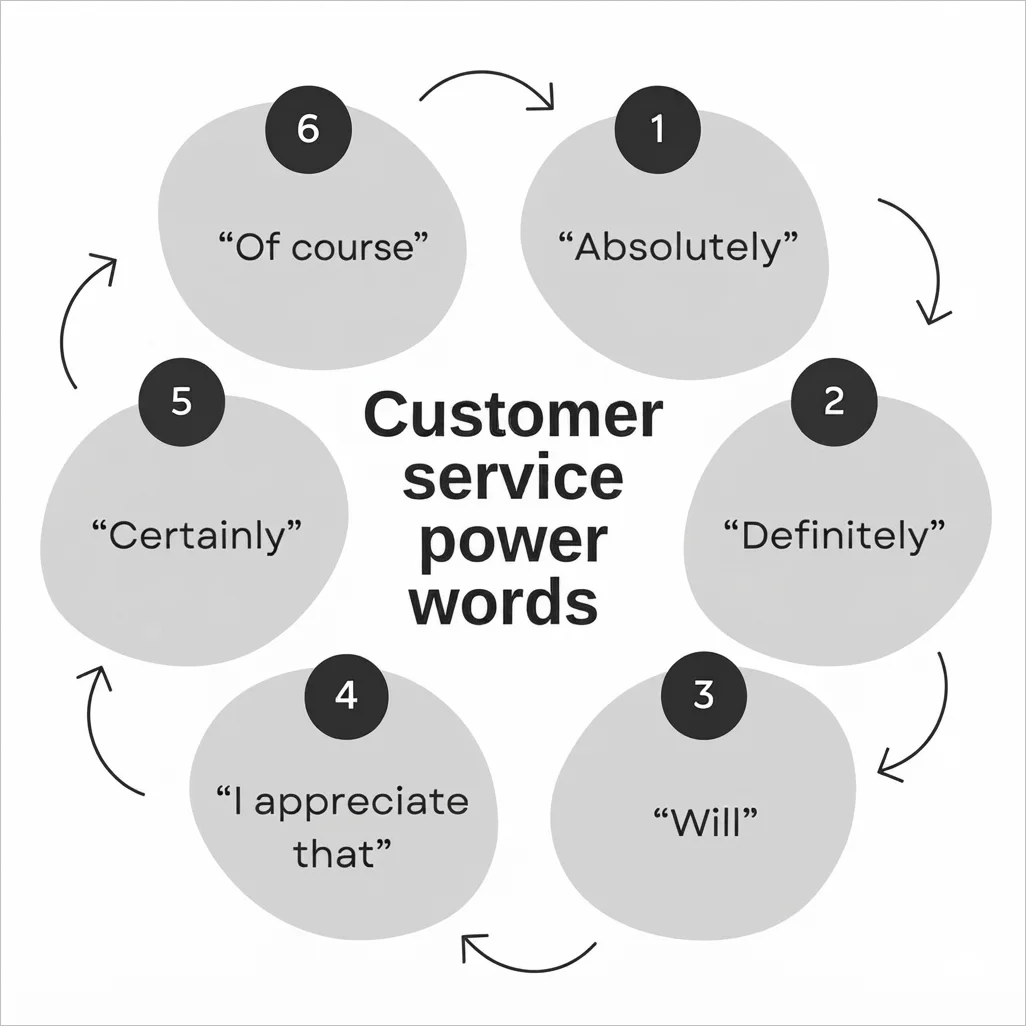
Some of these power words and phrases include:
20. “Absolutely”
21. “Definitely”
22. “Will”
23. “I appreciate that.”
24. “Certainly”
25. “Of course”
Pro tips for power words to use
- Pair reassurance with action: Follow words like “certainly” or “absolutely” with a specific next step.
- Use outcome-focused language: Words such as “resolved,” “updated,” and “confirmed” build confidence.
- Avoid overusing power words: Excessive reassurance can make responses feel scripted.
Apologizing and showing empathy
It’s crucial to use language that shows you are sorry for any inconvenience, frustration, or mistakes that may have occurred.
Expressing concern is a solid approach that shows empathy in customer service. Sincere empathy is the key to delivering excellent customer support.
Examples of customer service phrases you can use to apologize or empathize with customers include:
26. “I’m sorry this happened. I appreciate your patience as we sort this out.”
27. “Our apologies for letting you go through this.”
28. “Is there a specific situation you’re dealing with?”
Pro tips to show empathy
- Be specific in your apology: Refer directly to the issue instead of using generic apologies.
- Match the response to the severity of the issue: A major service disruption requires stronger empathy than a minor inconvenience.
- Follow empathy with action: Explain what will happen next immediately after apologizing.
Gathering and confirming information
Choosing the right words can significantly affect the tone of your response, especially when dealing with an unhappy customer.
This avoids misunderstandings and ensures both parties are on the same page before further discussion or actions to address the problem.
Some of the best customer service phrases to keep things upbeat while gathering information include:
29. “Let me find a solution for you. Please provide me with the following details.”
30. “I understand how [adjective] that must be.”
31. “Just to confirm, you’re saying [repeat the issue]. Is that correct?”
32. “Let me make sure I understand the situation correctly. Please correct me if I’m wrong.”
33. “I completely understand your situation.”
34. “I would like to understand more about [issue].”
35. “Kindly confirm whether I have understood this correctly.”
36. “Would you please tell me more about that?”
Even when clients make strange requests, remain positive and demonstrate the value of their ideas by using expressions that convey you understand their viewpoint and may consider their suggestions later.
Pro tips for collecting information
- Start broad, then narrow down: Gather context before asking detailed troubleshooting questions.
- Confirm key facts in your own words: This helps prevent misunderstandings and unnecessary back-and-forth.
- Identify when the issue began: Timing often provides important clues about the root cause.
Kickstart Your Support with Our Free Startup Program
Enjoy a free help desk as a startup, streamline support, and unify customer interactions for a seamless experience!

Expressing gratitude
Support agents use various customer service phrases to acknowledge and express gratitude for feedback, emphasizing their role in facilitating improvements.
This reassures the customer that their input is vital and is being considered for positive changes.
You can also show gratitude when someone is waiting for a resolution by acknowledging their patience while reassuring them that their concern is being addressed.
Some of the customer service phrases to use to express gratitude include:
37. “Thank you for bringing this to our attention. Your feedback helps us improve.”
38. “I appreciate your patience while we work on this matter.”
39. “We appreciate you bringing this to our attention.”
40. “Thank you for being a valued customer.”
Pro tips for expressing gratitude
- Thank customers for their effort: Recognize actions such as providing screenshots, feedback, or detailed information.
- Highlight the value of their input: Explain how their feedback helps improve products or services.
- Use gratitude purposefully: Reserve it for meaningful moments rather than repeating it throughout the conversation.
Closing the interaction
An agent can end an interaction with a customer in several ways. They can thank customers for their time, inquire if the customer requires further assistance, provide an open invitation for the customer to reach out again, or give the customer the exact time or date to expect a follow-up.
This way, customers will feel heard and valued, and they will be more likely to return. Remember, people’s experiences with your brand become more valuable when they know you’re always happy to help.
Support agents can choose any of the following customer service phrases to end a call:
41. “Is there anything else I can assist you with today?”
42. “Thank you for choosing us. Have a great day!”
43. “You can expect an update from us by [date/time].”
44. “If you’re ready, I will connect you to the [manager or specialist].”
45. “Please let us know if there is anything else we can help with.”
Pro tips to close the interaction
- Confirm the issue is resolved: Verify the outcome before ending the conversation.
- Set clear next steps: Provide a timeline, owner, or follow-up plan when additional work is required.
- Reduce future effort: Address common follow-up questions before closing the interaction.
Customer service phrases by channel: Phone, email, and live chat
The best customer service phrases vary depending on the communication channel. Phone conversations require a conversational tone, emails benefit from detailed explanations and clear follow-up commitments, and live chat responses should be brief and responsive.
The customer service phrase examples below show how to adapt common customer service scenarios across phone, email, and live chat interactions.
| Situation | Phone | Live chat | |
| Acknowledging the issue | “I can hear how frustrating this has been. Let’s get it sorted now.” | “Thanks for flagging this, and I’m sorry for the disruption. Here’s what I’ve found so far.” | “Got it. I can see the issue on your account. Looking into it now.” |
| Apologizing | “I’m sorry. That shouldn’t have happened. I’ll stay on the line until it’s fixed.” | “I’m sorry this happened. To be specific about what went wrong: [cause]. Here’s what we’re changing so it doesn’t recur.” | “That’s on us, apologies. Fixing it now.” |
| Asking the customer to wait | “May I put you on hold for about two minutes while I check [x]?” | “I need to confirm this with our [team]. I’ll come back to you by [day, time].” | “Give me about 90 seconds to pull up your billing history. I’ll be right here.” |
| Closing the conversation | “Before I let you go, is there anything else on this I can clear up?” | “You’re all set. If anything else comes up, reply to this thread, and it’ll come straight back to me.” | “All done. I’ll leave the chat open for a couple of minutes in case anything else comes up.” |
Whether you’re assisting customers over the phone, through live chat, or by email, using the right language and customer service software can improve communication and build trust.
Teams that regularly handle email support may also benefit from using standardized customer service email templates to maintain consistency.
Customer service phrases to avoid
A conversation can quickly take a negative turn when customers feel dismissed, blamed, or ignored.
The following table highlights common customer service phrases to avoid, along with better alternatives and reasons they can negatively impact the customer service experience.
| Phrases to avoid | Say instead | Why it backfires |
| “I don’t know.” | “Let me find the correct information for you.” | Sounds dismissive and unhelpful. |
| “That’s not our policy.” | “Here’s what I can do for you based on our policy.” | Focuses on limitations instead of solutions. |
| “Calm down.” | “I understand this situation is frustrating.” | Can escalate customer emotions. |
| “You’ll have to…” | “I’ll guide you through the next steps.” | Creates unnecessary friction. |
| “That’s impossible.” | “Let me explore available options.” | Eliminates hope of resolution. |
| “It’s not my department.” | “I’ll connect you with the right person.” | Makes customers feel abandoned. |
| “We can’t do that.” | “Here’s what we can do instead.” | Shifts attention from solutions to restrictions. |
| “You misunderstood.” | “Let me clarify that for you.” | Sounds accusatory. |
| “I’ve already told you.” | “Let me explain that another way.” | Creates frustration. |
| “You’ll need to wait.” | “Thank you for your patience while I check this.” | Sounds demanding. |
| “That’s not my fault.” | “Let’s work together to resolve this.” | Avoids ownership. |
| “You need to read the instructions.” | “Let me walk you through the instructions.” | Can sound condescending. |
| “There’s nothing I can do.” | “Let me see what options are available.” | Ends the conversation prematurely. |
| “You’ll have to contact someone else.” | “I’ll help direct you to the appropriate team.” | Feels like being passed around. |
By replacing potentially harmful phrases with empathetic, solution-oriented alternatives, you can de-escalate difficult situations, build trust, and create a more positive customer experience.
Improve customer interactions with the right customer service phrases
Every customer interaction is an opportunity to build trust and leave a positive impression. Whether you’re resolving a complaint, answering a question, or offering support, the right words can make all the difference.
Using effective customer service phrases alongside empathy, active listening, and responsiveness can help you deliver good customer service and create better customer experiences.
Ready to elevate your support? Start a free trial and see how BoldDesk helps teams manage conversations efficiently, resolve issues faster, and deliver exceptional customer service.
Have a favorite customer service phrase or tip? Share your thoughts and experiences in the comments below.
Related articles
- 11 Better Alternatives to Say, “Sorry for the Inconvenience”
- What Is Customer Advocacy? Definition, Strategies, and More
- 78 Customer Service Quotes for Support Teams
FAQs for customer service phrases
When dealing with an angry customer, start by acknowledging their feelings, showing empathy, focusing on finding a solution, and clearly explaining the next steps.
Phrases such as “I understand how frustrating this must be” or “I can see why you’re upset” help customers feel heard and validated.
Reassure the customer that you’ll find the information they need.
Try phrases like “Let me check that for you,” “I’ll find the correct information and get back to you,” or “Let me connect you with someone who can help.”
This demonstrates ownership and a willingness to assist.
When apologizing without admitting fault, acknowledge the customer’s experience without assuming responsibility before the facts are confirmed.
For example, say “I’m sorry you’ve experienced this inconvenience” or “I understand this situation has been frustrating for you.”
This shows empathy while remaining professional.
You should end a customer service chat by confirming that the customer’s needs have been addressed and offering further assistance.
For example, “I’m glad I could help today. Is there anything else I can assist you with?” or “Thank you for contacting us.
Please don’t hesitate to reach out if you have any other questions.”
Avoid phrases that sound dismissive, defensive, or unhelpful, such as “I don’t know,” “That’s not our policy,” “Calm down,” or “There’s nothing I can do.”
Instead, use solution-oriented language that focuses on what you can do to help and the next steps available to the customer.
Not necessarily. Customer service scripts are most effective when used as guidelines rather than strict word-for-word responses.
When combined with empathy and natural communication, scripts can improve customer interactions without making them feel robotic.