




TL;DR: Multi-agent AI systems coordinate specialized agents to automate complex workflows with greater speed, consistency, and scalability. By sharing context and operating under orchestration, they enable smarter customer support and enterprise automation across industries.
Multi-agent AI systems are redefining how customer service teams handle complex, high-volume support operations.
As ticket volumes grow and customers expect faster, more accurate responses, relying on a single intelligent system is no longer enough.
Instead, businesses are adopting collaborative AI models, where multiple specialized agents work together to manage different parts of the support workflow.
This coordinated approach improves scalability, reduces resolution time, and helps the support team maintain consistency even under heavy workloads.
In this blog, we’ll explore how multi‑agent AI systems work, why they matter, and how they prepare organizations for the future of intelligent support.
What are multi-agent AI systems?
A multi‑agent AI system is an architecture in which multiple autonomous AI agents collaborate, often through an orchestration workflow, to plan, delegate, and execute tasks.
Each agent focuses on a specific function, such as ticket routing, knowledge retrieval, and decision‑making or escalation, while sharing context to ensure seamless resolution across the entire interaction.
By dividing responsibilities and working together, these systems help customer service teams resolve issues faster, improve accuracy, and reduce the need for manual intervention.
How do multi-agent AI systems work?
A multi‑agent AI system uses orchestration to break complex tasks into smaller steps, assign them to specialized agents, and coordinate parallel execution for consistent, real‑time outcomes at scale.
Here’s how collaborative AI agents typically operate:
- Interpret the request: The system identifies the user’s goal, constraints, and context, such as order details, policies, or account history.
- Plan and route work (orchestrator): A planner breaks the task into subtasks and assigns each one to the most suitable agent, such as routing, retrieval, policy, or resolution.
- Retrieve and ground context: Agents pull relevant data from approved sources like the knowledge base, CRM, and ticket history, ensuring decisions are based on accurate information.
- Execute role‑specific actions: Each agent performs its function using tools, such as search, classification, summarization, or system integrations, then returns structured results.
- Coordinate outputs: Agents share updates, reconcile inconsistencies, and converge on a single, consistent answer or action plan.
- Verify and apply guardrails: The system verifies accuracy, checks policy compliance, and enforces permissions before finalizing actions.
- Deliver outcomes and escalate when needed: The system responds to the user, logs the decision trail, and escalates to a human agent when confidence is low or approval is required.
What is the difference between single-agent and multi-agent systems?
In customer service and automation workflows, AI systems are typically designed as either single-agent or multi-agent systems, depending on the complexity of tasks they need to handle.
A single-agent system relies on one AI agent to plan and execute a task end-to-end.
In contrast, a multi-agent system (MAS) coordinates multiple specialized agents, often via an orchestrator, to divide work, use tools in parallel, and verify outputs for complex workflows.
Here’s a breakdown of how they compare:
| Aspect | Single-agent systems | Multi-agent systems |
| System design | One agent handles all tasks | Multiple specialized agents collaborate |
| Coordination | Minimal (one reasoning loop) | Agents share context, hand off subtasks, and reconcile outputs |
| Scalability | Scales mainly by replication | Scales by adding agents and parallelizing subtasks |
| Reliability | Fewer moving parts: a single point of failure is simpler to manage | Can be more resilient with redundancy, but orchestration becomes critical |
| Adaptability | Limited role specialization | High specialization; easier to add new roles |
| Governance and security | Simpler permissions model | Requires stricter guardrails (permissions, audit logs, policy checks) |
For example, a single-agent system might handle a customer query from start to finish, while a multi-agent system can route the request, retrieve data, apply policies, and validate the response using different agents working together.
When to choose between a single agent and a multi-agent AI system
The right AI architecture depends on ticket complexity, risk, and how many systems your team must touch to resolve issues.
Use a single AI agent when:
- Most requests are simple and low risk e.g., FAQs, password resets, and order status.
- Resolutions rarely require multiple tools or a multi-step investigation.
- You need the lowest latency and cost per interaction.
Choose a multi-agent approach when:
- Tickets require multi-step workflows (triage → investigation → resolution → follow-up).
- Resolution depends on multiple systems (CRM, billing, subscriptions, shipping, ticketing, identity, knowledge base).
- You need specialized roles (routing, retrieval, policy or compliance, troubleshooting, verification).
- The cost of errors is high (refunds, account changes, regulated data, policy exceptions).
- You want consistent escalation and approvals (human-in-the-loop for sensitive actions).
- You operate at high volume with wide variance in issue types and complexity.
Key components of a multi-agent artificial intelligence system
Multi-agent systems work best when they’re designed with clear roles, shared context, and strong governance.
The core components typically include:
- Orchestrator (planner or router): Interprets the goal, decomposes it into subtasks, assigns work to the right agents, and manages handoffs.
- Specialized agents: Purpose-built agents for tasks like routing, retrieval, troubleshooting or resolution, policy and compliance, verification, and escalation.
- Shared context: A shared task state that stores key facts, such as customer details, constraints, and retrieved knowledge, so agents stay aligned and avoid duplication.
- Tool and integration layer: Secure tool-calling into systems such as ticketing, CRM, billing, order management, and the knowledge base software.
- Communication protocol: A structured way for agents to exchange messages, pass intermediate outputs, and resolve conflicts consistently.
- Guardrails and permissions: Rules for what actions agents can take e.g., refunds, account changes, plus PII handling, policy checks, and approval workflows.
- Verification and evaluation: Automated checks (a verifier, confidence thresholds, or test cases) to reduce errors and enforce quality.
- Observability and audit trail: Logging and tracing key customer service metrics, including tool success rate, escalation rate, time-to-resolution, and cost per resolution, monitors performance, and ensures continuous improvement.
Common characteristics of a multi-agent system in AI
Collaborative multi-agent systems exhibit distinct traits that enable intelligent teamwork and distributed problem-solving.
The following properties describe how agents behave, adapt, and coordinate to achieve shared objectives efficiently.
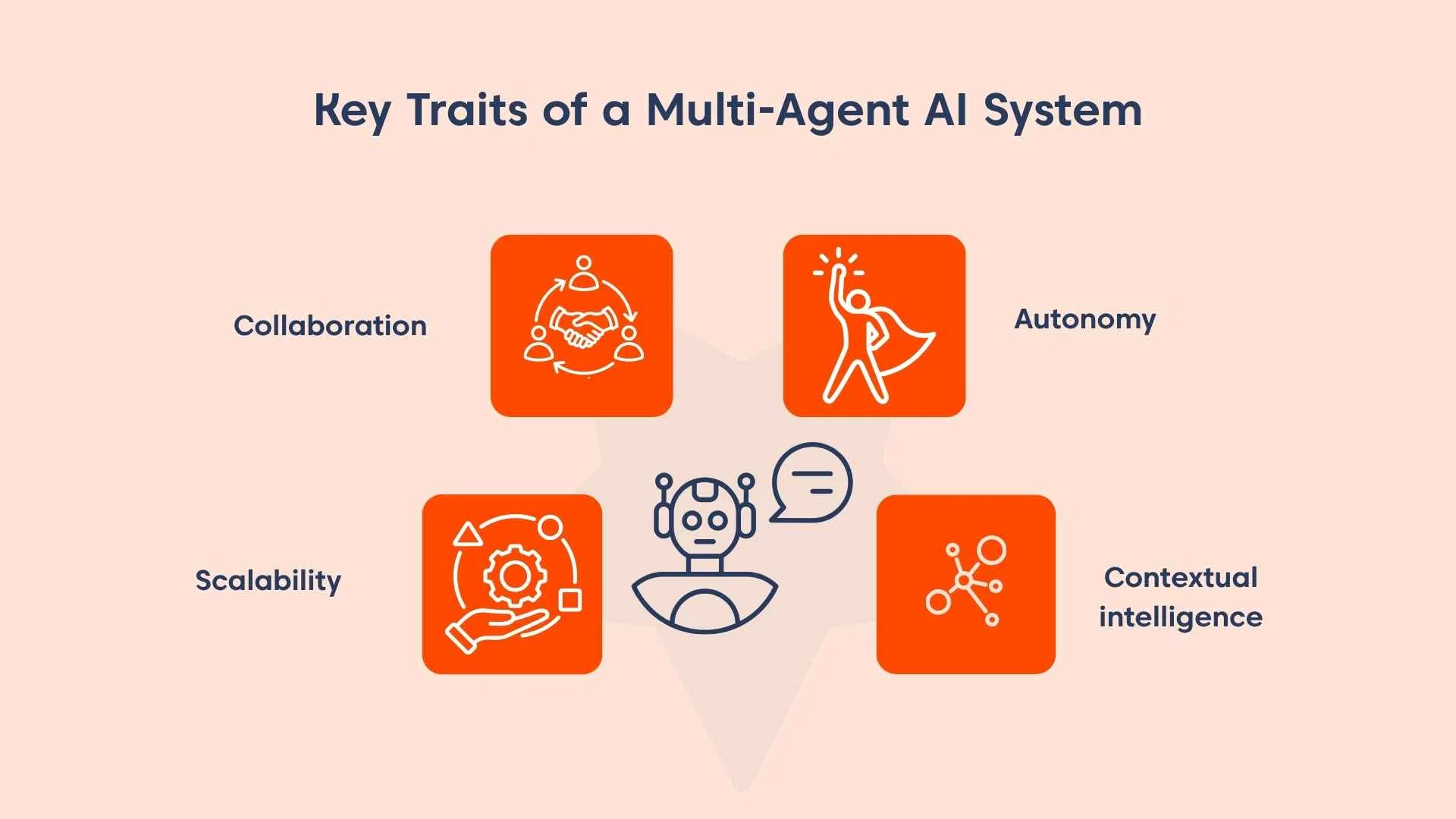
- Collaboration and communication: Agents work in parallel, share progress, and synchronize outputs to complete multi-step tasks efficiently.
- Autonomy (within constraints): Each agent makes decisions for its assigned role while following system policies and permissions.
- Scalability and flexibility: Work can be parallelized, and new agent roles can be added without redesigning the entire system.
- Contextual intelligence: A shared task state enables agents to maintain continuity, reduce redundancy, and produce consistent outcomes.
Benefits of collaborative AI agents in customer support
Multi‑agent AI systems deliver tangible business value for support teams by improving resolution speed, reducing operational risk, and enabling consistent service at scale.
As a form of agentic AI systems, they are especially effective in high‑volume, multi‑step support environments.
Industry analysts also highlight the growing role of AI‑driven decision intelligence, an area where multi‑agent systems excel.
In fact, Gartner projects that by 2027, 50% of business decisions will be augmented or automated by AI.
Here are some of the advantages that come with using multi-agent-based AI systems.
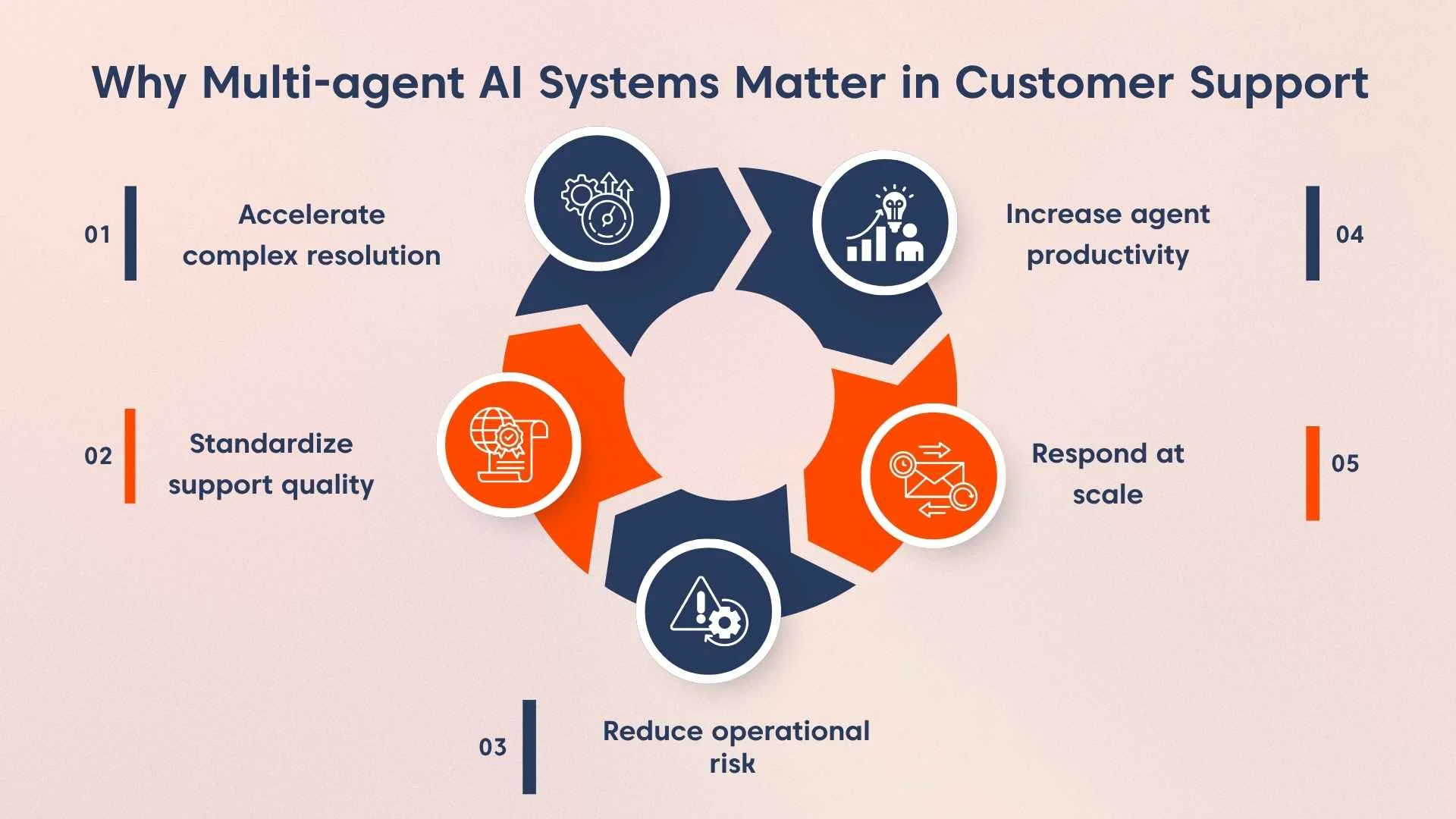
- Accelerate complex ticket resolution: Resolve multi‑step issues, such as billing disputes, account changes, or technical investigations, faster by coordinating specialized agents that work on subtasks in parallel.
- Standardize support quality at scale: Deliver consistent, policy‑aligned responses across channels by assigning dedicated agents to routing, retrieval, validation, and quality checks, even as ticket volumes grow.
- Reduce operational risk and costly errors: Prevent incorrect refunds, unauthorized account changes, and compliance violations by enforcing verification steps, permissions, and guardrails before actions are completed.
- Increase human agent productivity: Offload investigation, data gathering, and validation to AI agents so human support staff can focus on escalations, edge cases, and high‑value customer interactions.
- Respond instantly during demand spikes: Maintain fast, accurate responses during peak volumes or incidents by enabling agents to operate and coordinate in real time without bottlenecks.
Use cases of collaborative multi-agent AI systems
Collaborative multi-agent AI systems are designed to solve domain-specific problems by coordinating multiple specialized agents that share context and work toward a common goal.
This approach enables scalable, efficient, and adaptive automation across industries such as customer service, e-commerce, and banking.
Here are some of the real-world examples that illustrate how multi-agent AI systems operate in everyday workflows.
Customer service: Instant, intelligent support
Ever contacted support and received a helpful reply in seconds, not minutes? That’s not magic. That’s multiple AI Agents working together behind the scenes.
Here’s what typically happens:
- Agent 1 understands your request and identifies intent.
- Agent 2 searches internal knowledge bases via MCP (Model Context Protocol) and retrieves the exact answer.
- Agent 3 analyzes tone and sentiment to detect urgency or frustration.
- Agent 4 decides whether to respond instantly, ask a follow-up question, or escalate to a human.
Since these agents communicate through event-driven workflows and shared context, you experience support that feels fast and accurate.
E-Commerce: Seamless shopping experiences
Your online shopping journey is a common example of multi-agent AI teamwork, quietly optimizing recommendations, pricing, and delivery within the system.
The moment you browse or add items to your cart:
- A recommendation agent evaluates your preferences and suggests products.
- A pricing and availability agent checks inventory and delivery options.
- A returns and policy agent anticipates questions and prepares answers.
- A logistics agent coordinates fulfillment, tracking, and last-mile delivery.
These agents exchange data through catalog APIs, customer behavior insights, and supply chain systems, making the entire shopping experience feel effortless.
Banking: Secure and efficient financial operations
In digital banking environments, multi-agent systems specialize in handling issues like fraud detection, transaction validation, customer onboarding, and other high‑risk workflows through specialized coordination.
For example:
-
A fraud detection agent scans transactions for anomalies.
-
A compliance agent checks regulatory requirements.
-
A risk-scoring agent evaluates creditworthiness.
-
A customer service agent provides updates or answers questions.
These agents collaborate through secure APIs, encrypted data streams, and rule-based engines, enabling faster operations while maintaining customer trust.
McKinsey reports that multi-agent systems in banking and lending operations increase credit analyst productivity by 20–60%, and reduce decision times by 30%, supporting faster loan approvals without compromising risk controls.
Healthcare: Streamlined scheduling and medication support
Multi-agent AI systems support healthcare administrative and patient-service workflows that do not require clinical decision‑making.
These systems help reduce call volume and administrative burden while maintaining strict data-access controls.
For example:
When a patient requests to schedule or rebook a visit, or asks a general question about a prescription:
- An intake agent identifies the request type and gathers non‑sensitive details.
- A scheduling agent checks provider availability and proposes appointment options based on clinic rules and calendars.
- A prescription FAQ agent answers common, non‑personalized questions such as dosage instructions, refill timelines, or pharmacy pickup details.
- A policy and compliance agent enforces consent rules, restricts access to sensitive data, and routes PHI‑related requests to authorized staff.
- A verification agent confirms the response and escalates exceptions or unclear cases to human teams.
By coordinating through shared context and secure integrations, these agents enable faster responses, reduce administrative workload, and ensure compliant patient interactions, while keeping sensitive medical information protected.
What are the challenges of collaborative AI agents?
While multi-agent AI systems improve scalability and automation, they also introduce new layers of complexity that support teams must manage carefully.
Without proper design, coordination, and governance, these systems can impact accuracy, security, and operational efficiency.
Below are the key challenges to consider:
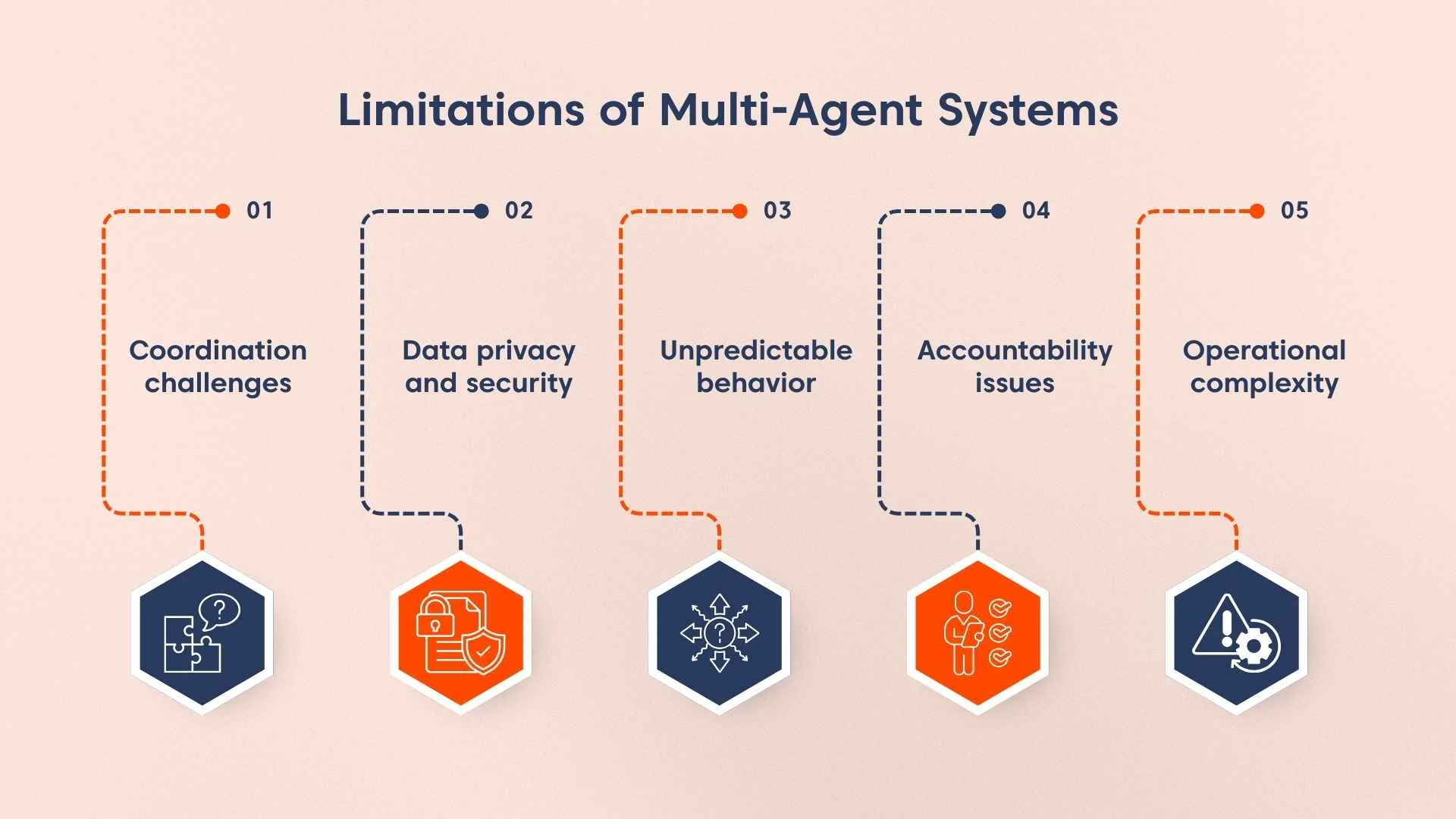
- Coordination challenges: Agents rely on structured communication and shared context to collaborate effectively. Poor orchestration can lead to duplicated work, conflicting outputs, or breakdowns in task execution.
- Data privacy and security: Distributing tasks across multiple agents increases the attack surface. Teams must enforce strict access controls, encryption, audit logs, and policy checks, which can add implementation overhead.
- Unpredictable behavior: Agents may interact in unexpected ways, especially in dynamic workflows. This can lead to inconsistent outputs or decisions that deviate from user intent, requiring continuous monitoring and guardrails.
- Accountability and auditability issues: When multiple agents contribute to a decision, it becomes harder to identify the source of errors. This can complicate debugging, compliance, and trust in automated systems.
- Operational and implementation complexity: Designing, testing, and maintaining multi‑agent AI systems requires careful planning for orchestration, integrations, and monitoring, especially as systems scale.
Enhance your digital workforce with collaborative multi-agent AI systems
As customer interactions become more complex and ticket volumes rise, support teams need automation that can coordinate tasks, not just generate responses.
Multi-agent AI uses specialized agents to work together with shared context, guardrails, and human escalation when needed.
The result is faster resolutions, more consistent answers, and support operations that scale with control and visibility.
Modern platforms like BoldDesk bring multi-agent AI into help desk workflows with built-in orchestration, automation rules, and visibility across support operations.
For more information, please contact our support team for expert guidance, and also, let us know what you think in the comments section.
Related articles
- AI Ticketing System: A Practical Guide for Modern Support Teams
- Future of Customer Service: Top Trends for Businesses in 2026
- Top 12 Chatbase Alternatives for AI Customer Service Agents in 2026
Frequently Asked Questions
Common types include cooperative, competitive, hierarchical, reactive, deliberative, and hybrid systems.
These models differ in how agents coordinate, make decisions, and respond to their environment.
The main architectures used in a multi-agent AI system are centralized, decentralized, and hybrid models, which determine how agents coordinate and share decisions.
The right choice depends on latency, reliability, and governance needs.
Teams commonly use agent frameworks such as LangGraph or LangChain, Microsoft AutoGen, CrewAI, and LlamaIndex to coordinate agents, tools, and shared context.
Many businesses also implement multi-agent workflows directly within a help desk or workflow platform via APIs and webhooks.
Agents typically communicate through structured messages like JSON, shared state or memory, and tool or API calls coordinated through an orchestrator or event bus.
In production environments, inter-agent communication is usually logged and governed to support debugging and compliance.
Multi-agent AI systems are often better for multi-step or high-volume workflows where tasks can run in parallel (triage, retrieval, drafting, verification).
A single agent can be simpler and more cost-effective for straightforward requests with minimal integration.
Yes. Especially for integrations, permissions, logging, and guardrails.
While some platforms offer no-code or low-code options for basic workflows, production-grade deployments typically require developer involvement.