


TL;DR: Customer service channels are the communication platforms customers use to interact with support teams. The most effective channels include phone, email, live chat, self-service, social media, video chat, community forums, and SMS. Combining multiple channels helps businesses improve accessibility, responsiveness, and overall customer satisfaction.
A customer messages your team on Instagram, follows up by email two days later, and calls when neither gets a fast enough reply.
Multiply that across hundreds of customers, and the wrong mix of customer service channels doesn’t just frustrate people.
It creates duplicate conversations, fragmented customer histories, and unnecessary work for your team.
The businesses that handle this well don’t try to be everywhere at once. Instead, they focus on delivering consistent support across the channels they choose to offer.
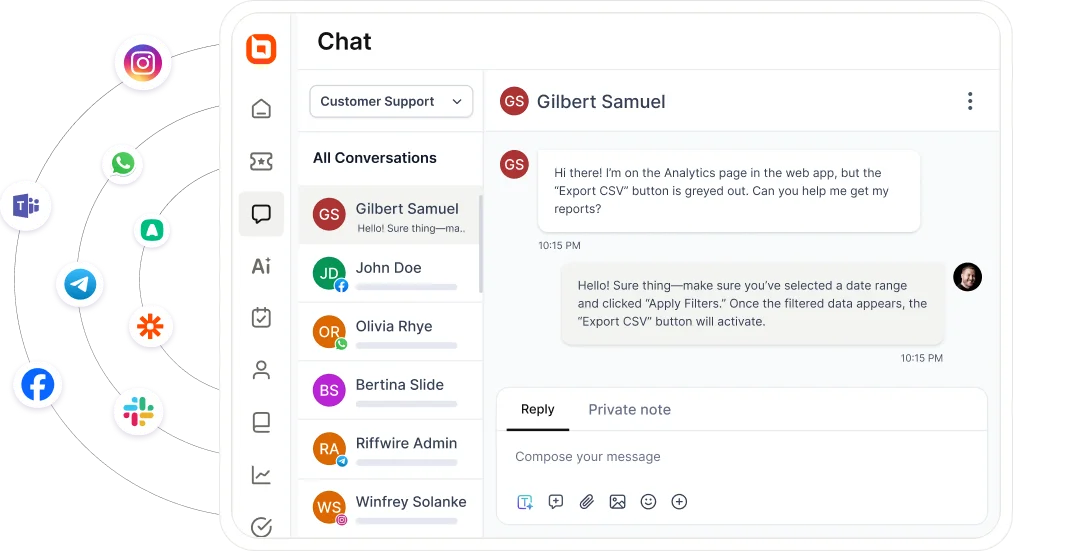
They can use customer service software to keep conversations connected and deliver a seamless experience across every channel.
This guide explores the different types of customer service channels, their strengths and limitations, and how to choose the right mix for your business.
What are customer service channels?
Customer service channels are media through which customers interact with support teams to ask questions, report issues, or seek assistance.
These channels play an important role in a company’s customer experience strategy.
While email and phone support have traditionally been the most common methods for obtaining help, digital customer service channels such as social media, chatbots, and live chat are becoming increasingly popular due to their accessibility and convenience.
8 Essential customer service channels
Businesses can choose from a variety of customer service channels to support their customers.
Below are some of the most common options, along with their strengths and limitations.
1. Phone support
Answering questions over the phone is one of the most popular methods of communication. Phone support is an essential channel that offers direct access to help and information.
Benefits of phone support
- Phone support is suitable for complicated inquiries that require lengthy discussions or detailed explanations.
- Phone calls enable real-time communication, helping customers explain their problems and receive immediate feedback.
Disadvantages of phone support
- Compared to other methods of communication, customers often have to wait on hold for long periods.
- Phone support may not always be available, especially if the support team is understaffed.
Pro tip: Train support staff on empathy, phone etiquette, and active listening to identify emotional cues in a customer’s tone and pace.
2. Email
Email remains one of the most widely used customer service channels because it allows customers to explain issues in detail, attach supporting documents, and maintain a written record of conversations.
It is particularly effective for non-urgent inquiries, follow-ups, and requests that require thorough documentation.
Benefits of email support
- Clients can describe issues in detail over email and even attach supporting documents and media.
- Email threads can act as records of customer communications and can be used for reference whenever necessary.
- Your support staff can promptly reply to frequent client inquiries using pre-written email templates.
Disadvantages of email support
- Support agents may take longer to respond, lowering satisfaction.
- Email may not be suitable for urgent issues because resolution often requires multiple exchanges between customers and support teams.
- It is easy to overlook emails, increasing the risk of missed messages.
Pro tip: Save time by using customer service email templates for common questions. You can also optimize your email support with an email ticketing system.
3. Live chat
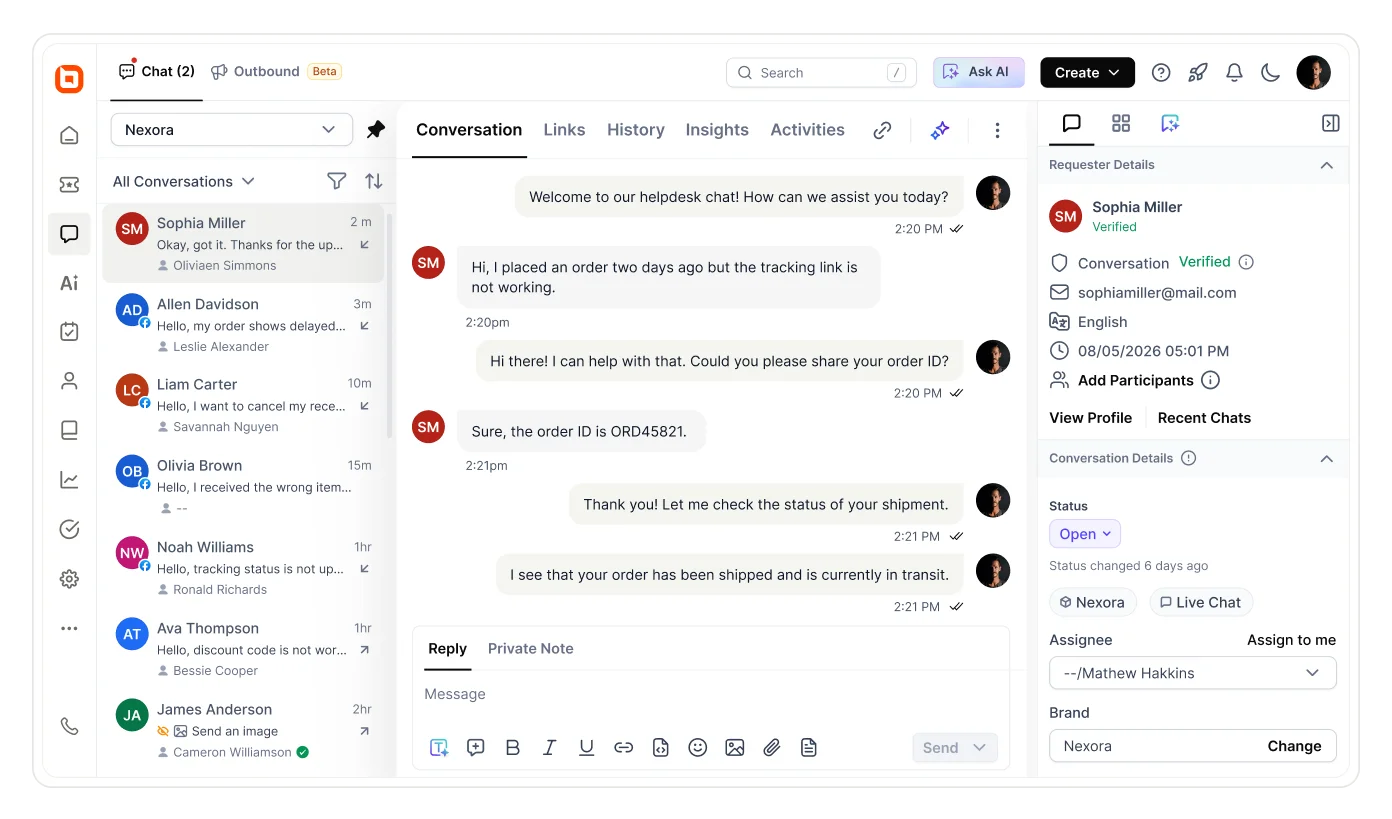
Companies implement live chat support into their customer care strategy to provide quick responses and improve satisfaction.
According to WhosOn, 63% of customers are more likely to return to a website that offers live chat when making repeat purchases.
Benefits of live chat
- Customers can receive real-time assistance without having to wait on hold or schedule a call.
- Live chat is accessible from a variety of devices.
Disadvantages of live chat
- A text-based customer communication channel can result in misinterpretations when the language is unclear.
- 24/7 live chat support can be costly as it may require additional staff or outsourcing.
Pro tips: Use canned responses and AI assist tools to save your support agents’ time.
Additionally, you can implement a shift-based system so there are always agents available to handle customer inquiries across customer support channels.
4. Self-service
Customers prefer to solve problems independently instead of contacting customer support representatives.
According to NICE’s 2022 Digital-First Customer Experience Report, 81% of consumers expect more customer self-service options.
Self-service solutions enable customers to find answers and resolve issues independently through resources such as knowledge bases, customer portals, FAQs, tutorials, and AI agents.
Benefits of self-service
- Reduces support ticket volume, allowing agents to focus on more critical issues and improving team productivity.
- Customers can find answers outside business hours without requiring assistance from support agents.
- Promotes proactive problem-solving through knowledge bases, tutorial videos, and FAQs.
- Customers can find information at any given time, enhancing your 24/7 customer service.
Disadvantages of self-service
- Poor search functionality, outdated content, or complicated navigation can prevent customers from finding the answers they need.
Pro tip: Regularly update content on your self-service resources and optimize them for accessibility, mobile devices, and multiple languages.
5. Social media
Social media is a powerful customer service channel because it allows businesses to respond publicly, engage with customers, and protect brand reputation.
Platforms such as Facebook, Instagram, LinkedIn, X, and TikTok are commonly used for support interactions.
Thus, promptly addressing a concern raised on social media can quickly turn into a valuable opportunity and significantly enhance your online customer service.
Benefits of utilizing social media
- Engaging and resolving customer issues on social media platforms can demonstrate that you are a genuine company that is customer-centric.
- Social media lets you reach thousands of prospective clients by maximizing positive word-of-mouth.
- Customers can submit requests at any time, but response availability depends on coverage.
Disadvantages of social media
- Negative interactions may be visible to a public audience.
- High volumes of comments and messages can be difficult to manage.
- Sensitive issues often need to be moved to private channels for resolution.
Pro tip: Be active on social media so that you can get notifications whenever your brand is mentioned or whenever you receive comments.
6. Messaging apps
Messaging apps such as WhatsApp, Facebook Messenger, Telegram, and WeChat allow customers to contact businesses through familiar platforms. They support quick, conversational assistance and make it easy to share text, images, documents, and order details.
Businesses handling high messaging volumes can use WhatsApp chatbots for customer service to answer common questions, provide instant responses, and direct complex requests to support agents.
Benefits of messaging apps
- Customers can communicate using familiar, convenient applications.
- Conversations are often faster and less formal than email.
- Messaging apps support ongoing conversations and updates without requiring customers to repeat information.
- Businesses can combine human support with automation to improve efficiency.
Disadvantages of messaging apps
- Customers may expect immediate responses, even outside business hours.
- Managing multiple messaging platforms can become challenging without the right tools.
- Complex issues may still require escalation to phone, video, or email support.
Pro tip: Use automation carefully. WhatsApp chatbots and other messaging bots should handle routine requests while making it easy for customers to reach a live agent when needed.
7. Community forums
A community forum is an online platform where your customers can share experiences, ask questions, and offer advice on how to improve your offerings.
Customers can learn from each other’s experiences and share tips on using products or services on this customer communication channel.
Community forums can be a valuable resource for businesses looking to enhance customer value. By actively participating in these forums, companies can gain several benefits.
Benefits of community forums
- Forums provide a direct avenue for customers to voice their opinions, concerns, and suggestions.
- Engaging with customers in a community helps build customer relations and loyalty.
- By observing discussions in forums, businesses can identify emerging trends and adapt their products or services as needed.
- Customers often have valuable insights and experiences. Encouraging them to share their knowledge can create a supportive, self-sufficient community.
Disadvantages of community forums
- At times, discussions may go off topic, drawing attention away from your products and services.
- Members may sometimes provide inaccurate information regarding your products or services, leading to misinformation.
Pro tip: Occasionally suggest topics and points to encourage constructive discussions.
8. Text or SMS support
Despite the rise of online communication, many consumers value the ability to text businesses with their questions and concerns.
Text support enables quick and convenient communication that enhances customer satisfaction, making SMS customer service a practical option for businesses that need fast, direct interactions with customers.
Benefits of SMS support
- Messages are easy to read and respond to, facilitating quick communication.
- Text support can help reduce customer wait times and improve response times.
- SMS support improves the efficiency of support agents as they can manage multiple conversations simultaneously.
Disadvantages of SMS support
- SMS messages are often limited to a fixed number of characters per message, which may restrict the amount of information a customer wants to convey.
- SMS has limited space and is less suitable for complex or media-heavy issues.
Pro tip: Ensure messages are brief and straightforward.
Other customer service channels
In addition to the most common customer service channels, some businesses use specialized options such as video chat, co-browsing, and Microsoft Teams for customer service.
These channels are particularly useful for product demonstrations, onboarding, technical troubleshooting, internal collaboration, and situations where visual guidance improves communication.
While they may not be necessary for every organization, they can complement a broader customer service channel strategy and help teams deliver more personalized support.
How to choose the right customer support channel for your business
The best customer support channel depends on your audience, industry, available resources, and the types of customer service your organization provides.
Here are some helpful tips to assist you in selecting the most effective channel.
Understand your industry standards
Different industries have unique customer service requirements and expectations.
Consider the types of interactions your customers have with your business and the channels that best support those needs.
For example, hospitality businesses may benefit from live chat and messaging apps for quick inquiries, while healthcare organizations may require secure messaging, phone support, or other compliant communication channels depending on the nature of the request.
It is also a good idea to analyze which channels your competitors use to get a sense of what works and what doesn’t in your industry. If your customers value personalized interactions, you may also want to invest in channels such as phone or video support.
Identify your customers’ needs and preferences
Leverage platforms that appeal to each customer base. Choose a customer support channel that caters to your users’ age and preferences. You can create surveys to determine what support channels best fit your customers.
For instance, some customers may favor social media and instant messaging, whereas others may prefer email and phone support, based on their communication habits and needs.
Proactively reach out to these audiences via these channels to boost engagement and deliver a more fulfilling customer experience.
Analyze your resources
Determine staffing and technology costs to assess your budget for different customer support channels. This will enable you to select channels that align with your operational capabilities and effectively address your customers’ needs.
Pilot before you scale
Before investing heavily in a new customer service channel, test it with a smaller group of customers or a specific team.
This helps validate customer demand, identify operational challenges, and determine whether the channel delivers enough value to justify wider adoption.
Match channels to the issues you handle
Understanding the nature of the support issues you encounter can help optimize the support process, allowing you to choose the most suitable channels.
Best practices for managing customer support channels
Optimizing service channels is critical to meeting customer expectations and building loyalty. By combining technologies, companies can deliver seamless experiences, enhance satisfaction, and drive growth.
To get the best out of your customer service channels, it is advisable to consider the following.
- Centralize conversations in a single platform: Manage customer interactions from all channels in an omnichannel customer service inbox to maintain context, improve visibility, and reduce missed inquiries.
- Train agents for each supported channel: Ensure agents understand the expectations, tone, and workflows associated with every channel your business supports.
- Personalize customer interactions: Make use of customer history, preferences, and previous interactions to deliver more relevant and effective support.
- Automate routing and repetitive tasks: Use automation to categorize tickets, assign requests, send updates, and handle routine inquiries efficiently.
- Use AI agents and AI copilots strategically: Deploy AI-powered tools to answer common questions, assist agents, and provide support outside business hours while escalating complex issues to human agents.
- Monitor channel performance: Track customer service metrics such as response times, resolution rates, CSAT scores, and usage trends to identify improvement opportunities.
- Maintain clear cross-channel handoffs: Customers should be able to move between channels without repeating information or losing context.
Build an effective customer service channel strategy
By optimizing your channel strategy, you can improve customer satisfaction, streamline operations, and create better support experiences.
A help desk system for growing businesses can help teams handle increasing support demands without sacrificing service quality.
BoldDesk helps teams manage multiple customer service channels from a single workspace, making it easier to deliver efficient, consistent support as customer expectations grow.
Ready to streamline support and scale efficiently? Start a 15-day free trial today.
Have thoughts or additional channels you think we should include? Share them in the comments. We’d love to hear from you.
Related articles
- Using Slack for Customer Service: Features and Benefits
- What is Customer Communication? Strategies and Tools
- Omnichannel Customer Experience: Definition, Examples, and Tips (2026)
FAQs about customer service channels
Yes. Modern customer service software centralizes conversations from channels such as email, live chat, social media, SMS, and messaging apps into a single workspace.
This helps support teams track interactions, improve response times, and deliver a consistent customer experience.
Customer service channels help customers reach businesses through their preferred communication methods.
Offering multiple support channels improves accessibility, reduces customer effort, enhances satisfaction, and enables businesses to deliver a more personalized customer experience.
The best customer service channels for small businesses are typically email, live chat, and self-service resources because they are cost-effective and scalable.
As customer demand grows, businesses can expand into SMS, WhatsApp, social media, and phone support to provide more comprehensive service.
Managing multiple customer service channels can lead to inconsistent communication, longer response times, and fragmented customer data if systems are not integrated.
Businesses can overcome these challenges by using a centralized customer service platform and establishing standardized support workflows.
Businesses can evaluate customer service channels using key metrics such as first response time, resolution time, customer satisfaction (CSAT), Net Promoter Score (NPS), ticket volume, channel adoption rate, and customer effort score (CES).
Monitoring these metrics helps identify the most effective channels and areas for improvement.