

 In this page

TL;DR: AI chatbots are intelligent virtual assistants that understand natural language, interpret intent, and deliver helpful responses without human intervention. Unlike rule-based bots, modern AI chatbots can pull knowledge from multiple sources, automate workflows, and resolve issues across channels. They’re widely used in customer support, sales, HR, IT, SaaS, and ecommerce.
Sales and customer service teams face an endless stream of repetitive questions every day. AI chatbots help lighten that load by automating routine interactions and freeing agents to focus on more complex issues.
And unlike traditional rule-based bots, modern AI chatbots can understand context, learn from past conversations, and deliver more personalized responses, whether they’re supporting customers, assisting sales, or streamlining internal service workflows.
When an issue requires a human touch, AI chatbots can also hand off the conversation to a live agent without disrupting the experience.
In this blog, we’ll cover everything you need to know about AI chatbots, from the technology behind them to real-world use cases that show where they make the biggest impact.
What is an AI chatbot?
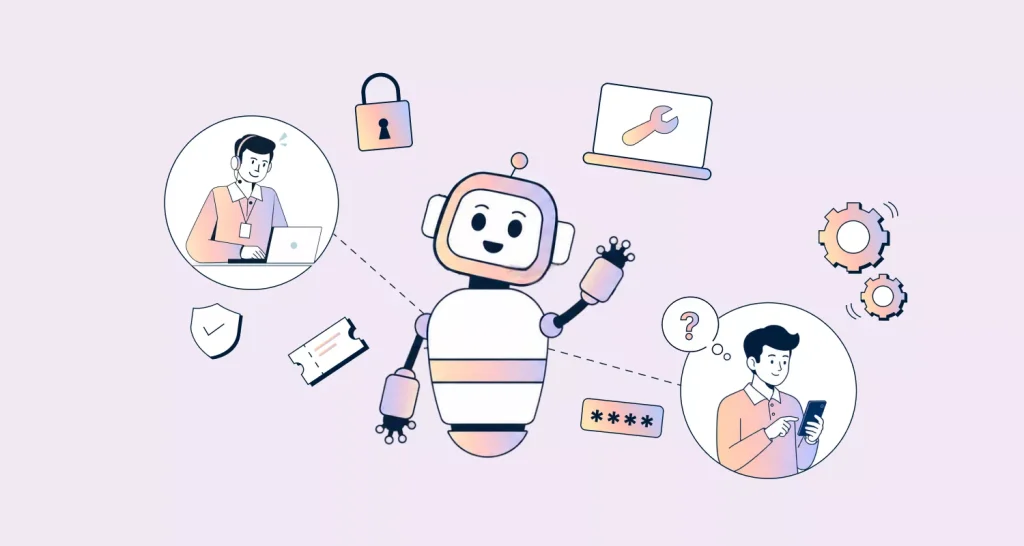
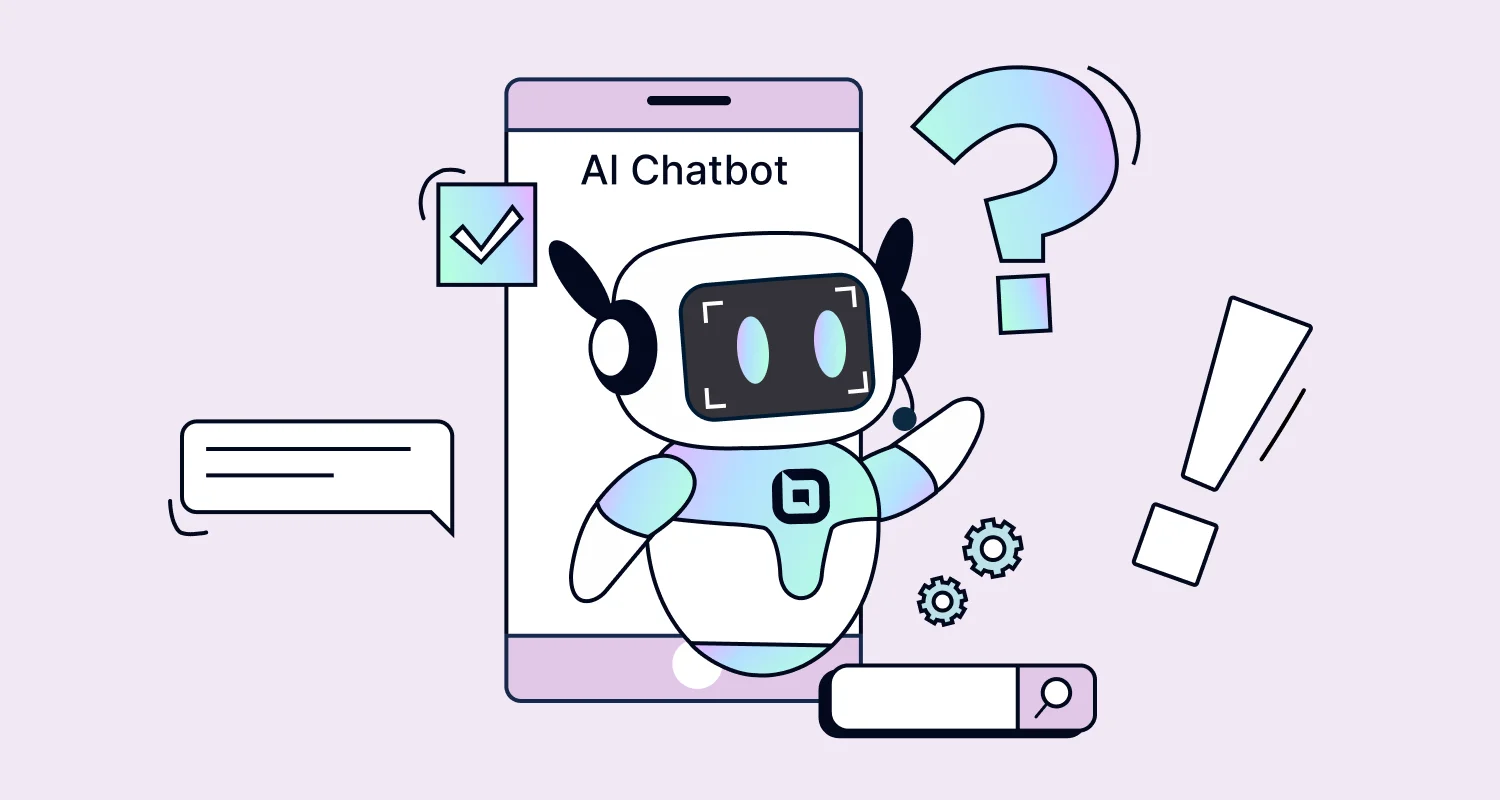
An AI chatbot is a software application that uses artificial intelligence to understand natural language, interpret user intent, and deliver relevant responses through conversational interfaces, with or without human handoff.
Unlike traditional chatbots, AI-powered chatbots can:
- Understand conversational language and not just predefined keywords
- Learn from previous interactions
- Provide personalized solutions
- Automate repetitive workflows
- Escalate complex issues to human agents with context
How does an AI chatbot work?
Modern AI chatbots are a form of conversational AI powered by large language models (LLMs). These models allow chatbots to understand context, detect user intent, and generate natural, human‑like responses instead of relying solely on predefined rules.
Here’s a simple, practical breakdown:
- Understand the message (NLP/NLU): The intelligent chatbot analyzes what the user says, identifies intent (for example, “reset password,” or “track order”), and extracts key entities such as dates, locations, or product names.
- Maintain context and memory: Depending on their design and integration, modern chatbots can retain conversation context and reference data such as past tickets, preferences, or account history, to avoid the same repetitive questions.
- Decide the best action: Based on intent and context, the chatbot chooses what to do: reply, retrieve information from a knowledge base, trigger automation, update a ticket, or escalate to a human agent.
- Integrate with business systems: These chatbots connect with CRMs, help desk ticketing systems, ecommerce platforms, HR systems, and APIs to perform actions in real-time.
- Learn over time: With ongoing feedback, training updates, and content refinement, chatbot accuracy can improve over time, while coverage expands and failure cases decrease.
Types of AI chatbots
AI chatbot examples can be categorized based on how they process conversations and interact with users. The most common types include:
- Conversational AI chatbots: These use natural language processing (NLP) and machine learning to understand context, intent, and variations in user queries, allowing for more natural and flexible conversations.
- Context‑aware AI chatbots: Context‑aware chatbots remember previous interactions, user preferences, and conversation history to deliver more personalized responses across sessions.
- Retrieval‑augmented chatbots: These chatbots combine NLP with external knowledge sources, such as help center articles, documentation, or databases, to provide accurate, up‑to‑date answers grounded in real content rather than static training data alone.
- Autonomous or agentic AI chatbots: Advanced AI chatbots can independently perform actions such as updating tickets, triggering workflows, or escalating issues without constant human input.
What is the difference between traditional chatbots, AI chatbots, and AI agents?
Traditional (rule-based) chatbots, AI chatbots, and AI agents are often used interchangeably, but they differ in how they understand language, handle context, and perform actions.
Traditional chatbots rely on predefined rules and scripts to handle predictable, repetitive interactions. AI-powered chatbots use machine learning (ML) and natural language processing (NLP) to understand context, interpret intent, and manage more complex conversations.
AI agents extend these capabilities further by not only conversing with users but also acting across systems, such as executing workflows or resolving issues autonomously.
| Feature | Rule-based chatbots | AI-powered chatbots | AI agents |
| Flexibility | Limited to programmed responses | Understand context and adapt dynamically | Context-aware and action-oriented |
| Tasks handling | Cannot handle complex or ambiguous questions | Handle complex queries | Resolve and act on them |
| Personalization | Minimal | High | Very high (uses customer and system data) |
| Best for | Simple, repetitive tasks | Dynamic, conversational support | End-to-end support automation |
Curious how BoldDesk’s conversational AI resolves tickets from start to finish? Experience it in action. Our support team is available 24/7 to guide you every step of the way.
What are the benefits of AI chatbots in business?
Modern chatbots go far beyond traditional scripted responses. They combine language intelligence, workflow automation, and system integrations to deliver measurable business impact.
Below are a few reasons why these AI-powered chatbots are important:

- Provide round-the-clock support without increasing backlog: AI chatbots offer 24/7 support, ensuring customer queries are acknowledged and addressed instantly, even outside business hours.
- Deliver faster and more consistent first responses: By instantly answering common questions and gathering key details upfront, AI chatbots improve first‑response consistency and reduce variability caused by agent availability or workload.
- Improve triage quality and routing accuracy: AI chatbots can identify intent, urgency, and context early in the conversation, allowing tickets to be categorized, prioritized, and routed correctly before reaching human agents.
- Reduce agent workload for repetitive requests: Automating high‑volume, low‑complexity inquiries such as order status checks or password resets significantly lowers repetitive ticket volume and frees agents to focus on complex, high‑value issues.
- Handle peak volumes more smoothly: During traffic spikes, AI chatbots scale instantly to manage surges in conversations, helping teams maintain service levels without adding temporary staff or compromising response quality.
- Increase customer satisfaction through faster resolution: Consistent responses, shorter wait times, and seamless escalation to human agents contribute to smoother experiences and higher customer satisfaction scores.
Customer service AI chatbot use cases across various industries
Every business has unique needs, and the value of an AI chatbot depends on how well it aligns with your specific customer support operations.
Here is a breakdown of their functionality:
Customer support
In customer support, AI chatbots act as virtual assistants that help organizations manage high volumes of customer inquiries efficiently.
They can answer frequently asked questions, surface relevant help articles, gather context such as order details or issue type, route conversations to the right team, and escalate complex cases to human agents with full context attached.
This reduces response times, improves triage accuracy, and ensures customers are not left waiting during peak periods.
Example: BoldDesk AI Agent extends these capabilities by escalating complex issues to human agents with relevant context, helping teams resolve issues faster while maintaining a consistent customer experience.

Ecommerce and retail
For businesses in the ecommerce and retail industry, AI chatbots function as digital shopping assistants that support customers throughout the buying journey.
They help shoppers find the right products, answer questions about pricing, sizing, availability, and shipping, and reduce friction that often causes hesitation or cart abandonment.
By engaging customers at key decision points, AI chatbots can also support upselling and cross‑selling by recommending complementary products based on browsing behavior or purchase intent without requiring additional human effort.
For example:
Ecommerce brand K2 reported significantly higher conversion rates during chat‑assisted sessions compared to non‑chat traffic, while other retailers observed 25–70% higher average order value (AOV) and up to 25% more conversions when chat was part of the shopping experience (Ecommerce Fastlane).
Lead qualification on-site
The most effective virtual assistants excel at capturing and qualifying leads. Rather than depending on static forms, these advanced chatbots interact with visitors in real-time, asking relevant questions to assess interest, budget, and timeline.
This approach speeds up conversions and allows sales teams to concentrate on high-quality prospects.
HR and internal service desks
Internal AI chatbots serve as virtual HR and IT assistants, answering FAQs on leave policies, benefits, and payroll, and helping employees access forms and troubleshoot IT issues.
The chatbots streamline onboarding and improve employee satisfaction without expanding HR teams.
For example:
IBM’s AskHR virtual agent automates 80+ HR tasks, handling 2.1 million conversations annually. On the other hand, another HR chatbot reduced workload by 40%, improved response times by 80%, and doubled employee satisfaction. (IBM, Modsen).
AI-Powered Help Desk for Smarter Customer Support
Resolve tickets faster with AI automation, smart routing, and real-time insights. Empower your support team to deliver consistent, delightful experiences at scale.
How to build an effective AI-powered chatbot
Creating the best AI chatbot requires more than deploying the right technology. It involves clearly defining goals, selecting suitable AI capabilities, integrating with existing systems, and continuously improving performance based on real user interactions.
The following best practices outline how to design an AI chatbot that delivers accurate responses, scales efficiently, and supports long‑term business objectives.

Define clear chatbot-specific objectives
Start by identifying what your AI-powered chatbot should accomplish and add the most value; whether it’s answering FAQs, reducing support tickets, generating leads, or improving customer service.
Clear objectives guide feature prioritization, performance tracking, and ensure meaningful outcomes for both your business and customers.
Tips:
- Review top repetitive queries.
- Analyze support tickets and chat logs.
- Focus on high-volume, low-complexity questions.
Choose the right AI chatbot platform
Select a platform that aligns with your technical capabilities and business requirements. The tool should support NLP, integrations, analytics, and human handoff.
Note that low-code or no-code tools are great for quick deployment, while advanced frameworks offer deeper customization for developers.
What to look for:
- AI training and intent recognition
- Omnichannel support (chat, email, WhatsApp)
- Help desk integration
- Security and compliance
Integrate the chatbot with your channels and support system
Connect your virtual assistants to your website, social media, and messaging apps for a unified experience.
Prioritize channels your customers use most and implement omnichannel integration to maintain consistent conversations across platforms.
Additionally, connect the chatbot with your help desk, CRM, and knowledge base so it can access real customer data and create or update tickets automatically.
The result is unified conversations, faster resolution times, and zero manual duplication.
Train the chatbot on real knowledge and customer queries
Use natural language processing (NLP) and machine learning to help your chatbot understand intent and respond conversationally.
You can feed the chatbot with FAQs, help articles, policies, and product documentation to ensure accurate responses.
Training with real-world queries improves accuracy and makes interactions feel human-like.
Best practices:
- Use simple, conversational language.
- Continuously refine responses.
- Monitor unanswered questions.
Set automation rules and escalation paths
Define when the chatbot should resolve issues automatically and when it should escalate to a human agent.
Examples:
- Escalate billing issues.
- Route technical problems to specialists.
- Trigger workflows based on intent.
Test thoroughly and monitor performance
Before launch, conduct thorough testing of chatbot responses with real user interactions and scenarios. After the launch, gather feedback, analyze performance, and continuously refine responses.
You can optimize your chatbot using AI insights and analytics to identify gaps, improve intents, and personalize future conversations.
Iteration ensures your virtual assistants evolve with customer needs, provide smarter automation, better customer experience, and reduce support workload.
Key metrics:
- Resolution rate.
- Customer satisfaction (CSAT).
- Response time.
- Bot-to-agent handoff rate.
Elevate your support with autonomous AI chatbots
AI chatbots are essential for businesses seeking faster, automated, and cost-efficient support. But as customer expectations rise, you need more than scripted replies.
BoldDesk’s AI-powered help desk delivers context-aware ticket resolution, intelligent automation, and personalized experiences that traditional bots can’t match.
Experience smarter support by contacting our team or scheduling a 30-minute live demo today!
Did you find this article helpful? Share your thoughts and suggestions in the comments section below.
Related articles
- 7 Best Ways to Utilize AI for Customer Experience
- Understanding Multi-Agent AI Systems: Definition, Benefits, and Use Case
- Difference Between Chatbot vs Live Chat (2026 Guide)
Frequently Asked Questions
AI chatbots for customer service are virtual assistants that automate customer interactions by answering common questions, guiding troubleshooting, and routing complex issues to human agents. They improve response time, reduce workload, and enhance overall customer experience.
AI chatbots support multiple languages by using NLP models trained on multilingual datasets, allowing them to understand and respond to customer queries in different languages without requiring separate workflows.
Yes. Most modern customer service chatbots provide APIs or native integrations for CRMs, help desks, and analytics tools, ensuring seamless workflows.
Traditional chatbots follow predefined rules and decision trees, while AI-powered chatbots use NLP and machine learning to interpret intent, handle varied phrasing, and respond more flexibly across more complex support scenarios.
No. AI-powered chatbots can’t replace human agents. Instead, they complement the agents by handling routine queries and freeing up time for complex issues. A hybrid approach ensures the best customer experience.
AI chatbots can produce inaccurate answers if knowledge is poorly grounded, fail to escalate complex issues, and raise privacy or compliance concerns. They also require ongoing training and monitoring to stay accurate, reliable, and aligned with business policies.