



TL;DR: Clear ticket ownership assigns one accountable person to keep each ticket moving and closed correctly. Unclear ownership creates delays, duplicate responses, and context loss during handoffs.
Ticket ownership in day-to-day support means knowing who is responsible for guiding each ticket to the right outcome.
When this isn’t clear, work slows down, replies overlap, handoffs increase, and customers end up repeating details.
According to Fullview’s report 90% of customers say an immediate response is critical when they have questions or run into issues.
This guide explains what ticket ownership looks like in practice, why it breaks as teams grow, and the rules that keep tickets moving with less rework.
What does ticket ownership really mean in support teams?
Ticket ownership is the practice of assigning one accountable person to keep a support ticket moving until it’s correctly resolved and closed, even if other teammates complete parts of the work.
The owner doesn’t need to handle every task themselves. But they are responsible for keeping the ticket moving, coordinating the work, communicating with the customer, and making sure it’s resolved properly.
Core roles in a modern support ticket workflow
- Owner (accountable): Responsible for progress, customer updates, and correct closure.
- Assignee (working): Completes the next action (may be the owner).
- Collaborators (supporting): Provide context, approvals, or specialist input.
Signs your team is missing clear ticket ownership
Unclear ownership rarely shows up as one obvious failure. It shows up as small friction that repeats across your customer base:
- Tickets get activity (notes, status changes), but no real progress.
- Two people reply because responsibility isn’t clear.
- Handoffs happen without a reason or summary.
- Escalations create gaps where the customer waits.
- Customers repeat themselves because context doesn’t carry forward.
Clear vs. unclear ticket ownership (side-by-side comparison)
The table below breaks down the difference between clear and unclear ticket ownership across responsibility, customer updates, reassignments, escalations, and shift handoffs.
| Area | Clear ownership | Unclear ownership |
|---|---|---|
| Responsibility | A single agent or defined team is fully accountable for the ticket from start to finish. | Multiple people may respond, but no one is clearly responsible for driving the next step to resolution. |
| Customer Updates | Updates are consistent, timely, and aligned in a single, unified voice. | Updates are sporadic, delayed, or conflicting, often leading to duplicate or overlapping responses. |
| Reassignments | Reassignments are rare and follow defined rules such as skills, priority, service level agreement (SLA), or escalation paths. | Tickets are frequently and informally reassigned, causing unnecessary ticket bouncing. |
| Escalations | Specialists assist during escalations while ownership remains clearly assigned at every level. | Escalation brings in more people without clarifying responsibility, creating gaps where no one owns the outcome. |
| Shift Handoffs | Ownership is intentionally transferred with clear notes, next steps, and expectations. | Handoffs are unclear or incomplete, causing tickets to stall, lose context, or require rework. |
Why support teams lose ticket ownership as they scale
Ticket ownership is simple when one person handles a request end to end. As volume grows and teams add channels, shifts, and specialties, clarity fades.
Common customer service problems start showing up as small delays that begin to pile up.
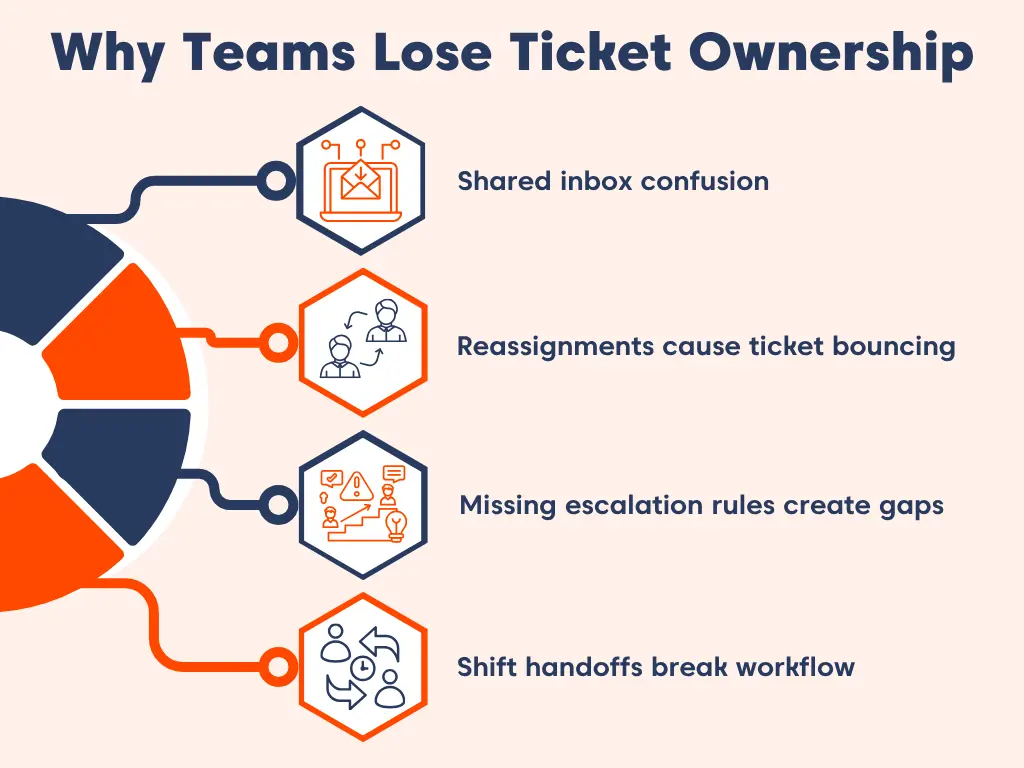
Here are the most common ways ownership breaks down:
Shared inbox confusion
When many agents monitor the same queue, it becomes unclear who should take each ticket.
Everyone assumes someone else will handle it, which causes delays and leaves some tickets untouched.
This often results in customers receiving repeated or mixed responses because no one is certain about who needs to act.
Reassignments cause ticket bouncing
When tickets are repeatedly passed from one person to another, the sense of ownership weakens. After several transfers, no one feels truly responsible for the request.
This leads to slower progress and forces customers to explain their issue again because important details are lost during each support ticket handoff.
Missing escalation rules create gaps
When a team does not have a clear ticket escalation process (when to escalate, to whom, and what happens next), requests can slip into gaps between teams.
As a result, the ticket sits without progress because no one knows who should take over once the issue becomes more complex.
Shift handoffs break workflow
When teams work across different shifts or time zones, progress slows down if ownership is not clearly transferred.
This causes work to pause, and customers may receive inconsistent updates because the next person does not have the full context needed to continue smoothly.
The hidden costs of unclear ticket ownership
You don’t need financial modeling to see the impact of unclear ticket ownership. The cost becomes visible in slower operations, repeated work, inconsistent updates, and growing team frustration.
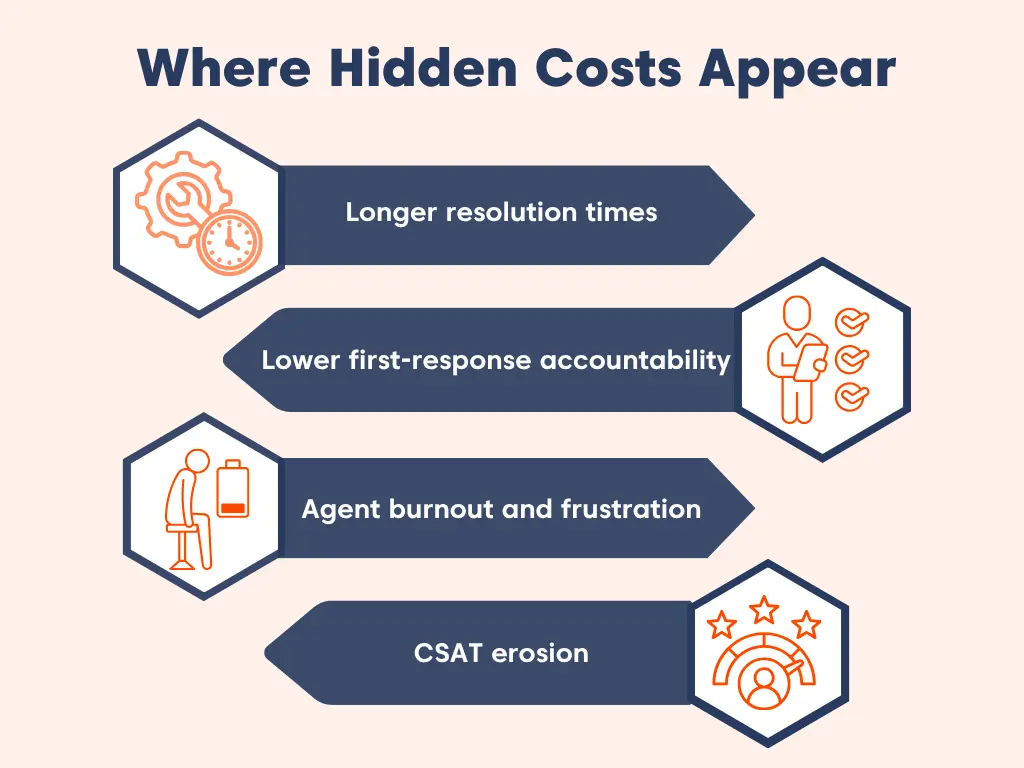
Here’s what it looks like in practice:
Longer resolution times and more rework
Every time a ticket is handed off to a new agent, progress slows down. The next person has to read through the entire conversation, rebuild the customer’s story, ask new questions, and figure out what to do next.
These small delays add up quickly, and tickets end up waiting longer as they move between different owners.
Lower first-response accountability across teams
When several people are able to respond to a ticket, it becomes easy for everyone to assume that someone else will take the first action. This creates a situation where tickets get noticed but not actually owned.
As a result, customers receive responses at unpredictable times, and the quality of the first reply varies from agent to agent.
Agent burnout and frustration
This isn’t just general workload stress; it’s the frustration that comes from unclear responsibility. When ownership is not clearly assigned, agents waste time and energy wondering:
- Is this ticket actually mine?
- Is someone else already working on it?
- If I reply, will it cause duplicate messages?
- Will I be blamed if the ticket misses its deadline?
This constant uncertainty drains motivation and leads to avoidable burnout.
Customer satisfaction drops from repeated context loss
Customer satisfaction usually declines because of small but repeated issues such as slow follow‑ups, conflicting answers, and missing details.
It also drops when customers are forced to repeat information they already shared. Over time, these moments create frustration. It shows up in customer reviews and reduces the perceived value of your service.
According to Unicom, 89% of consumers are more likely to make another purchase after a positive customer service experience.
Ticket ownership makes accountability dependable. It leads to smoother conversations and reduces the need for customers to restate their concerns.
The 5 rules of clear ticket ownership
A strong ownership model keeps work moving and prevents unnecessary handoffs. These rules help maintain accountability, limit unnecessary transfers, and ensure stalled or unassigned tickets are surfaced early.
Here are the core principles that keep ticket ownership predictable and consistent:
- Every ticket has exactly one owner at any point in time.
- Ownership does not change unless defined criteria are met.
- Escalation changes who works, not who owns, by default.
- Every reassignment includes a brief handoff summary.
- Stalled or unassigned tickets trigger alerts automatically.
These rules scale effortlessly, ensuring consistency without adding extra manual work.
How clear ticket ownership improves accountability and workflow
Clear ticket ownership improves speed and quality by reducing delays and confusion. When agents know who is responsible, they can follow a consistent process and keep tickets moving.
Below is a practical ownership model that scales without adding unnecessary complexity.
Use automated ticket routing for new tickets
Automatically categorize and route incoming tickets based on attributes like channel, topic, priority, tier, or product area.
This ensures each ticket is sent to the right team the first time, without manual re‑routing, with the help of an automated ticket routing system.
Assign a single accountable owner for each support ticket
Assign each support ticket to a specific owner, or use round robin ticket assignment within the correct group. Groups can still collaborate, but one person must remain accountable for progress and customer updates.
Standardize reassignments with clear transfer criteria
Reassignments should be intentional and based on simple, consistent rules, such as:
- Reassign only when triage confirms a genuine skill or category mismatch.
- Include a brief handoff summary (what happened, what’s been tried, and what should happen next).
- Avoid unnecessary transfers. Whenever possible, route the ticket to the right team the first time through automation.
Escalate work without losing communication ownership
Escalations should bring in specialists while keeping customer communication consistent. The original owner should remain accountable unless ownership is explicitly transferred with a documented handoff.
Reduce support ticket volume with self-service resources
Self‑service can reduce repeated support tickets by helping customers resolve common issues on their own. Publish FAQs, knowledge base articles, and guided request forms so customers can find answers without waiting.
This keeps queues lighter and allows agents to focus on more complex requests.
Spot stalled tickets early with clear visibility and alerts
Managers need a clear view of tickets that are unassigned, frequently reassigned, or inactive. With strong visibility, teams can quickly assign an owner, remove blockers, and prevent work from stalling.
This helps reduce preventable customer support costs and avoids common customer service mistakes caused by rushed catch-up work.
How BoldDesk can help encode ownership rules
Ticket ownership is not just a behavior; it is an intentional workflow design. BoldDesk reinforces clear ownership through its AI ticketing system, which uses intelligent automation, structured assignment rules, and full visibility.
This ensures every ticket is routed, prioritized, and managed efficiently.
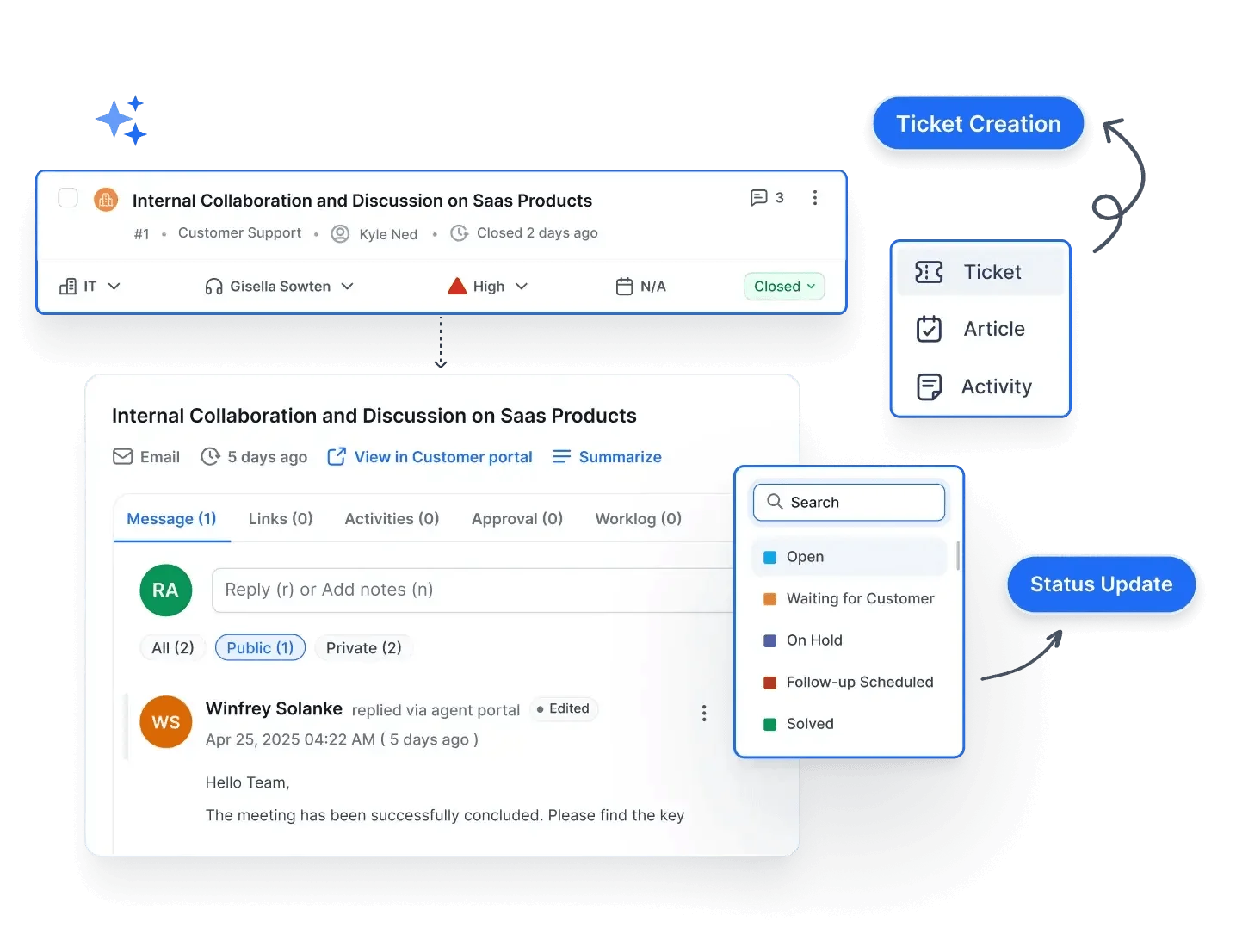
According to SuperOffice, companies that use dedicated customer service software can resolve tickets up to 35% faster and see higher customer satisfaction scores.
BoldDesk helps you encode those rules using:
Automated ticket routing and round-robin assignment
Automatically route new tickets to the right team or group based on predefined attributes, and assign them through round-robin distribution so no ticket remains unowned.
This reflects how our automated ticketing system handles routing in practice, ensuring faster response and clear accountability.
AI‑driven classification for clear ticket ownership
BoldDesk’s AI interprets customer messages, detects intent, and classifies each request so tickets start with the right owner instead of sitting unassigned.
AI Copilot provides conversation summaries and suggested replies, and it can help agents take next steps faster using AI-assisted actions (for example, drafting updates based on ticket context).
This helps agents take the next step quickly and maintain consistent ownership throughout the ticket.
Workflow automation for ownership and escalations
Automation runs actions when key events occur, such as ticket creation, priority updates, or ticket aging. Triggers keep tickets assigned through consistent routing and SLA‑based reminders.
Structured escalations and clear handoffs prevent stalled tickets and maintain ownership at every stage.
Reporting that reveals ownership gaps and stalled tickets
Track unassigned, aging, and escalated tickets so managers can spot ownership gaps early and fix the workflow.
Together, these features support faster ticket triage, smoother cross-team collaboration, and clearer handoffs across teams, so fewer tickets get stuck in limbo.
Building ticket ownership into your support workflow
A reliable support operation is built on clarity. When ticket ownership is unclear, work gets duplicated, updates stall, and escalations drift, often without one obvious “failure” to point to.
BoldDesk helps teams run this workflow with structured routing and workflow automation, so ownership is enforced by the system, not left to memory or guesswork.
Ready to standardize ticket ownership across teams and shifts? Start a free trial to configure routing and ownership rules.
Book a demo to map your real handoffs or contact us if you need help choosing the best setup.
Related articles
- 10+ Best Ticketing System Software for Customer Support in 2026
- 15 Best Email Ticketing Systems for Efficient Customer Support
Frequently asked questions
Ticket tagging supports classification by grouping issues for better routing and reporting. Ticket ownership ensures accountability by making one person responsible for the next action and customer update. Tags can enhance the workflow, but they cannot prevent delays when no clear owner is assigned.
Make ownership mandatory by auto‑assigning new tickets, defining a triage owner for each shift, and setting a rule that every ticket must always have an accountable owner.
There’s no universal number, but “as few as possible” is a good principle. Frequent reassignments usually signal unclear routing criteria, missing ownership rules, or weak handoff summaries.
Ticket bouncing is when a ticket is transferred back-and-forth between people/teams without clear criteria or a structured handoff. We can stop it with single-owner rules, transfer criteria, and a consistent handoff template so context doesn’t reset each time.