




TL;DR: The real choice between chatbot and live chat in 2026 is not bot or human. Route by query type: AI agents handle clear, system-based questions and actions; AI-assisted support handles exceptions; and people take emotional, disputed, or high-value issues. This guide shows where to draw the line.
Most articles comparing a chatbot vs live chat reach the same conclusion: use both. That advice is not wrong, but it leaves the key question unanswered: which customer queries should an AI chatbot handle, and which need a person?
That decision affects response times, support costs, customer satisfaction, and whether automation succeeds or fails. More importantly, it has less to do with the channel itself and more to do with the type of request being handled.
The answer is a routing decision, and you can make it in an afternoon. But first, there is one important reframe that changes the comparison entirely.
The comparison has changed: It is three tiers now, not two
Most guides compare a human agent against a scripted bot that follows a decision tree. That comparison is out of date.
Modern AI agents can interpret intent, use information from a knowledge base, and, when connected to the relevant systems, perform approved tasks such as checking an order or processing an eligible refund.
Unlike rule-based chatbots, which follow predefined scripts or decision trees, AI agents can respond to requests in context and take configured actions.
So the real options are:
| Tier | What it is | What it can do | What it costs to run |
| 1. AI Agent | Autonomous AI that answers and can act in your systems | Resolves the question end to end with no human involved | Lowest per contact |
| 2. AI-assisted human | A human agent with AI drafting replies, summarizing threads and suggesting knowledge | Handles judgment calls faster than an unassisted agent | Middle |
| 3. Human alone | An agent working without AI assistance | Full judgment, empathy, negotiation | Highest per contact |
Most teams need all three. The skill is knowing which query goes where, and that is a routing problem, not a software purchase.
Tier 1 is what our AI Agent does, tier 2 is AI Copilot and tier 3 is plain live chat software.
The routing table: Which query goes where
This is the part to bookmark. Route by the nature of the question, not by how busy your team is.
| Query type | Route to | Why |
| Order status, tracking, delivery date | AI agent | One correct answer, lives in a system, no judgment needed |
| Password reset, account access | AI agent | Deterministic, high volume, no emotional content |
| Opening hours, shipping costs, returns policy | AI agent | Static facts from your knowledge base |
| Product specifications and compatibility | AI agent | Factual, though escalate if the customer asks “will this work for my situation” |
| Refund within policy | AI agent if it can act, otherwise AI-assisted human | Deterministic only if the bot can actually process it |
| Refund outside policy | AI-assisted human | Requires a judgment call about an exception |
| Billing dispute | AI-assisted human | Needs account context and discretion |
| Technical troubleshooting, multi-step | AI-assisted human | The AI drafts steps, the human reads the situation |
| Pre-sale question on a considered purchase | AI-assisted human | Conversion matters more than deflection here |
| Complaint about service already received | Human alone | A bot in front of an angry customer compounds the problem |
| Cancellation or churn risk | Human alone | Retention conversations need judgment and authority |
| Anything involving health, money at risk, or legal exposure | Human alone | Regulatory and duty-of-care reasons |
| Accessibility needs or distressed customer | Human alone | No deflection layer, straight to a person |
| VIP or high-value account | Human alone | The relationship is worth more than the saved cost |
The rule underneath the table: If there is one correct answer and it lives in a system, automate it. If answering requires deciding whether to make an exception, a human decides. If the customer is upset, contested, or at risk, no bot goes in front.
What it costs: The honest comparison
Cost per contact is the number most decision makers actually want, and most articles skip it.
Published estimates put AI chatbot handling in the range of well under a dollar per ticket, against several dollars for a human-handled contact.
One 2026 comparison, AI Agent Square, puts AI chatbots at $0.30 to $1.00 per ticket with sub-two-second responses, against $5 to $15 per ticket for live chat support agents constrained by staffing schedules.
Against your own numbers, the calculation that matters is:
| Monthly saving = (Contacts automated) × (Human cost per contact − AI cost per contact) |
Three things that calculation usually misses:
- Setup and content cost: An AI agent is only as good as the knowledge base behind it. Budget for writing and maintaining that content, which is real work.
- The failed-deflection cost: A customer who fights a bot for five minutes and then reaches a human has cost you more than if they had gone straight to the human, because the agent now inherits a frustrated customer and a longer conversation.
- Ongoing governance: Someone has to review where the AI is giving incorrect answers and correct the underlying issue. Without this, quality decays quietly.
You can model the first part with our AI ROI calculator.
The honest case against automating too much
Most pages on this topic sell automation. Here is the counterweight, because it affects where you draw the line.
One report found that 63% of chatbot interactions did not resolve the customer’s issue (Solusian), while another found that 71% of customers preferred talking to a human agent rather than a chatbot (Complete AI Training).
What this means practically:
- Deflection rate is a vanity metric on its own: A bot that “resolves” 70% of chats by frustrating people into giving up looks identical in a dashboard to one that genuinely helps. Measure resolution quality and post-chat CSAT alongside deflection, never deflection alone.
- Always publish an escape route: A visible “talk to a person” option on every bot conversation. Hiding it raises deflection and lowers satisfaction, and customers remember the second one.
- Sector matters: Industries whose queries have a narrow set of known answers automate well. Industries whose queries need account-level judgment or emotional sensitivity do not. Look at your own top 20 query types before setting a target.
How to design the handoff
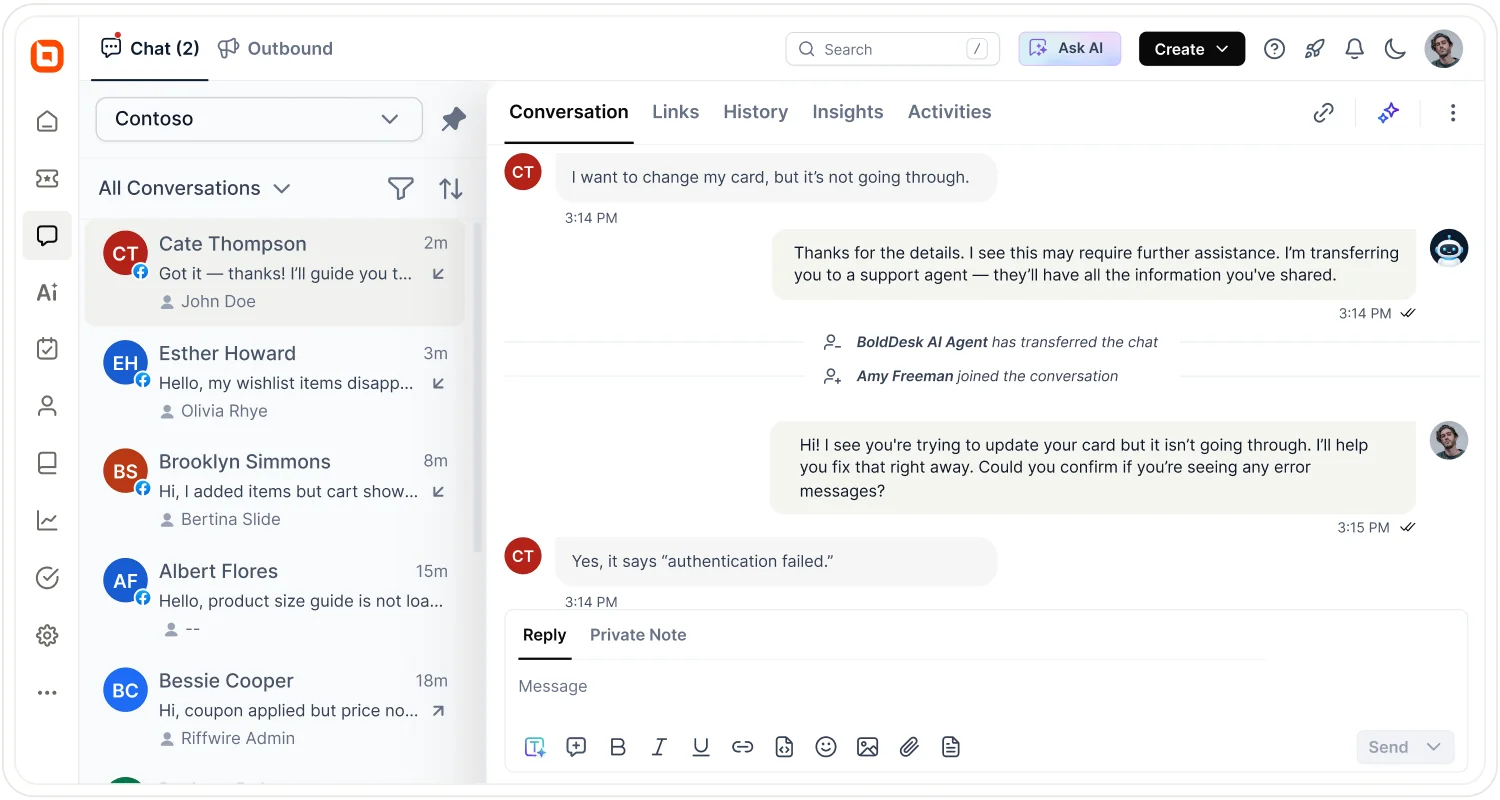
A support experience is only as strong as its handoff process. Even a capable AI agent can create frustration if conversations are transferred too late, without context, or without clear expectations.
Trigger the handoff early, not only after failure
Hand off when the customer asks for a human, the bot has failed twice on the same question, sentiment turns negative, the query involves money or account changes, or the customer repeats themselves.
Do not wait for the bot to exhaust every option.
Pass the full conversation context
The human agent should receive the transcript, previous bot actions, and relevant customer details before joining the conversation.
Asking customers to repeat information is one of the fastest ways to create frustration.
Set clear expectations during the transition
Tell customers that a human is joining, explain what will happen next, and provide an estimated wait time if possible. Silence during a handoff often feels like being ignored.
For the wording to use at each of these moments, see our live chat scripts library.
Where each option genuinely wins
The question is not which option is better overall, it is which option is best for a specific type of customer request.
Understanding these strengths makes it easier to build routing rules that improve resolution times, reduce costs, and avoid frustrating customers.
Before deciding where to route customer conversations, it helps to understand what each support model does best. AI agents, AI-assisted humans, and human-only support each excel in different situations.
Matching the query to the right option is what drives faster resolutions and better customer experiences.
AI agents are better at
- Volume: They handle a thousand simultaneous conversations as easily as one.
- Availability: Overnight and weekend coverage without a rota.
- Consistency: The same answer every time, which matters for policy questions.
- Languages: If the model supports the ones your customers use.
- Speed: On questions with a known answer.
Humans are better at
- Ambiguity: Working out what someone means when the question is badly phrased or incomplete.
- Exceptions: Deciding whether to bend a policy, which is a judgment no rule set covers.
- Emotion: Reading frustration and responding to it rather than around it.
- Persuasion: Pre-sale and retention conversations where the outcome depends on the relationship.
- Novel problems: Anything nobody wrote documentation for.
Both together are better at
- Peak load: The bot absorbs the routine spike so humans stay available for the complex ones.
- Cost control at scale: The only way to grow support volume without growing headcount proportionally.
- First response time: Instant acknowledgement even when every agent is busy.
A practical way to decide, in one afternoon
Rather than guessing which queries to automate, use your own support data.
A simple review of recent conversations can quickly reveal which requests belong with AI, which need human judgment, and where a hybrid approach makes the most sense.
- Export your last 500 conversations and tag each by query type.
- Sort by volume: The top 10 query types usually account for most customer contacts.
- Apply the routing table above to each of those top query types.
- Start with the top two automatable categories only. Order status checks and password resets are often the safest starting points.
- Measure results for a month: Track deflection rate, post-chat CSAT for automated conversations, and handoff rate using key live chat metrics.
- Expand only if customer satisfaction remains strong. If CSAT drops, you likely automated a type of query that requires human judgment.
This approach is more effective than buying software based on feature lists because it identifies what your support operation actually needs before you make a decision.
Once you know which query types you want to automate, compare the best AI chatbots for customer service to find a tool that fits your workflows and handoff requirements.
See all three tiers in one place
The goal is not to choose between AI and humans. It is to route each query to the option most likely to resolve it quickly and accurately.
When AI agents, AI-assisted agents, and human agents each handle the work they are best suited for, support becomes faster, more efficient, and easier to scale.
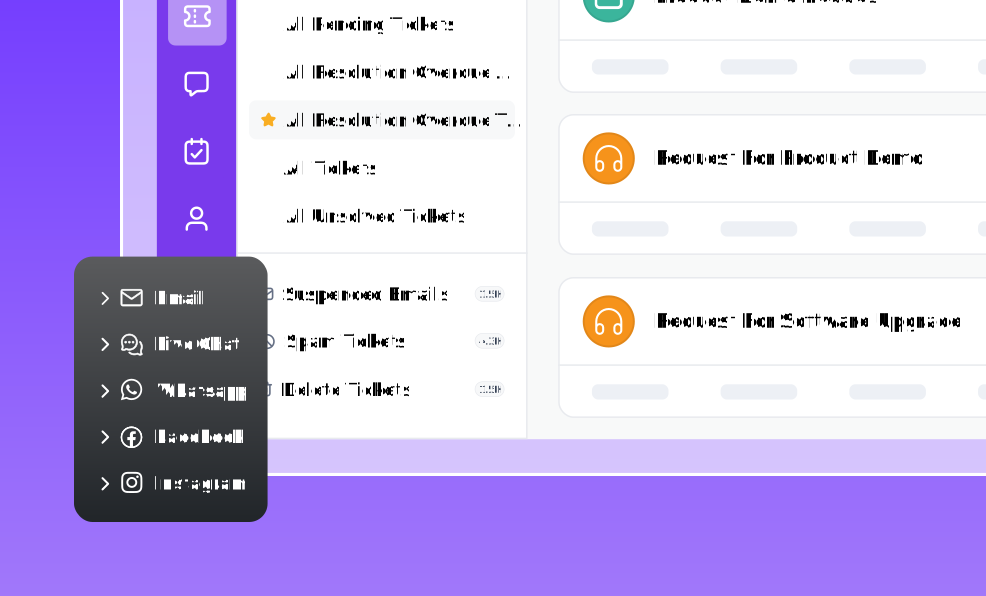
BoldDesk includes live chat, an AI agent that can act in your systems, and an AI copilot for your human agents, in one inbox. 15-day free trial, no credit card required.
Ready to put the right queries in the right hands? Start a free trial or book a demo.
Related articles
Frequently asked questions
Live chat connects a customer to a person in real time. A chatbot answers automatically. In 2026 the more useful distinction is three tiers rather than two: an AI agent that answers and can act in your systems, an AI-assisted human, and a human working alone.
Most teams need all three and route between them by query type.
Per contact, yes, usually by a wide margin. But the full cost includes building and maintaining the knowledge base behind it, governance time to review wrong answers, and the hidden cost of failed deflections where a frustrated customer reaches a human anyway.
Automate the high-volume, single-answer queries first, where the maths is clearly favorable.
Complaints about service already received, cancellations and churn conversations, anything touching health, legal exposure or money at risk, distressed customers, and high-value accounts.
In each case a bot in front of the customer makes the outcome worse, not cheaper.
An AI agent connected to your systems can handle questions that are complex in steps but have a definite answer, such as a multi-part order query.
It still cannot decide whether to make an exception to your policy, and that is the real dividing line, not complexity.
Usually, and increasingly they ask. Say so upfront and offer a visible route to a person. Attempting to pass off automation as human damages trust when it is discovered, and it usually is.
There is no universal figure, and chasing one is the wrong goal. A deflection rate achieved by frustrating people into abandoning the chat looks the same in a dashboard as one achieved by genuinely helping.
Track deflection alongside post-chat satisfaction on automated conversations and treat the pair as the measure.
Live chat first, in almost every case. You need to know what your customers actually ask before you can automate any of it, and the conversation transcripts from live chat are what you will use to train and scope the AI agent.