




TL;DR: The best AI chatbots for customer service automate customer conversations, answer common questions, collect information, and route complex issues to human agents. They help support teams improve response times, reduce repetitive work, and scale customer service across channels.
Customer service teams are under constant pressure to respond faster, handle growing ticket volumes, and remain available across channels.
AI chatbots have quickly become one of the most effective ways to meet these demands, helping businesses automate conversations while maintaining a consistent support experience.
Today’s best AI chatbots for customer service can answer common questions, guide customers to relevant resources, collect information, and connect users with human agents when required.
While organizations adopt a wide range of AI-powered support technologies, conversational chatbots continue to be one of the most practical and accessible applications of AI agents in customer service.
This guide compares the leading AI chatbot platforms built for customer service, focusing on conversational bots that automate customer interactions and support requests.
What is an AI chatbot for customer service?
An AI chatbot for customer service is a software application that uses natural language processing and machine learning to understand customer questions and automate support tasks.
It can answer FAQs, capture intent and customer details, route or create tickets, and hand off to a human agent when needed across chat and messaging apps.
What are the benefits of using AI chatbots for customer service?
AI chatbots help businesses deliver consistent support by automating routine interactions while supporting human agents where needed.
Here are the key benefits:
- Enables always-on customer support: AI chatbots provide 24/7 assistance, ensuring customers receive help instantly without waiting for business hours or agent availability.
- Delivers faster response and resolution times: By handling common questions and gathering context upfront, AI chatbots reduce wait times and speed up issue resolution.
- Lowers support costs: Chatbots automate repetitive inquiries, allowing teams to scale without proportionally increasing staffing costs.
- Improves agent productivity: By deflecting repetitive tickets, chatbots enable agents to focus on complex issues that require human judgment and empathy in customer service.
- Scales instantly during peak demand: AI chatbots can handle high conversation volumes simultaneously, making them ideal during outages, promotions, or seasonal spikes.
How to choose the best AI chatbot for customer service
Selecting the best AI chatbots for customer service goes beyond evaluating surface‑level features.
Here are key factors to consider:
- Accuracy and intent handling: Evaluate how well the chatbot understands customer questions and responds with relevant, context‑aware answers.
- Knowledge retrieval: Check whether the chatbot can accurately pull information from your FAQs, documentation, and internal knowledge base.
- Integrations and workflows: Assess how easily the chatbot connects with your CRM, ticketing systems, calendars, and other business tools, and whether it supports AI chat automation.
- Agent handoff and observability: Confirm that conversations can be smoothly transferred to human agents and that teams can track and review interactions.
- Team collaboration: Look for features that help agents work together, such as shared inboxes, task assignment, and internal notes.
- Pricing and scalability: Ensure the pricing fits your budget and can scale as support demand grows.
- Deployment and maintenance: Assess how easy it is to launch, train, and update the chatbot. No‑code or low‑code setup is important for non‑technical teams.
- Security and compliance: Check whether the platform meets your industry’s security and compliance requirements, such as data protection and access controls.
- Autonomous actions: Determine whether the chatbot only answers questions or can also take action, such as updating tickets, triggering workflows, or completing tasks.
If you’re evaluating action-oriented automation, our guide on AI agent vs chatbot explains the differences between conversational assistants and autonomous AI systems.
Comparison table of the best AI chatbots for customer service
The table below highlights the top AI chatbots for customer service to help you quickly identify the solution that best fits your organization.
The AI chatbot tools featured in this comparison were evaluated based on their support-specific AI capabilities, including intent recognition, knowledge retrieval, and workflow automation.
Selection criteria also included integration depth, scalability, pricing transparency, and validated user feedback from trusted platforms such as G2.
| Platform | Key features | Pricing starts at | G2 ratings | Capterra |
| BoldDesk’s AI chatbot |
|
$99/month for 5 agents, up to 500 credits | 4.5/5 | 5.0/5 |
| Drift AI chatbot |
|
Contact sales | 4.4/5 | 4.5/5 |
| LiveAgent AI chatbot |
|
$10/agent/month | 4.5/5 | 4.7/5 |
| Zoho Desk AI chatbot |
|
$7/agent/month | 4.4/5 | 4.5/5 |
| ChatBot.com |
|
$19/agent/month | 4.5/5 | 4.6/5 |
| Freshdesk AI chatbot |
|
$19/agent/month | 4.4/5 | 4.5/5 |
| LiveChat AI chatbot |
|
$19/agent/month | 4.5/5 | 4.6/5 |
| HappyFox AI chatbot |
|
$24/agent/month | 4.5/5 | 4.5/5 |
| ProProfs Chat AI chatbot |
|
$19.99/agent/month | 4.5/5 | 4.9/5 |
| HubSpot AI chatbot |
|
$7/agent/month | 4.4/5 | 4.4/5 |
If you’re evaluating broader support platforms that combine AI, ticketing, automation, and customer service management, explore our AI customer service software comparison.
AI Help Desk Built for Modern, Growing Teams
Automate repetitive tasks, enhance agent productivity, and deliver consistently great service with AI-powered support.
The best AI chatbots for customer service
The list below highlights leading AI chatbot tools for support teams, each offering different capabilities to manage conversations at scale.
1. BoldDesk AI chatbot solution
Best for customer service teams looking to automate support with AI agents while maintaining strong human agent control.
BoldDesk is one of the best AI chatbots designed for small, mid-sized, and large businesses.
It combines AI chatbots with live chat and ticketing to help teams deliver reliable customer service experiences.
Powered by conversational AI and natural language processing, this solution helps automate common customer questions, guide users through self‑service, and route complex issues to human agents when needed.
What makes BoldDesk AI chatbot powerful?
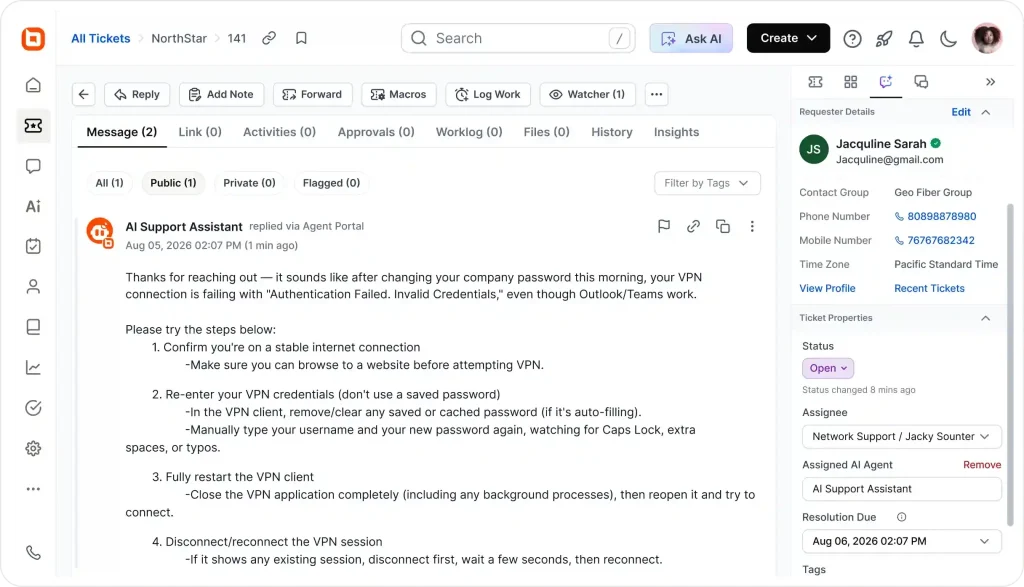
- Context-aware conversations: Uses knowledge base content, web pages, uploaded files, and Q&A data to generate relevant responses.
- 24/7 automated support: Provides round‑the‑clock assistance so customers can get help at any time.
- Live chat integration: Delivers AI responses in live chat and smoothly escalates conversations to human agents when needed.
- Training and customization: Admins can control the bot’s training sources and conversation behavior to match the company’s tone.
- AI Actions: Triggers automated tasks and workflows through secure integrations.
- AI Copilot: Assists human agents in working faster with real-time responses and knowledge suggestions.
- Omnichannel support: Unifies conversations across channels, including chat, ticketing, and messaging channels in a single inbox.
- Scalability: Multi-agent AI systems can be configured for different departments, teams, or use cases.
Key features: 24/7 AI-powered support, live chat, multi-channel ticketing, third-party integrations, and customizable automation workflows.
BoldDesk pros
- Supports a hybrid support model where AI handles routine conversations while human agents seamlessly take over complex issues within the same support environment.
- AI responses can be grounded in multiple sources, including knowledge base articles, website content, uploaded files, and custom Q&A data.
Cons
- AI capabilities may require additional credits or add-ons as automation usage grows.
Pricing
- Starts at $99/month for 5 agents
For a complete breakdown of pricing tiers and all available capabilities, explore the full BoldDesk pricing details.
Customer reviews on BoldDesk
“BoldDesk provides an easy-to-use ticketing system with strong audit trails, helpful knowledge base articles, and a convenient SSO login for users. Its customization options allow unique branding, and the pricing is very attractive for the features offered; currently, there’s nothing significant to dislike as it meets all ticketing needs.” Source
2. Drift AI chatbot
Best for both website visitor engagement and basic customer service conversations.
Drift is a conversational AI platform that combines live chat and chatbot automation to engage website visitors in real time.
While it is best known for lead qualification and sales conversations, it can also handle common customer inquiries, route requests, and connect customers with the appropriate team through automated chat workflows.
Key features: Real-time conversational AI, intelligent chat routing, conversational playbooks, lead qualification, meeting booking, CRM integrations, and analytics.
Pros
- Drift is strong at handling real‑time website conversations and routing inquiries.
- CRM integrations support conversation tracking and handoff.
Cons
- Customer support use cases are secondary to sales and marketing objectives.
Pricing: Contact sales.
Customer reviews on Drift
“Drift is a powerful platform that enables real-time conversations with potential customers at the moment of highest interest, replacing forms and delayed follow-ups with natural, personalized website chats. Its automation and chatbot features excel at qualifying visitors and routing them to the right person, allowing sales teams to focus on serious prospects.” Source
3. LiveAgent AI chatbot
Best for teams that want to add AI assistance to a traditional help desk with live chat and ticket-based support.
LiveAgent AI chatbot is a help desk-integrated AI chatbot designed to automate FAQs and ticket routing within an all-in-one customer service platform.
Key features: Autonomous AI responses, multilingual support, knowledge base integration, lead capture, seamless human handoff, and unified chat interface.
Pros
- Combines AI-assisted conversations with ticketing and call center capabilities.
- The platform supports a variety of communication channels in one dashboard.
Cons
- The interface can feel complex for teams seeking light or no-code setups.
Pricing: Starts at $10/agent/month.
Customer reviews on LiveAgent
“It’s great that we can easily direct the chatbot to support our efforts by answering frequently asked questions and providing a constant point of contact for customers to submit feedback and automatically document it at any time.” Source
4. Zoho Desk AI chatbot
Best for businesses already using the Zoho ecosystem that want AI assistance tightly integrated with Zoho CRM and support tools.
Zoho Desk’s AI chatbot, powered by Zia, is designed to support basic automation, intent detection, and routing while integrating with Zoho Desk and Zoho CRM for a unified customer context.
The chatbot can automate responses, capture visitor data, and integrate with Zoho CRM for streamlined sales processes.
Key features: Customizable chatbot builder, visitor tracking, CRM integration, and an analytics dashboard.
Pros
- Zoho combines AI chat, ticketing, and CRM under a single integrated ecosystem.
- Zia AI assists with intent detection, routing, and agent productivity.
Cons
- AI responses and conversational quality lag CX-focused AI platforms.
Pricing: Starts at $7/agent/month
Customer reviews on Zoho Desk
“Zoho Desk feels modern compared to Kayako and offers more features, including built-in AI for smarter support. However, its chatbot functionality is locked behind upper-tier plans, and while the abundance of options is useful, it can make the platform a bit complicated to use.” Source
5. ChatBot.com
Best for businesses looking to automate routine customer support inquiries across multiple channels.
ChatBot.com is an AI-powered customer service chatbot that helps businesses automate customer conversations, answer common questions, and provide around-the-clock support.
Using natural language processing (NLP), it can handle routine inquiries, collect customer information, and transfer conversations to human agents when needed.
Key features: AI-powered customer support, automated FAQ handling, omnichannel support, lead capture, human handoff, integrations, and analytics.
Pros
- Handles common support requests such as FAQs and order status inquiries automatically, helping reduce agent workload.
- Supports seamless escalation to human agents when questions require personalized assistance.
Cons
- Businesses with highly complex support workflows may need additional customization and integrations.
Pricing: $19/agent/month
Customer reviews on ChatBot.com
“The ease of setting responses and actions, simplifying solutions and also responses, and making employees’ daily work easier.” – Valeria M.
6. Freshdesk AI chatbot
Best for growing businesses seeking AI-powered automation within a broader customer support platform.
Freshdesk Freddy AI powers chatbots that automate customer interactions across web, mobile, and messaging platforms.
The AI-powered chatbot handles FAQs, session-based conversations, and integrates seamlessly with Freshdesk’s help desk and CRM for a unified support experience.
Key features: Omnichannel messaging, AI-powered self-service, agent Copilot, workflow automation, and analytics dashboard.
Pros
- Integration with the Freshworks ecosystem, including CRM and ticketing tools.
- Bot-to-agent handoffs feel easy and are managed within messaging workflows.
Cons
- AI functionality feels supplementary rather than core to the platform’s overall design.
Pricing: Starts at $19/agent/month.
Customer reviews on Freshdesk
“Freshdesk’s approachable UI makes setup and navigation smooth, while its ticket management features streamline support and escalations, saving time. The addition of Freddie AI for ticket summarization and response assistance is promising, though its accuracy still needs improvement, indicating room for refinement.” Source
7. LiveChat AI chatbot
Best for companies that prioritize live chat-first support with AI assistance to handle common questions.
LiveChat AI is a customer communication platform that includes the ChatBot AI builder, which uses machine learning and pre-trained conversational templates.
The ChatBot AI builder enables automated handling of customer queries while allowing support agents to intervene when necessary, saving time and improving efficiency.
Key features: Customizable chat widgets, AI ChatBot builder, CRM integration, and advanced reporting tools.
Pros
- Provides a live chat experience with AI-assisted features that help agents respond to customer inquiries.
- The platform integrates with popular CRMs, help desks, and messaging channels.
Cons
- AI capabilities are primarily focused on agent-assisted rather than fully autonomous conversational AI for SaaS companies.
Pricing: Starts at $19/agent/month.
Customer reviews on LiveChat
“LiveChat is an invaluable tool for automating customer support, saving time and reducing staffing costs. Its intuitive interface and customization options make it easy to tailor to our needs, though understanding the ChatBot integration was initially challenging.” Source
8. HappyFox AI chatbot
Best for support teams that need AI-assisted ticket handling and automation within structured help desk workflows.
HappyFox offers a chatbot powered by AI that integrates with its live chat platform.
This integration allows teams to effectively respond to customer inquiries, manage tickets, and provide instant support with improved messaging features.
Key features: Integrated live chat, instant ticket creation, workflow automation, and multi-channel support.
Pros
- HappyFox offers a help desk with AI-assisted ticket categorization and automation.
- The platform provides omnichannel support across email, chat, and social channels.
Cons
- Customization and reporting depth require higher-tier plans.
Pricing: Starts at $24/agent/month (Unlimited agents, 500 chats per month).
Customer reviews on HappyFox
“HappyFox Chatbot makes handling repetitive queries effortless with its Canned Responses feature, which speeds up response times significantly. Another standout is its smooth integration with the ticketing system; conversations can transition into tickets seamlessly, ensuring complex issues are tracked and resolved without customers repeating themselves. However, one area that could be improved is its ability to manage nuanced or multi-part queries.” Source
9. ProProfs Chat
Best for small to mid-sized teams looking for an easy-to-set-up chatbot connected to knowledge bases and FAQs.
ProProfs chatbot is an AI-powered tool that automates customer interactions on websites, helping businesses provide instant responses and qualify leads.
The AI chatbot works through a simple drag-and-drop builder, letting you create conversational flows, set triggers, and route complex queries to human agents.
Key features: 24/7 support, AI chatbot integration with CRM, customizable FAQ templates, and lead generation.
Pros
- Easy to deploy and use, making it suitable for small teams looking for AI-assisted live chat.
- Built-in automation supports basic FAQs and visitor engagement.
Cons
- Advanced integrations and workflow automation options are minimal.
Pricing: Starts at $19.99/agent/month.
Customer reviews on ProProfs
“ProProfs Chat is easy to set up on a website and has significantly improved agent performance and KPIs since implementation. However, adding advanced chatbot capabilities for faster responses and features like sneak peek between agents, supervisors, and customers would make it even better.” Source
10. HubSpot
Best for businesses using HubSpot that want AI chat functionality connected to CRM and customer interaction tools.
HubSpot’s AI chatbot is available through its Chatflows builder within the Conversations and Service Hub tools.
It enables teams to answer common customer questions, route chats to agents, and create support tickets directly within the HubSpot ecosystem.
The chatbot integrates natively with HubSpot CRM, allowing teams to use customer data and interaction history to deliver more personalized support experiences.
Key features: CRM-integrated chatbot builder, automated FAQ handling, ticket creation, live chat handoff, and multi-channel inbox support.
Pros
- HubSpot integrates AI chatbots with CRM, marketing, and service workflows.
- Automation is especially effective for lead qualification and customer lifecycle tracking.
Cons
- Customer support AI is secondary to sales and marketing use cases.
Pricing: Free plan available with basic AI chatbot functionality. Paid plans start at $7/agent/month (billed annually).
Customer reviews on HubSpot
“HubSpot Service Hub is incredibly easy to use, with simple chat flows and quick AI setup that make getting started effortless. However, one area for improvement is giving users more control over the AI chatbot, such as customizing responses and managing handover options to human agents.” Source
Enhancing customer experiences with the best AI chatbots for customer service
AI chatbots have become a core part of modern customer service, helping support teams respond faster, automate repetitive questions, and deliver value across channels.
With a wide range of AI chatbot platforms available, businesses can choose solutions built specifically for customer service automation and agent assistance.
Platforms such as BoldDesk are commonly used by teams looking to reduce ticket volume while keeping human agents involved in complex or high‑value interactions.
If you’re exploring AI chatbots for customer service, start a 15-day free trial to understand how our solution can fit your customer service workflows.
Found this article useful? Share your thoughts or experiences in the comments.
Related articles
- Difference Between Chatbot vs Live Chat (2026 Guide)
- Conversational AI for Customer Service: Types & How it Works
- How Agentic AI Is Transforming Customer Experience in 2026
FAQs
AI chatbots use natural language processing and machine learning to understand intent and respond dynamically, while rule-based chatbots rely on predefined scripts and decision trees. AI chatbots are better suited for complex customer service scenarios and evolving knowledge bases.
AI chatbots generally fall into four main types:
- Rule-based chatbots: Follow predefined rules or keywords and handle simple, predictable questions.
- Retrieval-based chatbots: Pull answers from approved sources like FAQs or help articles.
- AI-powered chatbots: Use NLP and large language models to understand intent and generate flexible responses.
- Hybrid chatbots: Combine rules, retrieval, and AI to balance accuracy, control, and flexibility.
AI chatbots use natural language processing (NLP) to understand customer intent and then generate responses using predefined rules, machine learning models, or large language models (LLMs).
In customer service, AI chatbots often connect to knowledge sources through search or retrieval-augmented generation (RAG) and can trigger actions, such as ticket creation or updates, through integrations with other systems
Yes. Leading AI chatbot platforms follow security best practices such as data encryption, secure APIs, role-based access controls, and compliance with standards like GDPR or HIPAA, depending on the industry.
AI chatbots are widely used across industries such as e-commerce, finance, healthcare, travel, SaaS, education, and telecommunications.
They help organizations provide 24/7 customer support and handle high-volume inquiries efficiently.
Many AI chatbots deliver multilingual customer support by detecting and responding in multiple languages.
This allows businesses to provide customer service across regions while maintaining consistent quality standards.