




TL;DR: AI customer service in healthcare can automate administrative tasks such as appointment scheduling, billing inquiries, and patient support while improving response times and efficiency. To maintain HIPAA compliance and protect PHI, healthcare organizations should establish clear AI boundaries, use human oversight for clinical interactions, and implement secure, compliant workflows.
Patients reach out to healthcare organizations for many reasons, including appointment changes and billing questions. While timely responses are important, they should never compromise privacy or clinical safety.
AI customer service in healthcare can handle routine administrative requests, improve access to support, and reduce pressure on staff.
However, not every patient interaction should be automated. Workflows involving PHI, medical advice, urgent concerns, or sensitive decisions require clear safeguards and human oversight.
This guide explains how AI customer service in healthcare works, how HIPAA and PHI affect its use, where automation adds value, and when human expertise should take over.
What is AI customer service in healthcare?
AI customer service in healthcare refers to the use of artificial intelligence to support patient-facing and administrative interactions.
These systems help healthcare organizations respond to inquiries, automate repetitive tasks, and provide timely support across digital channels.
Unlike traditional support tools that rely on predefined workflows, modern AI agents in customer service systems use natural language processing (NLP) to interpret user intent. They can then retrieve approved information and generate relevant responses.
How HIPAA, PHI, and BAAs affect AI customer support for healthcare
AI can help healthcare organizations improve patient support, but they must use it within strict privacy and compliance requirements.
HIPAA compliance applies to covered entities and their business associates. Protected health information (PHI) is individually identifiable health data created or received by a covered entity or business associate and maintained or transmitted in any form.
For a detailed overview of HIPAA and related obligations, see our HIPAA compliance guide.
When an AI vendor creates, receives, maintains, or transmits PHI on behalf of a covered entity, it generally functions as a business associate. A compliant business associate agreement (BAA) must therefore be in place before PHI is disclosed to the vendor.
A BAA alone does not make an AI workflow compliant; organizations must also conduct a risk analysis and configure appropriate access, security, retention, monitoring, and incident-response controls.
Why AI customer service in healthcare matters
The healthcare industry faces a unique combination of operational and service challenges that make AI for healthcare a valuable tool for improving patient support.
AI customer support in healthcare helps address these challenges by automating routine tasks, improving responsiveness, and enabling support teams to deliver better patient experiences at scale.
- Meeting rising patient expectations: According to Experian Health’s 2025 State of Patient Access Survey, 80% of patients want to schedule appointments anytime from their home or mobile device. AI-enabled self-service can help healthcare organizations provide more convenient scheduling and support outside traditional business hours.
- Addressing staffing and operational challenges: Healthcare organizations often manage growing support volumes with limited resources. AI can automate routine inquiries, helping teams reduce administrative workloads and focus on more complex patient needs.
- Expanding access to support: Patients may need assistance at any time, not just during business hours. AI-powered support tools can provide 24/7 customer service for common administrative requests, improving accessibility and responsiveness.
Where AI can support healthcare customer service effectively
When safeguards are in place, AI can automate many administrative and low-risk healthcare support tasks.
Across industries, Gartner predicts that by 2029, agentic AI will autonomously resolve 80% of common customer service issues without human intervention.
While this isn’t a healthcare-specific benchmark, it highlights AI’s potential to streamline routine support and improve efficiency.
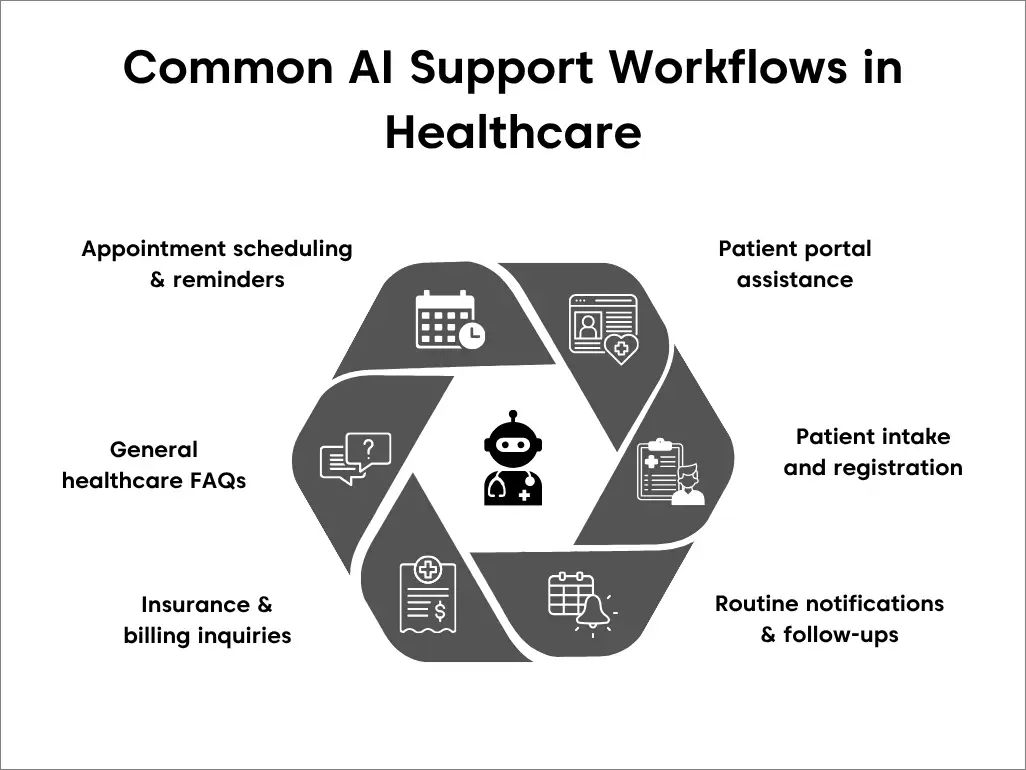
Appointment scheduling and reminders
AI-powered tools can help patients book, reschedule, or cancel appointments, check provider availability, and receive automated reminders.
This reduces administrative workloads while making it easier and more efficient for patients to access care.
Real-world example
Mayo Clinic uses generative AI to extract and summarize information from incoming referrals for staff review. The clinic reports that referrals for patients with serious or complex conditions are now reviewed and processed in less than 24 hours.
In one documented case, the system flagged an urgent referral, enabling staff to contact the patient immediately and schedule appointments across multiple specialties the following day.
General healthcare FAQs
Patients frequently contact healthcare organizations with basic questions about office hours, locations, accepted insurance plans, available services, and contact information.
AI in healthcare support can provide instant answers to these common questions, helping patients find information quickly while reducing routine support requests.
Insurance and billing inquiries
Healthcare AI can assist patients with common billing and insurance questions, such as payment options, claim statuses, and coverage details.
However, because these interactions often involve PHI, healthcare organizations should implement appropriate privacy controls, access restrictions, and escalation processes to ensure compliance and protect patient data.
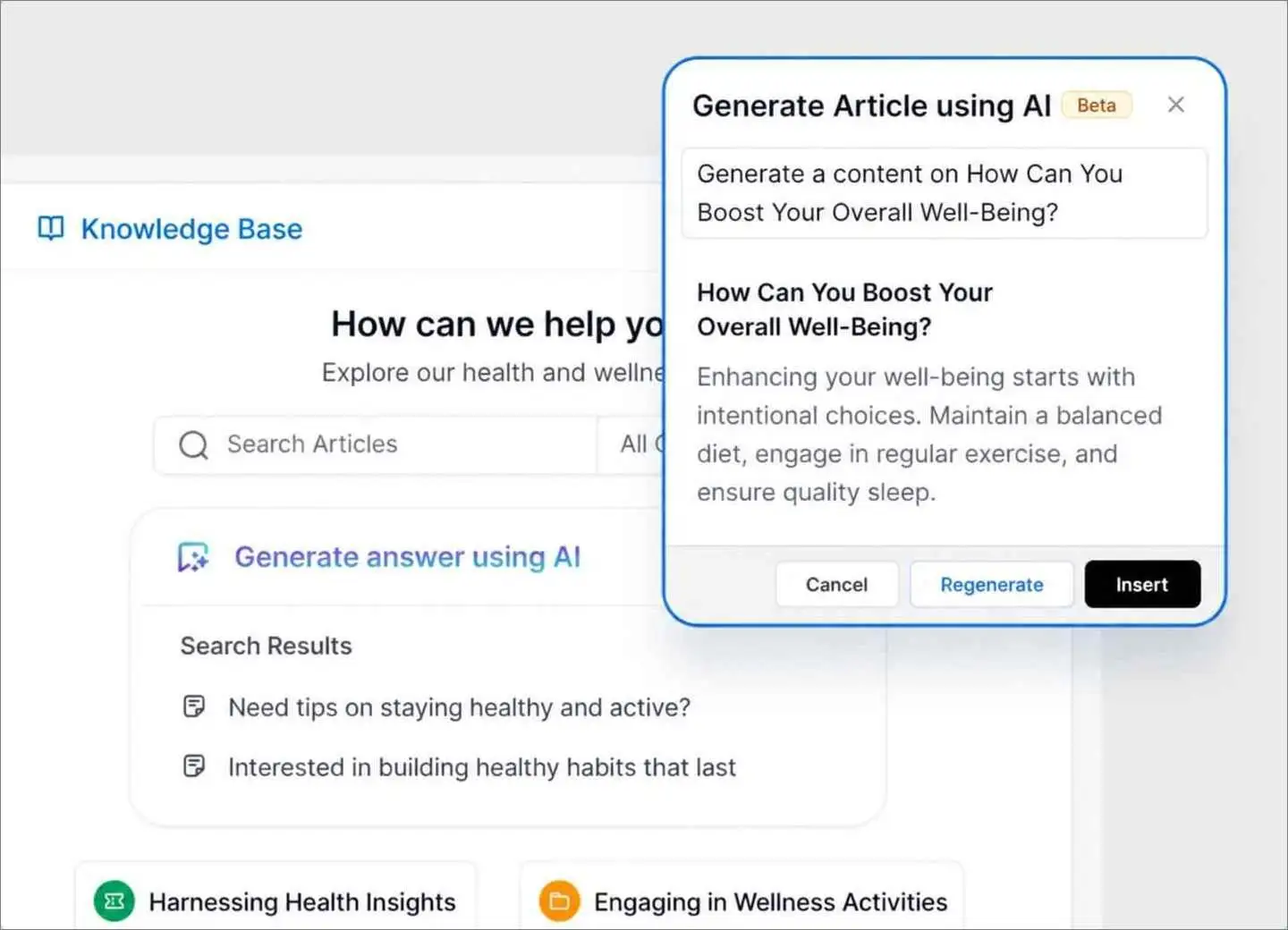
Patient portal assistance
Many patients need help navigating online portals, accessing accounts, resetting passwords, uploading documents, or locating information.
AI-powered assistants can guide patients through these processes, improving customer self-service adoption and reducing support wait times.
Real-world example
Vanderbilt Health introduced an AI assistant within its patient portal to help patients communicate more effectively with their care teams.
The assistant asks relevant follow-up questions and prepares a draft message that patients can review, edit, or reject before sending. Importantly, it does not provide medical advice, and clinicians remain responsible for responding to patients.
Patient intake and registration
Conversational AI for healthcare can simplify the intake process by collecting administrative information, verifying details, and guiding patients through required forms before appointments.
With appropriate safeguards, AI can reduce paperwork, improve data accuracy, and create a more efficient patient experience.
Routine notifications and follow-up communications
Healthcare organizations can use AI to send appointment reminders, registration confirmations, wellness updates, satisfaction surveys, and post-visit follow-up messages.
Automating these communications helps healthcare organizations deliver more consistent, timely patient outreach.
Where human expertise should take over in customer support for healthcare
AI can support customer service in healthcare, but some interactions require clinical judgment, human empathy, or careful interpretation of sensitive information.
A human-in-the-loop AI model helps organizations define when AI can proceed independently and when human review is required.
Healthcare organizations should establish clear escalation paths whenever conversations move beyond routine administrative support.
- Medical advice and treatment decisions: Healthcare AI should not provide diagnoses, treatment recommendations, or clinical guidance on its own.
- Emergency and urgent situations: Organizations should establish clear escalation protocols that direct patients to emergency services, emergency departments, or approved clinical care pathways when urgent intervention may be required.
- Sensitive patient concerns: Complaints involving care quality, emotional distress, or complex service issues often require empathy in customer service and personalized support that AI cannot fully provide.
- Complex healthcare decisions: Cases involving multiple care providers, treatment coordination, or high-risk outcomes should remain under human supervision.
Common risks of AI-powered customer support for healthcare (and solutions)
While AI customer support for healthcare can improve efficiency and accessibility, healthcare organizations must carefully manage the risks of handling sensitive patient information and support interactions.
AI hallucinations and misinformation
AI systems can occasionally generate inaccurate or unsupported responses. In healthcare, inaccurate information can have serious consequences, making oversight and verification essential.
To reduce the risk of AI hallucinations, healthcare organizations should ensure AI responses are grounded in approved knowledge sources and regularly reviewed by qualified personnel.
Privacy and security concerns
Without strong security and compliance measures, healthcare AI systems can increase the risk of unauthorized access, data exposure, or improper handling of protected health information (PHI).
Implementing secure access controls, encryption, and ongoing monitoring is essential to protecting patient privacy and data security.
Compliance violations
Misconfigured AI customer service systems used in healthcare can create compliance risks by exposing PHI, retaining sensitive data inappropriately, or processing information beyond approved use cases.
Healthcare organizations must establish clear policies, controls, and oversight mechanisms to ensure AI usage aligns with HIPAA requirements and internal compliance standards.
Bias and fairness concerns
The quality of conversational AI responses depends heavily on the data used to train and inform the system. If underlying data contains biases or gaps, AI may deliver inconsistent, inaccurate, or unfair support experiences.
Regular testing and auditing can help organizations identify potential biases and maintain equitable service for all patients.
Patient trust challenges
Patients need confidence that their information is handled responsibly and that AI enhances, not compromises, their care experience.
Being transparent about how AI is used, protecting patient data, and providing access to human support when needed can help organizations build and keep that trust.
Best practices for implementing AI in healthcare support
In McKinsey’s fourth-quarter 2024 survey of 150 U.S. healthcare leaders, 85% of respondents reported that their organizations were exploring or had already adopted generative AI capabilities.
Implementing AI in healthcare support requires more than selecting the right technology.
Healthcare organizations must establish clear governance, compliance safeguards, and operational processes to ensure AI improves patient experiences without introducing unnecessary risks.
The following best practices can help healthcare teams deploy AI responsibly while sustaining patient trust, privacy, and service quality.
Start with administrative workflows
Healthcare organizations should begin with low-risk, non-clinical use cases that deliver immediate value.
Tasks such as appointment scheduling, FAQs, billing inquiries, patient portal assistance, and routine notifications are ideal starting points.
These workflows carry less clinical risk than diagnosis or treatment decisions. However, they may still involve PHI and require identity verification, access controls, and a HIPAA-compliant ticketing system with appropriate safeguards.
Establish AI guardrails and escalation workflows
Define what AI for healthcare support can handle, what information it can access, and when to transfer conversations to human staff.
Clear guardrails and escalation management help protect patients’ safety, ensure compliance, and ensure patients receive appropriate support.
Use verified healthcare knowledge sources
AI should rely on approved healthcare resources, internal policies, and verified knowledge bases rather than generating responses without trustworthy references.
This reduces the risk of misinformation and improves response accuracy.
Evaluate vendors that handle PHI
Before deploying an AI for healthcare solution, assess how vendors protect PHI, manage data retention, support audit requirements, and respond to security incidents.
If the solution handles PHI on behalf of a covered entity, confirm that the vendor will sign a BAA. The vendor must also support the HIPAA requirements that apply to your organization.
These AI support vendor questions can help healthcare teams assess security, governance, escalation, and implementation requirements before choosing a platform.
Train teams on responsible AI usage
Employees play a critical role in the success of AI initiatives. Ensure teams understand the capabilities and limitations of AI in healthcare support, how escalation processes work, and their role in ensuring compliance and patient trust.
Continuously monitor performance and compliance
AI implementation is not a one-time project. Healthcare organizations should regularly review conversations, track performance metrics, and audit responses for accuracy, compliance, and patient satisfaction.
Ongoing monitoring helps identify knowledge gaps, detect potential risks, and uncover opportunities to improve both AI performance and the overall support experience.
The future of AI in customer service for healthcare
AI capabilities continue to evolve, particularly in areas such as voice support, workflow automation, and personalized patient engagement.
However, no matter how advanced AI becomes, healthcare organizations will still need strong governance, human oversight, and compliance controls to protect patient information and maintain trust.
Disclaimer: This article is informational only and should not be considered legal or compliance advice. Healthcare organizations should consult qualified professionals for HIPAA and AI implementation decisions.
Build patient trust with secure AI customer service in healthcare
AI customer service in healthcare can improve response times, reduce administrative workloads, and enhance patient experiences.
However, successful adoption requires clear boundaries around what AI can handle, strong PHI safeguards, and human oversight for sensitive patient interactions.
BoldDesk supports healthcare service teams with a secure healthcare help desk, structured ticket management, role-based access, audit trails, encryption, and HIPAA-focused configuration options.
In HIPAA mode, AI services and certain communication features are disabled to help protect ePHI.
Start your free trial to explore BoldDesk’s core support capabilities. Before entering ePHI, contact the BoldDesk support team to review BAA availability and configure HIPAA mode for your organization.
Related articles
- AI Agent Autonomy Levels: 5 Stages and When to Use Each
- 7 AI Customer Support Challenges (and Proven Fixes for 2026)
- What Is Conversational AI for Customer Service? Use Cases and Benefits
Frequently Asked Questions
PHI is identifiable patient information related to health conditions, treatments, or healthcare services that HIPAA requires healthcare organizations to protect.
AI may access patient information only within approved, secure, and compliant workflows that meet applicable HIPAA requirements and organizational policies.
AI itself is not automatically HIPAA compliant. Compliance depends on how technology is configured, managed, secured, and governed.
The main risks of AI in healthcare support include hallucinations, data privacy issues, compliance violations, bias, and loss of patient trust if systems are not properly monitored.
When an AI vendor creates, receives, preserves, or transmits PHI on behalf of a covered entity, it generally acts as a business associate. A BAA must be in place before disclosing PHI to the vendor.
Healthcare organizations should evaluate how vendors protect PHI, support HIPAA compliance, integrate with existing systems, and monitor AI activity. They should also confirm that staff can take over complex interactions.
Asking the right questions during vendor evaluation can help reduce compliance and operational risks.


