




TL;DR: AI agent autonomy levels range from assisted AI to self-directed autonomous systems. As autonomy increases, AI moves from providing information to recommending decisions, executing approved actions, managing bounded workflows, and pursuing broader goals. Higher autonomy requires stronger governance, monitoring, and clearly defined human intervention.
How much should an AI agent be allowed to do on its own? Summarizing a support ticket is very different from independently updating a customer account, especially in terms of authority, risk, and human oversight.
AI agent autonomy levels describe these differences in how much decision-making and execution authority AI receives. As AI agents in customer service gain more autonomy, organizations need to decide where human approval, monitoring, and operational boundaries should remain.
For a broader explanation of how autonomous agents work in customer support, see our autonomous agents in customer support article.
This guide focuses specifically on the five levels of AI agent autonomy, how authority and human oversight change at each autonomy level, and how to choose the right level for different tasks and workflows.
5 AI agent autonomy levels at a glance
AI agent autonomy exists on a spectrum, from agents that assist with tasks to agents that can execute workflows with increasing independence.
The table below shows what the AI is capable of at each autonomy level and how human involvement evolves as autonomy increases.
| Level | Who sets the goal? | What the AI can do | Human role |
| 1. Assisted AI | Human sets each task | Provides information or content when prompted | Directs the work and takes all actions |
| 2. Advisory AI | Human sets the task goal | Analyzes information and recommends next steps | Makes the decision and approves the action |
| 3. Human-approved execution | Human sets the goal | Completes multi-step work but pauses for approval on important actions | Approves key actions and handles exceptions |
| 4. Bounded autonomous AI | Human defines the workflow goal and limits | Completes tasks independently within defined rules | Monitors results and handles exceptions |
| 5. Self-directed autonomy | Human sets the objective; AI defines the tasks | Decides what work is needed and adapts its approach | Monitors outcomes and intervenes when needed |
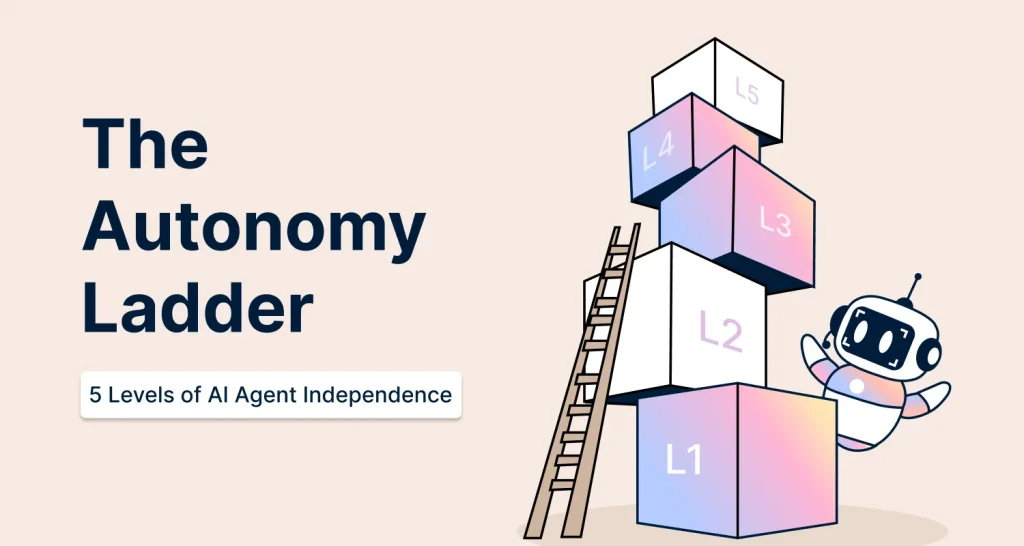
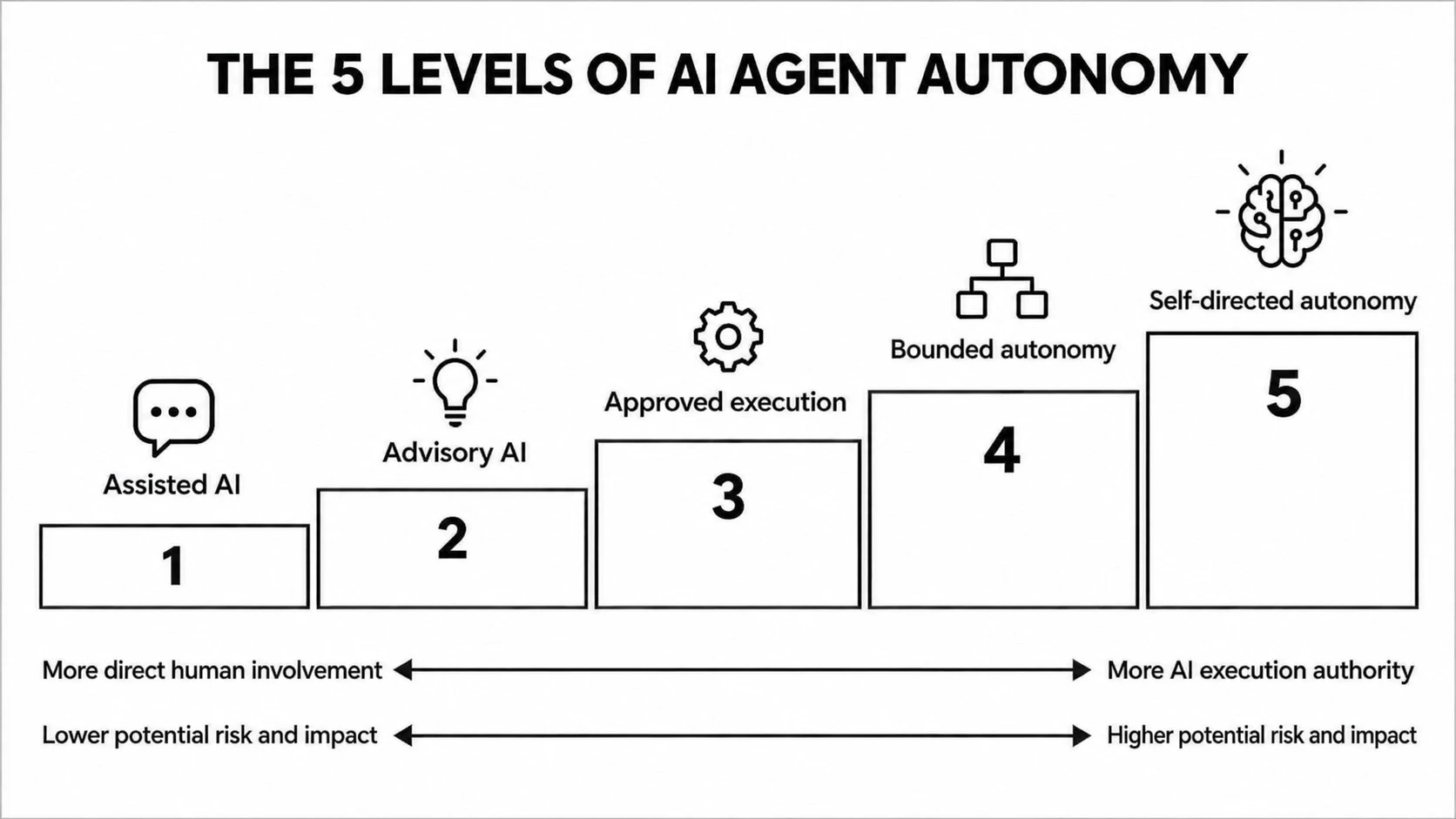
The autonomy ladder: 5 Levels of AI agent independence
As AI agents become more prevalent in the enterprise, organizations need a clear framework for evaluating autonomy.
Gartner predicts that by 2028, 15% of day-to-day work decisions will be made autonomously through agentic AI, up from 0% in 2024, indicating a shift from AI that primarily assists people to systems that can make decisions and take actions with greater independence.
There is no single industry-standard scale for AI agent autonomy. Frameworks differ in how they define and number autonomy levels.
For customer service teams, the following five-level autonomy ladder provides a practical way to understand how much decision-making and execution authority an AI agent has, how the human role changes, and where greater oversight may be required.
Level 1: Assisted AI
Assisted AI agents respond to direct instructions. They generate content, summarize information, answer questions, and help users complete tasks more efficiently, but they do not decide what should happen next or take actions independently.
In customer support, an assisted AI agent might summarize a lengthy ticket history, identify the customer’s main issue, or retrieve relevant knowledge-base articles for a support representative.
The human still directs the task, reviews the output, and decides what action to take. The main value is faster access to information and reduced effort on routine knowledge-based work.
Customer success story: How AdmissionPros uses AI-assisted support
AdmissionPros uses BoldDesk for customer support, ticket management, and its knowledge base. The company lists AI support in ticket responses among its favorite BoldDesk features and uses its AI knowledge base to give customers access to on-demand resources.
“It’s a user-friendly tool that gets the job done.” – Dr. Marki Johnson, AdmissionPros
Level 2: Advisory AI
Advisory AI goes a step further by analyzing available information and recommending actions. The AI helps determine the next best action, but the human remains responsible for the final decision.
This makes Level 2 useful for improving consistency and decision speed without handing over execution authority.
Level 3: Human-approved execution
This is where AI agents move from recommending next steps to taking approved actions across connected systems.
For example, a customer-support AI agent might retrieve account information, evaluate whether a request qualifies for a specific action, prepare a refund, return, or account update, and seek human approval before executing any sensitive action.
Once an authorized employee approves the action, the agent can execute it and update the relevant systems.
Human oversight remains important for consequential actions involving payments, account access, sensitive data, or other high-impact outcomes.
Level 4: Bounded autonomous AI
Bounded autonomous agents can independently coordinate and complete predefined workflows based on rules, permissions, policies, and escalation paths.
The human role shifts from approving individual actions to monitoring outcomes and handling exceptions.
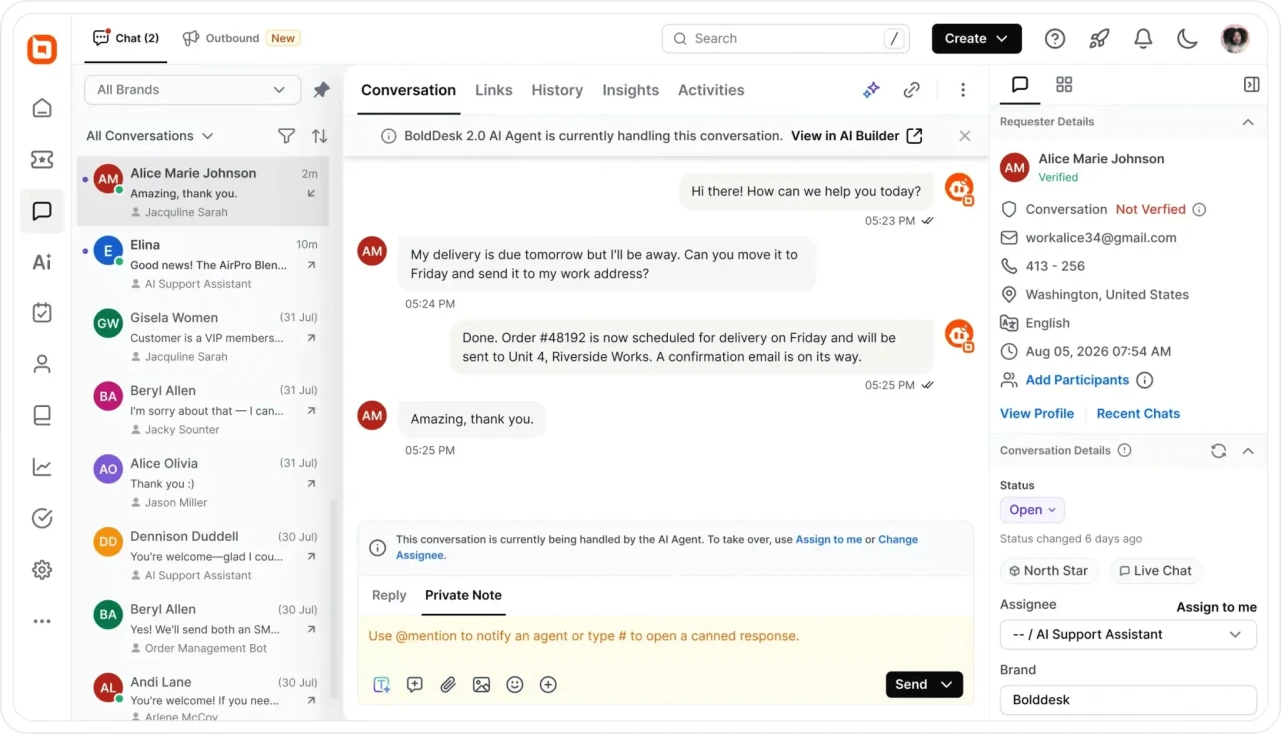
For example, a customer-support AI agent could handle an eligible product return by verifying the purchase, checking the return policy, creating the return request, updating the relevant systems, and providing instructions to the customer.
If the request falls outside established limits, such as exceeding a value threshold or requiring an exception to policy, it is handed off or routed to a human.
This enables repeatable support processes to be automated at scale while remaining within defined operational boundaries.
Level 5: Self-directed autonomy
Level 5 represents the highest level of autonomy, where AI agents can pursue broader objectives with minimal task-level supervision. In practice, this means humans do not review or approve every routine step; they set broader goals, policies, and intervention thresholds instead.
The agents can define sub-goals, coordinate actions across systems or specialized agents, and adapt their approach as conditions change.
Humans no longer supervise each workflow or approve individual steps. Instead, they define broader objectives, policies, access limits, risk thresholds, and intervention rules. For most customer-service environments, this remains an emerging capability rather than a standard deployment model.
Many AI systems described as autonomous today operate closer to Level 4 because they still work within clearly defined workflows and human-set boundaries.
How this framework compares with other AI autonomy models
There is no universally accepted scale for measuring AI agent autonomy levels. Different frameworks classify autonomy based on different factors, including human involvement, decision-making authority, execution capability, risk, and governance requirements.
For example:
- The Knight First Amendment Institute’s five-level framework defines autonomy largely by how the human role changes as AI systems become more autonomous. It progresses from operator to observer, as AI gains greater independence.
- The Cloud Security Alliance (CSA) five-level framework focuses on how much decision-making and action authority an AI agent receives, along with the governance, security, and oversight controls required as autonomy increases.
The five-level autonomy ladder used in this article applies similar principles to customer service workflows. It focuses on a practical question: How much decision-making and execution authority should an AI agent have, and where should human oversight remain?
Although the terminology and number of levels vary across frameworks, the general progression is similar: AI moves from supporting human work toward taking actions with increasing independence.
How human oversight changes across AI agent autonomy levels
As organizations move up the autonomy ladder, AI agents gain more authority and independence. Human oversight evolves from reviewing individual outputs and actions to setting boundaries, monitoring outcomes, and intervening when necessary.
The potential impact of mistakes also increases with autonomy. A poor recommendation may be easy to correct, while an incorrect action could affect customer accounts, payments, sensitive data, or compliance.
This makes permissions, monitoring, escalation rules, and human override mechanisms increasingly important.
According to Gartner, 40% of enterprises are expected to demote or decommission autonomous AI agents by 2027 because of governance failures.
The goal is not to remove human oversight, but to apply it at the right points based on the agent’s authority, the risk of the task, and the consequences of an incorrect action.
How to choose the right level of AI agent autonomy for your organization
There is no universal “best” autonomy level. Organizations should evaluate where each workflow belongs on the autonomy ladder based on risk, predictability, and operational requirements.
When deciding how much autonomy to give an AI agent, consider:
- Risk and impact: High-impact actions involving payments, account access, sensitive data, or policy exceptions usually require more human oversight.
- Workflow predictability: Well-defined, repeatable processes with clear rules and exceptions can support greater autonomy than ambiguous or judgment-heavy tasks.
- Recoverability: Greater autonomy is safer when incorrect actions can be detected, corrected, or reversed before they cause significant harm.
- Governance requirements: Regulatory, security, and internal policies may limit how much decision-making or execution authority can be delegated.
As a general guide, lower autonomy suits higher-risk or less predictable work, while higher autonomy is better suited to well-defined workflows with clear boundaries and strong governance.
| Autonomy level | Best suited for |
|---|---|
| Level 1: Assisted AI | Tasks such as summarization, information retrieval, and content generation where AI supports the work but does not take actions independently |
| Level 2: Advisory AI | Tasks where AI analyzes context and recommends next steps, while humans retain final decision-making authority |
| Level 3: Human-approved execution | Routine actions that can be automated but still require approval before consequential steps are completed |
| Level 4: Bounded autonomous AI | Predictable workflows with clear rules, defined exceptions, and appropriate monitoring |
| Level 5: Self-directed autonomy | Broader, adaptive workflows that require coordination across systems and mature governance |
For many organizations, Levels 2 and 3 are practical starting points because they reduce manual work while keeping people involved in important decisions. This aligns with human-in-the-loop AI for customer service, where humans remain involved at critical decision points.
As processes become more predictable and governance matures, organizations can gradually introduce higher autonomy where the potential benefits justify the added risk and oversight requirements.
How to evaluate autonomy controls in an AI agent platform
Not all AI platforms support the same level of autonomy or governance. Rather than focusing only on features, organizations should evaluate how effectively a platform balances automation, oversight, and risk management.
When assessing an AI agent platform, ask questions such as:
- What actions can the agent perform without human approval?
- Can autonomy levels be configured differently across workflows?
- Can administrators pause, override, or restrict an agent when needed?
- What happens when the agent encounters uncertainty or exceptions?
- Can autonomy be increased gradually as confidence and operational maturity grow?
For a more comprehensive evaluation framework, read our guide on AI support vendor questions, which covers AI capabilities, governance, security, implementation considerations, and long-term scalability.
Selecting the right platform is only one part of the process. Organizations also need a structured approach to designing, deploying, and managing AI agents effectively. Read our guide on how to build AI agents for practical implementation insights.
Scaling success across AI agent autonomy levels
The right level of AI agent autonomy depends on your organization’s goals, risk tolerance, and governance requirements. As trust and operational maturity grow, organizations can gradually expand autonomy to improve efficiency and scale automation responsibly.
BoldDesk helps customer service teams combine AI assistance with controlled automation. AI Copilot can support agents with tasks such as summaries and response generation, while AI Agents and AI Actions can handle configured customer interactions and perform actions across connected systems.
Approval workflows, permissions, audit logs, and human handoff options help teams keep automation within appropriate boundaries as they expand AI across their support operations.
Ready to get started? Sign up for a 15-day free trial of BoldDesk and explore how AI agents can transform your support operations.
Related articles
- AI Agent vs Chatbot: Key Differences and How to Choose the Right One
- AI Agent for IT Support and Service Desks: What’s Different from CX?
- Microsoft Build 2026 AI: Moving from Copilots to AI Agents
FAQs
Level 5 is the highest level in this framework. Self-directed AI agents can pursue broader objectives, determine sub-goals, coordinate actions across systems or agents, and adapt their approach with minimal task-level supervision.
Humans retain responsibility for governance, policies, and intervention.
Different, not necessarily less. At Levels 1 and 2, humans remain directly involved in instructions and decisions. At Level 3, they approve important actions before execution.
At Levels 4 and 5, oversight shifts toward setting boundaries, monitoring outcomes, and handling exceptions.
There is no universal best level. Levels 2 and 3 can be practical starting points for teams that want greater automation while retaining human control over consequential actions.
Common controls include human oversight, approval workflows, access controls, audit trails, and continuous monitoring. Governance requirements typically increase as autonomy levels rise.
Level 4 can be deployed for well-defined workflows with predefined permissions, thresholds, continuous monitoring, and human override mechanisms.
Level 5 remains an emerging capability for most enterprise environments and requires advanced governance before broad adoption.