







TL;DR: Sales teams win new customers, while customer service teams retain them. When both teams share customer insights, align communication, and collaborate on retention and growth opportunities, businesses deliver better customer experiences, increase loyalty, and drive long-term revenue growth.
Customers expect a smooth buying experience and reliable support throughout the customer journey. While sales teams focus on converting prospects, customer service teams ensure customers continue receiving value after the sale.
This is why sales and customer service are both critical to modern business growth.
Although these teams have different responsibilities, their impact is strongest when they work together.
This article breaks down how sales and customer service differ, where they overlap, and the practical ways they can collaborate to improve customer experience and drive measurable business results.
Differences between sales and customer service
Sales involves promoting and selling products or services to prospective customers. Usually, the goal of sales teams is to close deals, meet targets, and increase company revenue.
On the other hand, customer service means the assistance a customer receives even before, during, and after a purchase.
It usually involves answering their questions and following up to build strong relationships and improve customer satisfaction.
However, there are essential differences that set them apart:
| Characteristics | Sales | Customer Service |
| Focus | Close deals and generate revenue | Offer support and resolve customer issues |
| Communication | Use persuasive language and tactics to sell products or services | Use empathetic communication to address customers’ needs and concerns |
| Goals | Focus on acquisition, conversion, and revenue target | Focus on customer satisfaction, customer retention and long-term success |
| Primary approach | Proactively identifies needs, handles objections, and guides purchase decisions | Respond to support needs while also using proactive outreach to prevent issues and improve customer outcomes |
| Relationship | Build new relationships with customers | Maintain long-term relationships with new and existing customers |
| Training | Are often trained in sales techniques and negotiation skills | Are trained in problem-solving and conflict resolution |
Similarities between customer service and sales representatives
Sales reps and customer support agents share several goals. Here are the most important ones.
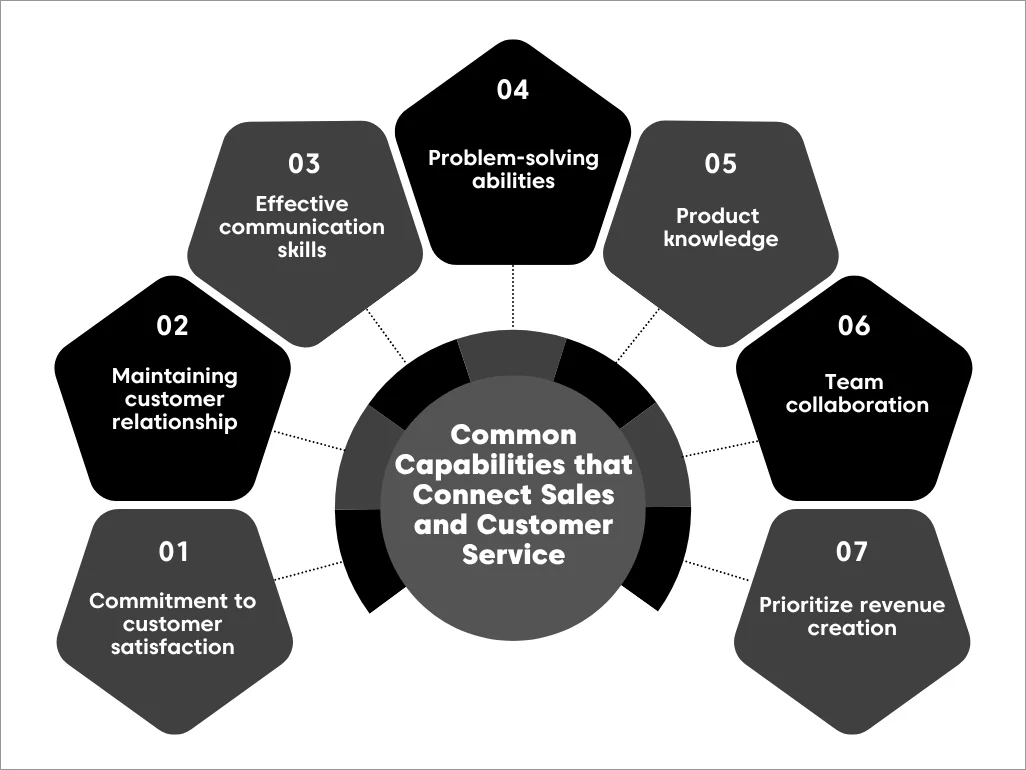
- Commitment to ensuring customer satisfaction: Sales reps match prospects to the right solution while support agents ensure that consumers are always satisfied after purchasing. Each team offers satisfying experiences and gives customers a sense of support and value.
- Maintain customer relationships: Both teams should aim to create a good rapport with their customers to win their loyalty, whether they are resolving an issue or closing a sale.
- Effective communication skills: Good communication is vital for both sales and support teams. Whether trying to convince a potential consumer to buy a product or just understanding their concerns, both teams must be able to listen effectively and communicate clearly. Adjusting communication style helps teams meet the needs of different customer segments.
- Problem-solving abilities: Customer happiness means both teams quickly and correctly address their issues. While customer service teams excel at resolving customer problems, sales representatives are skilled at addressing objections to meet customer needs.
- Product or service knowledge: Both roles require strong product or service knowledge.
- Team collaboration: Sales and customer service teams can collaborate with other departments, including marketing, product development, and technical support, to deliver a better customer service experience.
- Both teams prioritize business success: Both departments understand that happy customers are valuable assets for the company’s financial success. Sales teams attract new customers and close transactions, directly driving revenue.
Customer service indirectly influences revenue by increasing customer happiness and retention, encouraging repeat business, and favorable word-of-mouth.
8 Ways sales and customer service teams can collaborate
Sales and customer service shouldn’t work in silos. When these two teams work together in an organization, it allows a seamless experience for customers.
Here are some of the ways they can collaborate effectively:
Share customer data and insights
Sharing customer data and insights across customer service and sales divisions benefits both departments.
Support teams can share recurring customer complaints and product issues so sales representatives can address them earlier in the buying process.
Sales and customer service teams may access and update customer information in real time, track customer interactions, and align all customer-facing activities using a shared contact management (CRM) system.
Organizations should also prioritize customer service security to protect customer data and maintain trust while information is shared across teams.
Using shared dashboards, ticket history, call recordings, and customer notes allows both teams to understand customer behavior, identify issues early, personalize interactions, and make better decisions that improve retention, satisfaction, and revenue.
Resolve complex issues together
When faced with complex customer issues, sales and customer service teams can collaborate to find innovative solutions that meet the customers’ needs and company goals.
Both teams aim to support business growth, and collaboration helps them resolve complex issues more effectively.
They can utilize Microsoft Teams for customer service for real-time chat, voice, and video communication to seek information when faced with difficulties.
Additionally, it is helpful if you implement knowledge base software for self-service options so that sales or customer service teams can easily access information and have it at their fingertips.
Using Microsoft Teams enables them to troubleshoot issues, answer questions correctly, and suggest appropriate solutions to consumers.
Improving time to resolution is a shared benefit of stronger collaboration between sales and customer service teams.
Build a customer feedback loop
Customer feedback collected throughout the sales and support journey can help both teams identify recurring challenges, unmet expectations, and opportunities for improvement.
During the pre-purchase phase, both teams communicate with customers. They can negotiate with potential customers and understand their needs while closing deals.
After the sale, customer insights gathered during the buying process help support teams deliver more personalized onboarding and assistance.
These insights help customer service teams understand commitments made during sales and deliver more relevant post-purchase support.
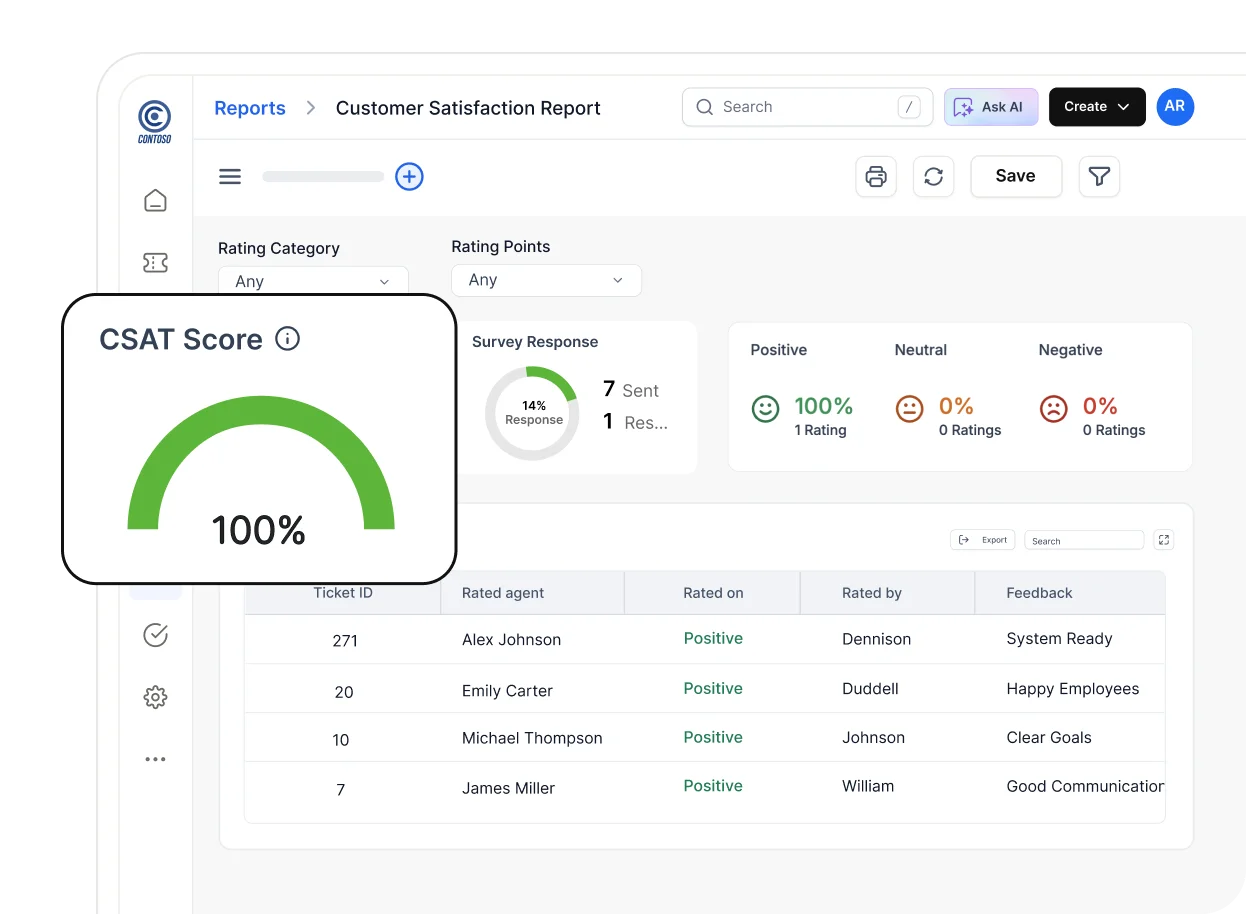
Measuring customer satisfaction helps reduce the risk of turnover and promotes customer loyalty.
Example:
If support agents notice repeated complaints about pricing or product limitations, they can share that insight with the sales team to adjust messaging or expectations during the sales process.
A strong customer feedback loop helps both teams learn from each other and continuously improve their processes.
Establish a structured sales-to-service handoff
A documented handoff process helps customer service teams understand customer goals, expectations, and purchase history from day one.
Sharing onboarding requirements, key stakeholders, and commitments made during the sales process reduces misunderstandings and creates a smoother customer experience.
Key information to include in a sales-to-service handoff:
- Customer profile
- Business goals
- Purchased product or plan
- Expectations set during sales
- Key stakeholders and contacts
- Onboarding requirements
- Risks, concerns, or special considerations
Identify upsell and cross-sell opportunities
Customer service teams are often the first to spot expansion signals because they interact with customers regularly. Support agents can identify indicators such as high product adoption, repeated feature requests, strong satisfaction scores, or questions about advanced capabilities.
When an upsell or cross‑sell opportunity emerges, support teams share the customer’s interaction history, satisfaction data, and usage context with sales.
Using a CRM and unified customer timelines, both teams maintain a complete view of all customer interactions, tickets, and touchpoints.
Sales teams then take ownership of executing the conversion, positioning relevant upgrades or add‑ons based on the customer’s needs, readiness, and prior support interactions.
This clear handoff ensures expansion efforts feel timely, personalized, and value‑driven rather than disruptive or sales‑led.
Example:
If a customer frequently asks about advanced features or usage limits, support teams can flag this opportunity to sales for potential upgrades or additional services.
Collaborate on customer retention
Since both teams play a role in customer retention, close collaboration is essential.
Both teams should share churn signals and retention opportunities as soon as they emerge.
Features such as shared inbox software and Microsoft Teams enable smooth collaboration among team members.
Implement cross-team training
Cross-training can benefit sales and customer service teams by allowing them to understand each other’s roles, work together more effectively, and improve communication.
Investing in ongoing customer service training helps teams strengthen communication, problem-solving, and customer engagement skills.
During onboarding processes, introduce both teams to the company policies, tools, and customers, and provide the necessary knowledge to improve team productivity.
Businesses can achieve this by:
- Providing training programs that cover essential sales and customer service skills, including product knowledge and positioning, shadowing support calls, problem-solving, communication techniques, and objection handling.
- Organizing workshops where team members can share best practices, learn from each other, and develop a shared understanding of the customer experience.
- Offering online courses to provide flexible learning opportunities and easy access to many resources.
- Creating user manuals that clearly outline the steps involved in performing specific tasks, such as processing orders, handling customer inquiries, or resolving complaints.
- Preparing how-to videos that visually demonstrate illustrated procedures making it easier for support teams to learn and retain information.
A lack of product or process knowledge can slow resolution times and affect CX.
By cross-training, teams can develop effective customer journey maps, allowing them to understand and anticipate potential problems and provide more efficient solutions.
Align shared metrics and incentives
Reinforce collaboration by tying recognition and incentives to shared sales‑and‑support outcomes, not individual performance alone.
Reward teams for achieving joint goals such as improved customer retention, faster issue resolution during onboarding, successful renewals, or revenue generated from service‑led upsells.
Establishing clear customer service objectives helps both teams align around measurable business outcomes and customer success.
By recognizing results that require shared data, coordinated handoffs, and joint problem‑solving, organizations encourage sales and customer service teams to work from the same priorities, follow consistent processes, and stay accountable to the full customer lifecycle.
This operational alignment drives repeatable performance improvements, not just short‑term motivation.
Common challenges between sales and customer service teams
Despite sharing the same customers, sales and customer service teams often face structural and operational challenges that prevent effective collaboration. Recognizing these issues is the first step toward fixing them.
- Misaligned incentives: Sales teams are typically rewarded for closing deals, while support teams are measured on resolution speed and satisfaction, leading to competing priorities rather than shared outcomes.
- Unrealistic expectations set during sales: Without clear documentation and handoff processes, promises made during sales may be difficult for support teams to fulfill, resulting in dissatisfied customers.
- Lack of shared customer data: When customer information is spread across disconnected systems, teams lack visibility into history, preferences, and prior interactions.
- Communication silos: Limited cross‑team communication reduces context sharing, slows issue resolution, and makes collaboration reactive instead of proactive.
Addressing these challenges requires shared metrics, transparent handoffs, unified tools, and clearly defined responsibilities across the customer journey.
Benefits of aligning sales and customer service teams
When sales and customer service teams operate in alignment, businesses create a smoother customer journey and unlock measurable performance gains across the entire lifecycle.
Instead of operating in silos, both teams contribute to shared outcomes that directly impact growth and retention.
- Better customer experience: Customers receive consistent information before and after purchase, reducing confusion and frustration caused by conflicting messages or repeated questions.
- Higher customer retention: Clear handoffs, shared context, and proactive support reduce churn by ensuring customers feel supported long after the sale.
- Increased revenue: Alignment enables service‑led upsells, smoother renewals, and higher customer lifetime value by identifying expansion opportunities at the right time.
- Fewer miscommunications: Shared customer data, unified tools, and coordinated workflows prevent gaps between what sales promises and what support delivers.
By aligning goals, data, and processes, sales and customer service teams move from reactive coordination to a predictable, scalable growth model.
Align sales and customer service for better business outcomes
Sales and customer service are two interconnected functions that work together to create a strong customer experience and support a company’s long‑term success.
Since sales attract and close deals, customer service helps retain customers through support, guidance, and relationship building.
Modern customer service software helps teams collaborate more effectively by centralizing customer information and simplifying workflows.
Ready to align your sales and support teams? BoldDesk centralizes tickets, knowledge, and collaboration for faster resolutions and happier customers.
Contact us to book a live demo and discover the latest functionalities, to see how BoldDesk can support collaboration between sales and customer service teams. You can also join for a 15-day free trial.
If you have any questions regarding sales vs customer service, please provide your ideas and suggestions in the section below.
Related articles
- Customer Engagement: 11 Powerful Strategies to Implement
- 10 Must-Track Help Desk Metrics & KPIs
- What is Good Customer Service? 9 Best Practices and Examples
FAQs on sales and customer service teams
Collaboration helps ensure a seamless customer journey from the first interaction through post-purchase support. When both teams work together, businesses can improve customer satisfaction, reduce churn, and increase revenue.