

 In this page

TL;DR: AI vs human customer service is about balance. AI drives speed, scalability, and cost efficiency for routine tasks, while humans manage complex, emotional cases. Hybrid models combine AI efficiency and human expertise to deliver faster support, better customer experiences, and more effective outcomes.
Customer support teams face growing pressure as ticket volumes increase and customers expect faster responses. To keep up, businesses are turning to AI-powered support to automate repetitive requests and improve efficiency.
However, AI is not a perfect solution. Customers can become frustrated when AI agents fail to understand complex issues, lack empathy, or make it difficult to reach a human agent.
This raises an important question: When should businesses use AI, and when is human support the better choice?
For most businesses, the answer isn’t AI or human support alone. A hybrid customer service model combines the strengths of both to deliver the best customer outcomes.
This guide compares AI and human customer service in 2026, helping you determine when to use AI, when to rely on human agents, and how to build a hybrid support model that improves both efficiency and customer satisfaction.
What is the difference between AI and human customer service?
AI customer service uses artificial intelligence to answer questions, route requests, assist agents, and resolve routine customer issues.
It includes systems such as AI agents, AI copilots, and AI‑driven actions that work together to handle interactions, assist human teams, and manage customer service tasks.
Human customer service, on the other hand, involves assistance provided by trained agents who engage directly with customers to address their issues.
It remains a critical part of support operations, helping businesses build trust, maintain customer relationships, and deliver experiences that align with customer expectations.
AI vs human customer support: A side-by-side comparison
Comparing AI and human customer support highlights their distinct capabilities, helping organizations determine how each can be applied across different customer service scenarios, as shown below.
| Aspect | AI customer service | Human customer service |
| Speed and response time | Provides near-instant responses | Slower due to queues but improves with experience |
| Availability | Available 24/7, handles many queries at once | Limited by working hours and staffing |
| Empathy and emotional intelligence | Limited empathy, can feel robotic | Strong empathy and human connection |
| Complexity handling | Can struggle with complex or sensitive issues | Strong at handling complex, high-stakes situations |
| Personalization | Data-driven personalization | Context-rich, human-driven personalization |
| Cost efficiency | Lower cost per interaction once deployed | Higher cost, depends on workforce |
| Scalability | Scales instantly to support increasing ticket volumes | Requires additional hiring and training to scale |
| Customer preference | Preferred for speed and convenience | Preferred for quality and trust |
| Use case fit | Best for FAQs, password resets, order tracking, and account updates | Best for escalations, billing disputes, and customer complaints |
AI vs human customer support: Where each excels
AI and human support each bring distinct strengths to the customer experience, shaping how businesses balance efficiency with customer satisfaction.
Understanding where customer service automation excels and where human interaction is essential helps organizations design smarter, more effective support strategies.
To compare them clearly, let’s look at where AI performs best, where human agents are still essential, and how both can work together.
When AI customer service works best
AI is widely used to handle customer interactions at scale, often through AI agents in customer service that manage high volumes of support requests efficiently across channels.
AI support excels in the following areas:
- Speed and availability: Customers can access support without delays, as AI processes requests instantly and remains continuously available, ensuring consistent service even during peak periods.
- Consistency: With AI providing standardized responses, interactions remain aligned with policies and maintain a consistent level of quality across customer support operations.
- Cost efficiency: By automating repetitive and high-volume queries, AI lowers operational costs and allows support teams to scale without proportionally increasing resources.
- Ticket routing: Automated ticket routing reduces manual triage, shortens response times, and helps support teams meet SLA targets by ensuring tickets reach the right agent the first time.
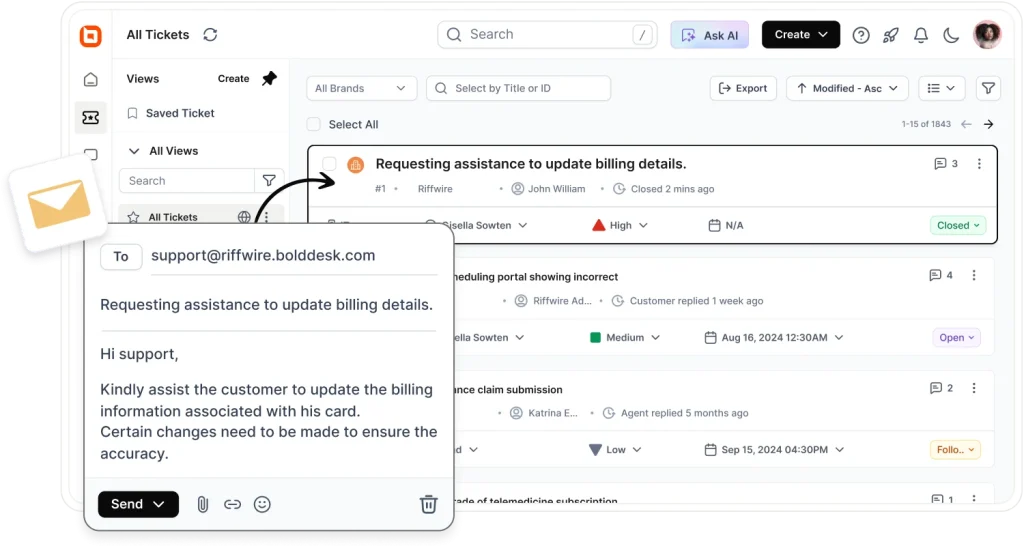
As AI capabilities continue to evolve, innovations such as Agentic AI in customer experience are enabling support systems to take more proactive actions, optimize workflows, and deliver more personalized customer interactions at scale.
AI customer service example: Shopify
In an ecommerce business using Shopify, AI customer service can handle routine customer questions such as order status, delivery updates, return policy details, product availability, and basic store-related FAQs. For example, when a customer asks, “Where is my order?” AI can instantly pull the order details, share the latest shipping status, and provide the tracking link without involving an agent.
If the customer reports a missing package, refund issue, or payment problem, the AI can collect the required details and route the conversation to a human agent with full context.
When human customer service is better
While AI brings speed and efficiency, human support remains essential in situations that require judgment, empathy, and flexibility.
Human agents perform best in the following areas:
- Complex or unclear issues: Human agents excel when customers present problems that require investigation, troubleshooting, or judgment beyond predefined workflows. Examples include software bugs, unusual account issues, and cross-department support requests.
- Emotionally sensitive conversations: Refund disputes, service disruptions, customer complaints, and negative experiences often require empathy and reassurance that AI cannot consistently provide.
- Billing, legal, or compliance-related issues: Financial disputes, privacy concerns, contractual obligations, and regulated interactions require accountability and careful decision-making.
- High-value or at-risk customers: When a customer relationship has significant revenue impact or churn risk, personalized engagement can preserve trust and strengthen long-term customer loyalty.
Human customer service example: Amazon
Amazon relies on human support for complex issues such as refund disputes, missing or damaged orders, account security concerns, and delivery problems.
In these situations, a customer service representative reviews the issue, investigates the details, and provides a personalized resolution that automation alone cannot deliver.
How hybrid customer service improves speed and quality
Strong customer support does not depend on choosing AI or humans alone. It depends on assigning each to the work they handle best.
A hybrid approach is becoming the preferred model for many support teams, with 76% of leaders defining a structure where AI supports routing and continuous availability, while human agents take on complex and emotionally sensitive cases (CMSWIRE).
The following workflow illustrates how a hybrid support model routes issues between AI agents, human agents, and specialist teams to ensure every request is resolved efficiently.
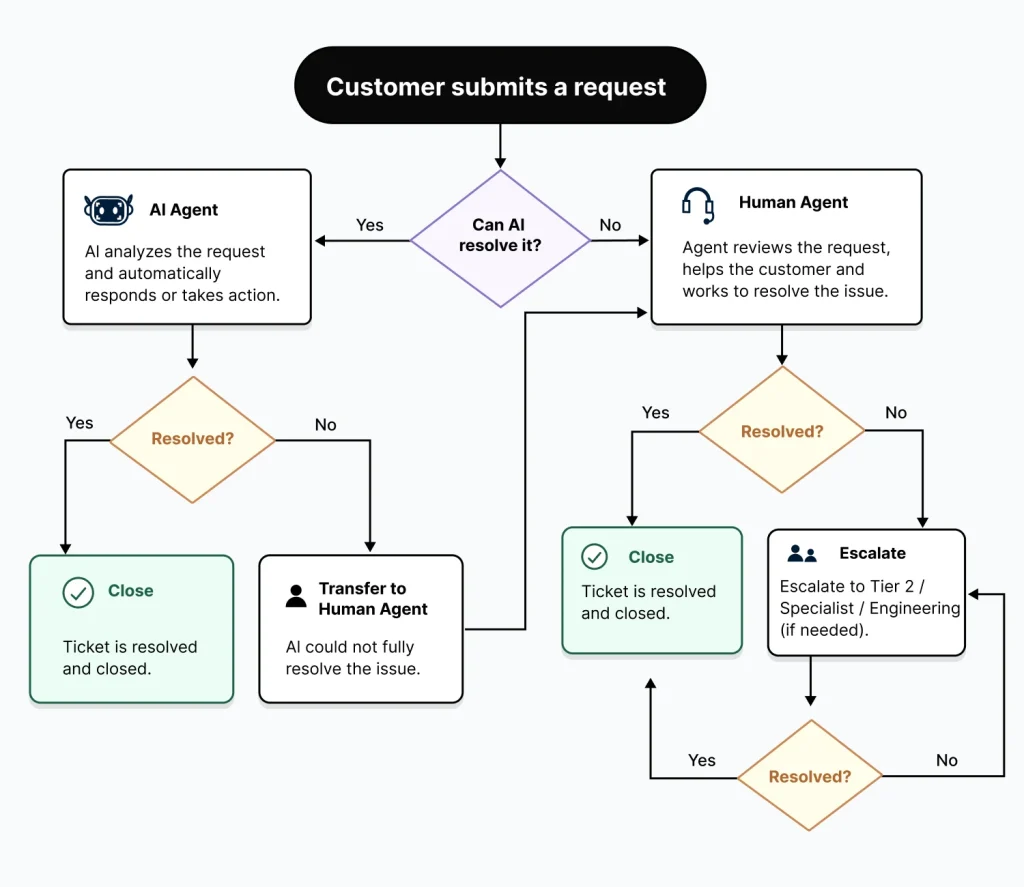
Let’s explore how a hybrid support model delivers value.
Seamless AI-to-human handoffs
AI enhances efficiency by performing initial ticket triage, including sorting and prioritizing requests, so support agents receive the right information at the right time.
It should hand off interactions when complexity increases, when emotional sensitivity is detected, or when issues require human judgment and contextual understanding.
Continuous learning and feedback loop
A hybrid model improves over time by combining AI and human expertise. AI manages initial interactions, while human agents step in for complex issues.
Every interaction generates data that improves routing accuracy, intent detection, and future customer support outcomes.
Efficiency with a seamless customer experience
A hybrid model combines AI speed with human understanding to deliver both efficiency and quality.
AI handles routine tasks and provides quick responses, while human agents step in for more complex issues, supported by shared customer data for full context.
This ensures fast, consistent support without losing context or continuity, creating a smooth and cohesive journey end-to-end.
Hybrid customer service example: Microsoft
Microsoft uses automated support for routine issues such as password resets, account access, subscription updates, and basic troubleshooting.
When customers need help with complex errors, billing disputes, security concerns, or product configuration issues, they can connect with a live support specialist. This helps Microsoft resolve simple requests faster while keeping human support available for issues that need expertise or judgment.
Measuring success in a hybrid customer service model
Evaluating performance in a hybrid customer service model requires looking beyond isolated metrics to understand how AI and human agents work together across the full customer journey.
Let’s break it down with customer service KPIs and practical insights.
Average Handle Time (AHT)
A balanced approach keeps average handle time low by allowing AI to manage repetitive tasks and assist with routine interactions, while human agents focus on resolving sensitive issues.
If AHT is high, it often indicates inefficient workflows or agents spending time gathering information instead of resolving customer issues, which can reduce overall support efficiency.
First Contact Resolution (FCR)
A hybrid setup ensures most issues are resolved correctly on the first interaction by combining AI’s routing accuracy with human judgment for complex cases.
If FCR is low, it often signals poor intent detection or misrouted escalations, leading to repeated touchpoints and customer frustration.
Customer satisfaction score
A well-balanced hybrid model maintains a high customer satisfaction score by pairing AI’s speed with human empathy at the right moments.
If CSAT score drops, it typically indicates gaps in handoffs, lack of personalization, or over-reliance on automation in situations that require human understanding.
Cost per ticket
An effective hybrid approach keeps costs low by allowing AI to handle high-volume, repetitive queries while reserving human agents for high-value interactions.
If costs remain high, it suggests underutilized automation or inefficient allocation of human effort toward tasks that AI could manage.
Escalation rate
In a hybrid support model, AI handles routine requests while escalating complex or sensitive issues to human agents when needed.
A healthy escalation rate indicates effective collaboration between AI and human support, resulting in faster resolutions and better customer experiences.
Together, these metrics show how hybrid support improves efficiency, scalability, and service quality.
Best practices for integrating AI and human support
Building an effective hybrid support model requires more than just adding automation.
The following best practices help organizations design how AI and human agents work together while balancing efficiency and empathy across the entire customer experience.
Map the customer journey before automating
Before implementing automation, identify the points in the customer journey where customers encounter delays, confusion, or unnecessary effort.
Focus automation efforts on removing these sources of friction at every stage of the customer journey rather than simply targeting high-volume interactions.
Regularly evaluate customer feedback and support data to ensure automation continues to deliver meaningful improvements.
Outcome: More effective automation, fewer customer pain points, and better service outcomes.
Align support with customer and issue complexity
Not every interaction needs the same level of support.
Segment requests by complexity. Use automation for simple tasks, AI with escalation for moderate queries, and human agents for complex situations. This ensures each interaction is handled appropriately without delays.
Outcome: Faster resolutions, efficient resource use, and a more personalized experience.
Use data to continuously improve AI-human collaboration
Effective hybrid service models continuously improve through data-driven optimization.
Track key metrics such as First Contact Resolution (FCR) across AI and human interactions, then identify patterns that reveal gaps.
Use insights to refine workflows, enable AI to assist agents with summaries, and let agents improve AI through feedback and corrections.
Outcome: Fewer misrouted tickets, faster resolutions, and continuously improving AI performance.
Establish clear escalation paths
Define clear triggers for escalation, such as failed intents, negative sentiment, or sensitive requests.
Use tiered routing to direct issues appropriately and provide support agents with conversation context during handoff while informing customers of next steps. This helps maintain continuity and avoid repetition.
Focus on customer intent, not support channels
Customers expect consistent support across all support channels. Prioritize understanding and resolving customer intent over channel optimization.
Use AI to identify customer needs and route requests within a unified system backed by shared knowledge and customer data. This helps maintain consistency and reduce unnecessary transfers.
Outcome: More consistent experiences and fewer channel-related gaps.
Introduce AI gradually and scale based on results
Many AI initiatives fail by trying to automate too much too quickly.
Start with targeted use cases, measure results, and expand based on performance. Use pilots to identify where AI adds value and where human support is needed, then scale accordingly.
Outcome: Lower risk, higher adoption, and a scalable, sustainable support model.
AI vs human customer service: Which should handle each issue?
The best customer service model depends on the type of support you provide, the complexity of customer requests, and your operational goals.
While AI excels at speed and scale, human agents remain essential for situations that require judgment and relationship building.
For many organizations, a hybrid approach delivers the best overall results.
Use the following decision framework to identify whether AI, human agents, or a hybrid approach is best suited for each support scenario.
| Customer issue | Best approach | Reason this approach is recommended |
| Password reset | AI | Simple, repetitive request that requires speed rather than human judgment |
| Order status inquiry | AI | Information is readily available and can be delivered instantly |
| Appointment scheduling | AI | Rule-based workflow with minimal complexity |
| Billing dispute | Human | Requires investigation, judgment, and customer reassurance |
| Account cancellation requests | Human | Retention opportunities and customer concerns often require personal engagement |
| Legal or compliance-related inquiry | Human | Sensitive issues require careful review and accountability |
| Frustrated or emotional customer complaint | Human | Empathy and customer reassurance are critical to resolution |
| Complex product configuration issue | Hybrid | AI gathers information first, then routes to a specialist with context |
| High-value or enterprise customer request | Hybrid | AI speeds up intake while human agents manage the relationship |
The most effective customer service strategies do not rely on AI or human agents alone. Instead, they use each where they add the most value, combining AI’s efficiency with human expertise to deliver improved service outcomes.
How BoldDesk helps teams build a balanced AI-human support model
For support teams, the challenge is not choosing between AI and human agents. It is creating a workflow where routine tasks are automated, escalations are well defined, and agents have the context needed to resolve issues confidently.
BoldDesk helps teams automate repetitive work with AI while ensuring human agents remain focused on complex, sensitive, and high-value customer conversations.
Instead of replacing agents, AI is used to enhance their productivity and improve response quality in the following ways:
- Automates routine requests with AI agents: Handles FAQs, order updates, ticket categorization, and repetitive customer inquiries automatically.
- Assists agents with AI Copilot summaries and replies: Provides human agents with conversation summaries, suggested responses, and contextual recommendations.
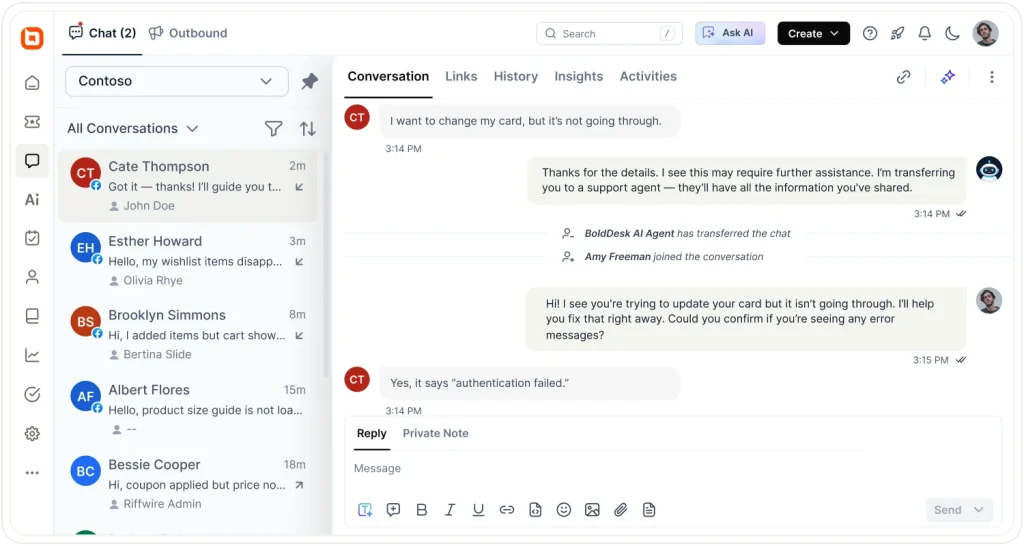
- Escalates complex issues with full context: Transfers conversations seamlessly from AI to human agents while preserving ticket history and customer information.
- Tracks performance with reports and analytics: Measures AHT, FCR, CSAT, cost per ticket, and escalation rates to continuously improve operations.
By combining autonomous AI agents with human expertise, BoldDesk enables support teams to scale efficiently while delivering personalized, high-quality support.
Drive better customer outcomes with a balanced AI and human support model
AI and human support should not compete for the same role. AI is strongest when it handles speed, scale, routing, and repetitive tasks.
Human agents are most valuable when customers need judgment, reassurance, or complex problem-solving.
With a hybrid model, teams can reduce repetitive workload, improve response speed, preserve service quality, and control support costs.
Through platforms like BoldDesk, teams can unify workflows, automate tasks, and clearly define roles across AI and human support.
The result is faster support, improved agent productivity, higher customer satisfaction, and better control over support costs.
Want to reduce repetitive support work without losing human control? Start a 15-day free trial or book a BoldDesk live demo to see how AI and human agents can work together.
If you’d like extra guidance, contact our support team, which is dedicated to helping you succeed.
Was this blog helpful? Please let us know in the comments section below.
Related articles
- How to Build AI Agents with BoldDesk for Smarter Support
- AI-Powered Customer Support: Tips for Scalable Business Growth
- How Agentic AI Is Transforming Customer Experience in 2026
FAQs
No. AI is increasingly handling high‑volume, routine interactions, but human customer support remains essential for complex, emotional, and high‑risk issues.
The most effective teams use a hybrid model, where AI supports agents rather than replacing them.
AI improves customer support by enabling instant, 24/7 responses, handling high volumes of repetitive queries at scale, reducing costs per interaction, and freeing human agents to focus on complex, high-value issues.
Customer preference depends on the situation. In most cases, customers prefer AI for speed but humans for quality and trust.
While many are comfortable using AI for quick, routine tasks, 79% still prefer talking to a human agent, and 84% believe humans provide more accurate answers, according to SurveyMonkey research.
This shows that AI is effective for efficiency, but human support remains essential for complex or high-stakes interactions.
Issues involving judgment, empathy, policy exceptions, or revenue risk should be handled by human agents.
These scenarios benefit from contextual understanding that AI still struggles to replicate consistently.
Businesses should measure AI and human support using shared KPIs such as CSAT, FCR, AHT, escalation rate, and cost per ticket, while evaluating handoff quality to ensure issues are routed and resolved efficiently.
Clear reporting helps identify where AI adds value and where human support performs better.