

TL;DR: Customer satisfaction reflects how well your product and support experiences meet customer expectations across touchpoints. By measuring it with CSAT, NPS, and CES, and improving it through proactive support, AI-driven insights, omnichannel service, and self-service, businesses can reduce friction, strengthen loyalty, and drive long-term growth.
Many businesses assume that resolving tickets quickly means customers are satisfied.
However, customers can still feel frustrated or overlooked even when an issue is technically resolved.
With a clear definition of customer satisfaction, the extent to which customer expectations are met, and the right way to measure it, support teams can understand what’s working, what isn’t, and where to focus their efforts.
This helps teams uncover opportunities to strengthen customer relations and improve long‑term loyalty.
In this article, we explore what customer satisfaction really means, why it matters, how to improve it in practice, and the key metrics used to measure it effectively.
What is customer satisfaction?
Customer satisfaction (CSAT) is how well a product, service, or support experience meets customer expectations.
It is commonly measured through customer satisfaction survey questions that capture customer perceptions, opinions, and attitudes after specific interactions.
A high customer satisfaction score indicates that most customers feel their expectations were met or exceeded, and fewer are reporting friction in the experience.
Why is customer satisfaction important?
Customer satisfaction plays a critical role in business performance and long-term growth.
It is shaped by every decision a business makes and directly influences how customers perceive, engage with, and remain loyal to a brand.
Here’s why client satisfaction matters:
- Increases customer retention: Satisfied customers are more likely to continue using your product or service over time, reducing churn and creating more stable, predictable customer relationships.
- Enhances customer lifetime value (CLV): Consistently satisfied customers tend to spend more, purchase frequently, and engage with additional products or services. This increases the overall customer lifetime value and contributes directly to profitability.
- Strengthens brand reputation: Satisfied customers often become brand advocates who share positive experiences through customer reviews, referrals, and online platforms. This boosts brand visibility and credibility while reducing reliance on paid advertising.
- Provides a competitive advantage: In saturated markets, companies that consistently deliver superior experiences stand out and retain customers despite similar offerings from competitors.
- Improves operational efficiency: Customer satisfaction metrics help teams identify gaps, prioritize improvements, and make data‑driven decisions that reduce friction and optimize support processes.
Strategies to improve customer satisfaction at scale
Enhancing customer satisfaction is the primary goal for businesses aiming to boost customer retention, loyalty, and profitability.
The following are some of the practical ways businesses can improve customer satisfaction across support and customer experience workflows.

Use AI and automation to scale support
AI and automation help teams standardize support workflows, reduce manual effort, and respond faster across customer interactions.
When applied thoughtfully, they support faster access to relevant information.
Effective use of AI and automation includes:
- Automating ticket categorization, assignment, and prioritization based on intent, urgency, or keywords
- Analyzing historical tickets and customer data with AI to surface trends and suggest next actions
- Automatically surfacing relevant knowledge base articles during live conversations
- Triggering workflows for follow‑ups, escalations, or status updates based on predefined rules or sentiment signals
Example:
If a customer submits a billing issue with negative sentiment, the request is automatically classified as a billing issue, marked as high priority, and routed directly to the billing team. At the same time, the system can attach relevant account data and suggest next steps before an agent opens the ticket.
Provide proactive customer support
Proactive customer service focuses on addressing issues before customers need to reach out for help. It helps prevent frustration, reduces repeat issues, and builds trust.
This can be achieved by:
- Identifying patterns in support tickets and recurring issues to spot problems early.
- Using AI to predict potential customer pain points and trigger alerts or preventive actions
- Publishing pre-emptive help articles or in‑app support when emerging issues are identified.
Example:
After a product update causes a spike in performance-related tickets, support teams can identify the pattern and publish an in-app notice explaining the issue and available workarounds. This information reaches customers before they contact support, reducing inbound requests related to the same problem.
Deliver faster response and resolution
Timely responses signal respect for customers’ time and directly influence how support quality is perceived.
For businesses to provide quick, efficient solutions, they can:
- Use canned responses for common questions to reduce first‑reply time
- Enable live chat to provide real‑time assistance for urgent issues
- Leverage AI‑powered knowledge bases to surface accurate answers instantly for agents and customers
Enable seamless omnichannel support
Modern customers expect seamless support regardless of where the conversation begins.
Omnichannel customer service ensures continuity, context, and consistency across all touchpoints.
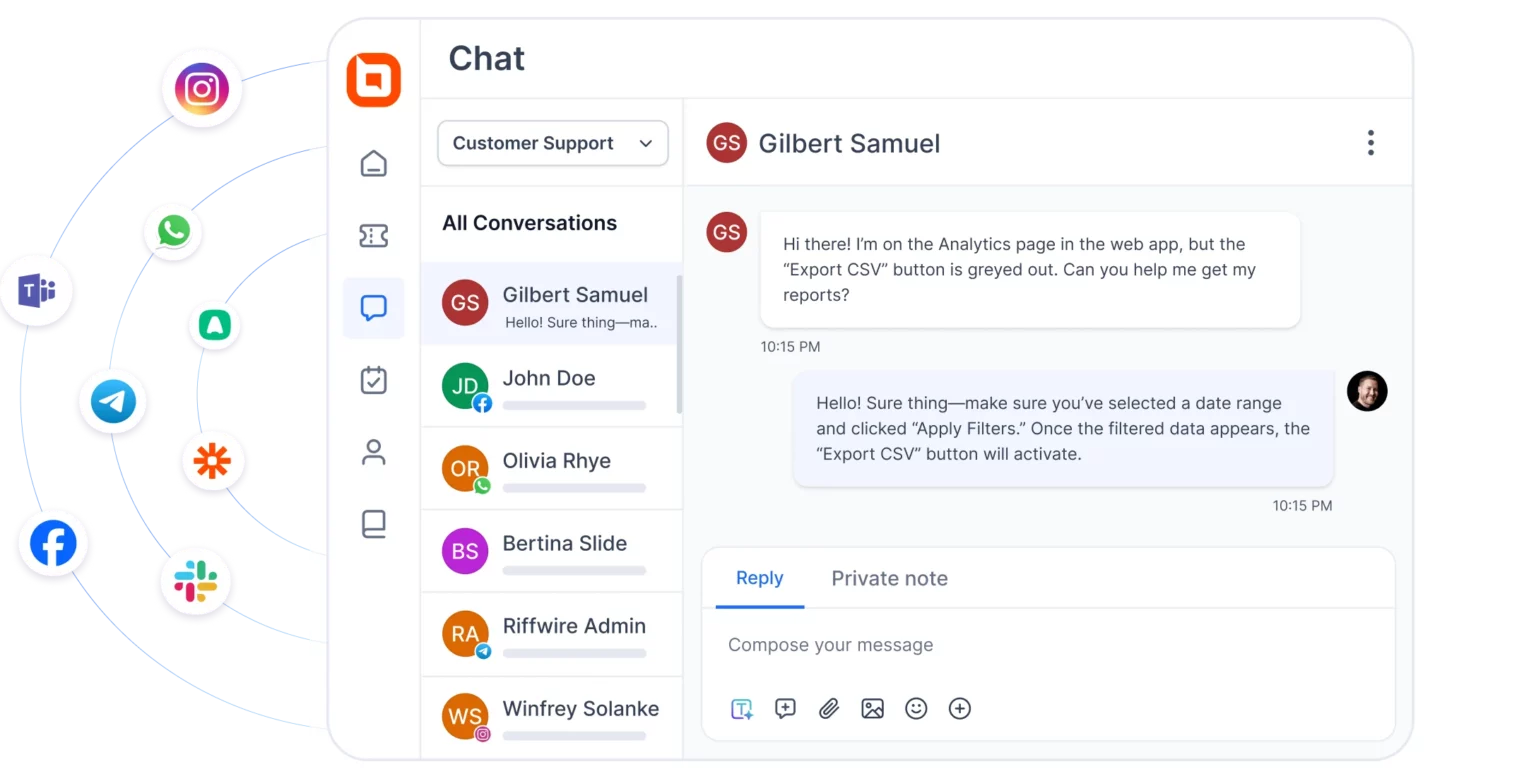
This level of consistency requires teams to:
- Centralize email, live chat, social media, and web forms into a single support system
- Maintain conversation history across channels so customers don’t have to repeat themselves
- Use AI‑based routing to assign tickets based on intent, priority, or urgency
- Ensure consistent SLAs and responses across all channels
Regularly collect and act on customer feedback
Customer feedback provides direct insight into what’s working and where improvements are needed.
Acting on feedback helps teams make informed changes that improve satisfaction over time.
Feedback becomes actionable when teams:
- Send CSAT surveys after key interactions or ticket resolutions
- Prioritize improvements based on impact and frequency
- Close the feedback loop by informing customers when changes are made based on their input
Offer self-service options
Customer self‑service allows customers to resolve simple issues independently while reducing the workload on support teams.
When done well, it improves convenience without compromising accuracy.
Effective self‑service starts with:
- Building a well‑structured, searchable knowledge base within your help desk software

- Keeping help content up to date using customer insights from ticket trends and feedback
- Deploying AI Agents to guide users to relevant knowledge resources
- Reviewing self‑service analytics to uncover content gaps and optimization opportunities
Example:
Password reset requests that frequently appear in support tickets can be addressed through a dedicated help article and surfaced by an AI agent when users search the help center. Customers resolve the issue immediately, while similar tickets stop getting into the support queue.
Train and empower your support team
Empowered agents can resolve issues without unnecessary handoffs, which improves speed, consistency, and customer confidence.
Customer service training equips agents with the right skills to handle complex inquiries and deliver empathetic, efficient support.
Support teams are best equipped when they:
- Receive continuous training on product knowledge and customer service skills
- Learn from customer feedback and past interactions
- Use AI‑assisted suggestions during live conversations to reduce guesswork
- Collaborate and share best practices to improve response quality
Personalize the customer experience
Personalization improves satisfaction because customers do not need to repeat context, preferences, account history, or previous issues.
Personalized customer service can be enabled by:
- Building detailed customer profiles that provide context for each interaction
- Tailoring responses and recommendations based on customer behavior
- Adapting support journeys dynamically as customer needs evolve
How to measure customer satisfaction
Understanding how happy customers are isn’t just a nice-to-have; it’s a strategic necessity.
The following methods are among the most effective ways to measure customer satisfaction.
Customer satisfaction score (CSAT)
Customer Satisfaction Score (CSAT) measures how satisfied customers are after a specific interaction.
CSAT surveys typically ask customers to rate their experience on a scale from 1 to 5.
Customer satisfaction scores are valuable for identifying areas that need improvement and for tracking how changes in service or product delivery impact customer perception over time.
Here is the CSAT formula:
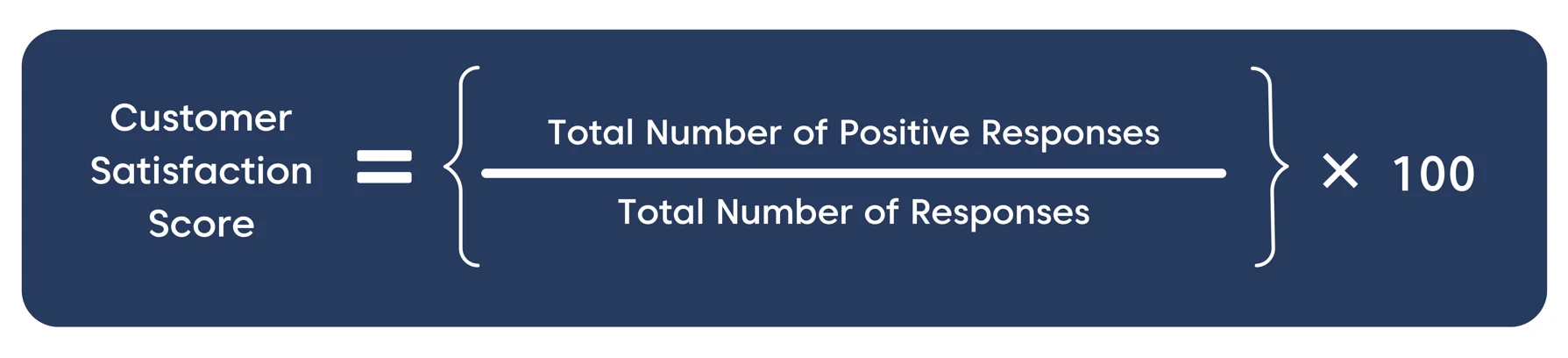
Instead of calculating CSAT scores manually, teams can leverage tools that offer a free CSAT score calculator to save time and improve accuracy.
Net promoter score (NPS)
Net promoter score measures customer loyalty by asking how likely customers are to recommend your brand.
Responses are grouped into:
- Promoters (9–10)
- Passives (7–8)
- Detractors (0–6)
The NPS score is calculated by subtracting the percentage of detractors from the percentage of promoters. This score reflects overall brand sentiment and customer advocacy.

To make this process even smoother, support teams can invest in customer service software built with an NPS Calculator that streamlines the calculation, improving accuracy.
Customer effort score (CES)
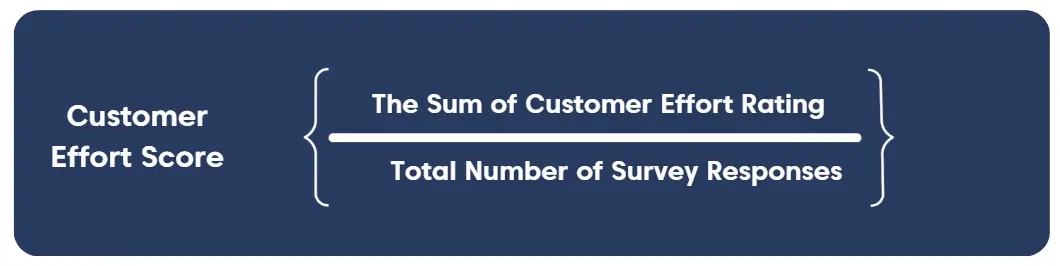
CES evaluates how easy it was for a customer to complete a task, such as resolving an issue using your product.
A lower CES usually means customers found it easier to get help or complete a task.
The CES is particularly effective for assessing support processes, self‑service experiences, and digital usability.
Here is a formula you can use:
Social media sentiment analysis
Customers frequently share experiences on platforms like Twitter, Facebook, and LinkedIn.
Monitoring brand mentions and sentiment trends can provide real-time insights into public perception and emerging issues.
Social listening tools like Brandwatch, Awario, or Sprout Social can help teams track sentiment patterns and respond quickly to potential risks or opportunities.
While sentiment analysis does not replace direct surveys, it helps teams monitor public perception and spot recurring issues that may affect satisfaction.
Customer interviews and focus groups
Surveys provide scale, but direct conversations provide depth. Customer interviews and focus groups uncover motivations, expectations, and frustrations that structured surveys may miss.
These methods are especially valuable during product development, service redesign, or major experience improvements.
Customer satisfaction examples from real brands
Some companies consistently excel in delivering outstanding customer experiences, earning top ratings from trusted evaluators like the American Customer Satisfaction Index (ACSI), a leading customer satisfaction benchmark
While ACSI focuses on the US market, the principles behind these customer satisfaction practices are widely applicable across industries and regions.
Chick-fil-A
Chick-fil-A is a fast-food restaurant chain that has maintained its position as the top-ranked company in customer satisfaction for the 9th straight year as of 2023, reinforcing its reputation for exceptional customer service (NRM).
One customer had this to say:
The professionalism and courtesy of the Chick-fil-A staff are far superior to any other chain restaurant I’ve frequented.
ACSI score: 85.0
Trader Joe’s
Trader Joe’s is a popular grocery store chain in the United States that receives high customer satisfaction ratings due to its unique product offerings, affordable prices, and excellent customer service.
According to Comparably, Trader Joe’s net promoter score stands at 46, considerably higher than the average grocery sector score of 24.
This is the feedback from one of their customers:
From the selection of products that you can only get there to the quality of service you can get nowhere else, they’re always my first choice. Trader Joe’s products are the standard by which I measure other stores.
ACSI score: 84
Amazon
Amazon, the world’s largest online retailer, has mastered a combination of value, satisfaction, and delivery efficiency that consumers love.
Recently, Amazon was rated top for its value and selection, indicating that the retail giant is a preferred choice among consumers for its affordability and variety (Amazon News).
Here’s one customer’s feedback:
Infinite variety on one site without having to search multiple brands and companies online.
ACSI score: 84
Improve customer satisfaction for long-term success
Customer satisfaction is a key driver of retention, loyalty, and long‑term business growth.
Rather than being a one‑time effort, it is an ongoing commitment to delivering consistent, meaningful experiences at every touchpoint.
Understanding customer satisfaction is one thing, improving it consistently depends on having the right processes and tools in place.
With BoldDesk, teams can manage conversations across channels, track customer satisfaction metrics, and use AI-powered insights to respond more efficiently.
These capabilities help ensure that every customer interaction contributes to a better overall experience.
Request a live demo or start a 15-day free trial to see how we can help your team turn customer satisfaction insights into better support experiences.
You can contact our support team to learn how BoldDesk can support your customer service goals.
If you have questions or feedback, feel free to leave a comment below.
Related articles
- 11 Best Practices for Successful Customer Satisfaction Surveys
- Support Workflow Optimization: Boost Productivity and Customer Satisfaction
- What Is Customer Advocacy? Definition and Winning Strategies
Frequently Asked Questions
Customer satisfaction measures how customers evaluate a specific interaction or outcome against their expectations.
Customer experience, by contrast, is broader and encompasses the entire journey a customer has with a brand across all touchpoints over time.
There is no single best metric, as customer satisfaction is best measured using a combination of CSAT, NPS, and CES.
Together, these metrics provide insight into interaction quality, customer loyalty, and the effort required to resolve issues.
When customers are not satisfied, businesses face higher churn, negative reviews, reduced loyalty, and lower revenue.
Poor customer satisfaction can damage brand reputation and increase customer acquisition costs over time.
Satisfying customers requires understanding their needs, meeting expectations, responding quickly, delivering quality service standards, and continuously improving based on customer feedback.
Customer satisfaction should be measured regularly, especially after key interactions such as support resolutions or product usage milestones.
Consistent measurement helps track trends and assess the impact of improvements over time.
AI helps improve customer satisfaction by enabling faster responses, predictive insights, and personalized support experiences.
It allows teams to analyze large volumes of data and act on customer needs more efficiently.