





TL;DR: Customer service standards are measurable expectations that guide how support teams respond to customers and resolve issues. Key standards include response time, resolution time, customer satisfaction (CSAT), escalation rate, and Net Promoter Score (NPS). Strong standards help businesses deliver consistent experiences, improve loyalty, and support long-term growth.
“Your brand is what other people say when you’re not in the room.” This powerful phrase by Jeff Bezos is true, especially in customer service, where the care you provide shapes the customer perception of your brand.
So, what’s the key to building a successful, lasting brand? Having the right customer service standards.
You may wonder what customer service standards are, how they differ from customer service guidelines, and which standards matter most for delivering exceptional support.
In this guide, you’ll learn the definition of customer service standards, review practical examples, discover industry benchmarks, and learn how to create standards that improve customer satisfaction and business performance.
What are customer service standards?
Customer service standards are measurable benchmarks businesses use to define, monitor, and improve the quality of customer service they deliver. These standards are based on an organization’s mission, objectives, and customer expectations.
No two businesses are alike, and neither are the customer service guidelines they set. Despite that, one thing remains constant–customers value quality services.
This means businesses must raise the bar high and ensure agents maintain the standards. In return, customers are more likely to recognize, trust, and return to your brand.
Customer service standards vs. customer service guidelines
Customer service standards and customer service guidelines work together but serve different purposes.
Customer service standards are measurable expectations that define the level of service a business aims to deliver. Examples include response times, resolution times, customer satisfaction scores, and escalation rates.
Customer service guidelines are the recommended practices that help employees meet those standards. They typically cover communication, problem-solving, and customer interaction best practices.
Key differences
| Customer service standards | Customer service guidelines |
| Define measurable expectations | Explain how to meet expectations |
| Focus on outcomes and performance | Focus on behavior and best practices |
| Often tied to KPIs and SLAs | Often tied to policies and training |
Together, standards establish accountability, while guidelines help teams consistently deliver high-quality customer experiences.
Customer service standards examples
Customer service standards can vary by industry, but most organizations establish clear expectations around responsiveness, communication, problem resolution, and customer satisfaction.
Some common customer service standards examples include:
| Service area | Example standard |
| First response time | Respond to customer inquiries within 1 hour |
| Resolution time | Resolve standard issues within 24 hours |
| Customer satisfaction | Maintain a CSAT score of 85% or higher |
| Escalation rate | Keep escalations below 10% |
| Communication | Use clear, professional, and empathetic language |
| Availability | Provide support across multiple channels |
| Follow-up | Confirm customer satisfaction after ticket resolution |
| Self-service support | Maintain updated help center articles and FAQs |
These standards help support teams deliver consistent customer experiences while providing measurable goals for performance evaluation.
Although customer service standards vary by industry, their primary purpose remains the same: delivering consistent, high-quality customer experiences that meet customer expectations.
Why are standards for customer support essential?
A report by Digital Minds BPO indicates that customers are more likely to recommend a brand if they offer good customer service.
The following are some reasons why these client service standards are essential for success:
- Positive brand reputation: Customers tend to gravitate towards brands that consistently support and prioritize their needs, which in turn leads to positive reviews, word-of-mouth marketing, a higher net promoter score, and better brand perception.
- Profitability: Exceptional customer support attracts new customers and keeps the existing ones. This boosts the customer lifetime value, ultimately leading to higher business revenue.
- A competitive market advantage: Maintaining consistently high customer service standards creates a unique selling position that easily tips customers towards such brands. With this, it becomes extremely difficult for competitors to measure up.
- Higher customer satisfaction rates: By offering quality services as a benchmark for your business, meeting customers’ needs and expectations becomes easier. This, in turn, increases customer satisfaction scores and engagement.
Common customer service standards that every team should meet
Take it from the successful industrialist Henry Ford, who once said, “A business absolutely devoted to service will have only one worry about profits. They will be embarrassingly large.”
For your team to be just as successful, you must take note of the following important customer service standards.
- Fast first response time to build customer trust
- High customer satisfaction scores to increase loyalty
- Reduce ticket backlog to a minimum for effective services
- Lower the time to resolution for improved customer experience
- Maintain a low escalation rate to resolve issues effectively
- Aim for a high net promoter score to grow your customer base
- Maintain a high first contact resolution rate to improve customer satisfaction
1. Fast first response time to build customer trust
First response times (FRT) play a crucial role when customers reach out. They expect a timely reply, even if it’s just a brief acknowledgment. Responding quickly shows that you’re attentive and ready to assist.
Standards for FRT
Aim to respond within 1 hour for high-priority tickets and within 4 hours for standard issues.
The following are the first response times benchmarks per channel, ticket category, and urgency that will set your support team apart:
| Channel / Ticket Type | First Response Time Benchmark |
|---|---|
| Below 2 hours | |
| Live chat | 1–2 minutes |
| Social media | Less than 20 minutes |
| Phone call | 1–3 minutes |
| High-priority tickets | 1 hour or less |
| Standard tickets | Within 6 hours |
Best practices
Maintain a fast first response time by leveraging artificial intelligence (AI) and automation to handle simple and routine tasks while agents handle complex ones.
Calculating FRT
Pro tip: Use auto-replies, pre-written response templates and smart routing to instantly acknowledge queries and send them to the right team for a faster first response.
2. High customer satisfaction scores to increase loyalty
Customer satisfaction (CSAT) score directly measures how contented customers are after a support interaction. It’s one of the most important customer service performance indicators. These scores are measured on a scale from 0 to 100.
Standards for CSAT score
Support teams should aim to maintain (or surpass) a score of 85% as their standard for customer service.
| CSAT Performance | Benchmark |
| Needs improvement | Below 75% |
| Good | 75%–84% |
| World-class | 85%+ |
Best practices
Send post-ticket surveys with a 1–5 rating scale, use open-ended follow-up questions to gather feedback for more context and regularly measure your CSAT score, for instance, weekly, monthly, and yearly.
Calculating CSAT score
Pro tip: It’s not just about collecting customer feedback; analyze and act on it to improve the overall support experience.
Real-world example
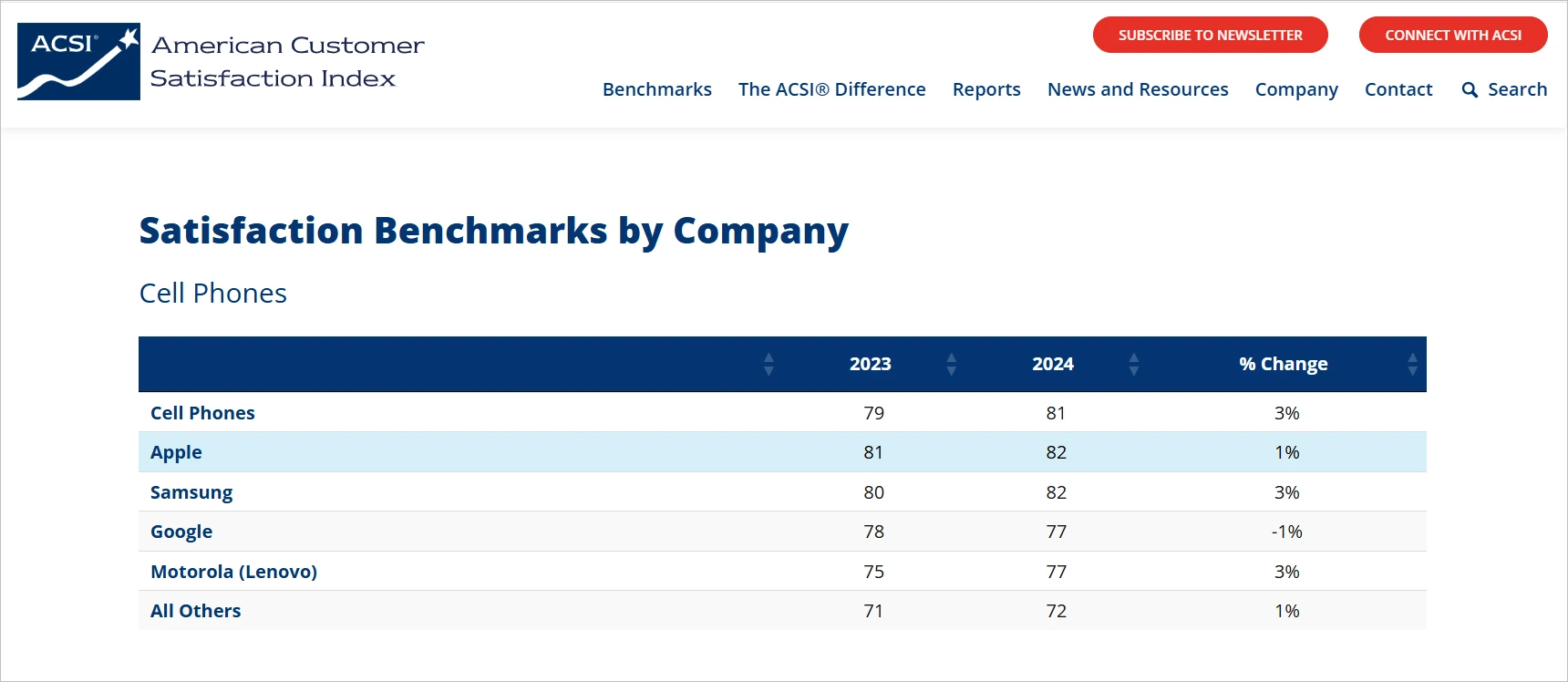
Apple’s iPhone earned a customer satisfaction score (CSAT) of 82%, according to American Customer Satisfaction Index (ACSI). That’s a point higher than the cell phone industry average of 81% in 2024.
But, how did they achieve this high customer satisfaction score? By consistently delivering high-quality, innovative products and providing exceptional customer support.
Apple is a great example of how setting a high standard for customer satisfaction can help businesses stand out and lead in their industry.
3. Reduce ticket backlog to a minimum for effective services
Ticket backlog is the number of open tickets or unresolved customer issues at any given time. A high backlog indicates that your support team is falling behind, while a low number of open tickets shows that they are keeping up with customer demands.
Standards for ticket backlog
There is no universal healthy ticket backlog percentage. Teams should evaluate backlog alongside ticket age, priority, throughput, staffing capacity, and historical trends.
A larger queue may still be manageable if a team has sufficient resolution capacity.
However, the ticket backlog benchmark can differ depending on the industry, product, or service offered.
Best practices
Set internal SLAs for response and resolution based on ticket type. Use automation tools to streamline workflow, monitor trends weekly, and adjust staffing as needed.
Calculating ticket backlog
Backlog Ratio = Average Ticket Backlog ÷ Average Daily Ticket Volume
Pro tip: Monitor backlog growth trends over time rather than relying on a fixed percentage benchmark.
4. Lower the time to resolution for improved customer experience
Another key customer service standard for most businesses is to provide fast resolutions, proving to clients that the support agent is knowledgeable, trustworthy, and reliable.
Standard for TTR
Resolution-time benchmarks vary considerably based on issue complexity, ticket priority, support model, and customer expectations.
Organizations should set resolution targets based on historical performance and SLA commitments.
Best practices
Track how long it takes to fix various issues to identify what frustrates customers the most. Additionally, give agents clear, step-by-step instructions to resolve common problems faster.
Calculating TTR
Pro tip: Equip your support team with internal knowledge base articles to resolve issues without escalations.
5. Maintain a low escalation rate to resolve issues effectively
The escalation rate tracks how many tickets are passed to senior staff or higher-tier support.
Not all tickets are resolved by the first agent, often due to knowledge gaps or role limitations.
Standards for escalation rate
There is no universal ideal escalation rate because escalation needs vary based on issue complexity, agent authority, product type, and support structure.
Organizations should monitor escalation trends against their own historical baseline and investigate sustained increases.
Best practices
Set a target escalation rate under 10% and offer regular training for agents whose tickets frequently escalate.
Calculating escalation rate
Pro tip: Implement skill-based routing so tickets land in the hands of the most capable agents.
6. Aim for a high net promoter score to grow your customer base
How easy or difficult is it for customers to recommend your brand to others? Net promoter score (NPS) measures how likely customers are to recommend your brand, using a 1–10 scale to classify them as detractors, passives, or promoters.
| Category | Score Range | Description |
|---|---|---|
| Detractors | 0-6 | Unhappy customers who can damage your brand through negative word-of-mouth. |
| Passives | 7-8 | Satisfied but indifferent customers who are vulnerable to competitive offerings. |
| Promoters | 9-10 | Loyal enthusiasts who will keep buying and refer others, fueling growth. |
Standards for net promoter score
SurveyMonkey data shows that top-performing companies have NPS scores of +72 or higher, while the global average is +32 and the median score is +44.
The NPS varies depending on the industry. Even so, always benchmark against the best companies in your industry to remain competitive.
Here are the average NPS for various industries:
| Industry | Lower quartile | Median | Upper quartile |
| Software & Online Services | 17 | 44 | 68 |
| Technology | 22 | 50 | 70 |
| Retail | 36 | 57 | 74 |
| Financial Services | 35 | 60 | 78 |
Best Practices
Send NPS surveys quarterly to customers who have recently interacted with your support team.
Calculating NPS
Pro tip: Improve your NPS by providing quality, proactive support and practicing empathy in customer service to ensure clients spread positive words about your brand.
A smarter way to measure loyalty is through BoldDesk NPS calculator, which replaces traditional survey analysis with instant, actionable insights.
Real-world example
According to Satmetrix, Chewy’s Net Promoter Score (NPS) exceeds Amazon’s by 28 points in the pet category.
This highlights the company’s ability to build strong customer loyalty and brand advocacy through consistently positive customer experiences.
7. Maintain a high first contact resolution rate to improve customer satisfaction
First contact resolution (FCR) measures the percentage of customer issues resolved during the first interaction without requiring follow-ups, transfers, or escalations.
A high FCR often indicates that agents have the knowledge, tools, and authority needed to resolve issues efficiently while reducing customer effort.
Standards for FCR
Support teams should aim to resolve as many customer issues as possible during the initial interaction.
| FCR performance | Benchmark |
| Needs improvement | Below 70% |
| Good | 70%–79% |
| World-class | 80%+ |
SQM Group’s contact-center benchmarking research reports an average first contact resolution rate of approximately 71%, with 70%–79% considered good and 80% or higher considered world-class. Benchmarks may vary depending on industry, support channel, issue complexity, and measurement methodology.
Best practices
- Equip agents with detailed knowledge base resources and troubleshooting guides.
- Use skill-based routing to connect customers with the most qualified agents.
- Provide ongoing coaching, product training, and process updates.
- Analyze repeat-contact trends to identify common issues that prevent first-contact resolution.
- Give agents the authority to resolve common customer issues without unnecessary escalations.
Calculating FCR
Pro tip: Empower agents with the tools, customer context, and decision-making authority they need to resolve issues during the first interaction whenever possible.
How to improve customer support standards for your team
Customer service has evolved tremendously and is no longer a buzzword but a necessity. Support agents must go the extra mile to identify and meet customer needs and expectations.
The following are ways to improve your team’s customer support standards:
Set clear standards and key performance indicators
The foundation of great support lies in clearly defining what “excellent” looks like. Define the customer support standards, outlining your organization’s expectations for how quickly customer issues should be acknowledged and resolved.
These customer service standards should include specific metrics such as:
-
Response time: How quickly should agents reply?
-
Resolution time: How fast should issues be resolved?
-
Customer satisfaction (CSAT) score: What’s the benchmark score?
-
First contact resolution (FCR): Aim to resolve issues on the first interaction.
In addition, clarify quality customer service standards for communication—tone of voice, accuracy of information, level of personalization, and empathy. When everyone on the team understands these benchmarks, consistency and accountability naturally improve.
Real-world example
Slack’s Business Technology Operations team used Jira Service Management and Halp to track KPIs like average handle time.
By integrating ticketing directly into Slack channels, they achieved a 50% reduction in handle time—from 48 to 24 hours—enabling faster issue resolution and improving team productivity across the organization.
Empower support agents regularly
Businesses should first establish clear structures and formats that will allow them to maximize the value of the resources and time invested in agent training.
- Document the customer service standards as policies or manuals that can be easily accessed by support agents. It allows agents to be updated and refer to this documentation for clarity.
- Conduct detailed onboarding to train agents from the get-go and equip them with the customer service standards they need to understand, maintain, and apply consistently.
- Take advantage of advanced technologies such as virtual reality (VR) to create real-time customer support simulations that can greatly enhance their skills.
Use omnichannel support to easily connect with customers
A report by Converzation has indicated that about 79% of customers believe that having a fast response time is very crucial in customer service.
It’s time-consuming for agents to be available and reliable, especially when your business has multichannel support without the structures to offer fast support.
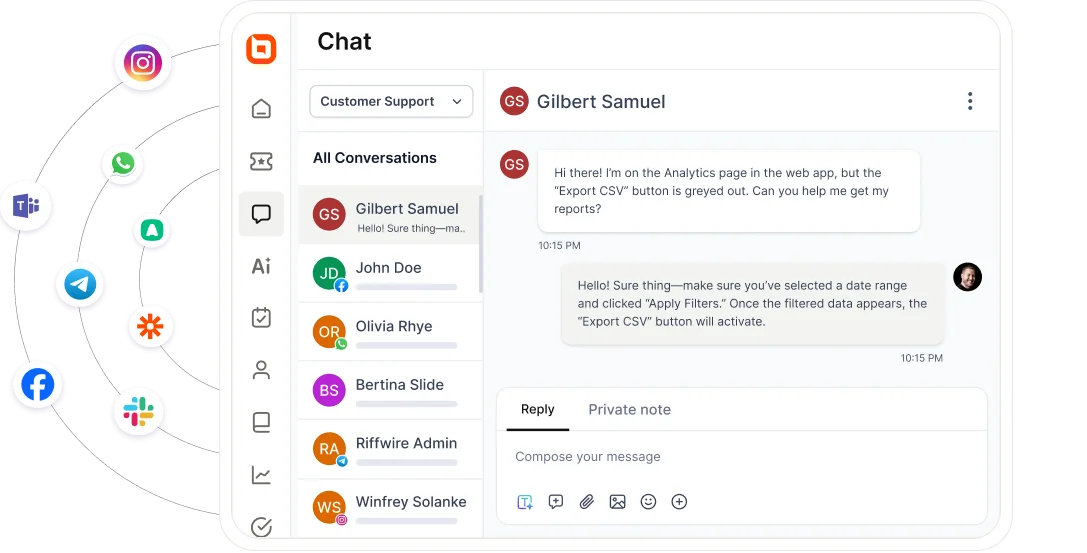
Thankfully, businesses can resolve this by investing in an omnichannel customer service tool. It integrates all communication platforms into one, allowing agents to provide prompt responses to customer inquiries regardless of the channel they use.
Additionally, agents can switch seamlessly from one communication channel, addressing all the concerns shared without losing context for better experiences.
Provide self-help options
Most businesses provide employees with a variety of self-service resources to gain valuable information and skills that help in understanding the set standards for customer service.
These self-help resources can be provided in the form of documentation such as user manuals, tutorials, FAQs, or in multi-media format like audio and video.
Companies have to ensure that all relevant information is easily and readily accessible within a unified knowledge base software.
These self-service tools help reduce the frustration of employees having to struggle with finding solutions.
Customers should also access these resources easily, enabling them to resolve issues at their convenience and learn more about the product or company by extension.
Aligning SLAs with customer expectations
Businesses should set and map realistic service level agreements (SLAs) for every ticket with well-defined conditions based on the needs for each communication platform.
Also, the SLA terms have to be updated regularly to match new trends and metrics. This helps to enhance support efficiency and maintain responsiveness as one of the crucial standards for customer service.
Equip your team with the right tools
Technology plays a vital role in helping teams consistently meet and exceed customer service standards.
- A robust customer service software ensures issues are tracked and resolved efficiently, aligning with expectations for timely and organized support.
- Automation and AI manage repetitive tasks like tagging and routing, allowing agents to focus on delivering quality, human-centered service—an essential standard in complex or sensitive cases.
- CRM integration provides agents with instant access to customer history and preferences, enabling personalized and empathetic interactions.
- Live chat software enables real-time responses, directly improving customer service standards that relate to speed and accessibility such as fast first response time.
Together, these tools empower support teams to uphold high customer service standards across every customer touchpoint.
Too Many Requests, Not Enough Time? Here’s the Fix!
Handle every query efficiently and deliver faster support without burning out your team.

Also, if you are looking for a practical way to assess your current support operation, you can use the customer service standards checklist below to identify gaps, track improvements, and benchmark your team against customer service best practices.
Reward agents who meet service standards to inspire others
Recognizing agents who meet or go beyond customer service standards helps build a strong, motivated support team. Simple actions like public praise, small rewards, or a thank-you message can make a big difference.
When agents feel appreciated, they stay motivated and others are encouraged to do their best too.
BoldDesk® gives you the tools to set, track, and reach your service goals, helping your team deliver consistent, high-quality support.
Make sure to review and update your customer support standards often. It keeps your support fresh and helps your business stand out.
What standards for customer service matter most in your industry? Share your thoughts in the comments!
Related articles
- Customer Service Philosophy: What It Is, Examples, and More
- The Importance of Involving Your Entire Company in Customer Service
- How to Set Smart Customer Service Goals
Frequently Asked Questions (FAQs)
The most important customer service standards include first response time, resolution time, customer satisfaction (CSAT), escalation rate, Net Promoter Score (NPS), and first contact resolution (FCR). These metrics help businesses measure service quality, improve customer satisfaction, and deliver consistent support experiences
Businesses measure customer service standards using key performance indicators (KPIs) such as CSAT, NPS, first response time, resolution time, ticket backlog, escalation rate, and first contact resolution. Tracking these metrics helps organizations monitor performance, identify improvement opportunities, and maintain service quality.
A customer service standards policy is a document that outlines an organization’s service expectations, performance goals, communication requirements, and customer experience guidelines. It helps ensure employees follow consistent practices and deliver a high standard of customer service across all interactions.
Consumers expect businesses to provide quick responses, availability through various channels, and a friendly, professional attitude.
They also value honesty, reliability, and accountability in service. Meeting these standards ensures a positive customer experience and builds trust.
Strong customer service standards boost brand loyalty, increase positive word-of-mouth, and drive revenue growth by creating exceptional experiences that differentiate a business from competitors.
The main elements to focus on include having knowledgeable staff, ensuring effective and clear communication, and providing quick and efficient responses.