




TL;DR: Ecommerce chatbots automate high‑volume customer service tasks like order tracking, product recommendations, cart recovery, after‑sales support, and FAQs. Popular tools include BoldDesk, Chatfuel, Ada, ManyChat, and ChatBot. With clear escalation paths and accurate knowledge sources, ecommerce chatbots help businesses scale support and improve customer satisfaction without replacing human agents.
As online retail accelerates, customer expectations have evolved just as quickly. Today’s shoppers expect instant, accurate support across every stage of the buying journey.
However, manual support teams often struggle to keep up with rising ticket volumes, seasonal traffic spikes, and always-on global audiences.
Gartner reported that 85% of customer service and support leaders will explore or pilot a customer-facing conversational GenAI solution in 2025.
This is where ecommerce chatbots move beyond being a convenience and become a strategic advantage.
In this guide, we’ll explore how ecommerce chatbots bridge the gap between speed and quality, and how they help ecommerce businesses scale support efficiently without losing the human touch.
What is an ecommerce chatbot?
An ecommerce chatbot is an AI-powered software application designed to simulate human conversation and automate support tasks in an online retail environment.
In practice, ecommerce chatbots help customers get answers faster and help support teams reduce repetitive tickets, without removing the option to talk to a human.
In customer service, ecommerce chatbots are typically used to:
- Answer FAQs (shipping timelines, return windows, warranty basics)
- Help with order-related questions (like “Where is my order?”)
- Collect details for a support request (order number, email, issue type)
- Escalate to a human agent when the issue is complex or sensitive
Most modern support teams use a hybrid approach: rules-based ecommerce chatbots for predictable workflows and AI chatbots for flexible conversation.
What fully automated store support means
Fully automated store support is about building a system where customers get instant help, routine issues are resolved without human effort, and agents step in only when needed.
It’s not about replacing humans. It’s about combining self-service, AI, and agent support into one seamless experience.
Self-service support for customers to find answers fast
The first layer focuses on empowering customers to solve problems on their own. With tools like FAQs, knowledge bases, self-service portals, and guided workflows, shoppers can track orders, process returns, or troubleshoot issues instantly.
This reduces repetitive inquiries and gives customers the satisfaction of quick, independent resolution.
Automate common requests with ecommerce AI chatbots
The second layer introduces AI‑driven ecommerce chatbots that handle everyday customer needs end‑to‑end.
These AI ecommerce chatbots have the ability to:
- Understand intent
- Provide personalized responses
- Resolve tasks like order updates or payment queries without human involvement
By automating routine conversations, ecommerce brands deliver faster service while freeing agents to focus on complex cases.
Human support: Agent assistance for complex issues
The final layer ensures customers aren’t left stranded when automation reaches its limits. If an issue is too complex or sensitive, the ecommerce chatbot hands off to a live agent.
Automation still plays a role here by giving agents full context, conversation history, and suggested responses, making human intervention faster, smoother, and more effective.
Core ecommerce chatbot use cases you can automate
AI chatbots for ecommerce automate key customer interactions across every stage of the e-commerce journey, from product discovery to post-purchase support.
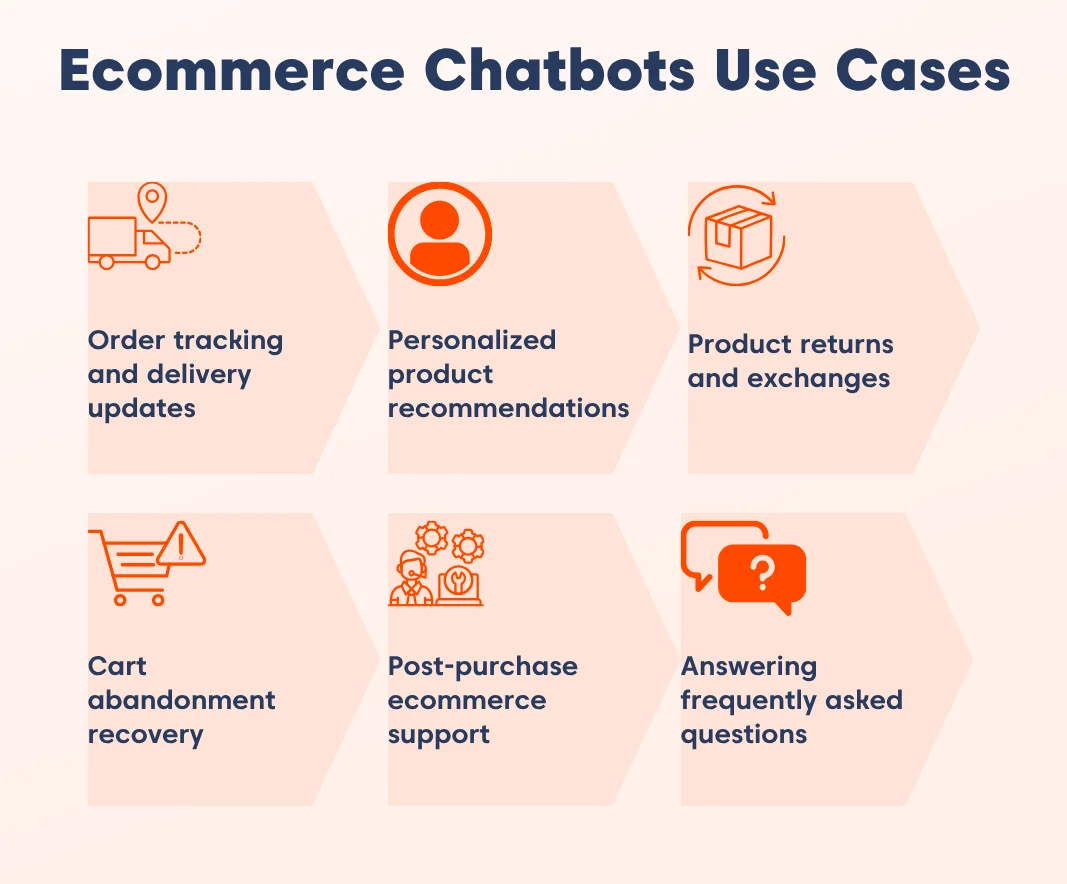
Each use case below highlights what the ecommerce chatbot automates, how it works, and the impact it delivers.
Order tracking and delivery updates
Ecommerce chatbots automate order tracking by instantly fetching real‑time shipping data and delivering it conversationally, without agent involvement.
By integrating directly with the order management system and shipping providers, the ecommerce shopping AI chatbot removes the need for customers to wait in queues or search through emails.
Instead, customers automatically receive:
- Real‑time shipment status
- Latest tracking updates
- Estimated delivery windows
- Delivery exceptions such as delays or failed delivery attempts
This automation eliminates repetitive WISMO (“Where Is My Order”) queries and significantly reduces support volume while keeping customers informed and reassured.
Example: Dynavics reduced order-status support inefficiencies by centralizing high-volume customer requests in BoldDesk during peak periods, improving tracking visibility and reducing repetitive WISMO tickets.
Product discovery and personalized recommendations
Many shoppers don’t arrive knowing exactly what they want. They’re usually browsing, comparing, and looking for guidance, like asking a helpful store assistant for advice.
AI chatbots for ecommerce automate product discovery by analyzing customer behavior and delivering tailored recommendations in real time.
Using data such as:
- Browsing activity
- Cart behavior
- Purchase history
The ecommerce chatbot suggests relevant products, instantly guiding shoppers toward purchase decisions without manual assistance.
This automated personalization can increase conversions and revenue, with personalized product recommendations shown to drive a 10–15% increase in revenue, making product discovery a high‑impact chatbot use case.
Returns and exchanges without friction
Returns and product exchanges are moments when customers value clarity and speed most.
Ecommerce AI chatbots automate return and exchange workflows by validating eligibility, retrieving order details, and guiding customers through the process.
Without agent involvement, the ecommerce chatbot can:
- Verify return eligibility
- Fetch order and shipping details
- Provide step-by-step return instructions
This reduces friction, speeds up resolutions, and improves customer satisfaction by creating a smooth, transparent experience that reduces frustration and builds customer trust.
Recovery of abandoned carts
Cart abandonment is one of the biggest missed revenue opportunities in ecommerce.
AI chatbots for ecommerce automate the cart recovery process by proactively engaging customers who leave before completing checkout.
Based on behavioral signals, AI shopping chatbots can:
- Trigger personalized follow-up messages
- Answer last-minute questions
- Address shipping or return concerns
- Offer targeted incentives
This behavior‑driven automation turns hesitation into action, making cart recovery one of the highest‑ROI use cases for ecommerce chatbots.
Post-purchase ecommerce support
After checkout, ecommerce chatbots automate post-purchase communication by proactively keeping customers informed and reassured.
Through automation, they can:
- Send order confirmations and updates
- Provide live shipment status from logistics systems
- Share tracking updates in a conversational, easy‑to‑understand format
- Send automated delay notifications when issues occur
- Offer estimated delivery windows without agent involvement
This automated personalized support strengthens customer relationships, improves retention, and increases lifetime value without adding operational overhead.
Answering frequently asked questions
Ecommerce chatbots automate FAQ handling by delivering fast, accurate answers without requiring customers to search through menus or help pages.
Through AI‑driven automation, ecommerce chatbots can instantly respond to:
- Product‑specific questions (such as dimensions or materials)
- Restock timelines
- Compatible accessories or stock availability
By resolving questions automatically and in real time, ecommerce chatbots reduce friction, keep shoppers engaged, and help them move forward with confidence.
Example: NannyFit used BoldDesk automation to scale post-purchase customer communication and handle more routine questions without adding agent workload.
How to automate customer support with ecommerce chatbots
Ecommerce chatbots powered by AI can automate a large share of repetitive support when they are connected to the right systems, trained on real conversations, and backed by clear escalation rules.
Use this proven setup sequence to automate ecommerce support with chatbots:
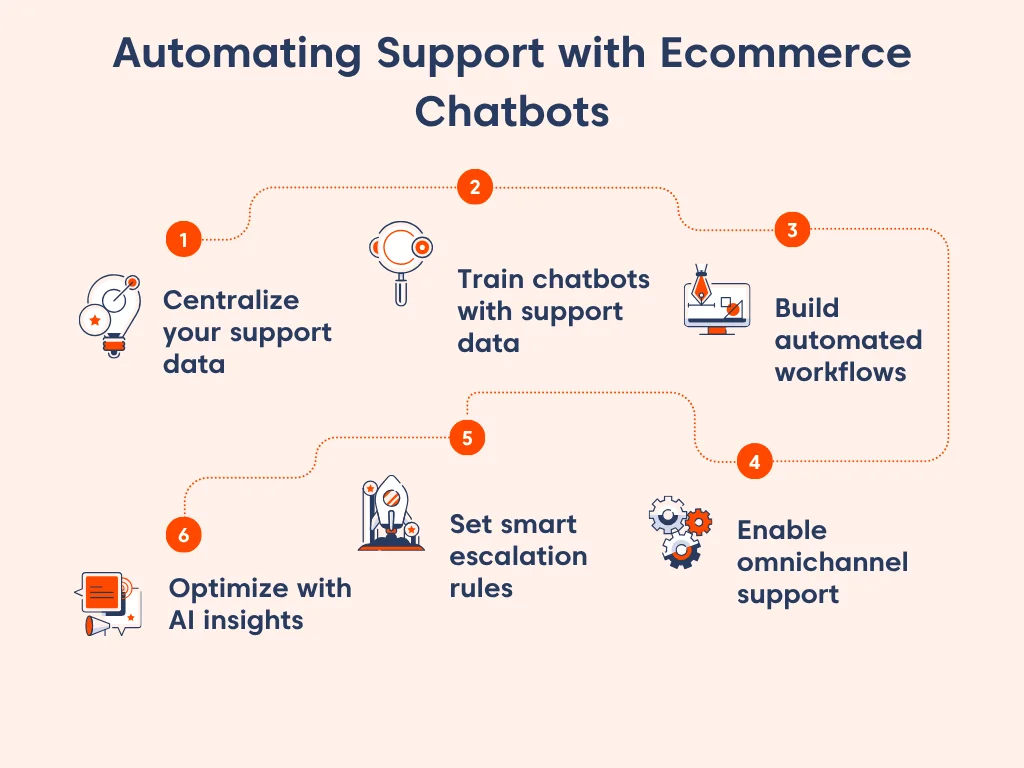
Step 1: Centralize your support data
Before you train anything, decide where the ecommerce chatbot is allowed to pull answers from. If policies live across scattered docs, outdated macros, and a knowledge base, the chatbot will respond inconsistently, and customers will notice.
Start by centralizing (or at least standardizing access to) the data that drives most ecommerce questions:
- Orders and fulfillment: Order status, items, timestamps, fulfillment cutoffs, cancellation eligibility.
- Shipping and delivery events: Carrier scans, delivery ETA, “delivered” proof, and delay reasons when available.
- Returns or refunds policies: Eligibility windows, final sale rules, exchange logic, refund timelines, restocking fees.
- Customer profile context: Email/phone, addresses, order history, VIP tags (if used), prior issues.
- Catalog and inventory (optional but valuable): Availability, variants, sizing info, backorder rules.
Operational tip: Write policies in “decision-ready” language (clear rules and exceptions). The more ambiguous your policy text is, the more often the AI chatbot for ecommerce will need to escalate.
Step 2: Train the ecommerce chatbot on real support conversations
Training your ecommerce chatbot should reflect how customers ask questions: typos, shorthand, and all.
Use past tickets, chat logs, and FAQs to teach your chatbot how customers phrase questions.
This training helps the AI recognize intent, understand variations in language, and provide accurate, human‑like responses.
Step 3: Build automated workflows
Automation delivers real value when your chatbot can take action, not just provide answers.
Focus on workflows that are frequent, rule-based, and easy to verify against system data, such as order tracking (WISMO), returns initiation, etc.
To keep workflows safe and accurate, include the following:
- Identity verification before sharing order-specific details (e.g., email + order number match)
- Evidence collection where needed (photos for damage, missing item details, delivery location notes)
- Clear “can’t do” boundaries (e.g., “Once fulfilled, we can’t cancel—here are your options.”)
Step 4: Enable omnichannel support
Customers won’t always use the same channel, and they often switch mid-issue.
Omnichannel deployment across all customer touchpoints reduces duplicate tickets and improves continuity, especially when the bot can carry context across touchpoints.
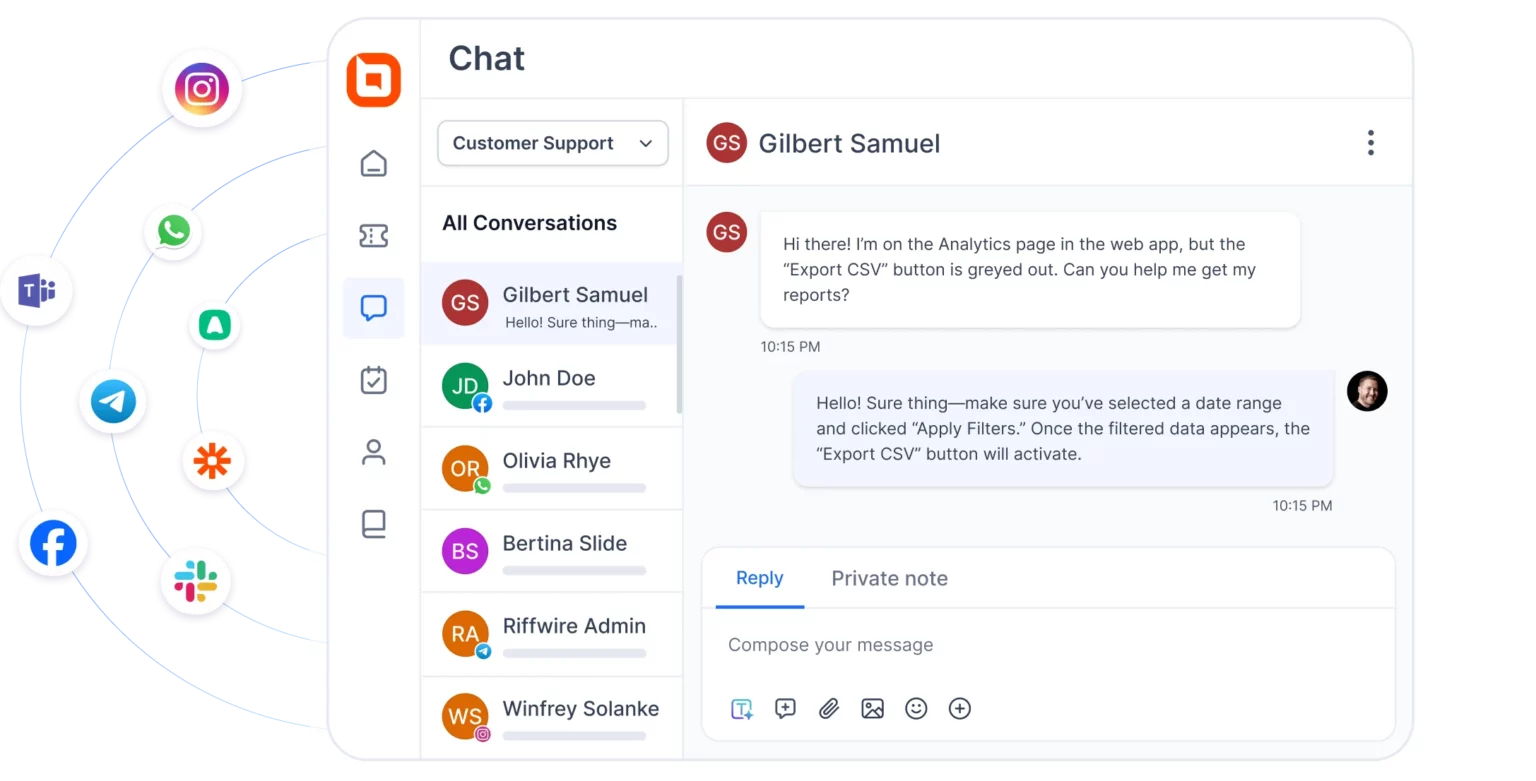
Through omnichannel support, customers get consistent answers wherever they reach out, improving satisfaction and reducing friction.
Step 5: Set smart escalation rules
Not every issue should be automated. Escalation is a designed part of fully automated store support, because it protects the customer experience and keeps automation trustworthy.
Common ecommerce chatbot escalation triggers include:
- Low confidence intent detection: When the bot isn’t sure what the customer means.
- Repeated failures: Customers ask the same question twice, get stuck in loops, or abandon a flow.
- Risky topics: payment disputes, chargebacks, or fraud signals that require human oversight.
- High‑priority scenarios: High‑value orders, time‑sensitive deliveries, or VIP customers (if segmented).
- Sensitive requests: Privacy/data concerns, legal threats, or harassment cases.
Step 6: Continuously optimize with AI insights
Monitor chatbot performance and analyze conversation data. AI can highlight gaps in knowledge, trending issues, or opportunities to improve workflows.
Regular optimization ensures your ecommerce chatbot stays accurate, efficient, and aligned with evolving customer needs.
5 Top AI chatbots for ecommerce
With countless ecommerce chatbot platforms available today, it can be overwhelming to know which ones truly deliver value.
After thorough research into leading solutions, we’ve curated five standout AI chatbots for ecommerce that excel in customer support, helping online businesses choose with confidence.
BoldDesk
Best for: Ecommerce businesses needing robust, end-to-end customer support with AI-driven automation
BoldDesk is a strong choice for ecommerce support teams because it combines a complete customer support platform with AI chatbots that can help scale responses and improve agent productivity.
It’s built for online stores that need to handle high-volume questions (orders, shipping, returns, product issues) efficiently, while still making it easy to route complex cases to human agents.
Key features
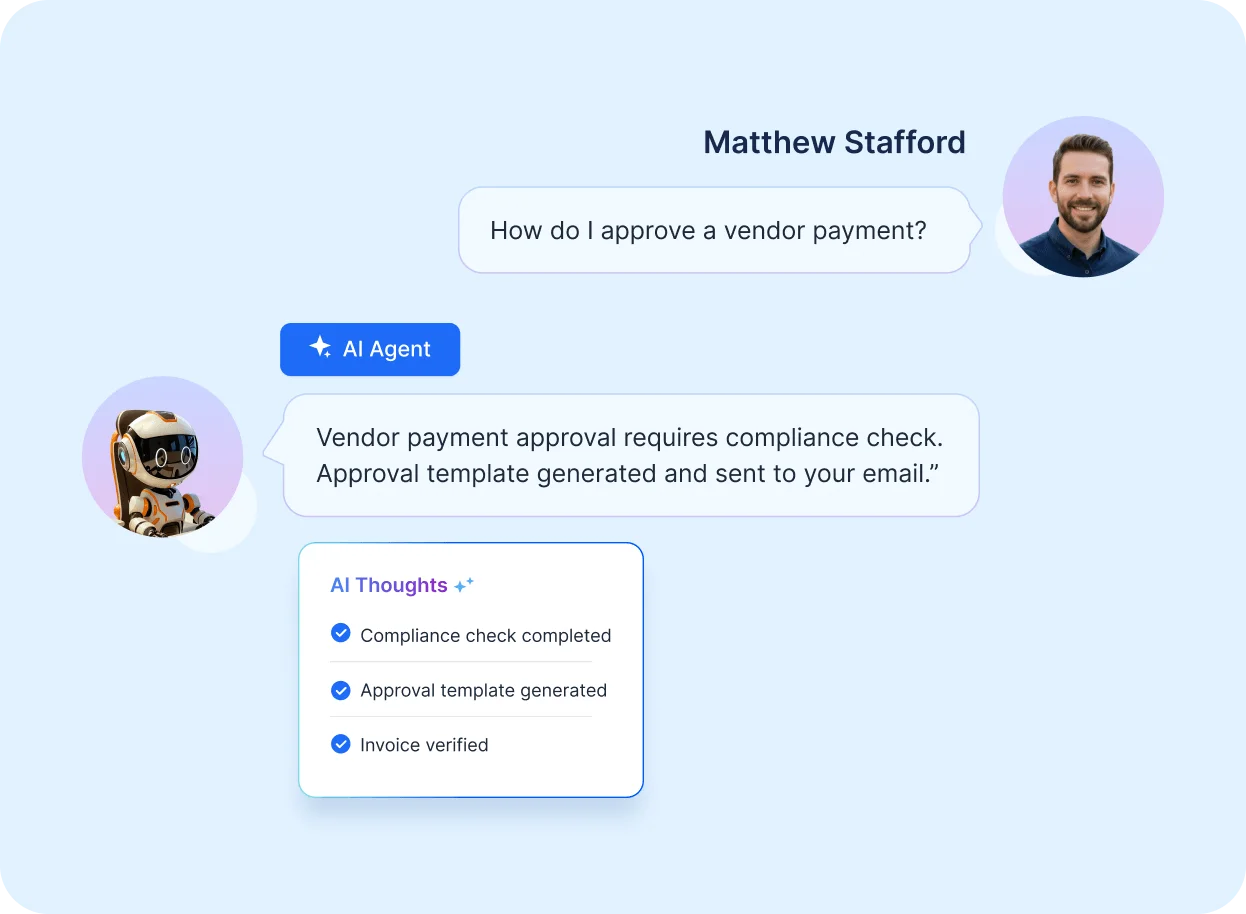
- Customizable AI chatbots: Create ecommerce AI chatbots tailored to your brand voice that automate FAQs, order tracking, and post-purchase support. Deliver instant, 24/7 responses across channels while ensuring smooth escalation to human agents when required.
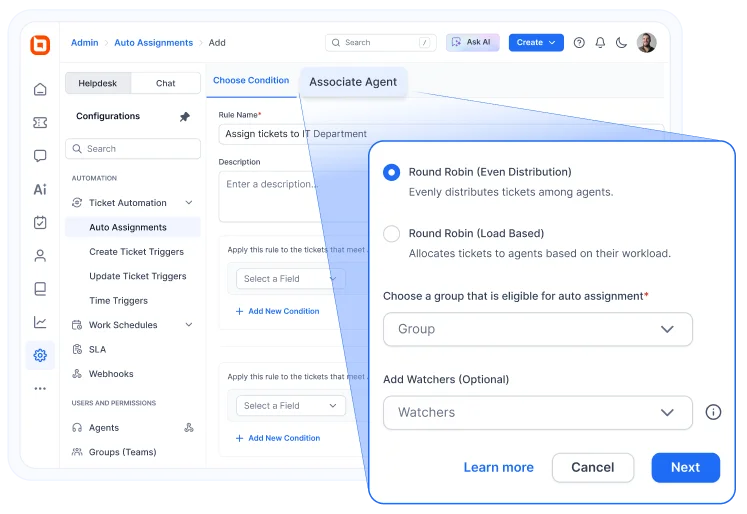
- Automation for faster resolutions: Automate repetitive support tasks such as ticket routing, field updates, and notifications. Use integrations and AI Actions to trigger API-based workflows in connected systems like order management platforms.
- AI‑driven ticket classification and prioritization: Automatically categorize incoming queries based on intent and urgency, helping teams prioritize critical issues and reduce manual triage effort (availability may vary by plan).
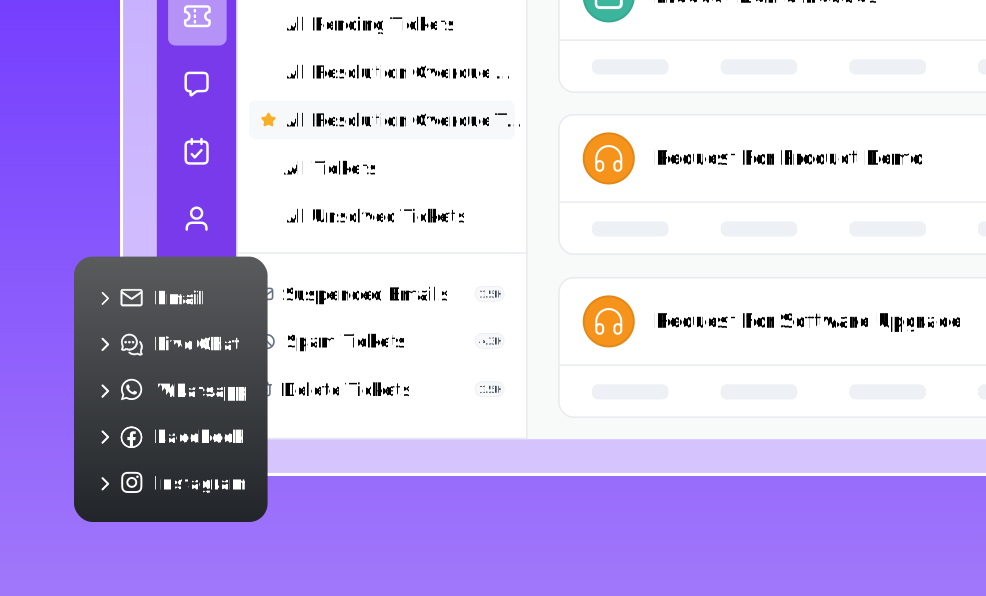
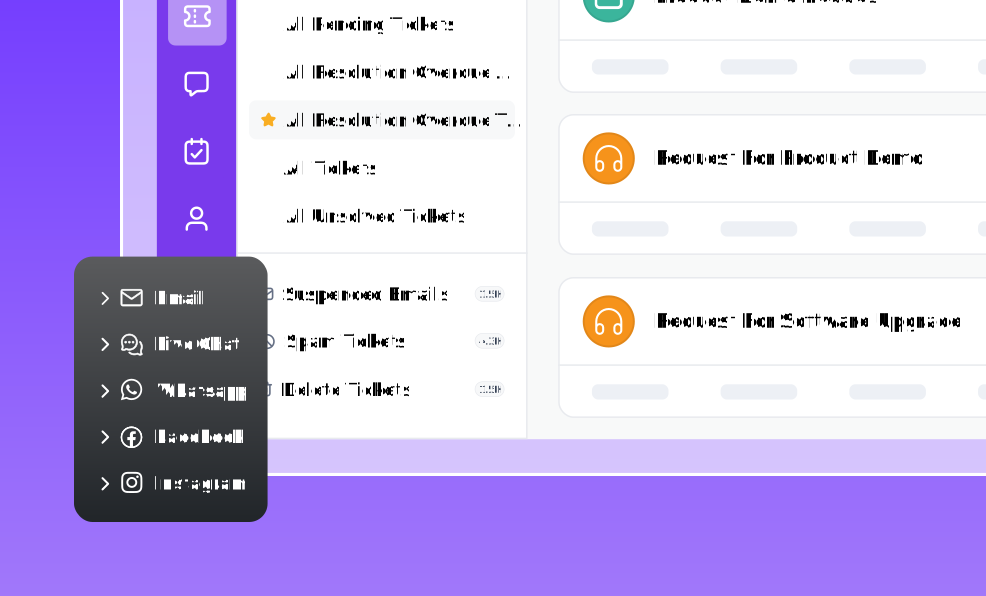
- Omnichannel inbox for ecommerce support: Centralize conversations from channels your team uses, such as live chat and email, and connect additional channels where supported (for example, WhatsApp) based on your setup.
- Built-in knowledge base: Enables self-service by publishing help content so customers can quickly find answers to common questions like shipping timelines, return policies, and order-tracking steps, without contacting support.
- SLA management and performance monitoring: Track response times, resolution rates, and SLA adherence to ensure consistent support quality during peak ecommerce demand.
- Detailed reporting and analytics: Provides real-time insights into resolution times, agent performance, recurring ecommerce issues, and customer satisfaction trends, enabling data-driven optimization of support workflows and chatbot effectiveness.
BoldDesk pricing
BoldDesk offers transparent, agent‑based pricing built for ecommerce support teams of any size, so your costs stay predictable no matter how many tickets you handle.
All essential features for customer support and ecommerce chatbot deployment are available from the base plan, with pricing starting at $99 per month for up to 5 agents.
Additionally, AI capabilities are available via add-ons as follows:
- AI Agent (chatbot): Uses AI credits ($20 per 1,000 credits)
- AI Copilot: $20 per agent/month
Chatfuel
Best for: Small to medium brands concentrating on social media sales.
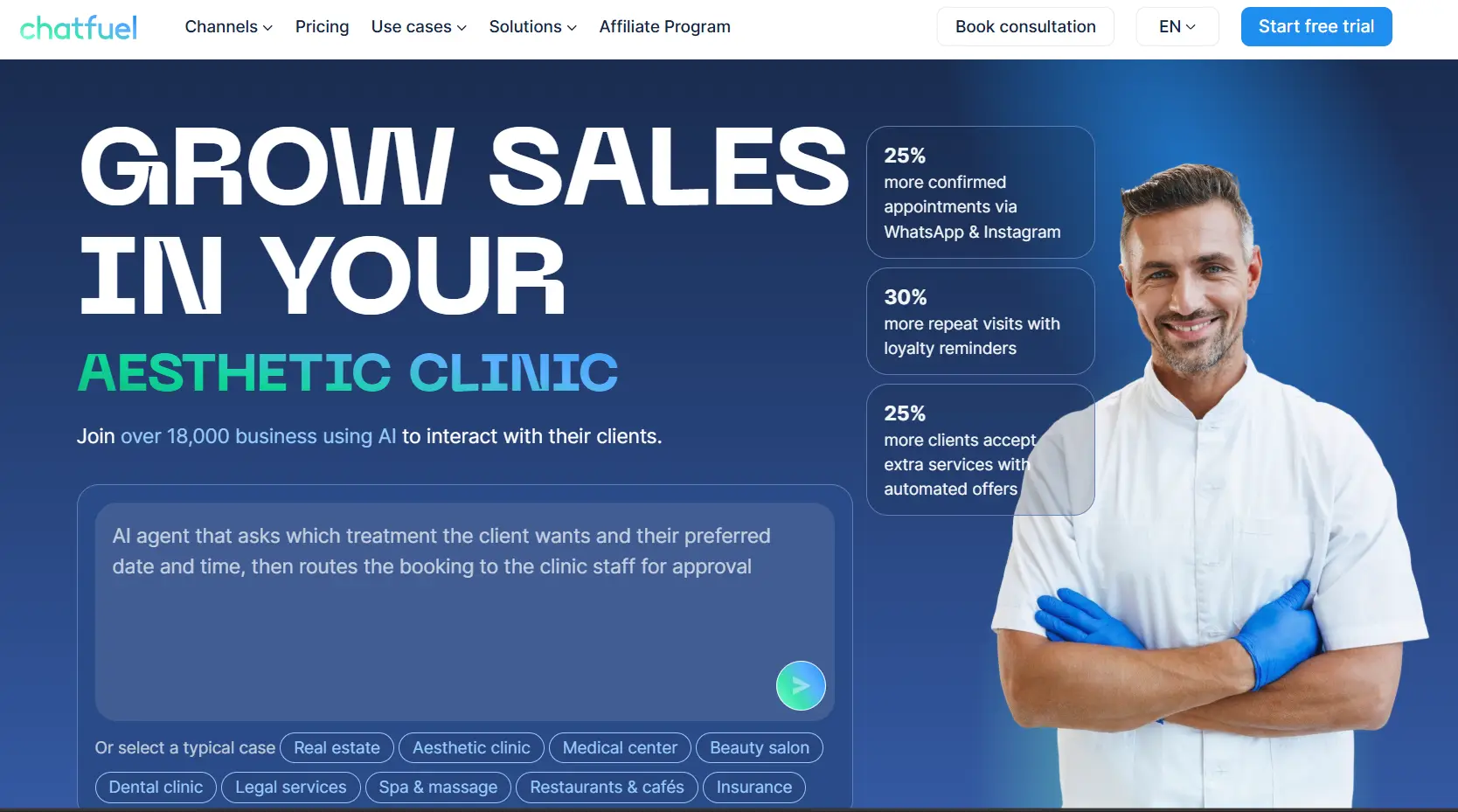
As a leading platform for social commerce, Chatfuel focuses on automating interactions on Facebook Messenger and Instagram.
It helps brands turn social conversations into sales through automated engagement.
Key features
- Social media channel integration: Primarily focused on Messenger and Instagram, with WhatsApp support available via integrations.
- Lead capture automation: Collects customer details and nurtures leads through conversational flows.
- Payment integration: Enables in‑chat purchases, making social commerce seamless.
Chatfuel pricing
Starts at $69 per month
Ada
Best for: Enterprise and large-scale ecommerce operations focused on AI-driven customer support automation
Ada is an AI-first customer service platform built to resolve a high volume of ecommerce queries autonomously and at scale.
It’s ideal for brands that want to reduce support costs while delivering fast, consistent, and personalized customer experiences across touchpoints.
Key features
- AI-powered self‑service automation: Resolves common ecommerce queries like order status, returns, and account issues without human intervention.
- Omnichannel support coverage: Delivers consistent chatbot experiences across web, mobile, email, and messaging platforms.
- Deep analytics and intent insights: Analyze customer intent, resolution rates, and automation performance to continuously improve support outcomes.
Ada pricing
Contact Ada for tailored pricing details
ManyChat
Best for: Ecommerce marketers focused on Messenger and SMS automation
ManyChat excels at helping ecommerce brands drive engagement and repeat purchases through conversational marketing.
It’s widely used for campaigns, promotions, and automated customer touchpoints.
Key features
- Messenger and SMS automation: Build interactive ecommerce chatbots for promotions, order confirmations, and follow-ups.
- Flow-based campaign builder: Create structured conversational journeys for product launches and seasonal sales.
- Customer segmentation tools: Target specific shopper groups based on behavior and engagement patterns.
ManyChat pricing
Starts at $14 per month
ChatBot
Best for: Teams looking for rule-based and hybrid AI chatbots with quick deployment
ChatBot is designed for fast setup and ease of use, making it suitable for ecommerce businesses new to AI-driven support.
Its automation features help ecommerce businesses handle repetitive customer inquiries at scale.
Key features
- Drag-and-drop bot editor: Build ecommerce chatbots quickly without coding.
- Live chat handoff: Transfer complex queries to human agents when automation reaches its limit.
- Prebuilt ecommerce templates: Launch bots for order tracking, FAQs, and shipping questions with minimal effort.
ChatBot pricing
Starts at $19/user per month
Benefits of ecommerce customer service chatbots
Implementing ecommerce chatbots can improve both customer experience and operational efficiency, especially when your team is handling repetitive, high-volume requests.
Key advantages of ecommerce AI chatbots for customer service include:
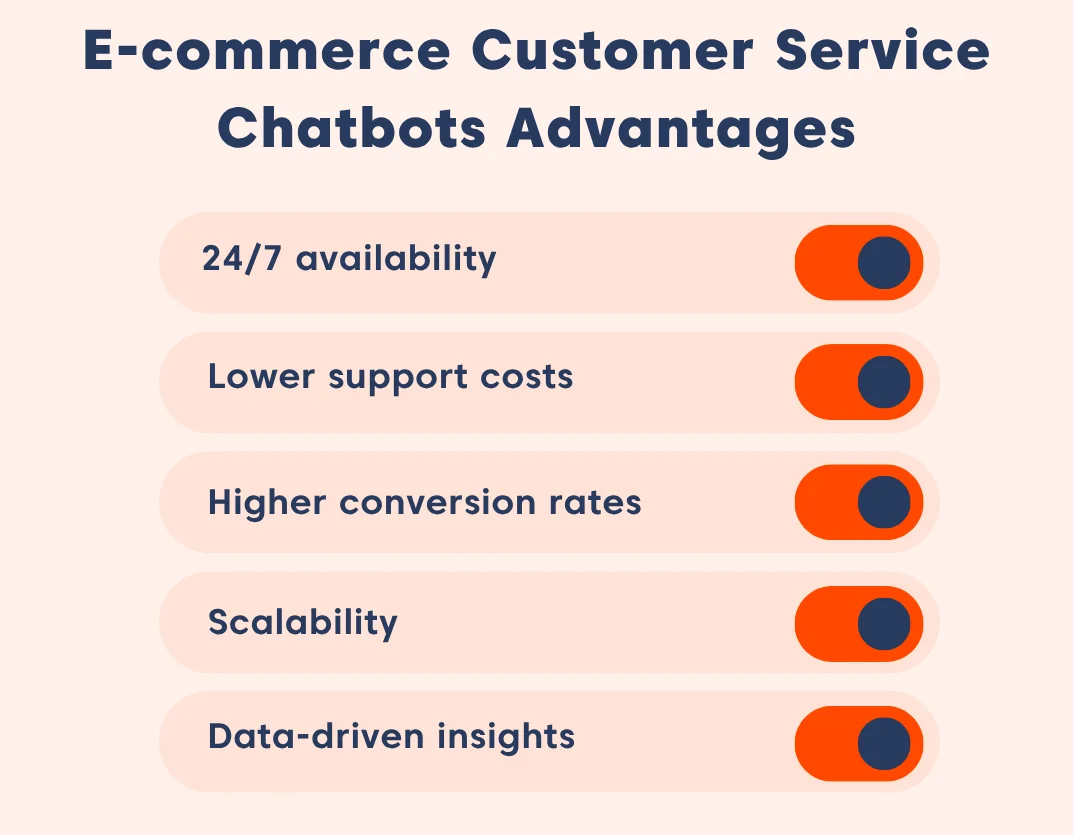
- 24/7 availability: AI chatbots for ecommerce provide instant assistance outside of standard business hours, ensuring global customers are never left waiting.
- Reduced support costs: By automating most of the routine customer inquiries, companies can significantly lower their cost-per-interaction.
- Increased conversion rates: Ecommerce shopping AI chatbots can guide users through the sales funnel, reducing cart abandonment by answering product questions in real time.
- Scalability: By handling thousands of simultaneous conversations, AI chatbots for ecommerce allow your business to manage peak seasonal traffic without hiring temporary staff.
- Data-driven insights: AI ecommerce chatbots collect valuable data on preferences and common customer pain points, helping support teams refine the user journey.
Key takeaway: Chatbots allow help desk managers to shift human agents toward complex troubleshooting while maintaining high customer satisfaction scores for routine queries.
Turn ecommerce AI chatbots into a reliable support channel
Ecommerce chatbots improve customer service by automating repetitive queries, reducing response time, and scaling support without increasing headcount.
If you treat a chatbot as a “set and forget” project, it can backfire. But if you treat it like a support channel, with QA, reporting, and continuous improvement, it can become a reliable first line of help.
Ready to modernize your ecommerce support? Discover how BoldDesk’s AI chatbot for ecommerce helps teams deliver faster, smarter customer service.
Start a free trial, book a live demo, or talk to the BoldDesk support team for more information. Also, let us know what you think in the comments section below.
Related articles
- Top eCommerce Customer Support Challenges (and How to Solve Them)
- Best Ecommerce Tools to Boost Sales in 2026
- Best Ecommerce Help Desk Software in 2026
Frequently Asked Questions
Yes. Many ecommerce chatbot platforms like BoldDesk support multilingual experiences, but quality varies.
Validate language coverage, translation accuracy, and agent handoff behavior for each language before launch.
Yes. Live chat involves a human agent responding in real time, whereas an AI-powered chatbot for ecommerce uses software to respond automatically without human help.
Most ecommerce chatbot software provides native integrations or API connections to popular platforms like Shopify, Magento, and BigCommerce to sync order data.
Not if implemented correctly. When a bot is programmed to provide quick, accurate answers and offers an easy handoff to a human agent for complex issues, it actually increases customer satisfaction.