

 In this page

TL;DR: Customer value increases when customers perceive the benefits they get as greater than the total costs they experience, such as money, time, effort, and risk. You can raise value by improving outcomes, reducing friction, and strengthening support, leading to higher satisfaction and long-term loyalty.
Customer value comes down to a simple comparison: customers evaluate the benefits they receive against the total cost of achieving them, including not just money, but also time, effort, and risk.
According to PwC, customers are willing to pay more for experiences that matter to them: 43% would pay more for greater convenience, while 42% would pay more for a friendly, welcoming experience.
That same evaluation influences customer loyalty and switching behavior.
When the value customers receive no longer outweighs the overall cost and effort of using a product or service, they begin looking for alternatives that feel easier, safer, or more effective.
This guide explains what customer value is, the main types, how to measure it using a benefits-minus-costs framework, and practical ways to improve it by increasing outcomes and reducing friction across the customer journey.
What is customer value?
Customer value is the customer’s perception of how much a product or service is worth based on the benefits they receive compared to the costs they incur.
These benefits can include functional advantages such as performance and reliability, as well as experiential and emotional factors such as convenience, trust, satisfaction, and brand perception.
The costs include not only price, but also time, effort, and potential risk involved in using the product or service.
What are the types of customer value?
Customer value is shaped by how customers evaluate the benefits they receive relative to the costs they experience.
These benefits generally fall into four main types, each influencing how customers decide whether a product or service is worth choosing. These include:
- Functional value: How well the product or service performs, including quality, reliability, and ability to deliver expected outcomes.
- Psychological value: The sense of reassurance, peace of mind, or confidence customers feel after making a purchase, including trust in the decision and reduced anxiety about risk.
- Social value: The trust, credibility, or reputation customers gain from associating with the brand.
- Monetary (economic) value: The customer’s assessment of whether the benefits they receive justify the price paid and long‑term investment, including savings, efficiency gains, and return over time.
Why is customer value important?
Customer value matters because it directly influences whether customers stay, return, or switch to alternatives that offer better benefits relative to cost.
The following benefits highlight why prioritizing customer value is essential for business success.
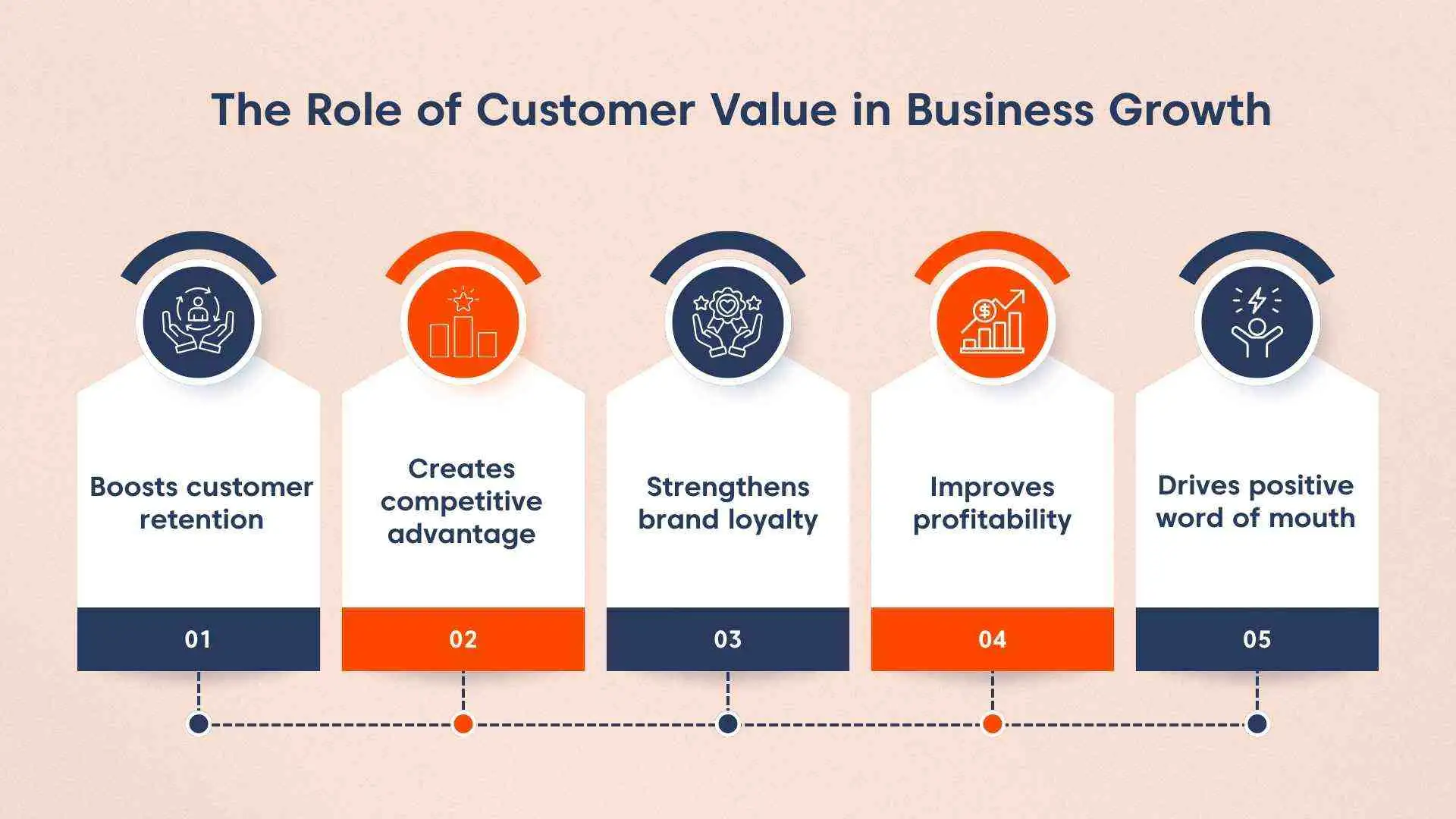
- Boosts customer retention: When customers feel they receive strong value, they are more likely to continue choosing the business.
- Creates competitive advantage: Companies that deliver higher value than competitors attract more customers and stand out in the market.
- Strengthens brand loyalty: Customers who consistently receive high value are likely to advocate for the brand.
- Improves profitability: Customers who recognize strong value are more willing to pay for quality products or services, increasing revenue.
- Drives positive word of mouth: Satisfied customers naturally recommend brands to others, leading to organic growth.
How to measure customer value
Measuring customer value requires breaking the process into clear, actionable steps.
The goal is to determine whether the benefits customers receive outweigh the total costs they experience throughout their journey with your business.
To do this effectively, focus on the following key components:
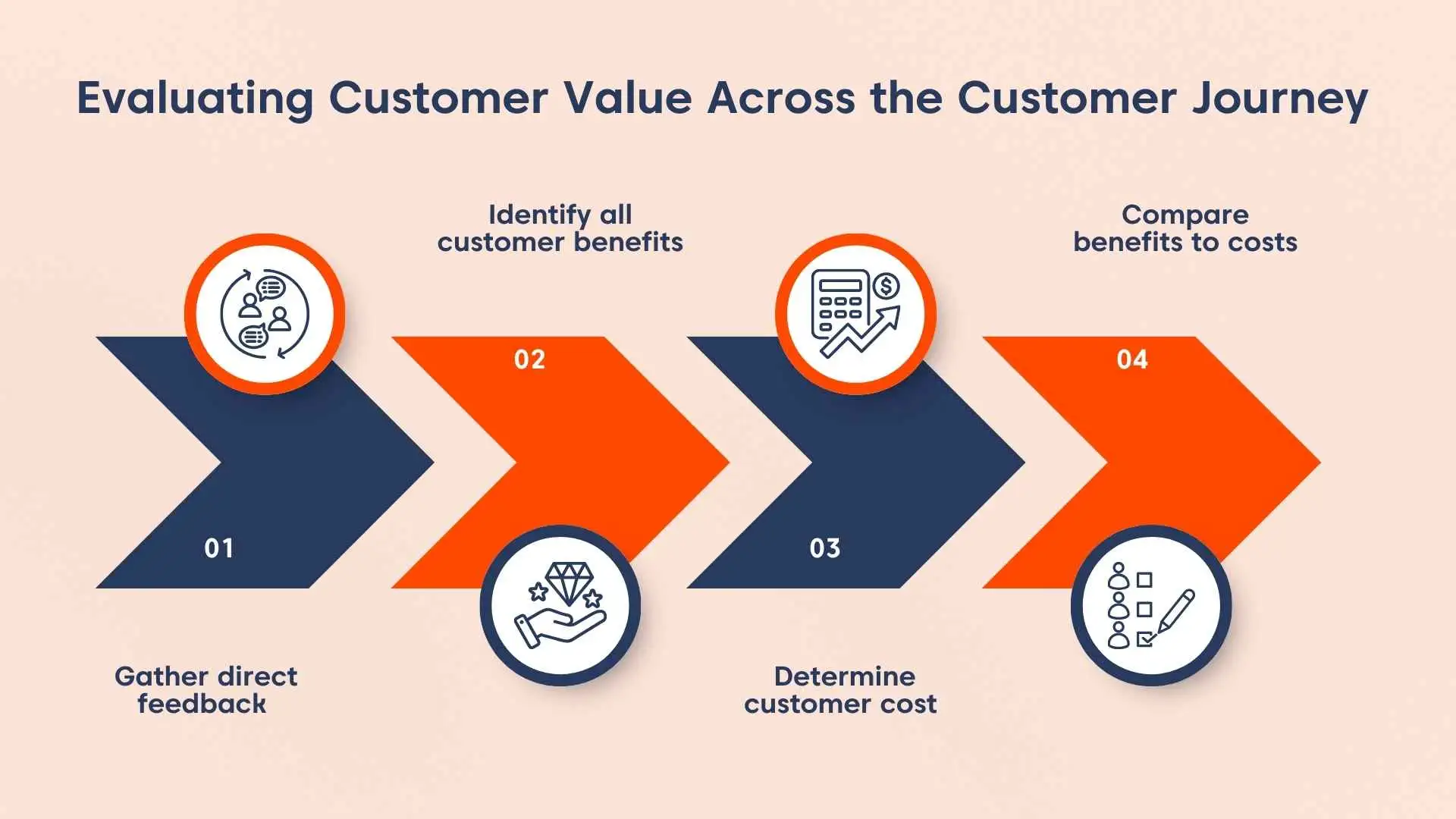
1. Gather direct feedback from customers
Intentional, well‑designed questions help reveal which product benefits matter, what challenges customers face, and how effectively your solution meets their expectations.
To collect clear, focused customer feedback from your customers, you can craft a short set of targeted questions that uncover real customer insights.
Then choose the most effective channel to capture that feedback, whether through quick email surveys, in‑app support prompts, follow‑up calls, or periodic check‑ins.
2. Identify all customer benefits
Start by listing all the benefits customers get across the entire journey, from evaluation and onboarding to daily use, support, and renewal.
These benefits represent the positive side of the value equation and must be assessed in terms of customers’ actual experience.
The customer benefits fall into two categories:
- Functional benefits: How well the product or service performs (performance, quality, reliability).
- Experiential benefits: How easy and satisfying it feels to use and get support (service quality, responsiveness, brand perception).
To measure these benefits meaningfully, tie each activity to either increasing perceived benefit or reducing customer cost.
This can be done through:
- Reviewing product or service performance, reliability, and quality.
- Auditing the support experience by tracking metrics such as CSAT, CES, first response time, and resolution time.
- Assessing the quality of customer service you provide.
- Tracking time to resolution.
- Tracking adoption and outcomes, including activation rate, feature usage, and time-to-value.
By explicitly mapping metrics to benefits or costs, this approach moves beyond activity tracking and shows how each improvement affects customer value.
This makes the measurement framework more accurate, actionable, and aligned with how customers evaluate value.
3. Determine customer cost (what they invest or sacrifice)
Map out everything your customers spend, beyond money, when using your product or service. Costs fall into two groups:
- Tangible costs: Purchase price, subscription or renewal fees, implementation or onboarding expenses, training costs, maintenance or support fees.
- Intangible costs: Time to learn the product, effort to complete tasks, frustration from poor usability, risk of errors or downtime, and emotional strain during support interactions.
Separating tangible and intangible costs makes it easier to calculate a complete cost profile.
Each cost should be mapped to a specific friction, such as time spent, steps required, or risk introduced.
The total cost incurred by customers can be determined by:
- Mapping every monetary cost from onboarding through renewal.
- Documenting the time and effort required at each step of the customer journey.
- Assessing friction in support, usability, or onboarding processes.
4. Assign values or scoring weights to compare the benefits to costs
Evaluate whether the benefits outweigh the total customer investment. You need to:
- Choose a scoring scale like 1–5 or 1–10 for each benefit and cost.
- Weigh what matters most e.g., reliability and time-to-value.
- Score by segment or use case (new customers vs advanced users, SMB vs enterprise).
- Calculate the net value by subtracting total costs from total benefits.
Here is the formula for calculating customer value:
Customer value = Total perceived benefits – Total customer costs
While many businesses use qualitative scoring instead of exact dollar values, the principle stays the same: value rises when benefits increase, and customer costs decrease.
This comparison helps you make informed decisions about resource allocation, customer experience improvements, and long‑term relationship management.
Example
If a customer gains $5,000 in benefits and incurs $2,000 in total costs, the customer value is:
$5,000 – $2,000 = $3,000.
Best practices to increase customer value
Customer value depends on how effectively your product or service solves customer problems and improves their experience.
Since each customer weighs benefits and costs differently, the perceived value varies from person to person.
Here’s how to create customer value and raise it in practical ways that matter.
Understand customer needs and expectations
According to a Gartner report, when customers receive added value during a service interaction, their chances of repurchasing or renewing increase by 86%.
Knowing what customers need and where they struggle is the foundation for delivering benefits that outweigh effort and cost.
You can make the following changes to build a clear picture of customer expectations:
- Conduct market research to understand customer priorities and use cases.
- Gather qualitative and quantitative insights from customers.
- Analyze industry and customer behavior trends to anticipate evolving needs.
Provide quality products or services consistently
Customers are more likely to stay loyal to a brand that delivers high-standard offerings.
Therefore, you can exceed customer expectations and differentiate yourself from competitors when you:
- Focus on improving the reliability, performance, and usability of your offerings.
- Invest in better product development, ongoing improvements, and strong quality assurance.
Strengthen customer relationships
Strong relationships build trust and make customers more likely to stay, return, and advocate for your brand.
Trust grows through empathy, consistency, and proactive communication—not repetition of value messages.
You can build strong connections through the following ways:
- Handle concerns with empathy and clarity.
- Express appreciation through simple check‑ins and follow-ups.
- Encourage clear and proactive customer service.
Make support experience a priority
A well‑designed customer service experience increases perceived value by reducing the time, effort, and friction customers face when they need help.
When customers can resolve issues smoothly and without unnecessary steps, the benefits they receive are more likely to outweigh the costs.
This can be achieved when you:
- Streamline customer onboarding so they can get help confidently from the start.
- Simplify navigation and workflows to avoid confusion.
- Make it easy for customers to find the right support entry point.
- Minimize back‑and‑forth during issue resolution.
This not only increases satisfaction but also makes customers more likely to return and recommend the business through positive word of mouth.
Empower your customer support team
Support teams play a major role in shaping how customers perceive value.
When agents feel confident, capable, and supported, they deliver better resolutions and more meaningful interactions, increasing perceived benefits for customers.
Here are the ways to invest in the people behind the experience:
- Provide regular customer service training to strengthen product and communication skills.
- Maintain up‑to‑date knowledge bases and playbooks to support accurate, consistent responses.
- Give agents the autonomy to resolve issues quickly without unnecessary escalation.
- Equip teams with tools that enable context‑aware, personalized customer service.
When support teams have the right skills, authority, and tools, they can respond more effectively, resolve issues with confidence, and consistently deliver higher‑quality support.
Improve support accessibility and responsiveness
Customers value the ability to reach support on their preferred platforms, and easier access directly reduces effort across the customer journey.
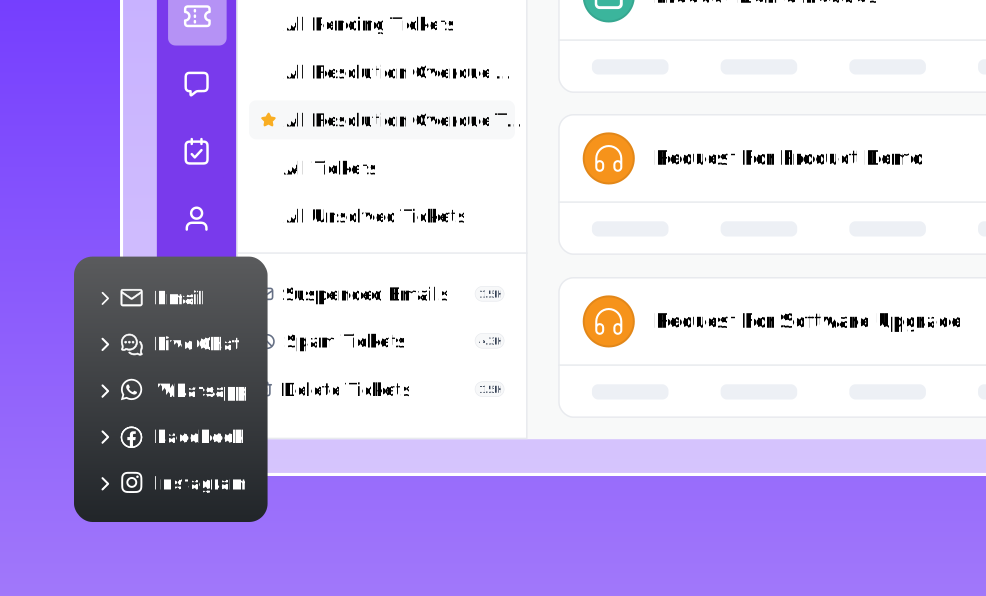
Support should be available on the channels customers already use, including email, phone, live chat, messaging apps, self‑service portals, and community forums.
To keep interactions seamless across these channels:
- Ensure customers can move between channels without losing context or repeating themselves.
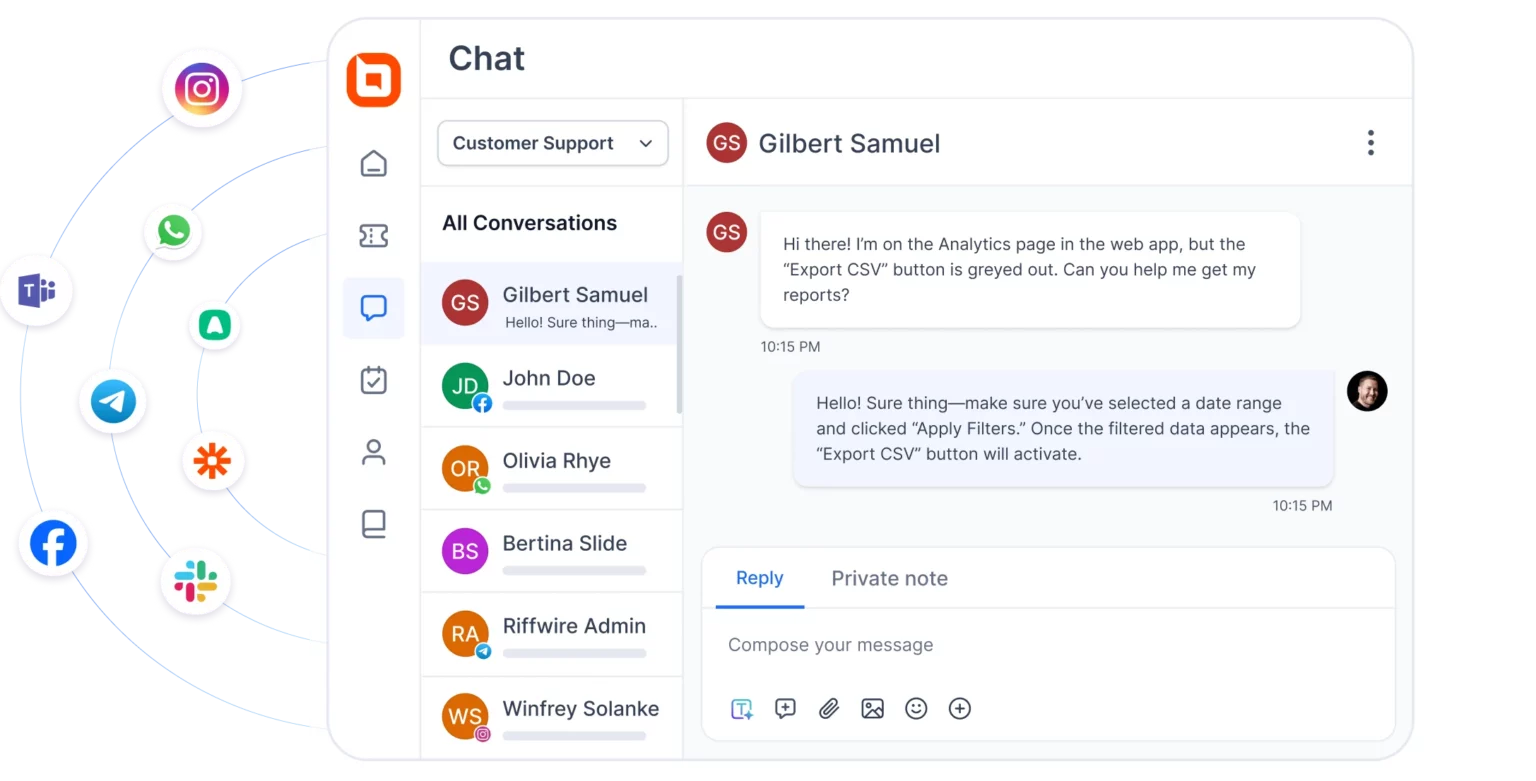
- Use an omnichannel customer service approach where all messages flow into a unified inbox, giving support agents full visibility across conversations.
Prioritize personalization and customization
Personalization increases relevance by tailoring communication and experiences to individual customer needs and contexts.
When interactions feel relevant, customers perceive more value with less effort.
To tailor responses, you need to:
- Use data from your contact management system to tailor communication.
- Analyze reports and customer data to understand customer perceptions, behavior, and needs.
- Customize workflows, notifications, and recommendations where possible.
Act on customer feedback
Customer feedback shows how well your current experience aligns with customer expectations and where friction still exists.
Acting on this feedback closes the loop and turns insights into measurable improvements.
To make continuous improvements, you need to:
- Collect feedback through surveys, reviews, and community forums.
- Identify recurring issues, gaps, and improvement opportunities.
- Apply insights to refine products, services, and support workflows.
Reward loyalty
Customer loyalty programs reinforce long‑term relationships by recognizing continued engagement.
When customers feel valued over time, retention and advocacy increase naturally.
To encourage ongoing customer engagement:
- Offer meaningful perks or exclusive benefits.
- Recognize repeat customers and long‑term usage.
- Encourage advocacy through referral or loyalty programs.
Turning customer value into long-term success
Creating long‑term customer value means continually improving the overall experience, not just enhancing features or lowering costs.
When the benefits you deliver outweigh the time, effort, and friction, satisfaction and loyalty naturally grow.
Personalization, clear communication, and consistent feedback help you understand what matters most to customers and where to improve.
Modern support software like BoldDesk enhances this by unifying communication, reducing effort, and enabling teams to deliver value at every touchpoint.
Ready to see how BoldDesk helps you reduce customer effort, improve support speed, and increase customer value at every touchpoint?
Schedule a live demo or start a free trial to explore its full capabilities. If you have any questions, our support team is always available.
Have strategies that worked for you? Share it in the comments.
Related articles
- Customer Orientation: Strategies, Benefits (+ Examples)
- Proactive Customer Service: Best Strategies and Benefits
- Customer Trust: Definition, Strategies, and Importance
Frequently Asked Questions
Customer value is how customers determine whether a product or service is worth choosing based on the benefits they receive compared to the total costs they experience, such as time, effort, money, and risk.
A value proposition is the promise a business makes about the value it aims to deliver. It explains why customers should choose a product or service, but it represents expected value before customers actually experience it.
Customer lifetime value (CLV) is a financial metric that estimates the total revenue a business expects to earn from a customer over the entire relationship.
In summary, the value proposition sets expectations, customer value reflects real customer experience, and customer lifetime value measures the long term financial outcome of delivering that value.
Customer value is created when the benefits a customer receives are greater than the total costs they incur, including time, effort, and price.
Businesses increase customer value by solving real problems effectively, delivering reliable service, and consistently meeting customer needs.
Customers value solutions that save time, reduce effort, and help them achieve their goals with less friction.
They also prioritize quality, convenience, trust, and responsive support, factors that significantly increase perceived value.
Customer perceived value is how a customer judges whether something is “worth it” based on the benefits they expect to get compared to the total costs they expect to pay.
Customer value influences the decision to choose and stay with a brand, while customer satisfaction measures how customers feel after using it.
High customer value often leads to satisfaction, but satisfaction alone does not guarantee long-term loyalty if the overall value is low.
Yes. Businesses increase value by enhancing benefits, such as better product performance, faster support, personalization, and easier experiences, or by reducing customer costs like time, effort, and friction.
When customers achieve their goals more easily and efficiently, they perceive higher value even at the same price.