


 In this page

TL;DR: Customer service problems, such as high-ticket volumes, long wait times, inconsistent support, poor personalization, and communication gaps can damage customer trust and revenue. Addressing their root causes with better processes, training, self‑service, automation, and centralized support tools enables businesses to deliver faster, more consistent, and customer‑centric experiences.
Customer service problems don’t usually come from poor intentions; they come from broken support operations like long wait times, inconsistent responses, lack of personalization, unresolved complaints, and weak ownership.
As customer expectations rise across channels, these issues escalate quickly. In fact, a Talkdesk study found that 68% of customers say a single negative service interaction can weaken brand loyalty.
The difference between struggling and scaling support lies in understanding why these customer service problems occur and fixing them with the right mix of processes, training, and technology.
In this blog, we break down the most common customer service problems, explain their root causes, and share practical ways to solve them so teams can deliver faster and more consistent support.
Why customer service problems are costly
Customer service problems have a direct and measurable impact on business performance.
According to Salesforce, 88% of consumers say customer experience is as important as the products or services a company offers.
Recurring service issues quickly become negative differentiators that drive churn and weaken brand perception.
That’s why identifying the most common customer service problems and fixing their root causes is critical to delivering consistent, high‑quality support and sustaining long‑term growth.
Beyond driving immediate sales, good customer service delivers long‑term value by:
- Building emotional connections with customers.
- Strengthening brand reputation.
- Establishing customer trust and credibility.
- Attracting new customers while retaining existing ones.
From Inconsistent Replies to Reliable Support — Free!
Eliminate communication gaps and response delays. Deliver seamless omnichannel customer service with BoldDesk across every interaction.
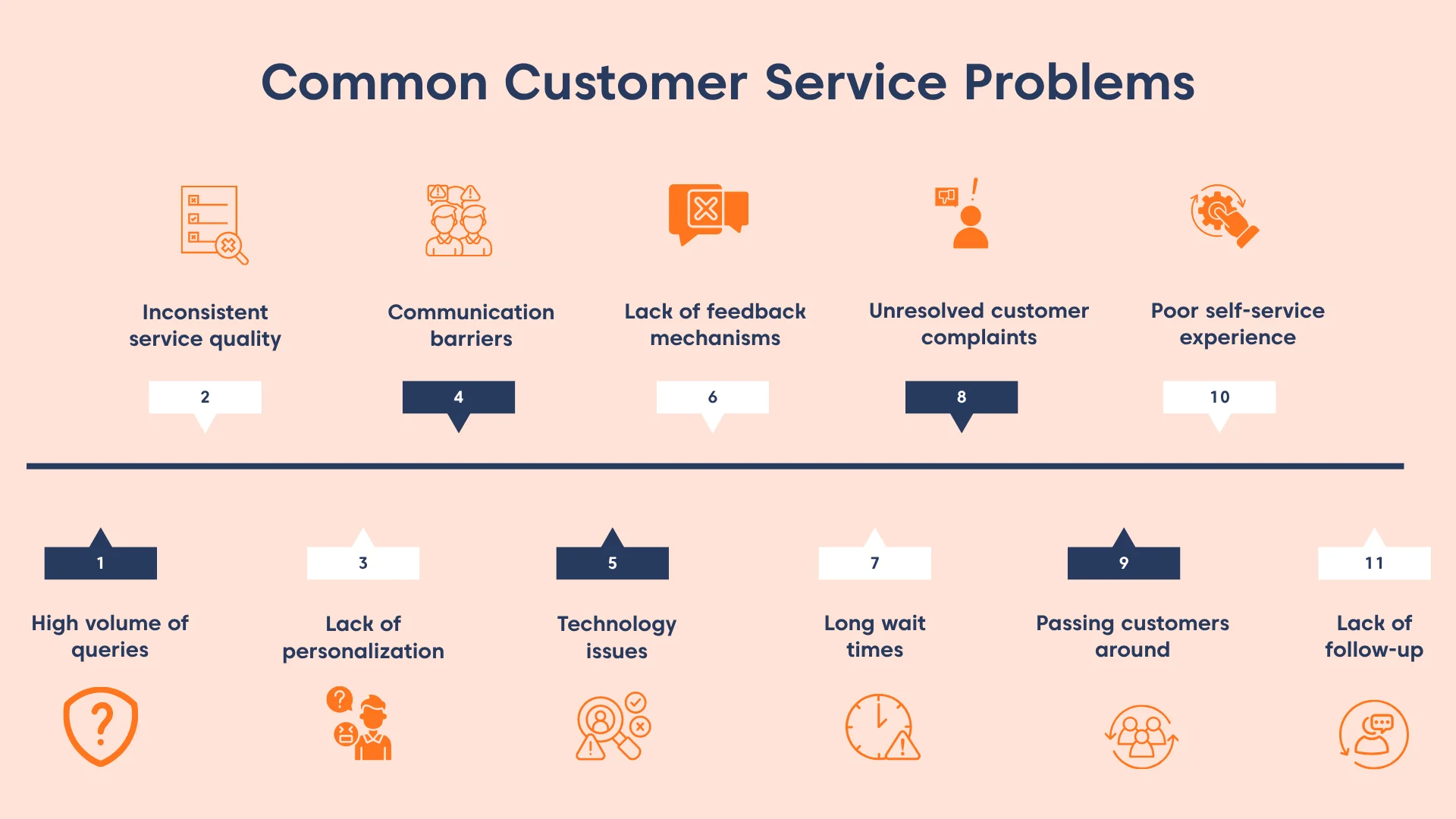
11 Common customer service challenges and how to handle them
Businesses often confront various customer service issues that can affect customer retention and loyalty.
Here are a few typical customer support problems, along with solutions:
High volume of queries
This customer service problem occurs when incoming support requests exceed the team’s capacity to handle them efficiently.
In these cases, response times increase, agent workloads rise, and service quality often declines, leading to frustrated customers and unresolved issues.
Reasons for high inquiry volumes
- Increased demand for products or services: As brands grow in popularity, customer inquiries naturally increase.
- Product or service issues: Bugs, outages, or unexpected technical problems can trigger a surge in customer complaints.
- Promotional campaigns: Marketing offers or new launches often generate a spike in questions from prospects and customers.
- Seasonal peaks: Certain industries experience predictable surges during high‑demand periods, such as major sales events or holiday seasons.
How to manage high inquiry volumes
- Use intelligent ticket routing: Implement a help desk system with automated routing to assign requests to the right agents or teams, reducing handling time and improving resolution speed.
- Strengthen self-service options: Offer well-structured FAQs, guides, and knowledge base software to help customers resolve common issues independently.
According to Higher Logic, 77% of customers view companies more positively when self-service options are available.
- Automate repetitive tasks: Leverage customer service software with automation and AI features to handle routine requests and streamline workflows.
- Scale staffing strategically: Add temporary or flexible support resources during peak periods to prevent backlogs and burnout.
Inconsistent service quality
Service quality becomes inconsistent when customers receive different levels of support during their interactions with a business.
For example, agents may provide varying answers to the same question, or response times may differ significantly.
When customers feel they are not treated fairly or perceive favoritism, trust erodes, leading to churn and negative brand perception.
Reasons for inconsistent service quality
- Lack of defined service standards: Agents may lack proper guidance on customer service standards, processes, or best practices.
- Unclear roles and responsibilities: Ambiguity in ownership can lead to uneven handling of customer issues.
- Unbalanced workloads: Overworked agents may rush conversations, resulting in lower service quality.
- Limited feedback mechanisms: Without regular feedback, businesses may fail to identify gaps in service consistency.
How to ensure consistent service quality
- Implement documented service standards: Provide structured documents so all support agents follow the same guidelines, tone, values, and service standards.
- Define clear service level agreements (SLAs): Set measurable performance benchmarks to ensure consistent response and resolution times.
- Empower support teams: Equip agents with the right tools, knowledge bases, and decision-making authority to resolve issues efficiently.
- Conduct regular performance reviews: Monitor adherence to service standards and use reviews to identify coaching and improvement opportunities.
Lack of personalization
Support interactions lose impact when they aren’t tailored to individual customer needs, preferences, or prior interactions.
This often results in customers feeling like interchangeable cases rather than valued individuals, weakening engagement and emotional connection with the brand.
According to McKinsey and Company, 71% of customers expect personalized interactions, and 76% become frustrated when those expectations are not met.
Reasons for lack of personalization
- Insufficient customer data or insights: Businesses may collect limited data or fail to use existing insights effectively to tailor experiences.
- High employee turnover: New or temporary staff may lack familiarity with customer histories, leading to impersonal interactions.
How to improve personalization in customer service
- Invest in customer data and analytics: Collect and analyze customer insights such as preferences, purchase history, and behavior to identify patterns and segment customers effectively.
- Personalize customer communication: Address customers by name, reference previous interactions, and tailor recommendations based on their needs and interests.
- Map the customer journey: Identify key touchpoints where personalization can add the most value and improve overall experience.
Communication barriers
Miscommunication during support interactions often results in misunderstandings, unresolved issues, missing details, and negative customer experiences, reducing satisfaction and trust.
Causes of communication barriers
- Language differences: When customers and agents do not share a common language, conversations can become unclear and require translation.
- Cultural differences: Customers from different regions may have varying communication styles, expectations, or interpretations.
- Overuse of jargon or technical language: Industry‑specific terms or complex explanations can confuse customers and create disconnects.
- Poor listening skills: Failure to actively listen can lead to incorrect assumptions and incomplete issue resolution.
How to overcome communication barriers
- Offer multilingual and culturally aware support: Provide multilingual support when needed and train agents on cultural sensitivity.
- Use clear, simple language: Avoid jargon and technical terms. Communicate in plain, straightforward language.
- Practice active listening: Encourage agents to focus on understanding the customer’s concern before responding.
- Adopt omnichannel support tools: Provide omnichannel customer service to manage and respond to customer requests consistently across email, chat, phone, and social platforms.
Technology issues
Technology breakdowns don’t just slow support; they shape how customers perceive reliability and competence.
Poor tool integrations, system downtime, or inefficient interfaces force agents to rely on workarounds instead of efficient, tool-driven workflows, increasing errors and resolution time.
Reasons for technology issues
- Outdated systems: Legacy tools may lack modern features, integrations, or security updates, limiting performance and scalability.
- System or network downtime: Software failures, maintenance activities, or network disruptions can temporarily prevent customers from reaching support teams.
- Insufficient training on tools: Agents may struggle to use customer service software effectively if they are not properly trained.
How to prevent and resolve technology issues
- Perform regular updates and maintenance: Keep customer support systems updated and proactively monitor performance to reduce unexpected downtime.
- Adopt modern, scalable platforms: Invest in cloud‑based customer service software that can scale with demand and integrate with other business tools, minimizing tool switching.
- Create fallback workflows: Define manual or alternative processes for handling tickets during outages to maintain continuity of service.
- Train agents on technology usage: Provide ongoing training to ensure support teams understand how to use tools efficiently, especially after updates or new feature releases.
Lack of feedback mechanisms
Gaps in feedback systems often prevent teams from consistently capturing, interpreting, and acting on customer input, allowing recurring service issues to go unnoticed and unresolved.
As a result, organizations miss early signals of dissatisfaction, leading to lower satisfaction, weakened customer loyalty, and a higher attrition rate.
Reasons for poor feedback collection
- Underestimating the value of feedback: Some organizations treat customer feedback as optional rather than a critical input for service improvement.
- Fear of negative responses: Businesses may avoid requesting feedback to prevent criticism or unfavorable reviews.
How to build effective feedback mechanisms
- Offer multiple feedback channels: Collect customer input through surveys, email, social media, reviews, and direct conversations.
- Make feedback easy to provide: Use short, clear surveys and ensure feedback forms are simple to access and complete.
- Act on customer feedback: Demonstrate that feedback matters by making visible improvements based on customer input.
- Use analytics and CRM tools: Leverage reporting, analytics, and CRM systems to track trends, identify recurring issues, and measure improvements over time.
Long wait times
Extended response times often point to deeper operational design flaws, not simply high demand.
Misaligned staffing levels, channel priorities, and queue structures make it difficult for even well‑trained teams to respond quickly.
This often results in frustrated customers, especially since fast acknowledgment matters almost as much as fast resolution, making response strategy just as important as staffing levels.
Reasons for long wait times
- Understaffing: Too few support agents to handle rising support ticket volumes.
- Inefficient processes: Complex or outdated workflows that slow down issue resolution.
- Limited self–service options: Without self-service resources, customers rely heavily on agents, increasing queue lengths.
How to reduce long wait times
- Monitor key performance metrics: Track KPIs such as average response time, resolution time, and customer satisfaction to identify bottlenecks and areas for improvement.
- Communicate expected wait times: Keep customers informed through alerts or messages to set customer expectations and reduce frustration.
- Expand self‑service capabilities: Offer FAQs, chatbots, and knowledge bases so customers can resolve common issues without waiting for live assistance.
- Optimize queue design: Route urgent or high‑impact issues faster instead of treating all requests equally.
Unresolved customer service complaints
Unresolved customer complaints are especially damaging because they represent moments when customer trust is already fragile.
In many cases, the issue isn’t agent intent; it’s the absence of clear recovery paths, escalation authority, or resolution boundaries. Without a defined recovery strategy, customer service complaints linger or escalate unnecessarily.
Reasons for unresolved complaints
- Limited agent empowerment: Support agents may lack the authority or tools needed to resolve issues independently, resulting in repeated escalations and delays.
- Insufficient training: Agents who are not trained to handle diverse or complex situations may struggle to resolve unique customer service problems effectively.
- High complaint volumes: A surge in complaints can overwhelm support teams, causing some issues to be overlooked or inadequately addressed.
How to resolve customer complaints
- Acknowledge and empathize: Promptly acknowledge the issue, show empathy, and apologize for the negative experience to reduce frustration.
- Define resolution authority by tier: Clearly specify what frontline agents, senior agents, and managers are empowered to resolve without escalation.
- Set resolution deadlines: Apply internal SLAs for complaints that are stricter than standard support tickets.
- Measure post-resolution confirmation: Track whether customers explicitly confirm resolution, not just ticket closure.
Passing customers around
Frequent handoffs usually indicate unclear ownership models or poorly designed escalation paths. Customers are less frustrated by escalation than by having to repeat information or wait without progress.
Every transfer increases the chance of lost context and reduces confidence in the support process.
Reasons for passing customers around
- Insufficient agent training: Agents may lack the product knowledge or skills needed to resolve issues independently, leading to unnecessary escalations.
- Ineffective communication systems: Poor tools or workflows can prevent agents from accessing customer context or routing requests efficiently.
- Departmental silos: When teams operate in isolation, issues are transferred rather than resolved collaboratively.
- Complex products or services: Specialized offerings may require multiple touchpoints if knowledge is fragmented across teams.
How to prevent passing customers around
- Measure handoff rates: Track how often tickets change owners and identify patterns that indicate routing or training gaps.
- Use a centralized help desk system: Implement a ticketing system that captures, preserves full customer context, and automatically routes requests to the right agents.
- Cross‑train support teams: Equip agents with cross‑functional knowledge so they can handle a broader range of inquiries.
- Maintain a shared knowledge base: Create a centralized knowledge repository that enables agents to quickly find answers and resolve issues without transfers.
Poor self-service experience
Customers quickly lose confidence in self‑service options that fail to deliver clear, accurate answers through FAQs, knowledge bases, or automation.
This often forces them to contact support for simple issues, increasing ticket volume and frustration. In environments where fast answers are expected, weak self‑service becomes a bottleneck, slowing response times, overloading agents, and lowering overall satisfaction.
Common reasons for self-service gaps
- Outdated or incomplete content: Knowledge base articles and FAQs may be inaccurate, hard to follow, or missing answers to common questions.
- Poor organization and searchability: Customers struggle to find relevant information due to unclear categories, weak search functionality, or inconsistent content structure.
- Lack of ownership: Without clear responsibility for maintaining self-service portals, updates are delayed or overlooked.
- Overreliance on automation without design: Chatbots or automated flows may exist but fail to guide users to meaningful resolutions.
How to improve self-service effectiveness
- Maintain a structured, up–to–date knowledge base: Regularly review and update articles based on recurring support tickets and customer feedback.
- Design for findability: Organize content logically, use clear titles, and ensure search functionality surfaces the most relevant answers quickly.
- Assign content ownership: Designate responsibility for creating, reviewing, and improving self‑service resources.
- Use self–service analytics: Track article usage, failed searches, and drop‑off points to refine content and automation flows continuously.
Lack of follow-up
Failure to close the feedback loop after customer interactions, such as missed callbacks, skipped confirmation emails, or no follow‑up requests, creates uncertainty and frustration.
This often leaves customers feeling ignored or undervalued, unsure whether their issue is being addressed or fully resolved. Over time, weak follow‑up undermines trust and increases repeat contacts.
Reasons for poor follow-up
- High agent workload: Overburdened support teams may overlook follow‑up tasks while managing ongoing inquiries.
- Ineffective processes: Without proper issue‑tracking systems, follow‑ups can easily be missed or delayed.
- Lack of accountability: When responsibilities and expectations are unclear, follow‑up actions are often deprioritized.
How to improve customer follow-up
- Establish clear follow-up procedures: Define consistent workflows and use templates to ensure follow‑ups are completed at every stage of the support process.
- Set and communicate timelines: Inform customers about expected follow‑up or resolution timelines to manage expectations.
- Make follow-up owned, not optional: Emphasize the importance of follow‑up in building trust and maintaining long‑term customer relationships.
Below is the summary table of the 11 common customer service problems.
| Customer service problems | Common operational causes | Business impact | Best solutions |
| High volume of queries |
|
|
|
| Inconsistent service quality |
|
|
|
| Lack of personalization |
|
|
|
| Communication barriers |
|
|
|
| Technology issues |
|
|
|
| Lack of feedback mechanisms |
|
|
|
| Long wait times |
|
|
|
| Unresolved complaints |
|
|
|
| Passing customers around |
|
|
|
| Poor self‑service experience |
|
|
|
| Lack of follow‑up |
|
|
|
Teams struggling with volume and delays should prioritize routing, staffing, and self-service, while teams facing inconsistency and complaints should focus on training, SLAs, and clear ownership.
Addressing customer service problems the right way
Unresolved customer service issues can damage customer trust, weaken brand reputation, and reduce overall profitability.
Solving these challenges requires more than good intentions. It requires centralized ticket management, clear ownership, automation for repetitive requests, strong self‑service options, and real‑time reporting to track SLAs and performance.
BoldDesk brings these capabilities together in one centralized platform. With automated ticket routing, omnichannel inboxes, built‑in knowledge base tools, SLA tracking, and actionable reports, BoldDesk helps teams reduce delays, maintain consistency, and deliver more reliable support across every channel.
Start a free trial or book a live demo to see how BoldDesk can help your team turn daily customer service problems into structured, scalable support experiences.
If you need assistance, the BoldDesk support team is always ready to help.
Related articles
- 9 Best Ecommerce Customer Service Tips
- Millennials vs Gen Z: Differences in Customer Support Expectations
- 24/7 Customer Service: A Complete Guide