


 In this page

TL;DR: Challenges in telecom customer service include slow responses, inconsistent support, billing issues, poor self-service, and high agent turnover. Solutions like unified support, AI-driven personalization, proactive communication, and robust self-service tools help reduce frustration, boost satisfaction, and build lasting loyalty.
Today, telecom service providers are flooded with messages from every direction: apps, live chat, and social media. Customers expect instant, flawless support experiences, and every response is under the microscope, with compliance teams and auditors watching closely.
It’s no longer just about managing technology. It’s about exceeding customer expectations with speed, fairness, and precision every single time.
According to the J.D. Power 2025 Wireless Customer Care Study in North America, customer satisfaction in telecom has declined for the first time in years, despite promises of smarter, faster tech.
These everyday challenges in telecom customer service show why modern workflows are essential. They simplify communication, ensure compliance, and rebuild trust.
In this guide, you’ll learn how telecom customer service leaders can cut churn, boost satisfaction scores, and deliver seamless support with AI-powered and omnichannel strategies.
Summary of challenges in telecom customer service and their solutions
The telecom industry faces unique customer service challenges, including disconnected support channels, billing transparency issues, and high agent turnover.
This section outlines the most pressing challenges in telecom customer service and highlights practical, real-world solutions to address each one.
| Telecom Support Challenges | Customer Impacts | Solutions |
| Inconsistent service across channels | Customers repeat information and lose patience | Centralize all customer interactions into a unified view to maintain context |
| Generic, one-size-fits-all support | Feels impersonal and reduces trust | Use AI to personalize responses, recommendations, and support |
| Reactive issue handling | Problems escalate before support steps in, leading to churn | Implement predictive monitoring and proactive outreach |
| Complex or unclear billing | Leads to disputes and frustration | Provide transparent, itemized billing with automated billing assistance |
| Limited self-service options | Longer wait times and higher support volume | Offer a robust self-service portal with AI-powered search and automated resolutions |
| High agent turnover and knowledge gaps | Slow responses and inconsistent answers | Empower teams with an AI-driven knowledge base and guided workflows |
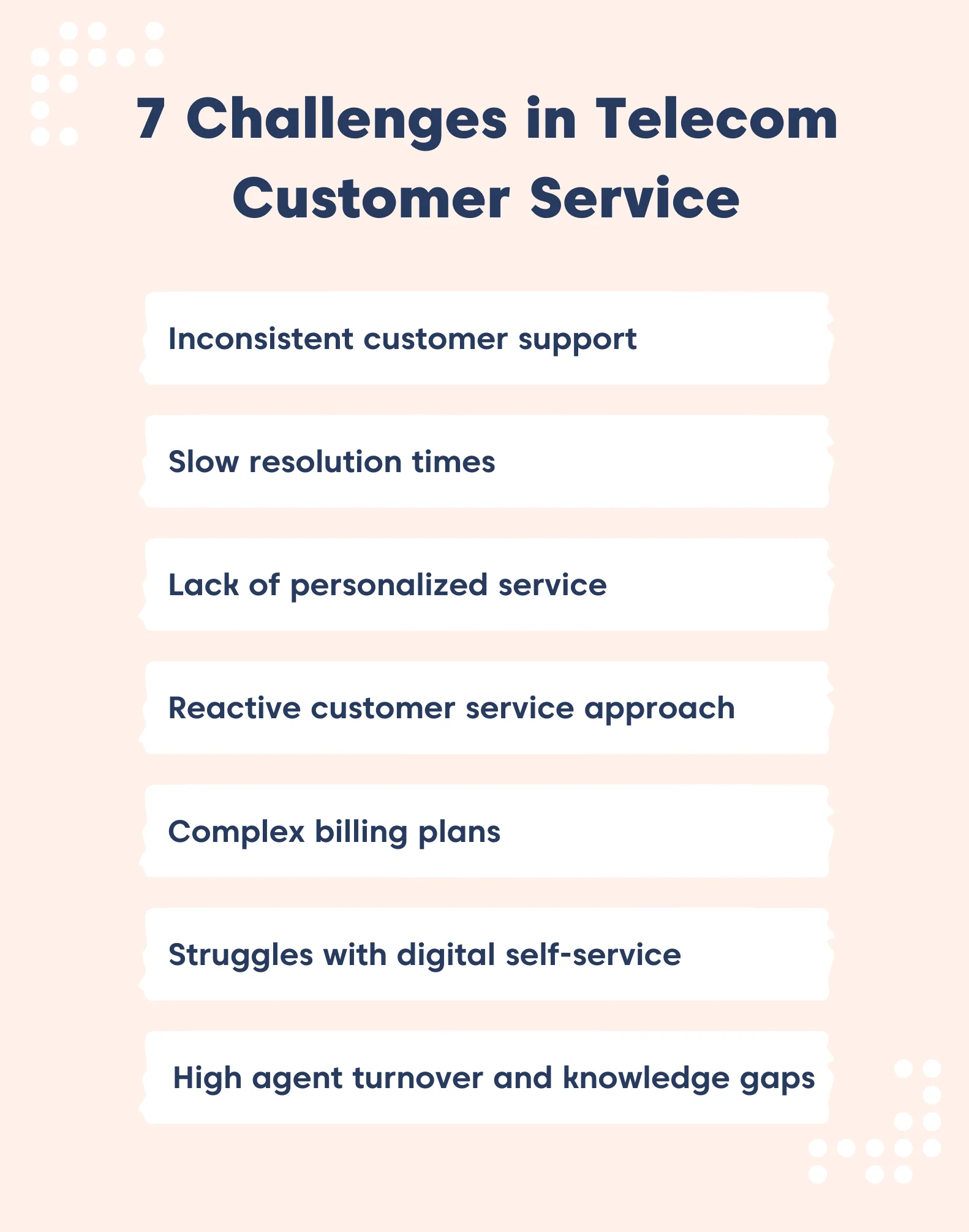
7 Key challenges facing telecom customer service
Telecom customer service is under increasing pressure to meet rising user expectations in a rapidly evolving digital communication space.
Here are the major telecom customer service challenges hurting satisfaction today:
1. Inconsistent customer service experiences
Today’s customers rarely stick to one channel. They might start with a live chat on your website, switch to a phone call when it gets complex, and then follow up on social media.
The expectation is that their journey will be seamless. Yet, most telecom customer service teams often operate in silos.
This disconnected, multi-channel experience is both upsetting and inefficient. It forces customers to repeat their story endlessly, leading to frustration and a sense of being just another ticket number.
2. Slow resolution times and long waiting queues
Telecom customer service systems often struggle with high ticket volumes, inefficient routing, and outdated processes that delay issue handling.
Customers end up waiting on hold, stuck in chat queues, or transferred multiple times before reaching the right agent.
These problems in telecom customer service frustrate users and drive churn, as even simple issues take far too long to resolve.
3. Inadequate personalized customer experiences
At a time when Netflix knows your binge-watching habits better than your friends, telecom customers expect the same level of personalization.
A small business owner has vastly different needs and expectations than a college student on a budget.
However, many customer service interactions feel generic and impersonal. Agents rely on rigid scripts, offer irrelevant deals, and show little to no understanding of the customer’s unique needs.
4. A reactive customer service delivery strategy
Traditionally, telecom customer support has been entirely reactive: wait for the customer to call with a problem, then fix it.
Today, this is a losing strategy. Customers expect their providers to be one step ahead.
The absence of proactive customer service leaves customers in the dark and forces them into a support queue for issues that could have been anticipated and resolved beforehand.
Real example: Optus outage disrupts emergency calls
In 2025, Optus faced a major outage that blocked hundreds of emergency calls during a firewall upgrade. The lack of proactive communication and delayed response led to severe customer backlash and regulatory scrutiny.
Key lesson: Service reliability isn’t optional, especially in telecom. Proactive monitoring and rapid escalation workflows are critical to customer safety and trust.
5. Complex billing plans that confuse customers
Billing is a major problem in telecom customer service, and it’s getting worse.
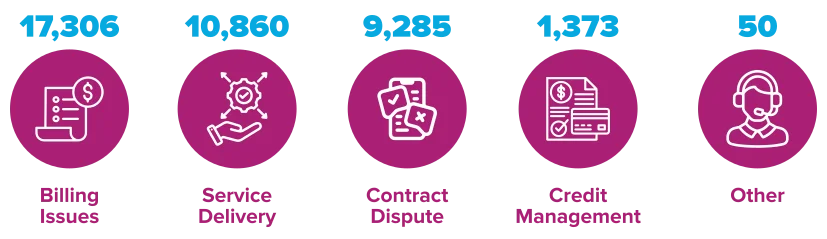
According to the CCTS 2023–2024 Annual Report, billing issues accounted for 17,306 complaints, far outpacing other categories like service delivery (10,860) and contract disputes (9,285).
The same report also indicated that billing complaints in telecom rose by 52%, the largest increase across all issue types during the reporting period (2023–2024).
These billing problems typically appear in the form of:
- Hidden fees
- Complex plan structures
- Inaccurate usage charges
- Bills that are difficult to understand or reconcile
Real example: Virgin Media fined for poor migration support
Virgin Media was fined £23.8 million after a service migration left vulnerable customers, including those using telecare alarms, unable to access essential support services. The issue resulted from gaps in planning, customer segmentation, and clear communication.
Key lesson: Major service changes demand transparent communication, customer-impact analysis, and dedicated support for high-risk users.
6. Telecoms struggle with digital self-service
For most customers today, having to call a customer service center for simple tasks is a major annoyance. Even so, many telecom providers still lack robust customer self-service options.
Customers want to pay bills, upgrade plans, troubleshoot outages, or check usage at any time without having to wait on hold.
When the telecom self-service options are missing or poorly designed, it leads to unnecessary call volume, higher operational costs, and immense customer frustration.
7. High agent turnover and knowledge gaps
Telecom customer service teams often struggle to keep experienced agents on board. This is mainly because of highly stressful conditions and limited career growth that drive them away.
Consequently, customers face inconsistent answers, longer wait times, and repeated escalations. Instead of feeling supported, people sense uncertainty and inefficiency.
For customers, this doesn’t just mean slower resolutions; it erodes trust. They want confident, knowledgeable help, not trial-and-error responses that make them doubt whether their issue will ever be solved.
How to solve telecom customer service challenges
Telecom providers face growing pressure to deliver better customer experiences. Even with growing telecom customer service challenges, businesses can convert frustrated customers into loyal advocates.
Below are some of the practical strategies to improve your telecom customer service:
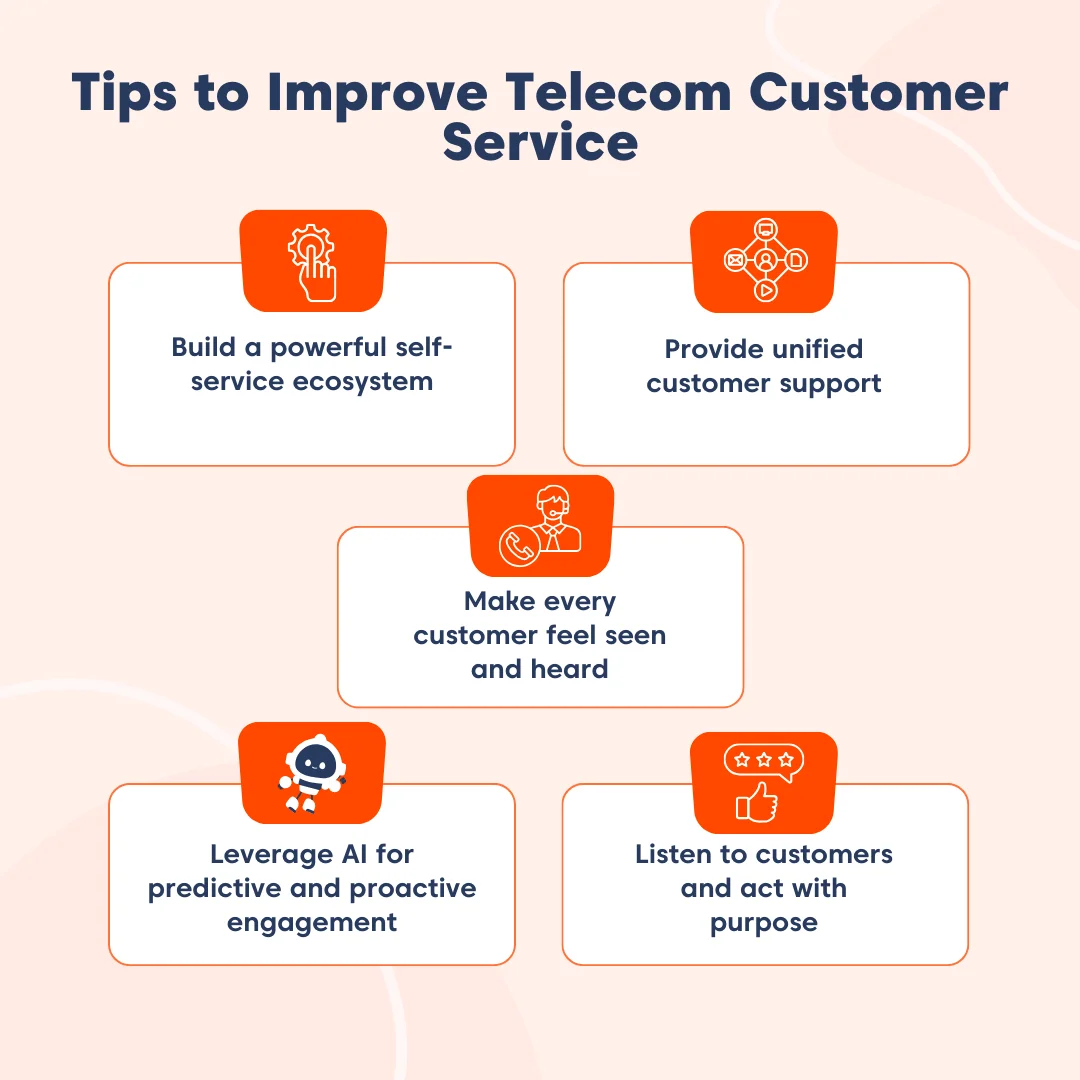
Build a powerful self-service ecosystem
Self-service isn’t just about cutting costs; it’s about empowering customers. A well-designed customer self-service portal or mobile app can transform frustration into freedom by giving users control and convenience.
The key is to provide comprehensive, easy-to-use self-service tools. This ecosystem should include:
- A searchable knowledge base with relevant user guides
- An AI agent that can handle common queries
- Full account management capabilities
Essentially, this ecosystem allows customers to solve issues, manage accounts, and get updates instantly, without waiting in queues.
Provide unified customer support
Omnichannel customer service is about providing a seamless, consistent, and integrated customer experience across all communication channels.
To solve the telecom support challenges of inconsistency, companies can blend live chat, email, and even peer-to-peer support into one unified experience. This enables customers to get the same quality of help regardless of where the conversation starts.
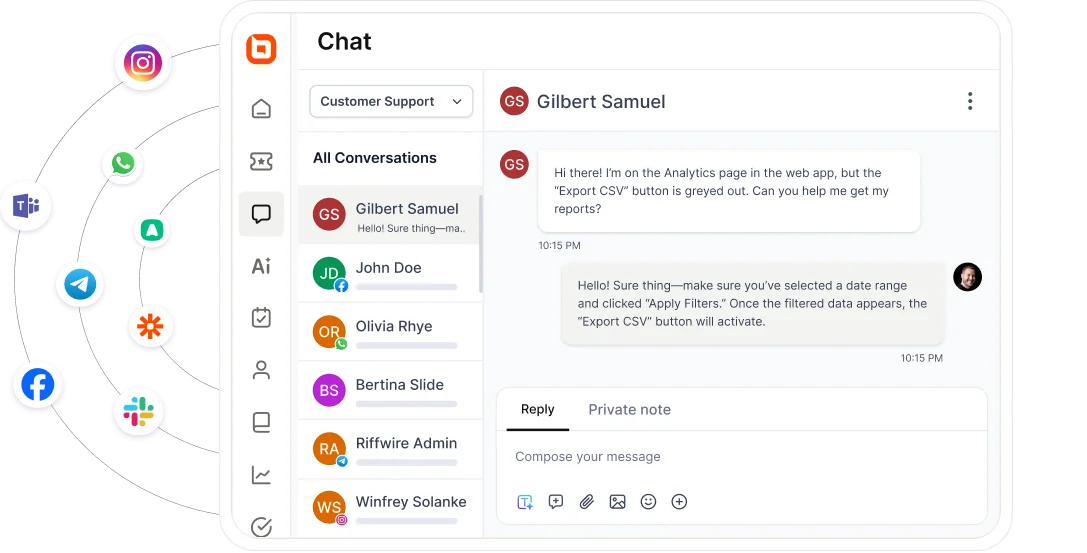
When agents and customers stay in sync across every channel, it becomes much easier to build and sustain customer trust, strengthening the overall telecom customer experience.
Make every customer feel seen and heard
Personalization starts with data, but it thrives when that data is used to deliver real value that clearly improves the customer’s experience.
To do this effectively, AI-driven insights make hyper-personalization seamless by analyzing customer behavior, preferences, and past interactions in real time.
For instance, when a customer asks about upgrading their internet plan, an AI agent instantly suggests options based on usage history, and a human agent can step in to finalize the change.
Leverage AI for predictive and proactive engagement
Using AI in telecom customer service isn’t just about reacting faster to customers; it’s also about anticipating what they need.
Telecom companies can use AI to identify trends, predict service issues, and proactively offer solutions such as outage alerts.
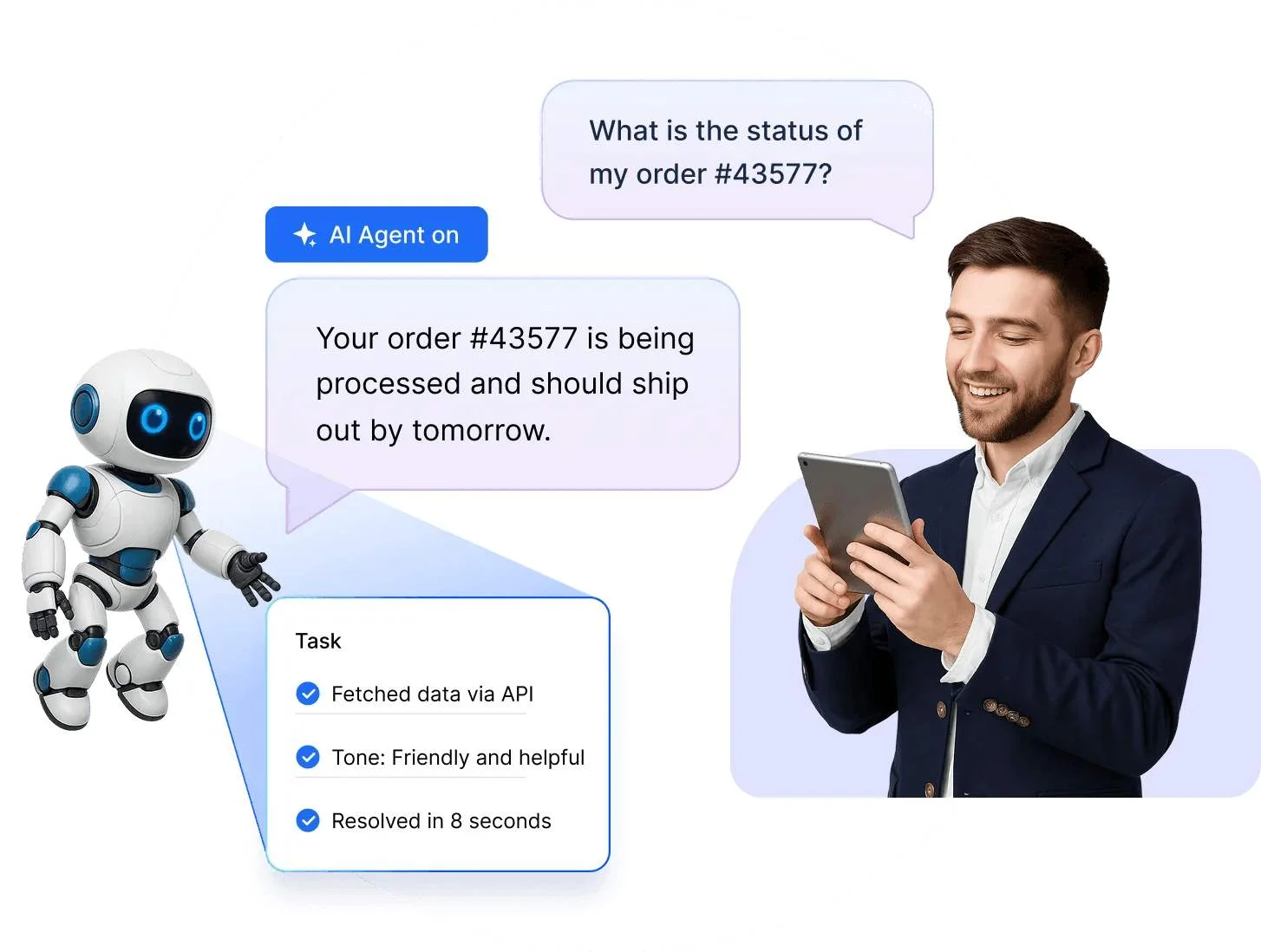
Meanwhile, intelligent automation handles repetitive tasks like processing routine requests or routing tickets, thus freeing human agents to focus on more complex interactions.
Listen to customers and act with purpose
Getting through challenges in telecom customer service starts with truly hearing what customers are saying and then acting on it.
You can achieve this through:
- Feedback: These are the real experiences from employees and customers that reveal what matters most.
- Surveys: Clear, structured questions capture customer preferences and expectations.
- AI tools: Analyzing call and chat data uncovers hidden patterns and emerging needs.
These insights can then be used to streamline processes, eliminate customer pain points, and significantly improve the overall telecom customer service experience.
Overcoming challenges in telecom customer service
Great telecom technology deserves customer service that matches and amplifies its quality. Addressing telecom support challenges isn’t just about fixing issues; it’s about earning trust, strengthening loyalty, and staying competitive.
The good news? Modern, AI-driven help desk platforms make this far easier. A solution like BoldDesk unifies every customer interaction in one place and uses automation plus a 360° customer view to help agents deliver faster, more personalized support.
Ready to enhance your telecom customer service? Book a live demo, try BoldDesk for free, or explore our product tour and documentation to learn more.
If you have questions, our support team is always here to help. We’d love to hear your thoughts. Please share them in the comments below.
Related articles
FAQs on customer support challenges in telecommunication
Telecom companies can reduce long hold times without hiring more agents by deploying AI agents to handle routine inquiries, triage customer issues, and guide users through telecom self-service options.
Additionally, automated ticket routing and predictive analytics help optimize workflows and anticipate high-demand seasons, thereby minimizing delays and improving first-contact resolution (FCR).
The telecom industry is highly competitive because customers have many providers to choose from, and switching is easier thanks to flexible contracts, number portability, and aggressive pricing.
Telecom companies use help desk software like BoldDesk with features such as omnichannel support, automation, and customer insights to resolve issues fast, reduce churn, and turn service quality into a competitive edge.
One of the biggest telecom customer service challenges in rural areas is limited infrastructure, causing weak connectivity and unreliable service.
A strong help desk system can cut support delays, increase transparency, and improve the customer experience in rural areas, even before network upgrades occur.