





TL;DR: Challenges in fintech customer service include ticket surges, inconsistent support, complex workflows, compliance demands, and fraud disputes. Solutions like automation, unified omnichannel support, risk-based authentication, and proactive communication help resolve these fintech customer service problems to reduce frustration, build trust, and deliver secure, seamless experiences.
Every time a payment fails at checkout, a loan approval gets stuck, or a customer spends minutes navigating automated menus, the promise of seamless digital finance starts to unravel.
Addressing the challenges in fintech customer service goes beyond creating innovative products; it’s about making sure customers don’t feel abandoned by the very technology meant to simplify their lives.
From confusing error messages to the struggle of reaching a human who can actually help, these daily frustrations highlight a crucial truth: convenience means little without reliability and support.
This guide examines the most common fintech customer service challenges and provides practical solutions organizations can implement to easily solve them.
Summary of fintech customer service challenges
Financial companies often face unique fintech customer service problems driven by high security demands, complex products, and rapid user growth.
Identifying the root causes of fintech customer service issues is the first step toward improving service quality.
This summary table highlights the most common fintech customer service challenges and the practical solutions that help teams deliver secure, consistent, and reliable support.
| Challenges in fintech customer service | Customer impacts | Solutions |
| Delays in handling large volumes of inquiries | Slow responses to urgent financial issues lead to anxiety and distrust | Use automation and AI to handle routine inquiries |
| Fragmented support across communication channels | Customers repeat issues, lose context, and abandon support | Adopt an omnichannel customer service platform |
| Balancing security and user convenience | Frequent identity checks slow down resolutions and feel inconvenient | Adopt risk‑based authentication to speed up verification |
| Navigating complex technical platforms | Users may get confused by technical terms and complicated processes | Use simplified visual guides to explain complex technical details |
| Handling sensitive financial data | Customers feel anxious about sharing personal details | Enforce encryption, MFA, and access controls to protect data |
| Difficulty earning customer trust | Unclear explanations reduce credibility | Maintain transparent and proactive communications |
| Maintaining regulatory compliance | Legal restrictions lead to vague answers that frustrate users | Equip agents with pre-approved, compliant scripts |
When customers share financial information, every support interaction must be handled with accuracy, discretion, and a clear understanding of compliance boundaries.
Following the right do’s and don’ts for fintech can help support teams protect sensitive data, avoid risky communication mistakes, and build greater confidence in every financial support conversation.
Why fintech support is uniquely hard
Customer support in fintech is fundamentally different from support in ecommerce, SaaS, or consumer apps.
The stakes are higher, the rules are stricter, and customer tolerance for mistakes is almost zero. Here are the key fintech service obstacles most teams face:
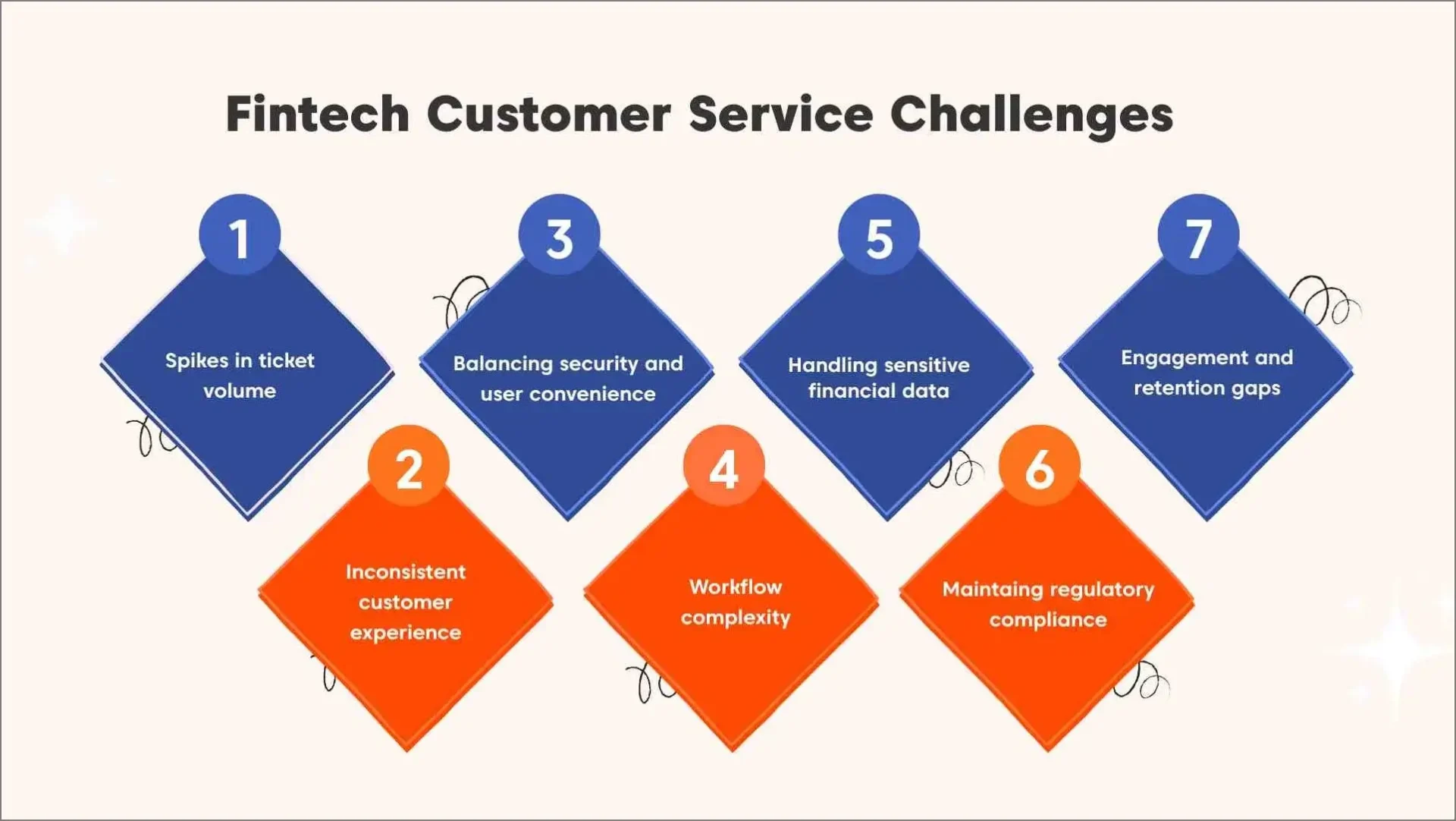
Handling large volumes of customer requests
Fintech companies frequently struggle to respond quickly during sudden increases in customer inquiries, especially during outages or feature launches.
In fact, research from KPMG found that banks can take an average of 13 hours to respond to priority inquiries on social media, a delay that 45% of consumers find unacceptable.
These surges overwhelm customer service agents, making it difficult to scale fast enough to handle:
- Sudden demand ticket increases
- Unplanned outages or transaction failures
- Balancing routine queries with urgent financial issues
Solution: Manage routine queries with automation and AI
Many fintech companies can handle ticket surges by adopting automation and AI-driven workflows to interpret, classify, and resolve incoming messages.
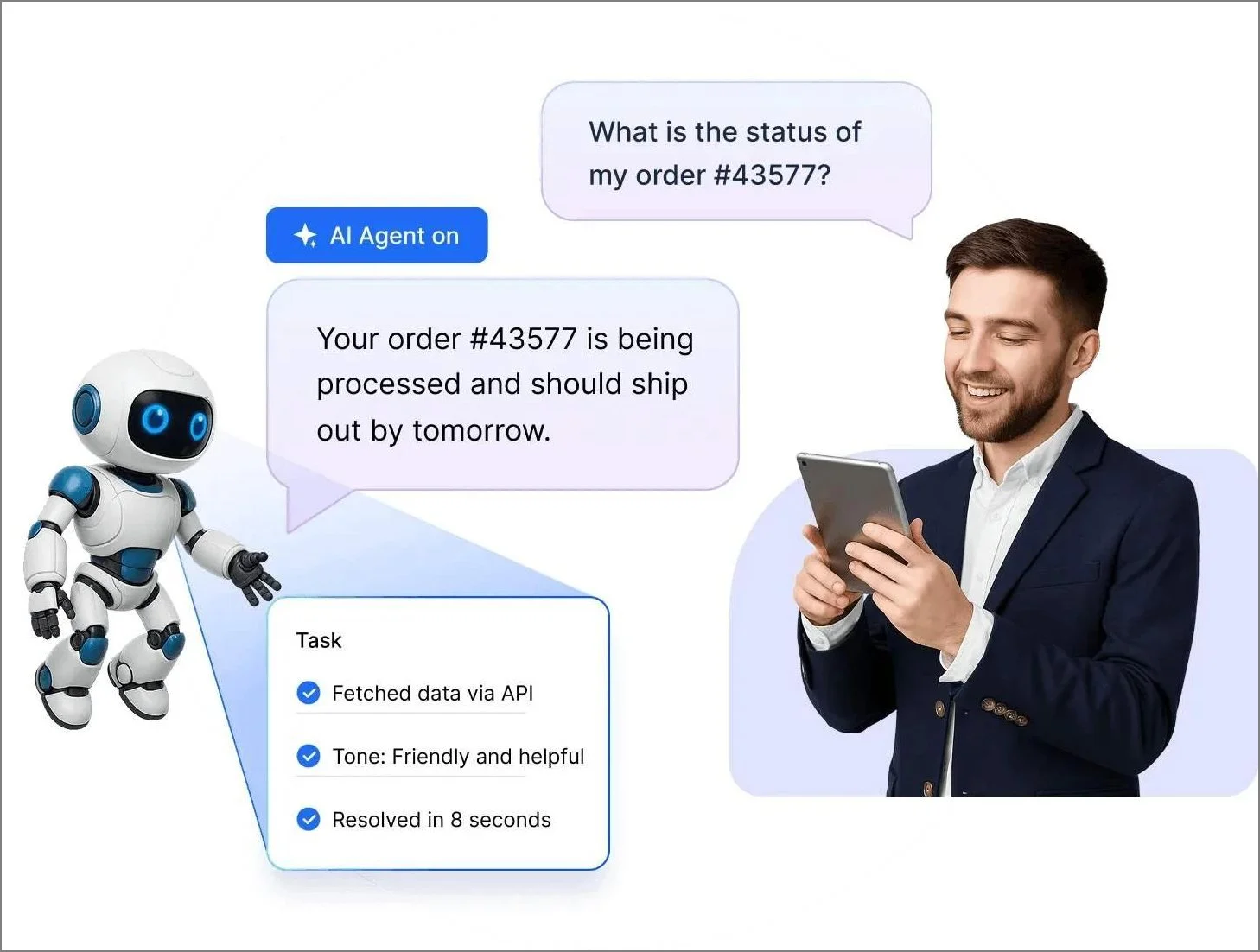
AI agents can instantly answer routine financial queries, while tools like AI Copilot streamline workflows by retrieving real-time banking data to assist human agents.
AI-powered automation ensures simple cases are handled automatically, freeing up support staff to focus on urgent fintech customer service challenges.
Inconsistent customer experience across communication channels
Fragmented customer service channels are a major hurdle in fintech customer service as clients frequently switch between platforms expecting agents to know their history without having to repeat themselves.
According to Salesforce’s financial services report, 25% of customers switched banks in the past year, citing a desire for a better digital service experience as the primary reason.
When these channels deliver conflicting updates on sensitive financial matters, like payments or account status, it can create confusion and raise doubts about the reliability of the service.
Solution: Leverage omnichannel inbox for seamless customer interactions
Managing problems in fintech customer service is easier when every conversation stays connected.
Providing omnichannel customer service helps to centralize financial messages from every channel into one consolidated conversation thread tied to the customer’s account.
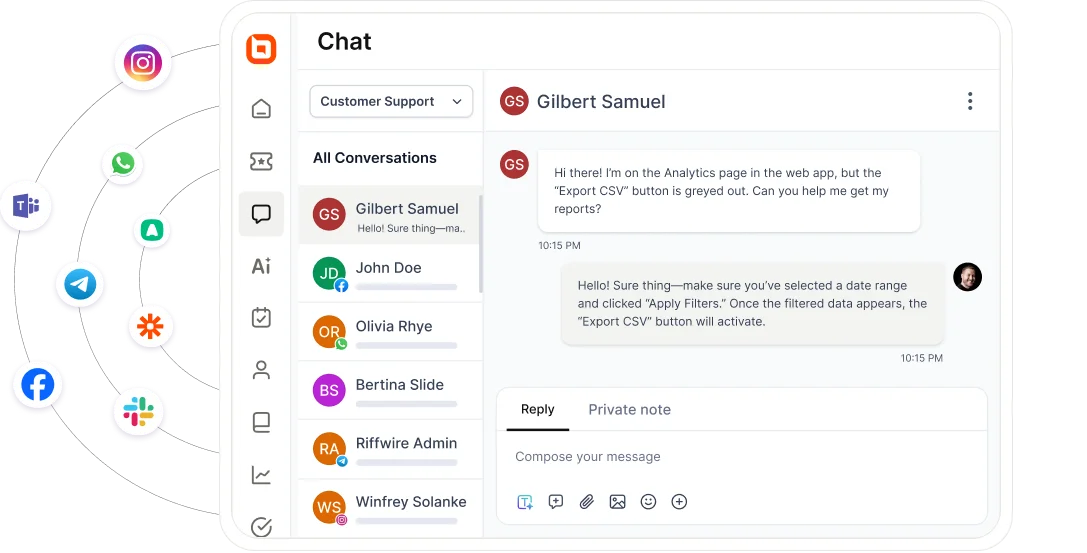
Centralizing support messages preserves critical context, such as transaction history and verification steps, allowing agents to address fintech customer service challenges with full visibility.
Balancing security with user convenience
Fintech customers expect immediate support, particularly during moments of high financial stress or urgency.
Providers face a significant challenge in balancing this demand for speed with the rigorous security protocols required to protect sensitive data and prevent fraud.
If not managed carefully, repetitive identity checks can create friction that causes customer frustration and makes essential security measures feel like barriers to resolution.
Solution: Apply risk-based authentication to protect financial data
Fintech providers can solve support friction by implementing risk-based authentication that adjusts security requirements based on the specific risk level of an interaction.
Smart methods like biometrics, two-factor authentication (2FA), and multi-factor authentication (MFA) are selectively triggered for high-stakes events. This may include high-value transactions, unusual account behaviour, or suspicious login attempts.
This intelligent approach streamlines identity validation, ensuring the support experience remains fast and convenient without compromising financial data security.
Difficulty in handling complex technical products
Fintech products often come with layered features, interconnected systems and automated workflows that make support interactions highly technical.
As a result, agents often struggle to diagnose these technical issues and translate them into simple terms, while customers find it hard to understand why a simple transaction takes too long to complete.
This complexity turns inquiries into lengthy troubleshooting sessions, frustrating agents who need time to research and users who just want their service to work immediately.
Solution: Provide simplified guidance and intuitive learning resources
To reduce frustration caused by technical complexity, support agents should use standardized scripts, visual aids, and internal resolution guides.
These tools allow agents to explain processes clearly without relying on jargon.
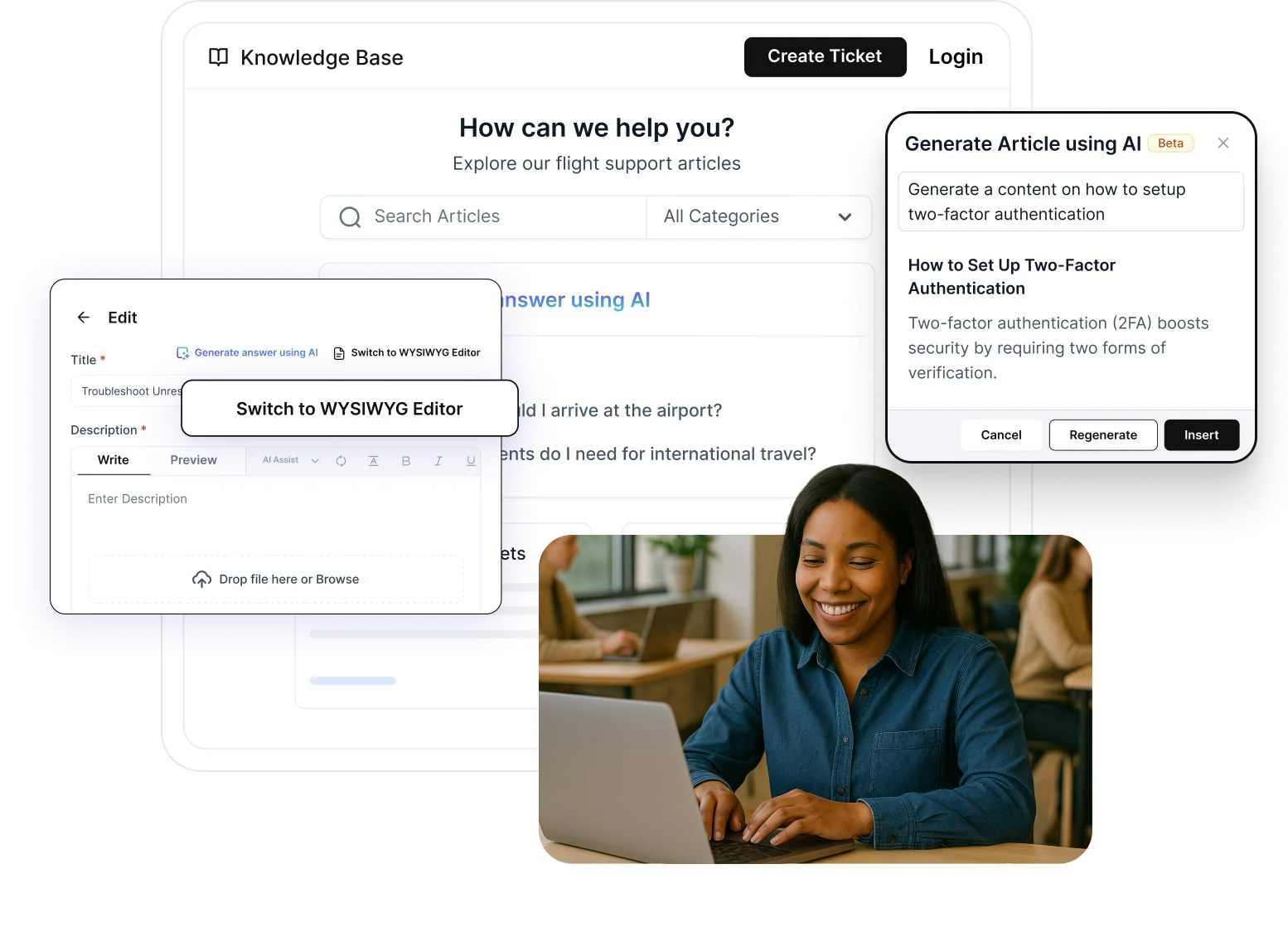
Simultaneously, companies should create a customer-facing knowledge base containing screenshots and short tutorials that break down complex features into simple, easy-to-follow steps.
Dealing with sensitive financial information
Fintech support agents frequently handle sensitive customer data, such as account numbers and identity documents, which introduces significant risks of data breaches.
Without strong internal controls, strict access restrictions, and constant regulatory awareness, the likelihood of a data incident increases.
This means that just one mistake or a security gap can expose private financial data, leading to severe reputation damage and regulatory penalties.
Solution: Secure customer data with strict protection measures
A single weak point in data security can ruin the entire fintech customer experience.
Fintech providers should protect customer data by enforcing strict controls, including:
- Advanced encryption protocols
- Automatic masking of sensitive fields like card numbers within tickets
- MFA for agent access
- Tightly controlled, role-based access controls that limit data visibility to authorized personnel
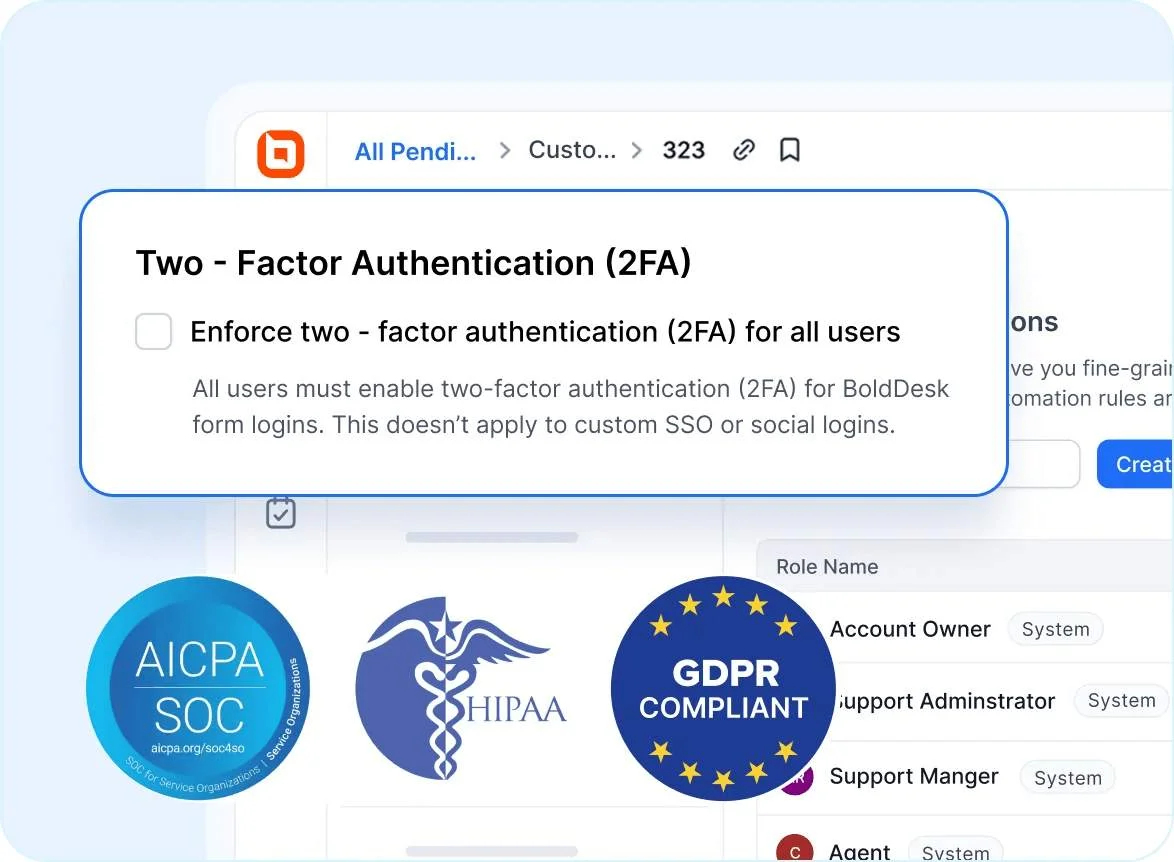
Teams should also run continuous security monitoring and audits to detect and neutralize potential data threats before they negatively impact the customer.
Struggles in establishing credibility and trust with customers
In fintech, the hardest part isn’t the technology, it’s getting customers to believe the company is truly open and straightforward.
Explaining complex financial or technical details in clear, simple terms may at times be difficult, making the communication come across as confusing rather than transparent.
Customers judge trust through every interaction, so even small errors or mixed messages can erode the overall brand perception.
Solution: Build reliability through transparent customer support
Trust is the currency fintech companies must secure before any financial transaction ever happens. Overcoming this fintech support challenge, therefore, requires honesty.
Fintech teams should standardize customer communication using predefined incident updates, status notifications, and follow-up messages, enabling clients to stay informed throughout.
To further enhance credibility, companies should actively showcase customer stories and allow for open reviews.
This transparency provides social proof, reassuring potential users that the platform is verified and trusted by others, effectively solving trust-based problems in fintech customer service.
Maintaining regulatory compliance during support interactions
Fintech customer service operates under strict regulations that dictate exactly what support agents can and cannot say.
Agents often face situations, such as flagged transactions or frozen accounts, where laws explicitly forbid them from revealing the specific reason to the customer to prevent “tipping off.”
This forces agents to provide vague or limited answers, leaving customers feeling stonewalled and frustrated, even though the support team is simply following the law.
Solution: Integrate compliance checks and templates into workflows
To navigate these restrictions, companies should embed compliance guardrails directly into their support tools.
Fintech customer service teams should use pre-approved response templates that help them deliver necessary regulatory information without accidentally breaking the law.
By guiding agents with clear, compliant templates, fintech organizations can protect themselves from fines while ensuring agents manage difficult conversations with confidence.
Aligning regulatory requirements with customer expectations
In fintech, customer service quality is judged as much by security and compliance as by speed.
Meeting customer expectations means proving their data is safe during every interaction and aligns with the global security standards.
Fintech support teams operate under overlapping regulatory frameworks, including:
- AML (Anti-Money Laundering): Anti-tipping laws prevent agents from explaining frozen accounts, often forcing vague answers that escalate customer frustration.
- PCI DSS (Payment Card Industry Data Security Standard): Data masking hides transaction details from agents, leading to slow and repetitive troubleshooting loops.
- SOC 2 (System and Organization Controls 2): Strict internal access controls limit what agents can see in the backend system, resulting in long wait times as they must wait for authorized managers to fix simple technical errors.
- KYC (Know Your Customer): Manual document verification creates a bottleneck that can leave teams overwhelmed with complaints about slow sign-up times.
- GDPR and regional data protection laws: Strict data handling rules force agents to follow rigid, robotic scripts and admin protocols instead of solving problems quickly.
Support data exposure risk self‑assessment
These regulatory constraints don’t just affect internal workflows; they directly shape how customers experience support.
In many fintech teams, friction isn’t caused by slow agents, but by unintended data exposure risks that force restrictive processes.
To understand whether compliance controls are protecting customers or unintentionally hurting their experience, teams can start with this simple self-assessment.
Why generic help desks break at scale
Generic help desks work well for early-stage teams handling low-risk support. But as fintech companies scale, these tools begin to show structural limitations.
What once felt fast and flexible becomes a source of operational friction, compliance risk, and customer frustration.
The issue isn’t poor execution by support teams. It’s that most help desks were never designed for regulated, data-sensitive environments.
Built for volume, not risk
Traditional help desks are optimized to process large volumes of tickets quickly. In fintech, however, not all tickets are equal.
A single support request may involve:
- Financial transactions
- Identity verification data
- Regulatory restrictions on what can be disclosed
Generic systems treat these interactions the same way they treat password resets or product questions.
This flat ticket model exposes sensitive data to more agents than necessary and increases the risk of internal data leaks.
Over-permissioned access by default
Most generic help desks follow a full visibility model to improve speed. While convenient, this approach creates serious issues in fintech environments.
Common problems include:
- Agents viewing transaction or identity data they don’t need
- Shared access across teams without clear boundaries
- Limited ability to restrict data by role or context
As teams grow, managing access manually becomes unscalable and unsafe.
Compliance added after the fact
Compliance in many help desks is treated as an add-on rather than a foundation.
This leads to:
- Incomplete or fragmented audit trails
- Manual logging of sensitive actions
- Difficulty proving compliance during audits
In regulated industries, compliance must be enforced by the system itself. Relying on training or policies alone creates gaps that surface during audits or incidents.
Slow support disguised as secure support
To compensate for weak controls, teams often add manual approval layers. While this reduces risk, it also slows down resolution times.
Customers experience:
- Long wait times
- Vague or scripted responses
- Repeated handoffs between agents
What appears to be “secure support” is often just restricted support, where productivity and experience suffer.
Poor audit and reporting readiness
When auditors request evidence, generic help desks struggle to provide:
- Clear action histories
- Time-stamped access records
- End-to-end visibility into support workflows
Teams are forced to reconstruct events manually, an expensive and error-prone process that increases stress during audits.
Designed for general SaaS, not fintech reality
Generic help desks assume:
- Low data sensitivity
- Minimal regulatory oversight
- Broad agent access
Fintech support operates under the opposite conditions. As customer bases grow and regulatory scrutiny increases, these assumptions no longer hold.
At scale, fintech teams need support systems that are secure by design, compliant by default, and scalable without sacrificing customer experience.
What does good fintech support look like?
Good fintech support is secure by default, compliant by design, and scalable without increasing risk.
It enables teams to resolve customer issues quickly while enforcing regulatory controls automatically without relying on manual workarounds or agent judgment alone.
Modern fintech teams design support operations around three core principles:
Proactive, automation-driven support
Good fintech support does not wait for customers to report problems. Teams proactively notify users about payment failures, account restrictions, system maintenance, or unusual activity before frustration builds.
By automating alerts, routing, and prioritization, support teams:
- Reduce inbound ticket volume
- Prevent repeat follow-ups
- Maintain transparency during sensitive financial events
This approach improves customer confidence while keeping support workloads predictable at scale.
Risk-based security with built-In guardrails
Effective fintech support applies security intelligently not uniformly.
Instead of forcing every customer through repetitive verification steps, modern systems use risk-based controls that trigger additional checks only for high-risk, high-value, or regulated actions.
Security guardrails are enforced by the platform itself, ensuring:
- Sensitive actions follow predefined workflows
- Agents are guided by system rules, not guesswork
- Compliance is maintained without slowing down routine support
This balance protects both customer data and support efficiency.
Unified support context without overexposure
Good fintech support gives agents a single, secure workspace with the context they need—without exposing unnecessary data.
Rather than switching between CRMs, payment systems, and internal tools, agents see:
- Relevant account status
- Recent activity indicators
- Issue history and conversation context
All while sensitive financial and identity data remains masked or restricted based on role and permission.
This unified-but-controlled context enables faster resolutions without violating least-privilege principles.
Comparison table for ineffective vs good fintech support in action
Are your fintech customer support operations truly meeting your customer needs. The difference between ineffective support and well-designed fintech support becomes clear in practice.
Here’s how ineffective and good fintech support truly compare:
| Support aspect | Ineffective support | Good support |
| Response strategy | Waits for the customer to complain about a failed payment | Proactively explains issues before customers ask |
| Issue prioritization | Treats fraud alerts and password resets the same | Automatically prioritizes high-risk financial issues |
| Security controls | Applies rigid verification to every interaction | Uses adaptive, risk-based security guardrails |
| Compliance handling | Relies on manual checks and manager approvals | Enforces compliance through automated workflows |
| Agent context | Forces agents to switch between multiple systems | Provides a unified, permission-controlled support view |
In fintech, good support is not defined by speed alone. It is defined by how consistently teams can deliver fast, clear help while protecting customer data and meeting regulatory expectations at scale.
This is a challenge modern fintech teams address by rethinking how fintech customer service is designed and delivered.
To help you implement these benchmarks and ensure your fintech support aligns with the highest customer service standards, download our fintech customer support compliance checklist.
Overcoming the challenges in fintech customer service
A single failed transaction or delayed response can instantly erode customer trust. Overcoming these challenges in fintech customer service requires fast, consistent, and secure support across every customer touchpoint.
Modern fintech help desks combine automation, omnichannel visibility, and compliance-first workflows.
With help desk software for fintech like BoldDesk, support agents can centralize support workflows, prioritize urgent issues, and ensure customers always receive timely and reliable help.
Sign up for a free trial or book a live demo to see how modern fintech teams design secure, customer-first support workflows.
You can also take a product tour to explore features firsthand. For additional support, reach out to the BoldDesk support team.
Related articles
Frequently Asked Questions
Fintech platforms experience sudden spikes due to outages, transaction errors, new feature launches, verification delays, or changes in financial regulations.
Security protocols like multi‑factor authentication, access controls, and data masking can slow down support interactions but are necessary to protect financial information and prevent fraud.
Compliance frameworks (like AML, KYC, PCI DSS, and GDPR) limit what agents can disclose and require strict processes that can make conversations slower or less transparent.
Delays usually arise from manual verification steps, agent escalation loops, limited backend visibility, or the need to involve compliance or risk teams.