


 In this page

Acquiring new customers is expensive, but keeping them is even more challenging.
That’s why smart businesses focus on customer lifetime value (CLV), a customer satisfaction metric that measures the total revenue a customer can generate over their entire relationship with your brand.
The question is: are you maximizing the value of every customer you already have?
Understanding CLV isn’t just about numbers; it’s about building trust, creating meaningful relationships, and driving sustainable growth.
In this blog, you’ll learn what customer lifetime value is, how to measure it, and the proven strategies to improve it so your business thrives.
What is customer lifetime value?
Customer lifetime value (CLV) is a metric that businesses use to estimate the total revenue a customer will generate throughout their entire relationship with the company.
This metric helps assess the customer’s value over time rather than just focusing on the value of a single purchase.
Calculating customer lifetime value can be complex, as it involves several factors, including products, costs, purchase frequency, and volume.
However, it can be simplified with the right customer service tools, and strategies can be developed to increase it.
Why is customer lifetime value important?
Understanding the lifetime value of a customer gives you a clear picture of a client’s worth and long-term business performance.
The following are some of the benefits of tracking the lifetime value of a customer.

- Helps segment and target high-value customers: CLV identifies which customers generate the most revenue over time. By focusing on these segments, businesses can tailor campaigns and allocate resources to maximize return on investment.
- Improves customer retention: Knowing the lifetime value of a customer highlights which relationships are worth nurturing. This insight helps you design personalized marketing strategies that keep customers engaged and loyal.
- Optimizes customer acquisition costs: Customer lifetime value metrics reveal the true worth of acquiring a customer, ensuring marketing budgets are invested in channels that attract high-value customers and reduce wasted spend.
- Increases profitability: With a clear view of long-term revenue potential, businesses can make smarter decisions about pricing, upselling, and cross-selling strategies, driving sustainable growth.
- Guides product and service improvements: Customer lifetime value analysis uncovers what keeps customers loyal, whether it’s product features, service standards, or overall experience. These insights foster innovation and enhancements that align with customer expectations.
Factors that influence customer lifetime value
The customer lifetime value model is shaped by multiple factors that affect how long customers stay and how much they spend.
Understanding these drivers helps businesses create strategies that maximize revenue per customer.
- Customer experience: Delivering exceptional experiences at every stage, from onboarding to post-purchase, builds trust and satisfaction, making customers more likely to make repeat purchases and increase their lifetime value.
- Pricing strategy: Competitive pricing and strong perceived value directly influence purchase frequency and customer retention. Offering flexible plans, tiered pricing, or strategic discounts can significantly boost CLV.
- Loyalty programs and incentives: Rewarding repeat purchases through loyalty programs and personalized discounts keeps customers engaged and motivated to return. This can turn them into passionate brand advocates, indirectly increasing CLV through referrals.
- Market fit: When your product perfectly aligns with customer needs and evolves with market changes, it creates lasting relevance. This adaptability reduces churn and encourages customers to stay longer.
How to calculate customer lifetime value
Calculating CLV accurately means looking beyond simple purchase data.
Since most customers don’t discover businesses on their own, your calculation should factor in market research, acquisition costs, customer engagement efforts, and retention strategies.
The basic customer lifetime value formula is:

Key customer lifetime value metrics you should track
The lifetime value of a customer goes beyond a single number; it’s a collection of key metrics that reveal how profitable and loyal your customers are over time, enabling businesses to segment clients based on their value.
They include:
1. Customer value
This is the average amount of money a customer spends with your business in a given period. This metric can be used in customer segmentation for targeted campaigns.
The formula to find customer value is:

The average value of sales = Total sales/The number of days
The average value of transactions = Sales/Transactions
2. Average purchase value
This metric shows how much a customer spends per transaction. It’s calculated using the formula:
Average Purchase Value = Total revenue / Number of purchases
3. Average purchase frequency rate
How often do customers buy from you within a specific period? Higher frequency means stronger engagement and loyalty.
It is calculated using the formula:
Average purchase frequency rate = Total number of purchases / Number of customers
Increasing purchase frequency through loyalty programs or personalized offers boosts CLV significantly.
4. Average customer lifespan
Customer lifespan refers to the total time a single customer remains active with your business, from their first purchase to their last.
Here is the formula for calculating individual customer lifespan:
Customer lifespan = Date of previous purchase−Date of current purchase
Longer lifespans indicate better retention and customer satisfaction. The average customer lifespan is calculated using the formula:

By multiplying these two factors together, you get an estimate of the total revenue a customer can be expected to generate.
5. Customer acquisition cost
It is the cost of acquiring a new customer through marketing and sales efforts. The formula to calculate this metric is:
Customer acquisition cost (CAC) = Total marketing and sales cost/Number of new customers acquired
Comparing CAC vs CLV ratio ensures customer profitability, and a healthy CLV: CAC ratio is typically 3:1 or higher.
How to increase customer lifetime value
Increasing CLV requires a strategic approach that enhances customer relationships and maximizes long-term revenue.
Here are some strategies to consider:

Deliver exceptional customer experience
From onboarding to post-purchase support, every interaction shapes how customers perceive your brand. To create a seamless, personalized experience that builds trust and loyalty:
- Map the entire customer journey to identify friction points and opportunities for improvement.
- Implement smooth customer onboarding processes that make customers feel confident and supported from day one.
- Provide proactive support and maintain consistent quality across all touchpoints to keep customers engaged and satisfied.
Personalize interactions, marketing, and offers
Generic campaigns no longer work; customers expect tailored experiences that feel relevant and timely.
According to statistics by Wisernotify, 80% of consumers prefer a brand that tailors interactions, keeping the customer journey in mind
To deliver personalized customer service that can increase the repeat purchase rate, you can:
- Segment customers based on value, behavior, and preferences using data analytics.
- Create dynamic content and offers that reflect individual interests and past purchases.
- Leverage automation tools to send personalized emails and recommendations that keep customers engaged.
Implement loyalty programs
Customer loyalty programs are powerful tools for increasing CLV when designed with customer motivation in mind. To make them effective:
- Offer meaningful rewards such as points, discounts, or exclusive perks that truly encourage customers to stay and spend more.
- Create tiered benefits that give customers a reason to progress and unlock better rewards over time.
- Promote the program across all channels and make enrolment simple so customers see its value and join without friction.
Upsell and cross-sell strategically
Upselling and cross-selling are powerful ways to enhance customer lifetime value because they raise the average revenue per customer.
Here’s how:
- Analyze purchase history to identify complementary products or premium upgrades that add real value.
- Introduce offers at the right moment, such as during checkout, in post-purchase emails, or after a positive support interaction when trust is high.
- Highlight benefits and added value, not just price, so customers clearly see how the upgrade or additional product enhances their experience.
Optimize pricing and plans
Pricing plays a critical role in both customer acquisition and retention marketing. Competitive pricing combined with strong perceived value keeps customers committed for longer.
To make pricing work:
- Offer flexible models such as subscriptions, bundles, or tiered plans to cater to different customer needs and budgets.
- Review pricing regularly using CLV data and market trends to ensure your pricing strategy aligns with customer value and profitability goals.
- Communicate value clearly so customers understand what they’re paying for and why it’s worth the investment.
Provide outstanding customer support
Good customer service is a key driver of loyalty and long-term value. To make your support stand out, you can:
- Deploy AI Agents that handle routine queries instantly to ensure instant, empathetic responses across all channels.
- Invest in the best customer service software to streamline workflows, centralize communication, and deliver consistent, high-quality support experiences.
- Empower support teams with AI Copilot tools that provide real-time suggestions, enabling agents to resolve issues faster.
- Implement customer self-service options like knowledge bases and interactive FAQs, allowing customers to resolve issues independently.
Gather feedback and improve continuously
Customer feedback is a goldmine for improving customer lifetime value as it reveals what keeps customers loyal and what drives them away.
You need to:
- Collect feedback regularly through surveys, reviews, and social listening, and use AI-powered customer sentiment analysis to uncover deeper insights.
- Analyze trends to identify recurring pain points and predict future customer needs.
- Act on insights quickly to show customers their opinions matter and enhance their experience.
How to predict CLV risks
Not all signs of churn are obvious. Some customers may look engaged on the surface, but are quietly signaling risk.
Predictive analytics for CLV can help you identify these indicators and take prompt action. Here are key signals that you should not ignore:
- Decrease in customer spending: When clients begin reducing their purchases or delaying renewals, it’s often a sign that they no longer see the same value in your product or service. This decline can happen gradually, making it easy to overlook until the revenue impact becomes significant.
- Drop in usage or engagement: A noticeable decrease in logins, feature adoption, or participation in product-related activities suggests that interest is fading, even if the customer hasn’t voiced dissatisfaction.
- Silence after outreach: When a customer who previously responded promptly to emails, surveys, or check-ins suddenly goes quiet, it often signals shifting priorities or hidden dissatisfaction. Silence should never be ignored; it’s an opportunity to reconnect and uncover what’s changed before the customer relationship deteriorates.
- Spike in support issues: An increase in complaints is a clear warning sign that frustration is building. Beyond the immediate impact on satisfaction, recurring issues can damage your brand reputation and accelerate customer churn.
Customer lifetime value example
Customer lifetime value (CLV) can vary significantly across industries and business models.
Research conducted by Genesys states that, while 82% of SaaS companies track customer lifetime value, fewer than half calculate the critical CLV: CAC ratio.
Therefore, exploring real-world examples helps illustrate how companies calculate and leverage CLV to guide marketing strategies and customer retention efforts.
Example
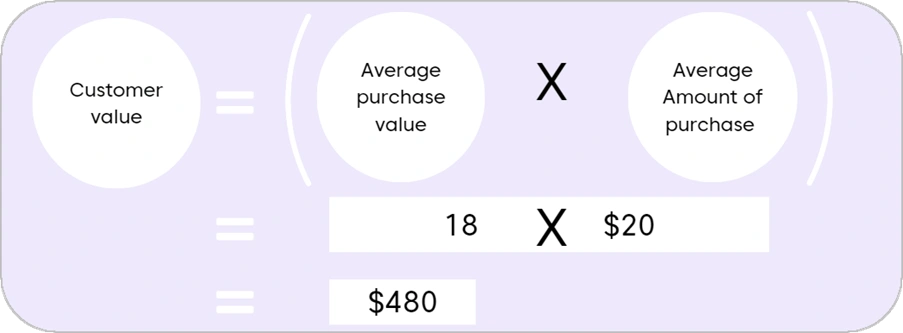
The pricing structure for subscription-based services is $10, $20, and $30 per month, with an average purchase value of 18.
The SaaS company targets middle-aged adults, specifically married individuals aged 35-55, who stay for an average of two years and spend an average of $20 per purchase.
The customer value will be:
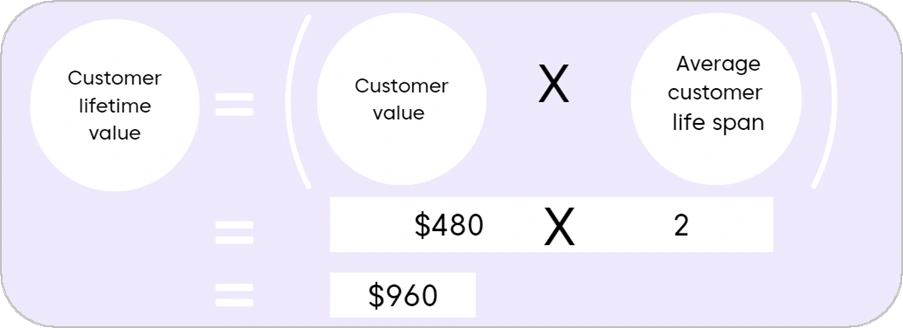
Now, let’s calculate the CLV for the middle-aged adult.
The SaaS company is targeting another young adult customer profile aged 18-30, who typically stay customers for 1.5 years and have an average purchase amount of $30.
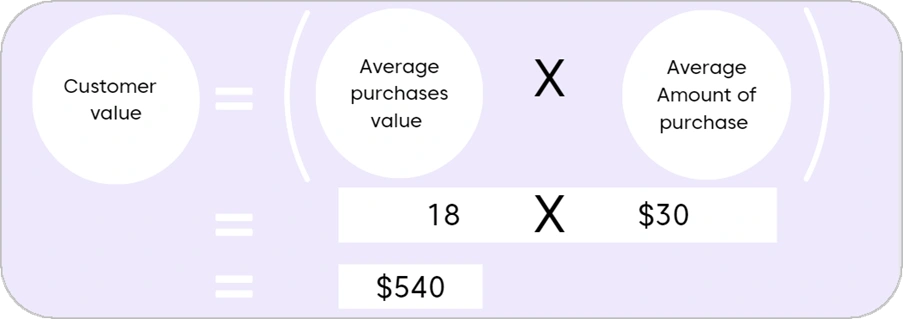
The CLV for the young adults will be:
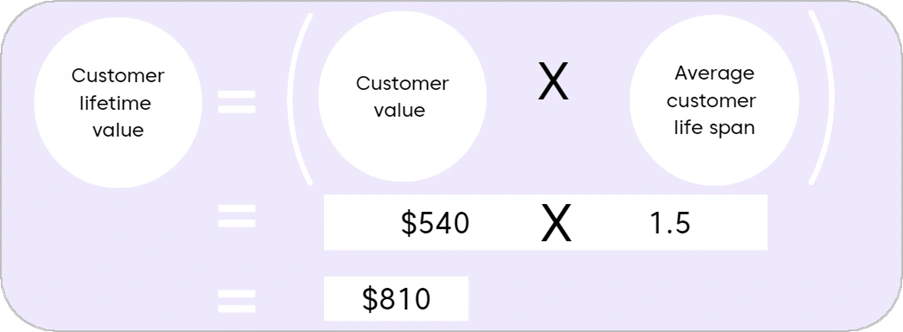
In conclusion, the middle-aged customer profile has a higher CLV of $960 compared to $810 for younger individuals, indicating that the SaaS business should target middle-aged adults.
Maximize customer lifetime value to drive sustainable growth
Companies that measure and optimize CLV can identify high-value customers, allocate marketing resources effectively, and design experiences that keep customers engaged for the long term.
BoldDesk empowers businesses to achieve these goals through advanced customer support solutions.
With AI-powered assistance, real-time analytics, and omnichannel support tools, BoldDesk helps you deliver exceptional experiences that reduce churn rate, increase loyalty, and turn satisfied customers into brand advocates.
Ready to unlock sustainable growth? Contact our support team to experience how BoldDesk features can increase customer lifetime value.
I hope you found the article useful. Do you have any more ideas or recommendations? Kindly leave your comments in the section below.
Related articles