



 In this page

TL;DR: The best knowledge management software helps teams organize information and streamline self-service through AI powered search, integrations, and scalable documentation tools. Platforms like BoldDesk, Guru, and ClickUp simplify content creation, improve support efficiency, and centralize company knowledge for faster, more consistent answers.
When knowledge lives in silos or is difficult to access, productivity drops and support teams face unnecessary pressure.
If your organization deals with scattered information, repeated questions, and teams struggling to find the right answers, these are strong signs of a fragmented knowledge system that users can’t rely on.
A study by Higher Logic shows that 92% of users would use a knowledge base if one were easily accessible, highlighting how much people depend on well-organized information.
The right knowledge management software helps your organization deliver fast, consistent, and reliable answers across every touchpoint.
By centralizing information, improving discoverability, and supporting self‑service, these tools streamline collaboration, enhance decision-making, and strengthen customer experience.
In this blog, we’ll break down the leading knowledge management platforms in the market today to help you choose the best fit for your organization’s needs.
What is knowledge management software?
Knowledge management software is a platform that helps businesses collect, organize, store, and share information internally or externally.
It centralizes essential content, such as procedures, best practices, troubleshooting steps, and company policies, into one searchable, easy‑to‑access location.
Modern knowledge management tools include features like advanced search, AI-generated suggestions, collaboration workflows, and version control to keep information accurate and up to date.
By improving discoverability and reducing information silos, this software boosts productivity, supports customer self-service, and ensures consistent answers across teams and departments.
Examples of knowledge management tools
The following are examples of different knowledge management solutions.
- Knowledge base: A centralized self-service repository of FAQs, product documentation, troubleshooting guides, and internal process documents. It enables teams and customers to quickly find accurate, up-to-date information without relying on direct support.
- Document management systems (DMS): Tools that store, organize, version, and control access to business documents. They help teams maintain structured knowledge, ensure compliance, and prevent information silos across departments.
- Enterprise wiki or intranet: Internal platforms that allow teams to collaboratively create, edit, and share institutional knowledge such as policies, SOPs, onboarding materials, and best practices.
- AI-powered knowledge management tools: Systems that use artificial intelligence to understand user intent, surface relevant answers, identify knowledge gaps, recommend content improvements, and automate documentation workflows.
Summary of the top knowledge management solutions
The following is a list of the best knowledge management tools in the market.
We evaluated the best knowledge management software tools, focusing on their documentation capabilities, AI-assisted features, customization options, knowledge analytics and reporting depth, verified user review platforms like G2, and overall usability as described in each platform’s feature set.
The selection criteria were chosen to fit business needs, ensuring the list reflects tools that support scalable knowledge creation, efficient information retrieval, and strong collaboration across teams.
| Software | Key features | Starting price | G2 ratings |
| BoldDesk |
|
$99/month for 5 agents | 4.5/5 |
| Document360 |
|
Contact Document360 | 4.7/5 |
| Confluence |
|
$5.42/user/month | 4.1/5 |
| Guru |
|
$25/user/month | 4.7/5 |
| Notion |
|
$10/user/month | 4.5/5 |
| ClickUp |
|
$7/user/month | 4.7/5 |
| Knowmax |
|
Contact Knowmax | 4.5/5 |
| Zendesk |
|
$19/user/month | 4.3/5 |
| Bloomfire |
|
Contact Bloomfire | 4.6/5 |
| Tettra |
|
Contact Tettra | 4.7/5 |
| Bitrix24 |
|
$49/month (Includes up to 5 users) | 4.1/5 |
| ProProfs |
|
$49/user/month | 4.7/5 |
| Slite |
|
$10/user/month | 4.6/5 |
Best knowledge management platforms for businesses
Navigating the knowledge management tools available in the market can be overwhelming, but we hope this article can help your decision-making process.
Here’s a rundown of the top 13 best knowledge management software platforms on the market.
1. BoldDesk
Best for: Teams that want an all-in-one help desk with an AI-driven knowledge management system.
BoldDesk is a top-rated, powerful help desk software that empowers users to create comprehensive knowledge base tools for both customers and support teams.
Its secure knowledge base software is renowned for its excellent features and tools that help businesses create self-service repositories for different products and departments.
The software includes workflow automation tools that streamline documentation, from designing to simple content creation, editing, styling, and publishing.
Its knowledge-based AI also provides multilingual support and translation capabilities, helping agents produce clear, easy‑to‑understand articles for global audiences.
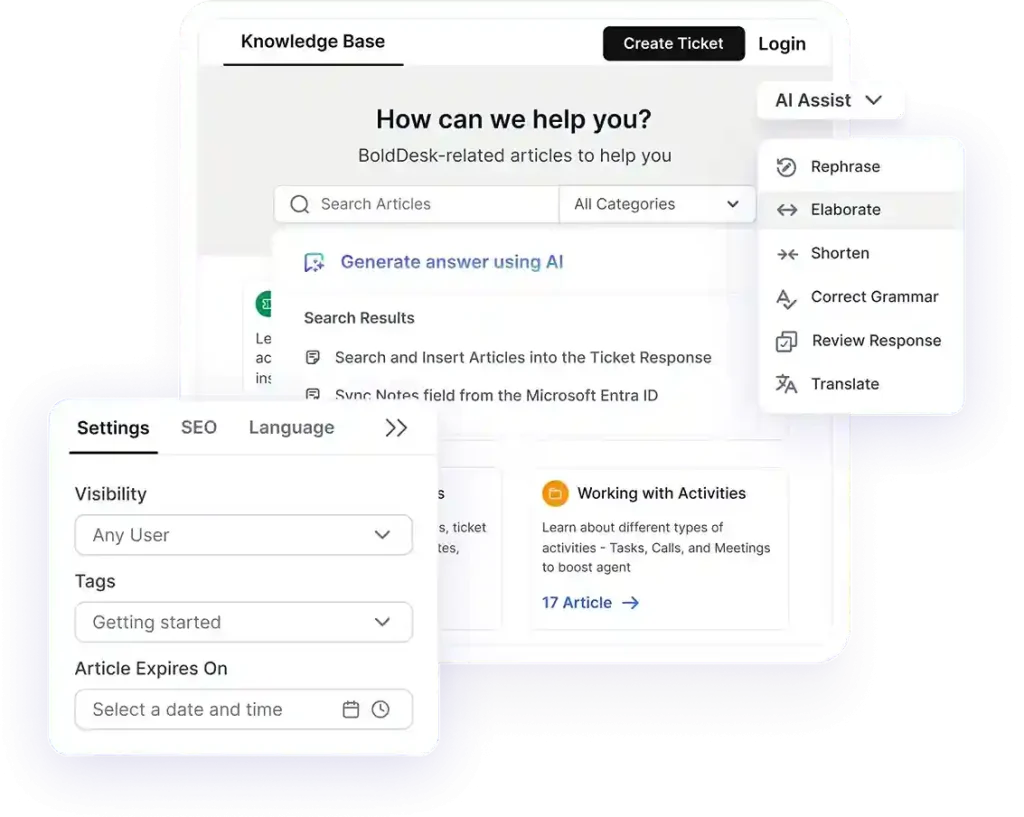
It ensures a compliant-ready knowledge base with security and control features such as roles and permissions, access control, password policies, audit logs, and IP restrictions, allowing you to manage and track content access.
Collaboration is easier with features like private notes and @ mentions, so subject-matter experts can add context, validate information, and keep articles accurate.
Centralized knowledge access ensures information is consistently shared and reused across teams, providing a single source of truth for accurate and reliable answers.
The branding and customization options allow you to tailor the knowledge management software with your company’s logo, colors, and login options.
Information can be surfaced directly within live chat and embedded into ticket replies, enabling users and agents to access and reuse relevant knowledge base articles without leaving the flow of the conversation.
BoldDesk’s key features
The following features position BoldDesk as a market leader, delivering effortless self-service at an unbeatable price:
- The ability to create internal and external knowledge bases for multiple brands
- Workflow automation
- Generative AI Copilot
- Robust AI Agent
- A powerful article search function
- A simple yet powerful article editor
- On-page SEO tools for content optimization
- Article categorization
- Multilingual help desk
- Unlimited article templates
- Content library tools like tags, categories, and sections
- Analytics and metrics on article performance
- Top-notch security and privacy
Pricing
BoldDesk empowers businesses to build a hybrid support team that’s both cost-effective and highly scalable. Every plan includes the complete feature set, allowing you to scale confidently without paying extra for essential capabilities.
| No. of agents | Monthly price (USD) | Free AI credits (First 3 months) |
| 5 | $99 | 500 |
| 10 | $199 | 1,000 |
| 25 | $349 | 1,500 |
| 50 | $499 | 2,000 |
| 75 | $749 | 2,500 |
| 100 | $999 | 3,000 |
AI add-ons pricing
Instead of charging flat fees for AI agent usage, BoldDesk uses a credit-based pricing approach at only $20 per 1,000 AI credits. You purchase AI credits and pay only for what you use, giving you flexibility and control over costs.
Additionally, you can supercharge your human agents with the AI Copilot for just $20 per agent/month.
For a complete breakdown of pricing tiers, including features and AI add-ons, explore the full BoldDesk pricing details. You can also start a 15-day free trial or arrange a live demo.
2. Document360
Best for: Enterprises and large documentation teams needing structured documentation, multiple versions, team roles, and in-depth analytics.
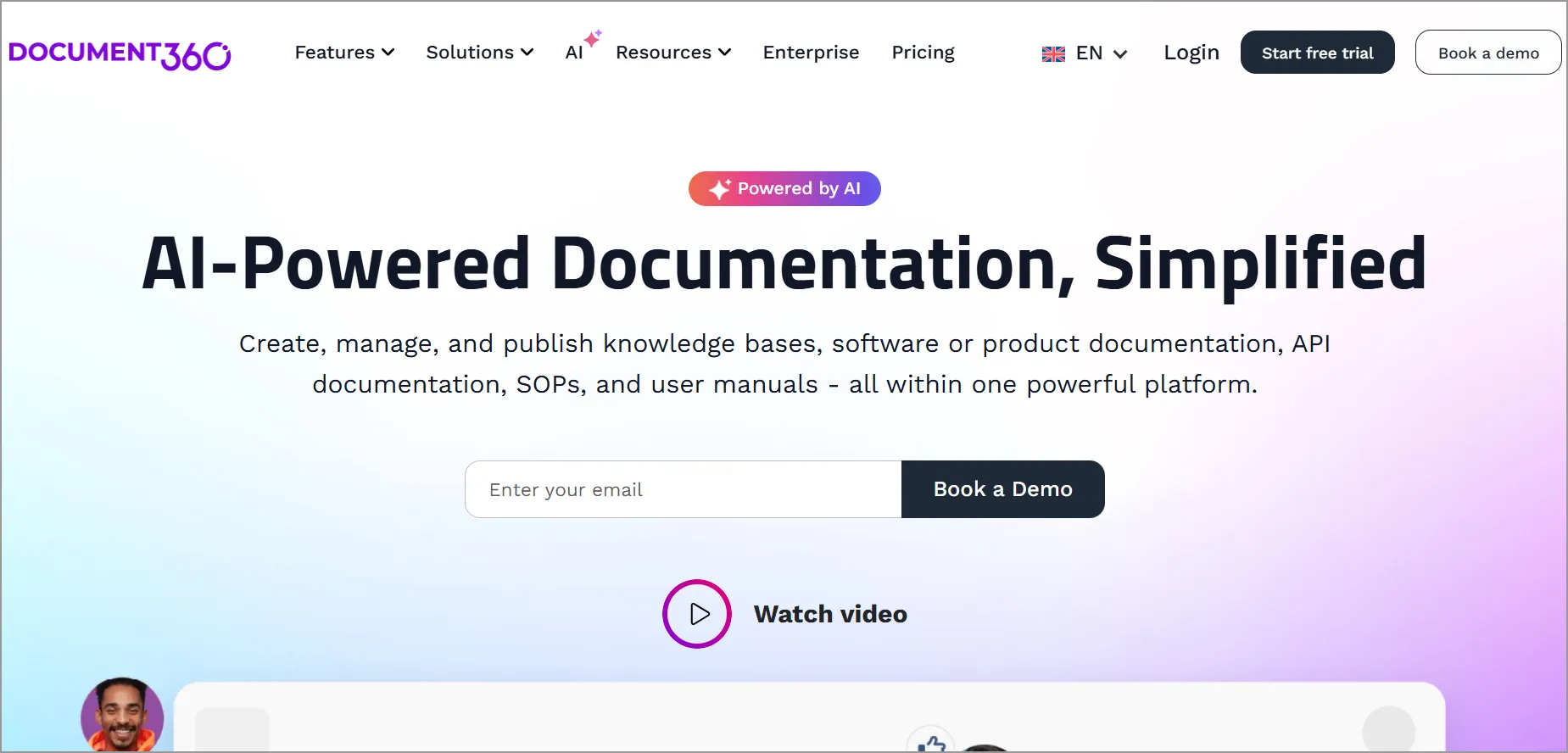
Document360 is knowledge management software suitable for big teams and enterprises that need to create, organize, and share knowledge easily.
It enables users to maintain multiple versions of documents for numerous projects, set up multiple users, and access analytics that will assist in maintaining the relevance of the knowledge base content.
Features
- Search engine with AI-powered recommendations
- Branding and customization options
- Integrations with third-party tools and applications
- Comprehensive analytics and reporting dashboards
Pros
- Offers strong analytics, version control, and multiple projects.
- Allows deep branding and customization options for documentation portals.
Cons
- Complexity and specialized features may be unnecessary for small teams that just need a lightweight KB.
Pricing
Contact Document360 for pricing
3. Confluence
Best for: Teams working inside the Atlassian ecosystem that need a deeply collaborative internal wiki/documentation workspace.
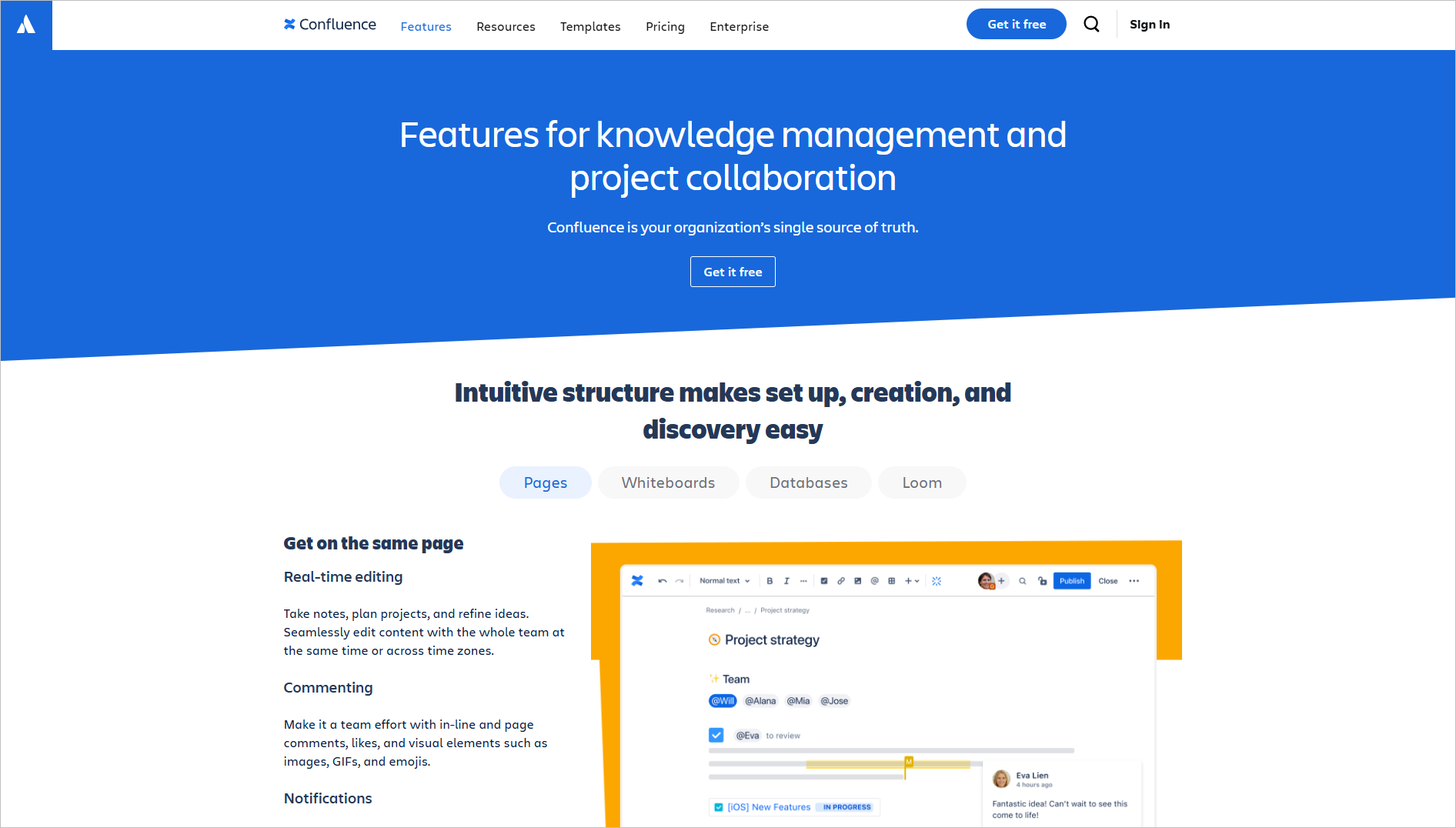
Confluence is ideal for teams seeking to integrate smoothly with productivity tools to facilitate seamless knowledge sharing, enhance productivity, and promote collaboration on numerous projects.
It provides users with a rich template library to help them get started and track their changes on the fly.
Features
- Seamless collaboration with real-time editing, tagging, commenting, and notifications
- Integration with Atlassian’s software suite and other tools
- Security
- Full-text search
Pros
- Integrates deeply with Atlassian tools, making it ideal for teams already using Jira ecosystems.
- Offers real‑time editing, tagging, and commenting, improving team collaboration.
Cons
- Scaling can lead to clutter and search difficulty without strong governance.
Pricing
- Starts at $5.42/user/month
4. Guru
Best for: Teams needing AI-assisted internal knowledge with instant suggestions to improve speed and accuracy in daily workflows.
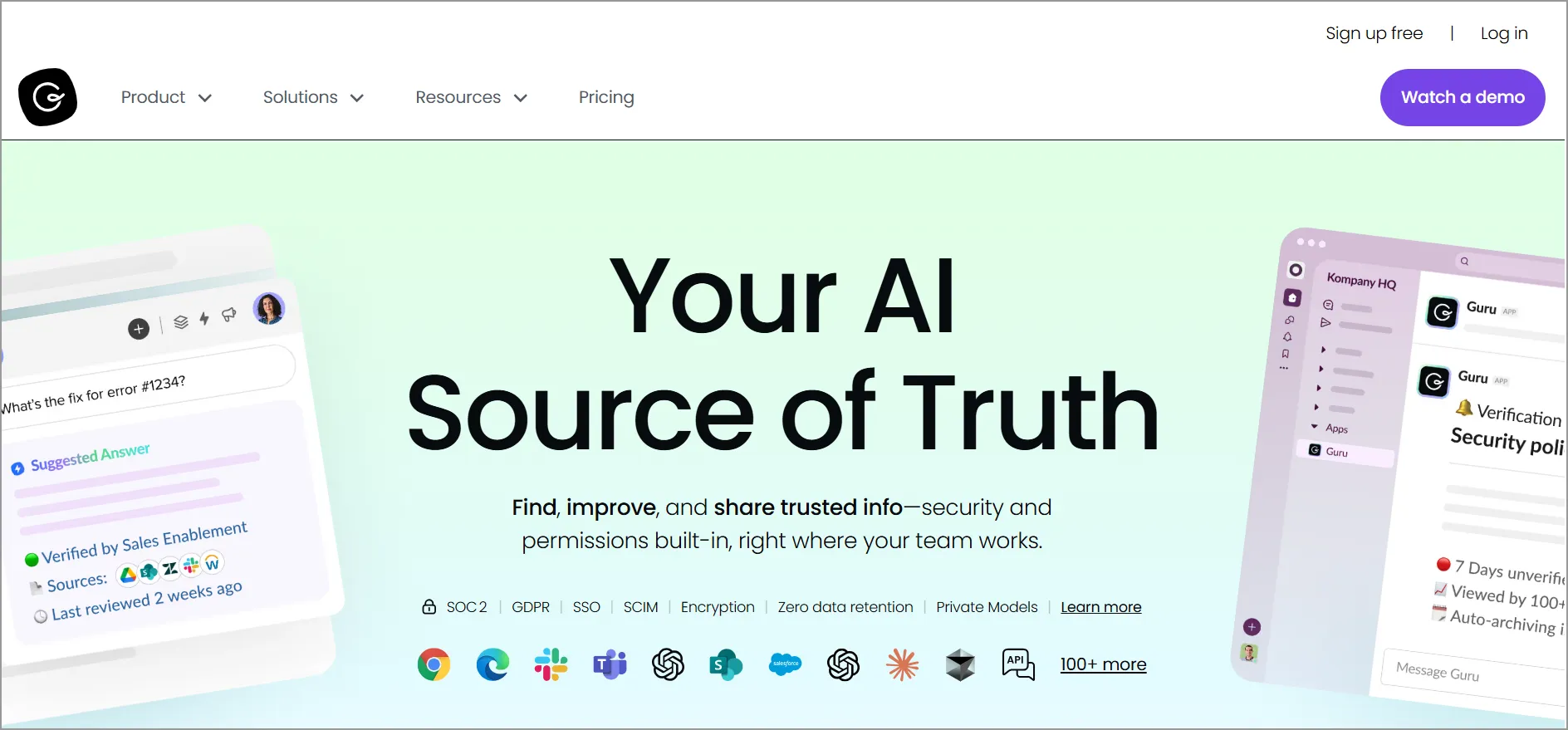
Guru is a stand-alone, AI-driven, and feature-rich platform that allows teams to capture and share knowledge. It uses AI to quickly suggest information to enhance productivity and improve response times.
Features
- AI-powered search engine
- Integrations
- Analytics and reporting
- Real-time editing and collaboration
Pros
- Strong integrations with widely used tools like Slack and Teams.
- Provides real-time collaboration and editing features.
Cons
- Better suited for quick knowledge sharing than long-form documentation.
Pricing
- Starts at $25/user/month
5. Notion
Best for: Companies wanting an all-in-one workspace with knowledge management and team collaboration.
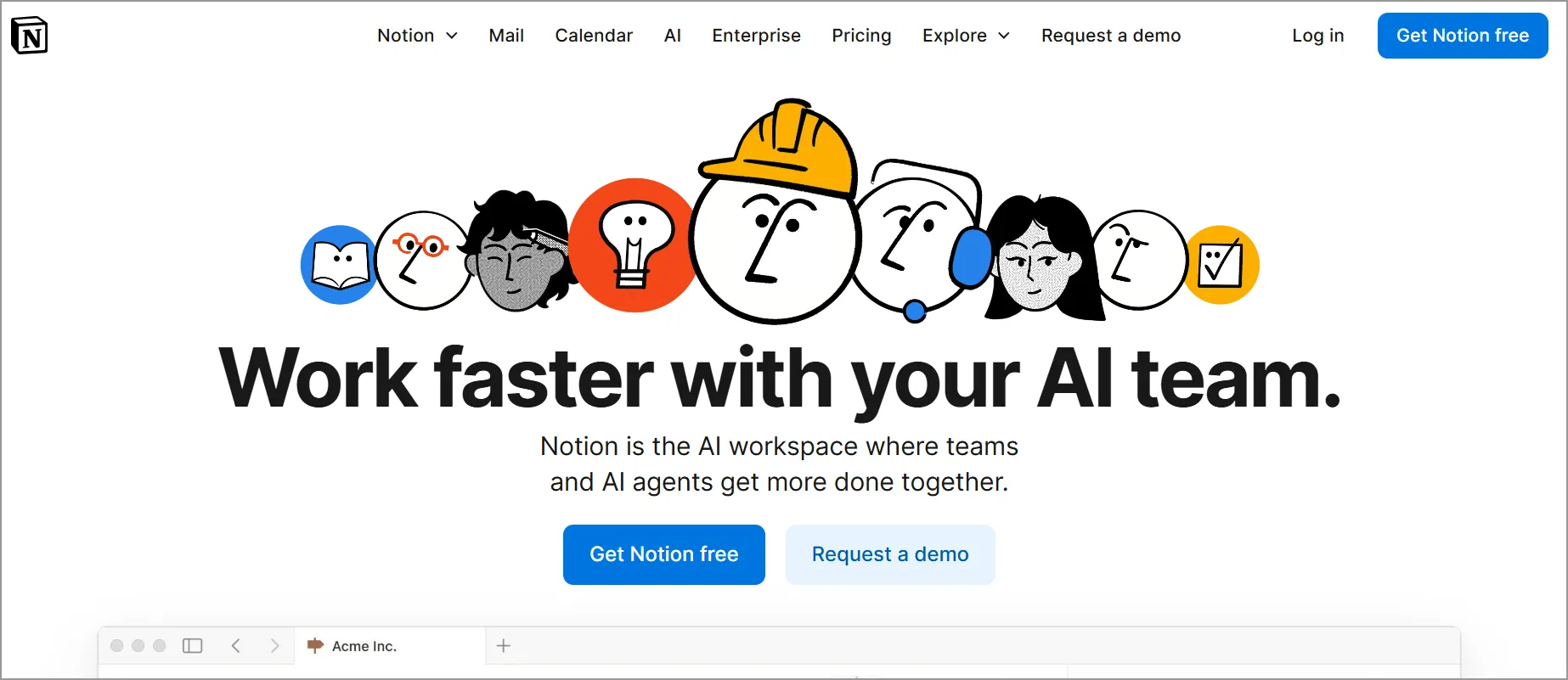
Notion is a versatile, cloud-based knowledge management platform suitable for companies that need an all-in-one solution that merges knowledge management, project management, and other functions into a single system.
Features
- AI capabilities
- Real-time collaboration
- Robust search engine
- Analytics and reporting
Pros
- Highly flexible workspace with customizable pages and databases.
- Includes AI features, making drafting and summarizing easier.
Cons
- Lacks certain KB‑specific features (approval workflows, article lifecycle controls).
Pricing
- Starts at $10/user/month
6. ClickUp
Best for: Teams looking for knowledge management in a single, highly customizable platform with dashboards and integrations.
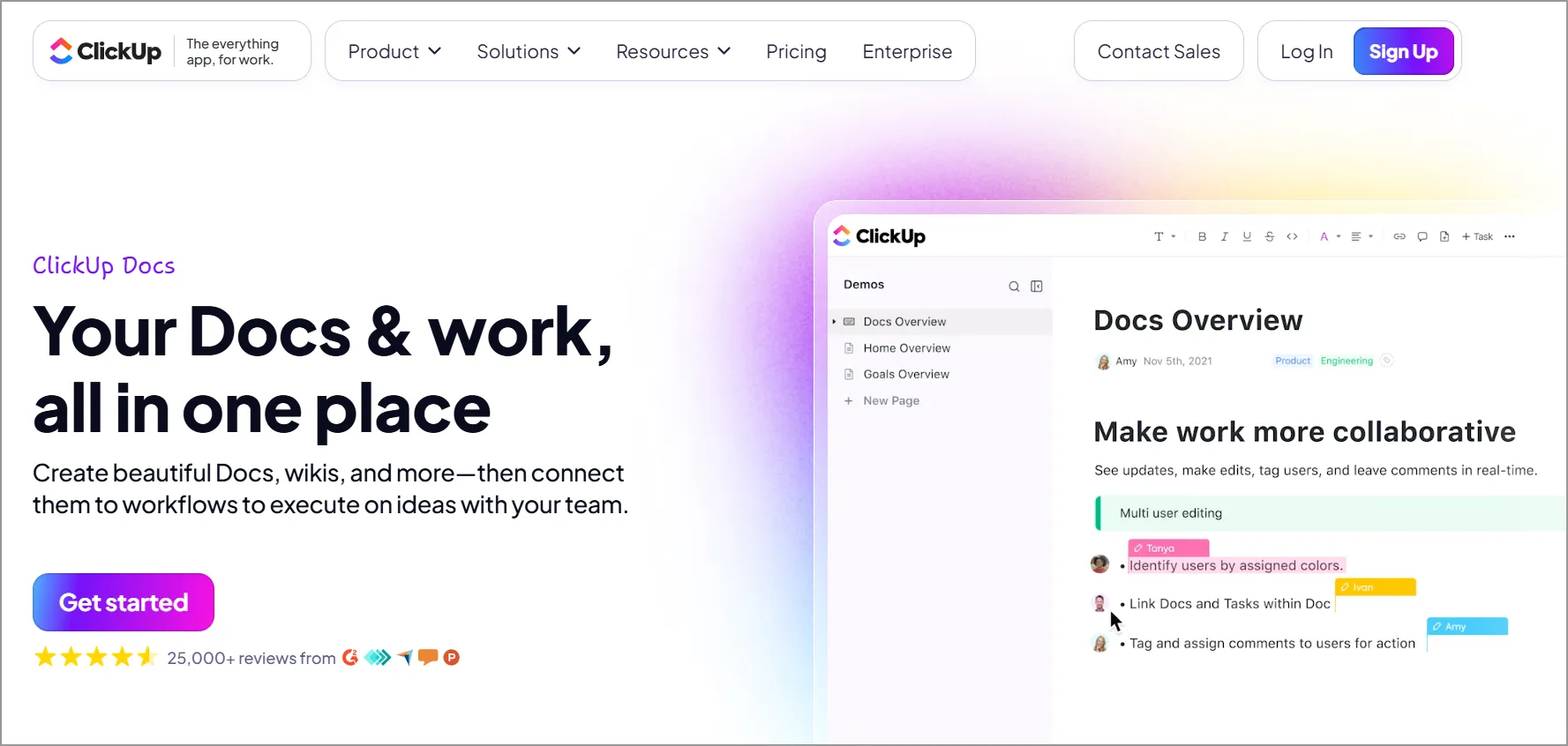
ClickUp is a knowledge management app that centralizes resources, communication, and team management into a single platform.
Its free forever plan provides a range of powerful and customizable features that allow users to create formatted knowledge bases.
Features
- Integration with third-party apps and tools
- Privacy and edit controls
- Unlimited dashboards
- Analytics and reporting
Pros
- Combines project management and documentation, ideal for cross‑functional teams.
- Provides unlimited dashboards and analytics for documentation.
Cons
- Advanced features require paid plans for full utility.
Pricing
- Starts at $7/user/month
7. Knowmax
Best for: Customer experience teams delivering guided customer support and omnichannel knowledge delivery.
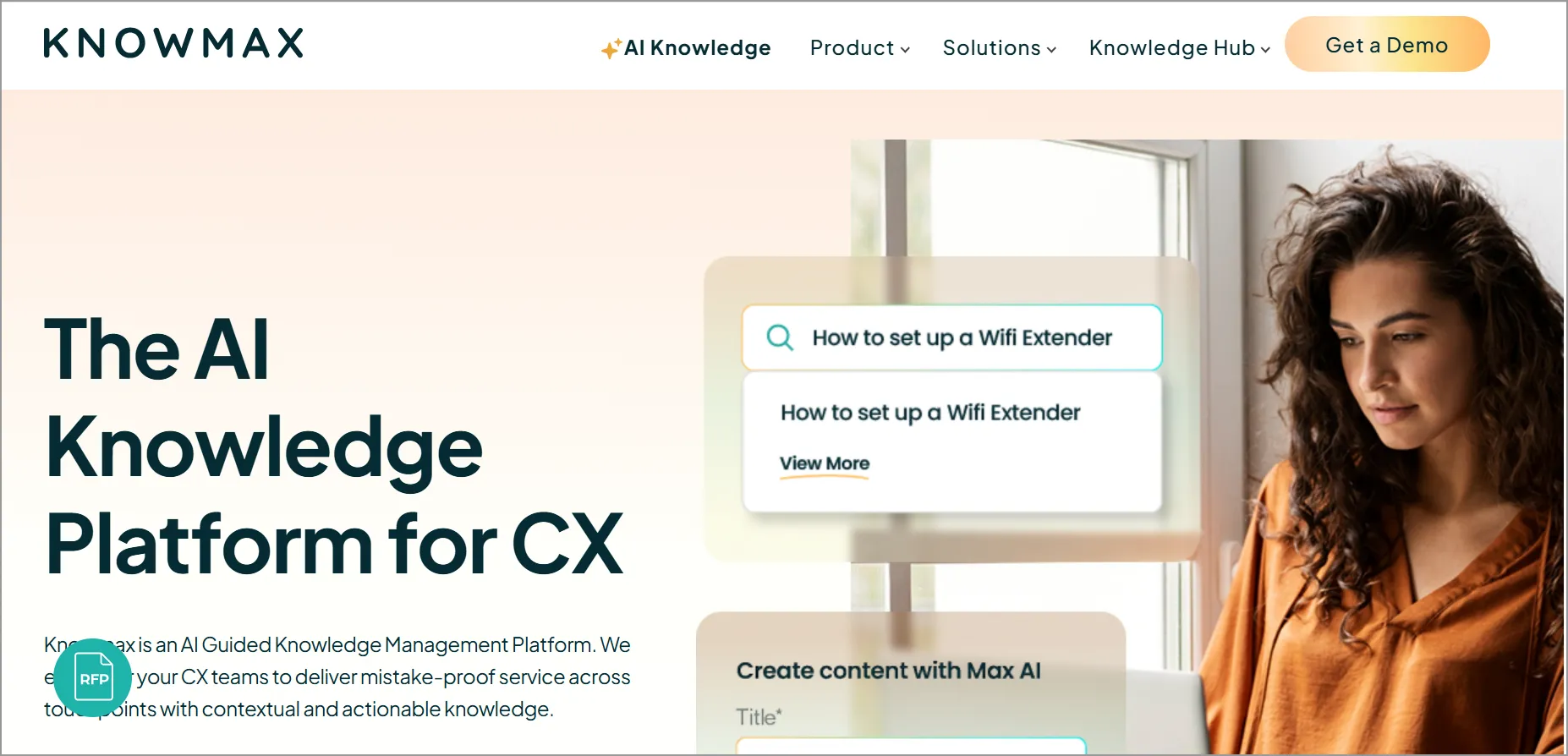
Knowmax is an AI-guided knowledge management platform that empowers CX teams to deliver mistake-proof customer service across channels with actionable knowledge.
It offers guided knowledge formats like interactive decision trees and picture guides, along with standard knowledge base articles and FAQs.
Knowmax Gen AI capabilities empower your agents with instant answers, knowledge authors with faster content creation, and admins with detailed insights to optimize knowledge content.
Features
- AI-powered search for instant answers
- Omnichannel knowledge management solution
- DIY knowledge management platform
- Interactive decision trees
- Visual guides
Pros
- Strong for contact centers, helping reduce errors and speed up resolution.
- Supports omnichannel customer experiences.
Cons
- Not ideal for general-purpose documentation; more suited to structured workflows than narrative guides.
Pricing
- Contact Knowmax for pricing
8. Zendesk
Best for: Customer service teams building a searchable external knowledge base integrated directly into a multichannel support suite.
Zendesk is a customer support suite that allows users to create a knowledge base that stores, organizes, and shares valuable information with clients and staff.

Features
- Robust AI search engine
- Integrations with third-party tools
- Analytics and reporting
- Collaboration capabilities
Pros
- Offers robust AI search and agent assistance.
- Strong integrations and ease of use for support teams.
Cons
- KB features may feel basic compared to specialized documentation tools offered by other Zendesk alternatives.
Pricing
- Starts at $19/user/month
9. Bloomfire
Best for: Organizations needing a search-centric knowledge hub with AI-generated tags, quick retrieval, and strong content organization.
Bloomfire is a cloud-based knowledge management solution that helps teams capture, organize, and share information. It uses AI-generated tags to categorize information and help users find information quickly.

Features
- Powerful search functionality
- Integration options
- Analytics and reporting
- Unlimited storage
- Advanced security and access controls
Pros
- Supports knowledge sharing across distributed teams.
- Includes analytics to track content usage and trends.
Cons
- Not ideal for step-by-step documentation, better suited to knowledge discovery rather than procedural guides.
Pricing
Contact Bloomfire for pricing
10. Tettra
Best for: Small and mid-sized teams using Slack/Teams who want a simple internal wiki system with AI-powered search.
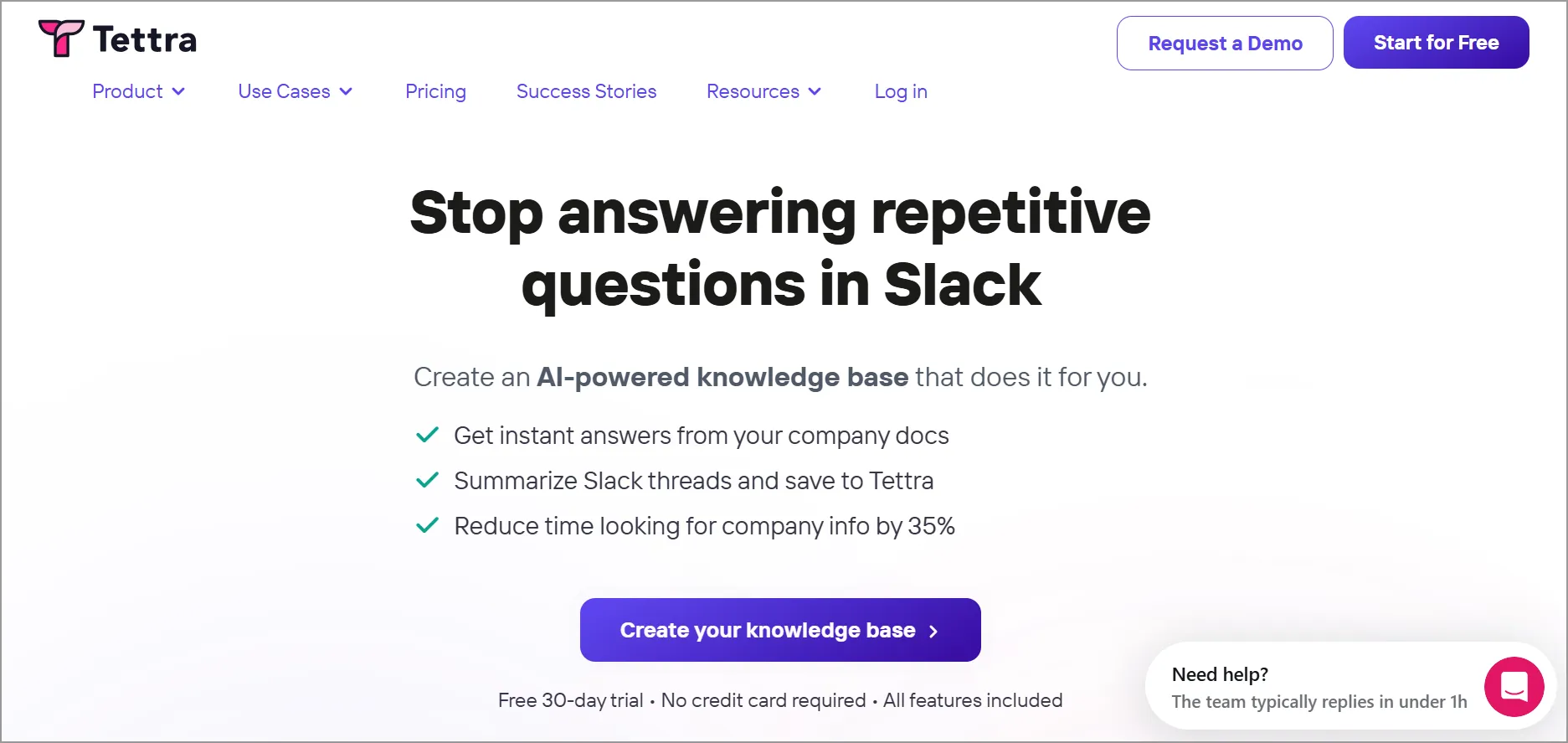
Tettra is an AI-powered knowledge base platform that centralizes company information. It offers a free version that primarily caters to small businesses.
Tettra focuses on delivering knowledge and posting questions and answers in Slack and Microsoft Teams.
Features
- AI knowledge management
- Integration
- Powerful search functionality
- Page and update request
Pros
- Lightweight internal wiki with Slack-first knowledge management.
- Includes Q&A workflows and content verification.
Cons
- Limited to internal documentation, lacking strong external KB features.
Pricing
- Contact Tettra for pricing
11. Bitrix24
Best for: Companies that want knowledge management built into broader project management, workflows, and collaboration.
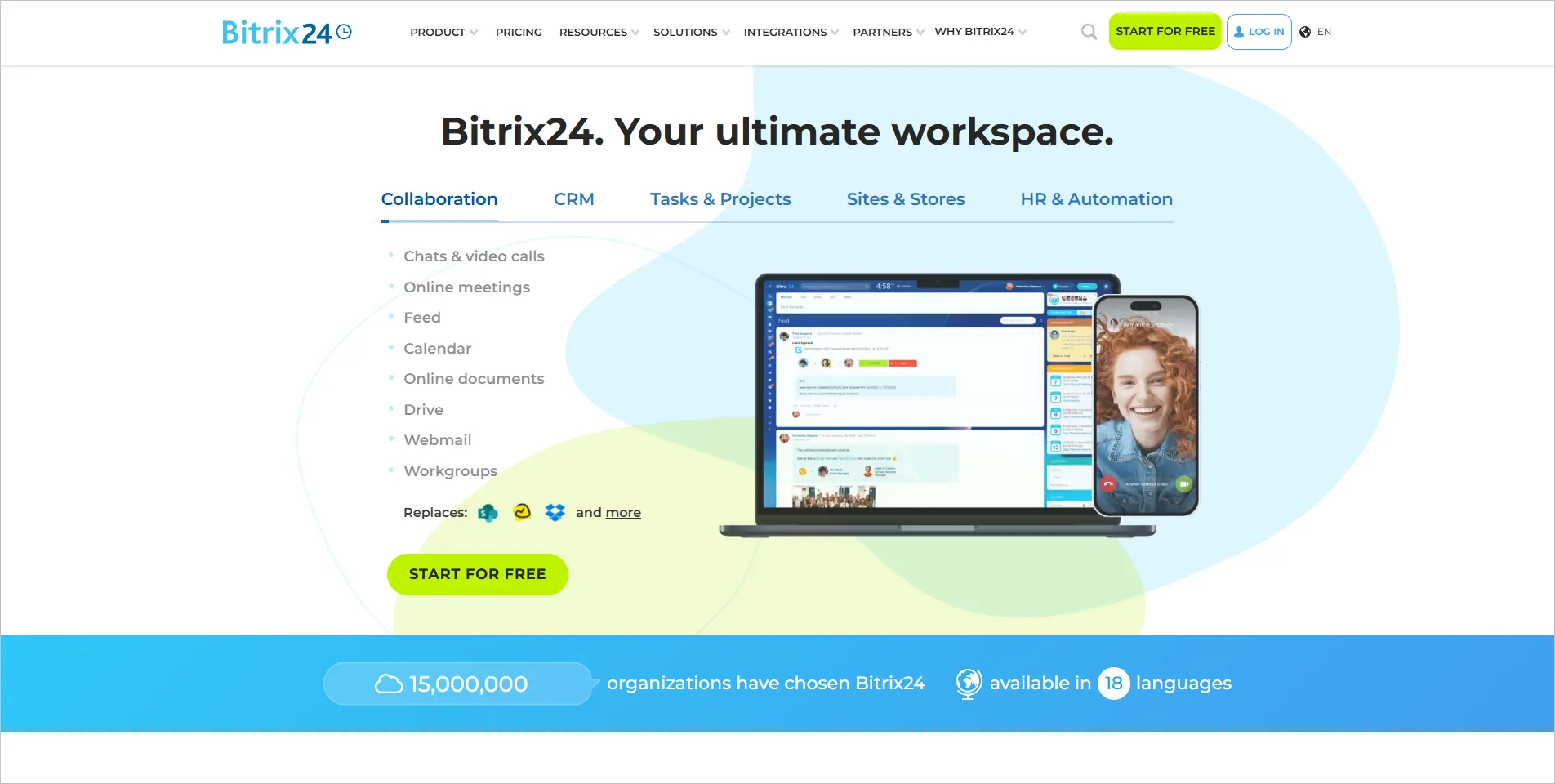
Bitrix24 is a cloud and on-premises knowledge management software that supports collaborative document editing, workflow, and process automation.
Features
- Robust search engine
- Integrations with third-party productivity tools
- Analytics and reporting
- Collaboration capabilities
Pros
- Offers collaborative document editing and customer support automation.
- Includes strong integration with other Bitrix24 tools.
Cons
- UI can be complex due to the large feature set.
Pricing
- Starts at $49/month (includes up to 5 users)
12. ProProfs
Best for: Teams needing a customer service software with simple internal and external documentation features.
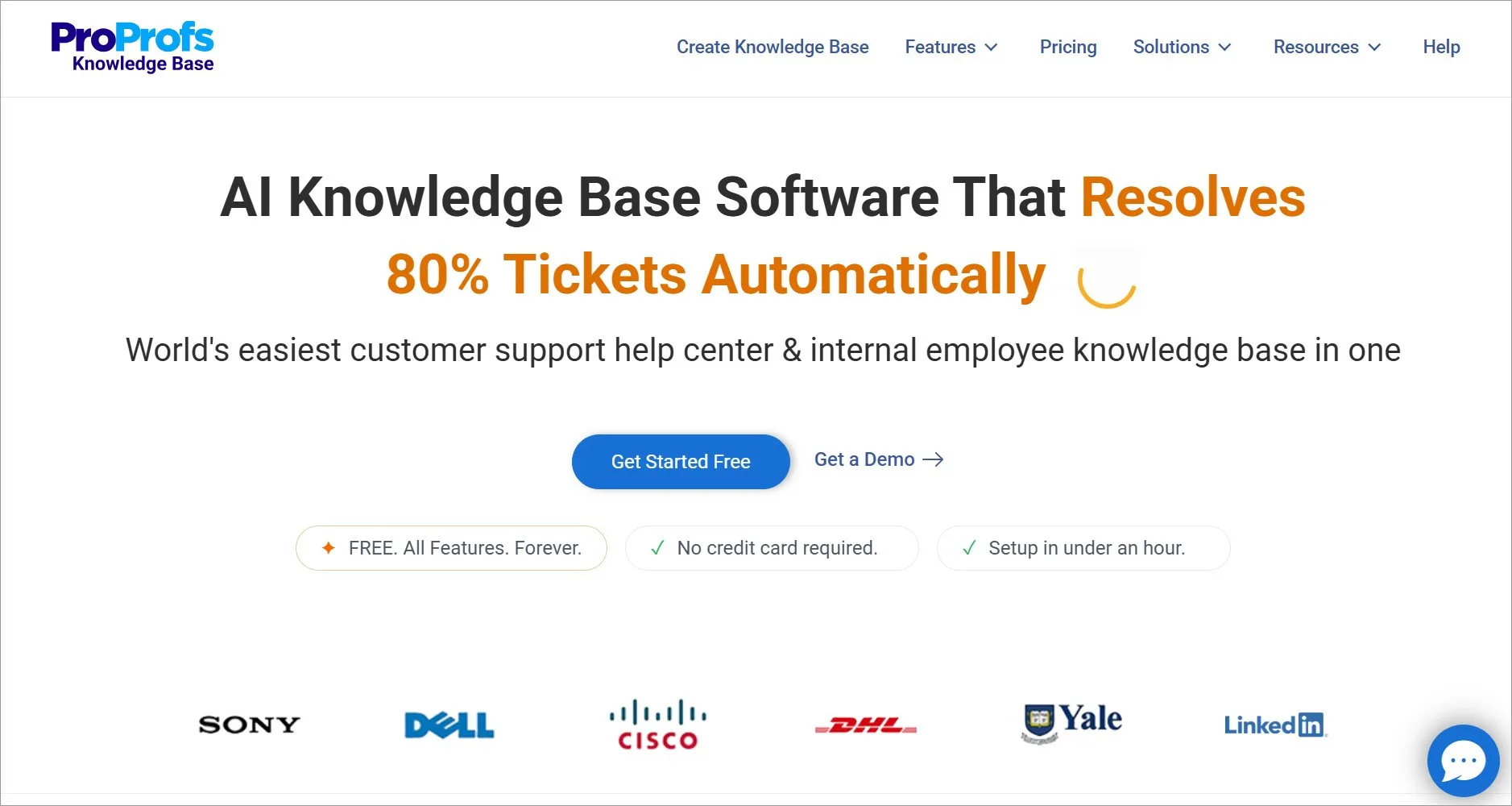
ProProfs is an all-in-one solution for creating a help center and a documentation platform that can assist teams starting from scratch with predesigned templates to create documents.
Features
- Easy content creation
- Collaboration capabilities
- Integration options
- Analytics and reporting
- Built-in templates
Pros
- Very user-friendly for creating help centers quickly.
- Includes templates and easy import tools.
Cons
- Not as feature‑rich as enterprise KB solutions and lacks advanced controls.
Pricing
- Starts at $49/user/month
13. Slite
Best for: Distributed teams needing collaborative documentation, onboarding guides, and real time content management.
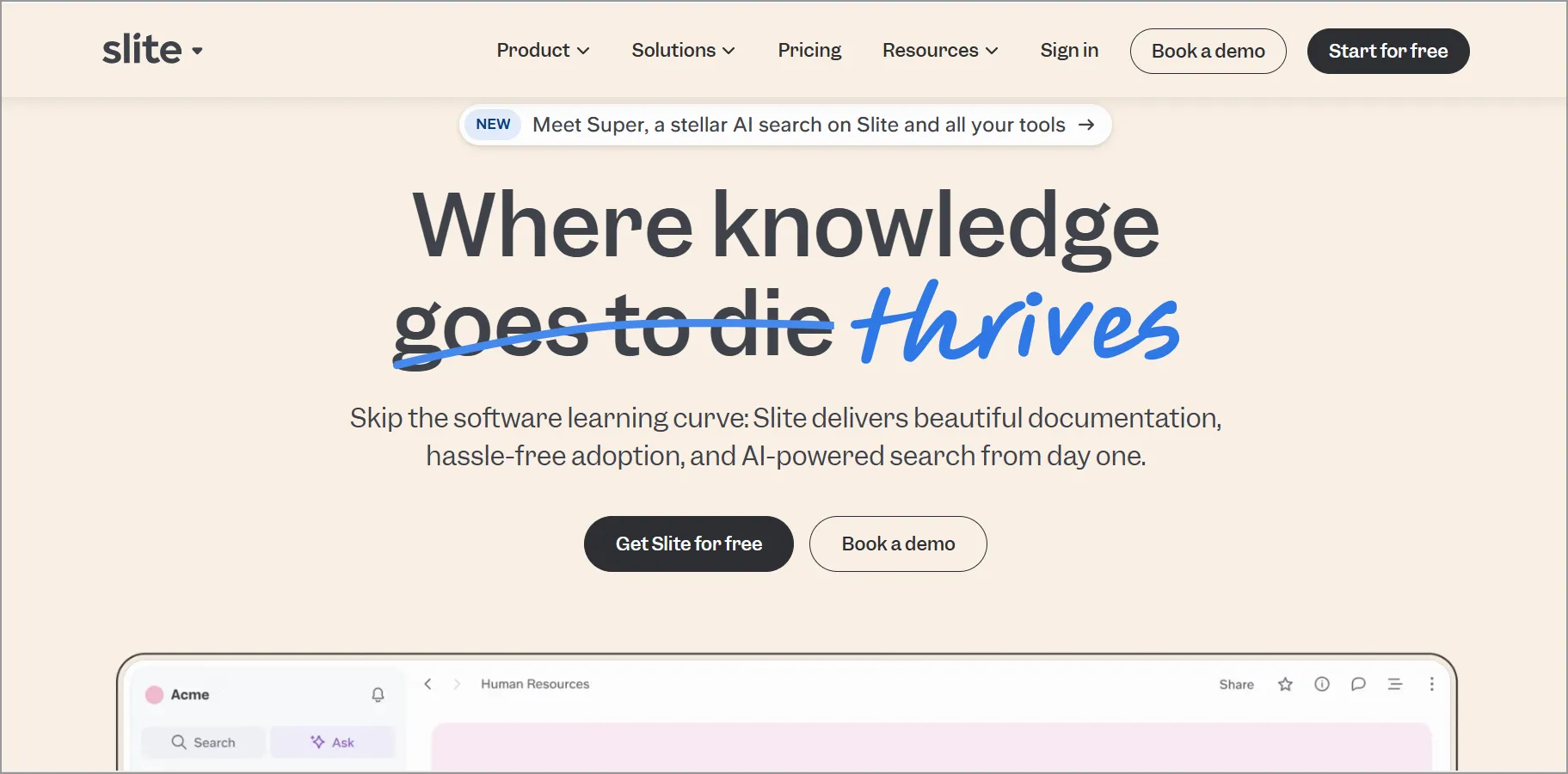
Slite is a knowledge management solution designed to help remote teams collaborate seamlessly. It allows companies to create onboarding guides and manage content libraries and projects.
Features
- Collaboration capabilities
- Robust search engine
- Integrations with third-party tools
- Analytics and reporting
- Security
Pros
- Strong collaborative editing with simple organization.
- Offers AI features and analytics supporting internal documentation.
Cons
- Not designed for external customer-facing knowledge bases.
Pricing
- Starts at $10/user/month
What features should you look for in knowledge management software?
The features of knowledge management solutions differ among platforms. Here are some essentials you should consider when selecting a suitable knowledge base solution for your business:
- Customization: The knowledge solution should have many customization options that enable users to tailor its design and user interface to suit their business requirements.
- Efficient search capabilities: Choose a knowledge management system with a powerful search function that will allow your team to quickly locate specific information.
- Article tracking: The system should include article-tracking functionalities to monitor edits, identify editors, discern modifications, and restore previous versions.
- Ease of access: The solution should be easily accessible to everyone with permission, even those with the lowest technical skills.
- Third-party integration: The knowledge management software should seamlessly integrate with your existing business systems, such as help desk ticketing systems and project management tools, to further streamline processes and avoid duplication of efforts.
- Templates: An ideal knowledge management tool should provide highly adaptable, ready-to-use templates.
- Security: There should be appropriate security measures in place to safeguard the sensitive internal knowledge base and customer information.
- Reports and analytics: Look for knowledge management software that incorporates reporting and analytics tools that track user interactions.
- Scalability: As the business grows, the solution’s capacity should adapt to suit the changing needs of the business.
- User feedback: An ideal knowledge management solution should have built-in features that allow users to provide feedback on the usefulness of the content.
- Ease of adding and editing content: The solution should offer an easy knowledge management process. It should incorporate a user-friendly interface, such as a WYSIWYG editor, facilitating a simple way to add and modify articles.
- Collaborative features: Choose knowledge management solutions with features like real-time editing, commenting, and version control that empower multiple users to work together.
What are the benefits of a knowledge management solution?
Consolidating all your information in a well-organized knowledge base may be a strategic process that requires commitment and ongoing effort. However, the gains it brings make it a worthwhile investment for your business.
Here are some benefits of implementing a knowledge management technology:
- Enhances efficiency: By centralizing information, knowledge base management solutions enhance accessibility-first documentation and reduce the time spent searching for information.
- Facilitates collaboration: Knowledge management tools enable staff members from various departments to share ideas and update information as required.
- Seamless knowledge transfer to new hires: Knowledge management software helps with training by providing new employees with official training materials and a single source to answer questions about company products.
- Promotes self-service: External knowledge management tools provide clients with round-the-clock, location-independent access to information, allowing them to find solutions autonomously.
- Knowledge preservation: Knowledge management tools help retain company information even when experienced subject matter experts leave.
Choose the best knowledge management software for you!
Selecting the appropriate knowledge management tool like BoldDesk for your business may seem like an overwhelming endeavor, particularly when you are presented with options that are almost identical.
It’s crucial to bear in mind that the best knowledge management software for omnichannel customer support isn’t a one-size-fits-all solution but rather one that is tailored to your specific needs.
These needs can vary due to the size of your team, the budget allocated for such tools, and the preferred methodology for managing knowledge and projects.
Therefore, having provided a comprehensive analysis of the top knowledge base solutions available on the market, we are confident that you are now equipped to begin your knowledge management journey.
We hope this guide helps you make an informed decision. Please provide your thoughts and suggestions in the comment section below.
Related articles
- 9 Steps to Create Your Knowledge Management Strategy
- How to Create and Manage Your Personal Knowledge Base
- 13 Best Knowledge Management Software Tools (2026)
Knowledge Management System FAQs
Start by assessing your business needs and identifying the type of information you need to capture and manage.
Define the core features required to support your workflows, then consider your budget, scalability for future growth, and integration with existing systems.
Finally, evaluate shortlisted tools through demos or free trials and gather feedback from your team before making a decision.
Key trends include:
- AI-powered search, enabling faster and more accurate information discovery
- Deeper integration with collaboration tools, improving teamwork, and reducing knowledge silos
- Enhanced security and compliance features, designed to protect sensitive information
- Mobile accessibility allows users to access knowledge from anywhere
- Personalized user experiences, where systems adapt to user roles and behavior to boost engagement
A knowledge base is a component of a knowledge management software focused on storing and retrieving information, often customer-facing. A KMS includes broader tools for managing all organizational knowledge.
AI helps with auto-tagging, summarizing content, suggesting articles, and enabling conversational search experiences for faster information retrieval.
Yes. Internal knowledge management software supports employee productivity and onboarding, while external KMSs provide customer self-service and reduce support ticket volume.
To measure ROI on a knowledge management system, track improvements in support efficiency, content usage, employee productivity, ticket deflection, cost savings, and customer or employee satisfaction.
Compare these outcomes against your baseline before implementation to determine the financial and operational impact.
Tools like BoldDesk’s AI ROI calculator can help estimate savings by analyzing key metrics such as reduced support workload and faster information retrieval.