



 In this page

TL;DR: Customer service in banking ensures secure transactions, fast issue resolution, and consistent support across channels. Banks that fix service gaps can boost customer trust, reduce churn, and improve long-term loyalty.
As digital adoption accelerates and fraud risks increase, customer service in banking has become a defining factor in how customers perceive their financial institutions.
Today’s customers expect secure interactions, quick resolutions, transparent communication, and consistent support across every channel.
To stay competitive, banks must deliver customer experiences that build trust and strengthen long-term relationships.
Identifying service gaps is the first step toward improving service quality.
This blog explores the most common challenges encountered in banking customer service and provides practical strategies and real‑world examples to help financial institutions enhance service quality across every channel.
What is customer service in banking?
Customer service in banking refers to the support banks provide to help clients manage accounts, resolve issues, and use banking services smoothly and securely.
It includes assistance with tasks such as opening and managing accounts, guiding customers through loan or card processes, and handling concerns like disputed transactions or lost cards.
As digital banking continues to grow, customer service also covers support delivered through online and mobile channels, including:
- Assisting clients with mobile and online banking features.
- Troubleshooting technical issues.
- Ensuring secure and reliable digital transactions.
In simple terms, customer service in banking is how banks support customers before, during, and after financial transactions to ensure trust, convenience, and satisfaction.
Can Your Bank Resolve Customer Issues Before Trust Is Lost?
Use BoldDesk to centralize requests, speed up responses, and keep every banking customer interaction organized and secure.
Why customer service matters in the banking industry
Customer service is crucial in banking because financial products are often similar, and what truly differentiates a bank is the quality of support it delivers.
Here’s the importance of customer service in banking industry:

- Builds trust and loyalty: Banking relies heavily on trust. When customers receive reliable, helpful support, they feel confident in their bank and are more likely to stay long term.
- Improves customer satisfaction: Quick, empathetic, and efficient assistance helps customers feel valued and understood, which directly boosts customer satisfaction.
- Creates a competitive advantage: Most financial institutions offer similar products, so great banking customer service becomes the differentiator. Personalized, proactive, and responsive service helps a bank stand out.
- Encourages cross‑selling and retention: Satisfied customers are more open to exploring additional products, such as loans, credit cards, or investment options, leading to higher retention and revenue growth.
- Strengthens crisis management: Effective support helps banks respond quickly to issues like fraud, technical problems, or disputes. This reduces risk, protects the bank’s reputation, and reassures customers when it matters most.
Despite its importance, delivering exceptional customer service in banking is not without challenges.
What are the common challenges in banking customer service?
The banking sector faces several obstacles that make it difficult to deliver consistent, outstanding customer service in banking. These include:
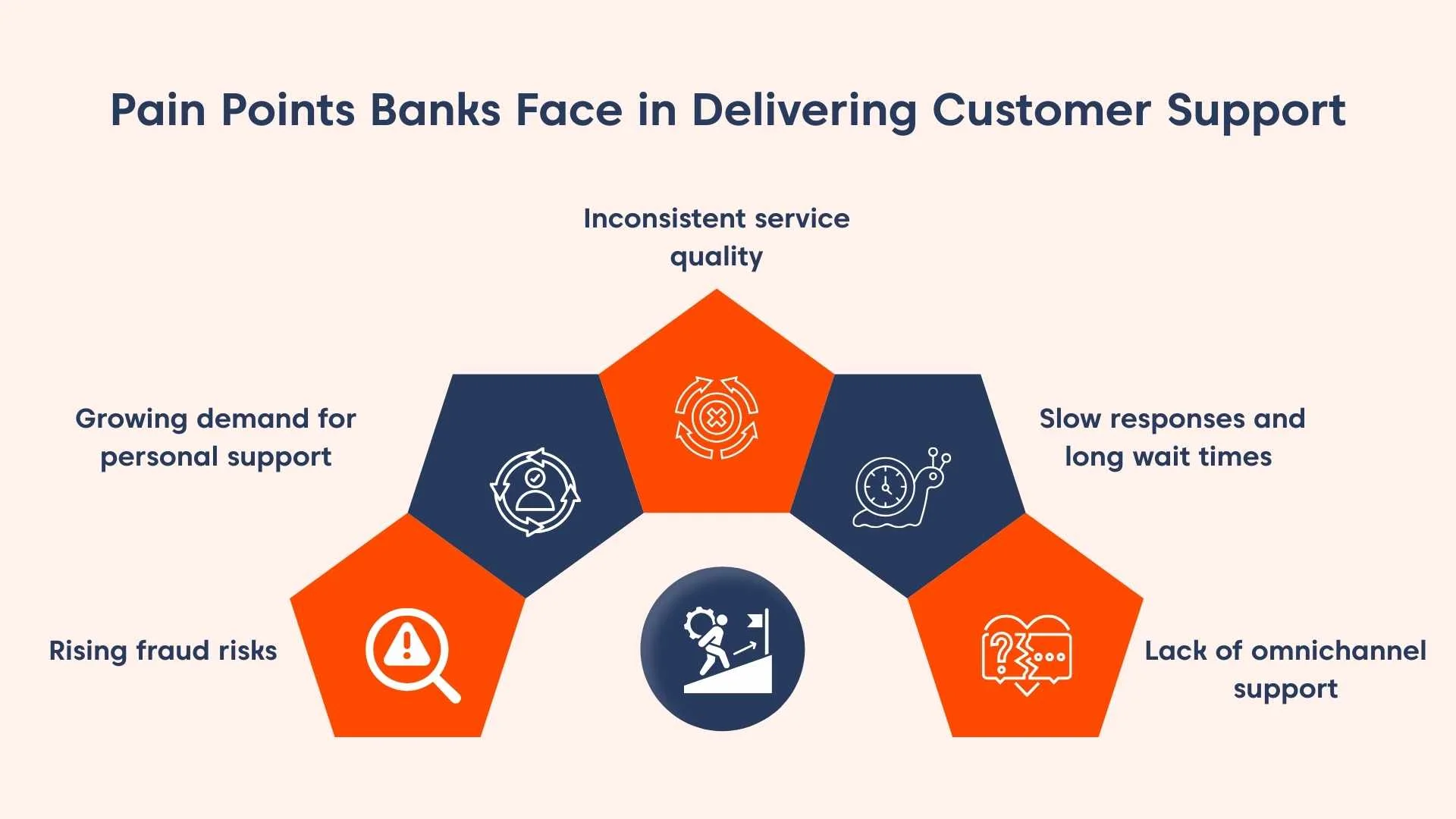
Rising fraud and security risks
Fraud risks continue to increase as customers rely more on mobile banking, digital payments, and online channels.
Banking teams must balance convenience with rigorous security, making it harder to deliver smooth service while protecting customers from phishing scams, identity theft, and cyberattacks.
Growing demand for personal support
According to Salesforce, 73% of customers expect brands to recognize and understand their unique needs and preferences.
Customers want service tailored to their financial situation, not generic scripts or repetitive questions.
Inconsistent service quality
Service quality often varies between branches, departments, or support agents.
These inconsistencies usually stem from uneven training, outdated internal processes, or different interpretations of service policies.
Slow responses and long wait times
A Ringover study shows that 63.7% of individuals will wait 20–30 minutes before feeling frustrated, while 17.9% feel annoyed after just 10 minutes.
Slow service, long queues, and lengthy phone wait times remain major pain points in banking customer service.
These delays, especially for tasks like opening accounts, loan applications, or resolving basic inquiries, often stem from manual workflows, inefficient processes, or inadequate staffing during busy periods.
Lack of omnichannel support
Customers expect a unified experience across mobile apps, websites, ATMs, chat, and in‑branch visits.
Many banks struggle because their systems are not integrated, resulting in fragmented customer journeys.
Best practices to improve customer service in the banking industry
Enhancing customer service in the banking sector requires a strategic approach that combines technology, empathy, and efficiency.
Here’s how to improve customer service in banking industry:
Use AI for automation
Artificial intelligence enables banks to handle high volumes of service requests more efficiently by automating routine work, reducing operational costs, and supporting customers with quick, accurate responses.
This enables banking support teams to focus on complex issues that require human judgment and personalized attention.
Additionally, you can use AI to:
- Automate repetitive processes such as data entry, compliance checks, and ticket categorization.
- Enhance banking agent performance with AI tools that can suggest, rephrase, and summarize responses.
- Use AI to analyze customer behavior and recommend relevant products or actions.
- Deploy AI‑powered fraud alerts to detect suspicious activity early.
- Route tickets intelligently based on intent, urgency, or customer profile.
Strengthen data security
With cyber threats rising and digital banking adoption increasing, customers expect their personal and financial information to be protected at every step of their banking journey.
A single breach can damage customer trust, disrupt operations, and create long‑term reputational harm.
To safeguard customer data, financial institutions must prioritize implementing robust security measures. This includes:
- Use end‑to‑end encryption to protect sensitive data during transmission and storage.
- Enable multi‑factor authentication (MFA) to prevent unauthorized access.
- Conduct regular cybersecurity audits to identify and close security gaps.
- Comply with regulations like GDPR to maintain transparency and meet legal obligations.
Deliver omnichannel support across touchpoints
Delivering seamless omnichannel support helps banks eliminate the fragmentation customers experience when switching between digital and in‑branch channels.
When systems and processes are connected, customers enjoy a smoother journey, and support teams can work more efficiently.
To implement omnichannel customer service in banking, you can:
- Allow customers to begin a task digitally and continue in‑branch without re‑entering information.
- Ensure smooth transitions from AI Agents to live support agents by transferring the full interaction history.
- Standardize workflows and service processes across all teams so customers receive the same quality of support.
- Unify customer data across mobile apps, websites, ATMs, and branches, giving agents complete context.
- Eliminate channel silos so customers can move naturally between touchpoints without interruptions.

Personalize customer interactions
Modern banking customers want to feel understood. Personalization is no longer a bonus; it’s a key expectation.
For financial institutions to tailor recommendations and customer interactions effectively, they need to:
- Analyze customer activity and transaction histories to understand needs and preferences.
- Use AI and ML to recommend relevant financial products, such as credit cards, loans, or savings plans.
- Customize communication tone and content instead of relying on generic scripts.
- Leverage CRM and help desk tools to ensure agents have full customer context for every interaction.
Provide self-service options to customers
Customer self‑service tools empower customers to solve simple issues quickly, without waiting in queues or contacting support.
These tools are especially valuable for modern, digital‑first customers who prefer immediate solutions.
Banks can strengthen self‑service capabilities by:
- Offering comprehensive FAQs, knowledge bases, and interactive tutorials.
- Including self‑service features in banking apps and portals, such as account management, loan calculators, and financial tips.
- Continuously updating self‑service content based on trending customer inquiries.
Simplify banking processes to reduce friction
Complex banking processes can frustrate customers and reduce confidence in the bank.
Simpler, more user-friendly workflows improve satisfaction, shorten wait times, and make service interactions easier to complete.
To achieve this, banks need to:
- Reduce paperwork for applications and account updates.
- Introduce single‑click transactions and auto‑fill forms for frequently performed tasks.
- Automate routine workflows like account updates, reminders, and verification steps.
- Pair process simplification with self‑service tools to accelerate customer resolutions.
Communicate proactively to improve customer confidence
Customers appreciate being informed, especially during unexpected issues, policy updates, or service interruptions.
Proactive communication signals reliability and prevents unnecessary frustration.
How to communicate proactively:
- Announce service disruptions or maintenance early to manage expectations.
- Provide timely updates on policy changes, new products, and branch information.
- Send personalized alerts when relevant, such as security notifications or transaction warnings.
- Use clear, concise language to avoid confusion or misinterpretation.
Empower your employees to resolve issues effectively
Even with advanced tools and automation, frontline employees remain essential.
Empowered staff handle issues quickly, improve satisfaction, and reinforce trust through human engagement.
You can do the following to empower your employees:
- Provide ongoing training programs to strengthen product and technical knowledge.
- Equip teams with a modern finance help desk system, internal knowledge bases, and AI‑assisted tools.
- Allow employees enough decision‑making authority to resolve minor issues without delay.
- Encourage a customer‑first mindset backed by the right tools and support.
Prioritize customer feedback to drive continuous improvement
Customer feedback is one of the most valuable insights banks can use to refine services, identify customer pain points early, and enhance customer experience.
This entails:
- Collecting feedback through surveys, social media, in‑app forms, and direct conversations.
- Analyzing recurring issues using analytics dashboards to spot trends.
- Implementing noticeable changes and communicating improvements back to customers.
- Using feedback insights to refine products, processes, and digital channels continuously.
Real-world examples of excellent customer service in banking
Banks around the world are using AI, digital tools, and personalized support models to raise the standard for banking customer service.

The chart shows a rapid year‑over‑year increase in the generative AI banking market, signaling accelerating adoption of AI-driven customer service solutions such as chatbots and automated support.
Below are real‑world examples that show how leading institutions turn strategy into practical, customer‑focused improvements.
JPMorgan Chase: AI-powered customer engagement
JPMorgan Chase uses AI to analyze client data and deliver personalized customer service in banking for financial products like credit cards and loans.
Its mobile app also provides real‑time budgeting insights, helping users understand spending patterns and make informed financial decisions.

DBS Bank: Digital financial planning and personalized support
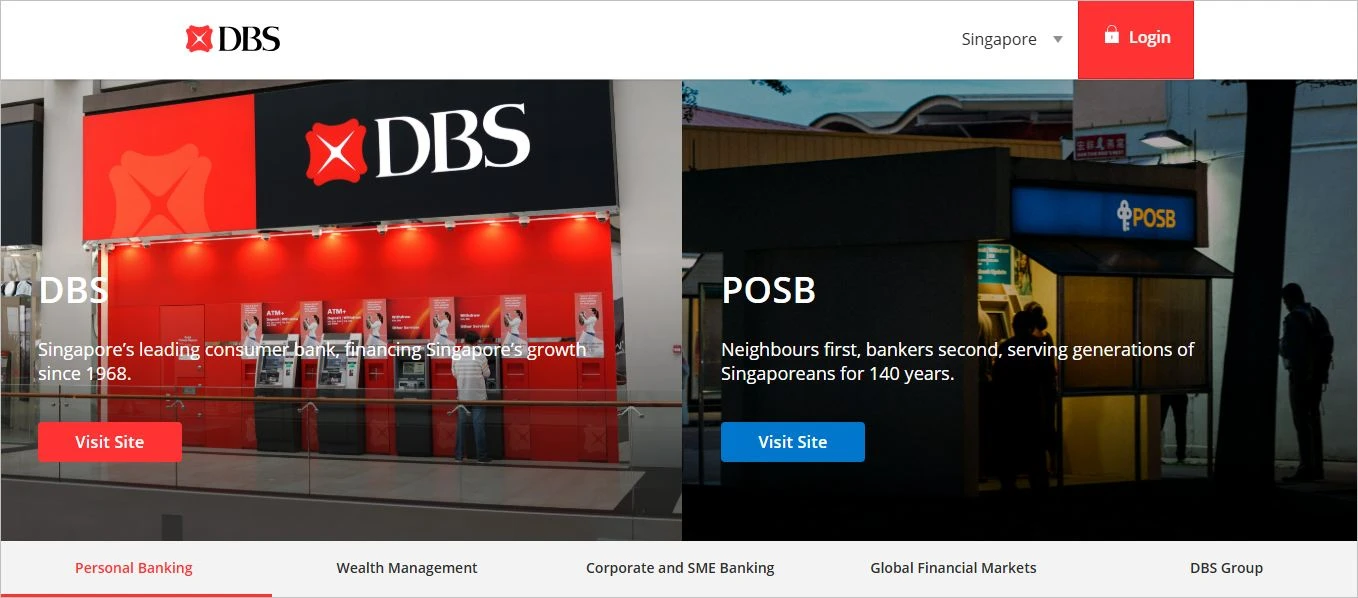
DBS Bank in Singapore uses AI‑powered tools like the NAV Planner to help customers evaluate their financial well-being.
The platform highlights trends in savings, debt, and investments, then recommends practical steps to achieve goals.
Bank of America: Erica, the AI virtual assistant
Bank of America’s virtual assistant, Erica, provides 24/7 customer support with tasks like checking balances, tracking expenses, and flagging unusual activity.
Its intuitive interface and always‑available support have become a benchmark for digital banking customer service.

How BoldDesk improves customer service in the banking sector
BoldDesk helps financial institutions deliver faster, more reliable customer service in banking by bringing essential support functions into one secure, easy‑to‑use platform.
Here’s how BoldDesk delivers value to the banking sector:
Efficient ticket management
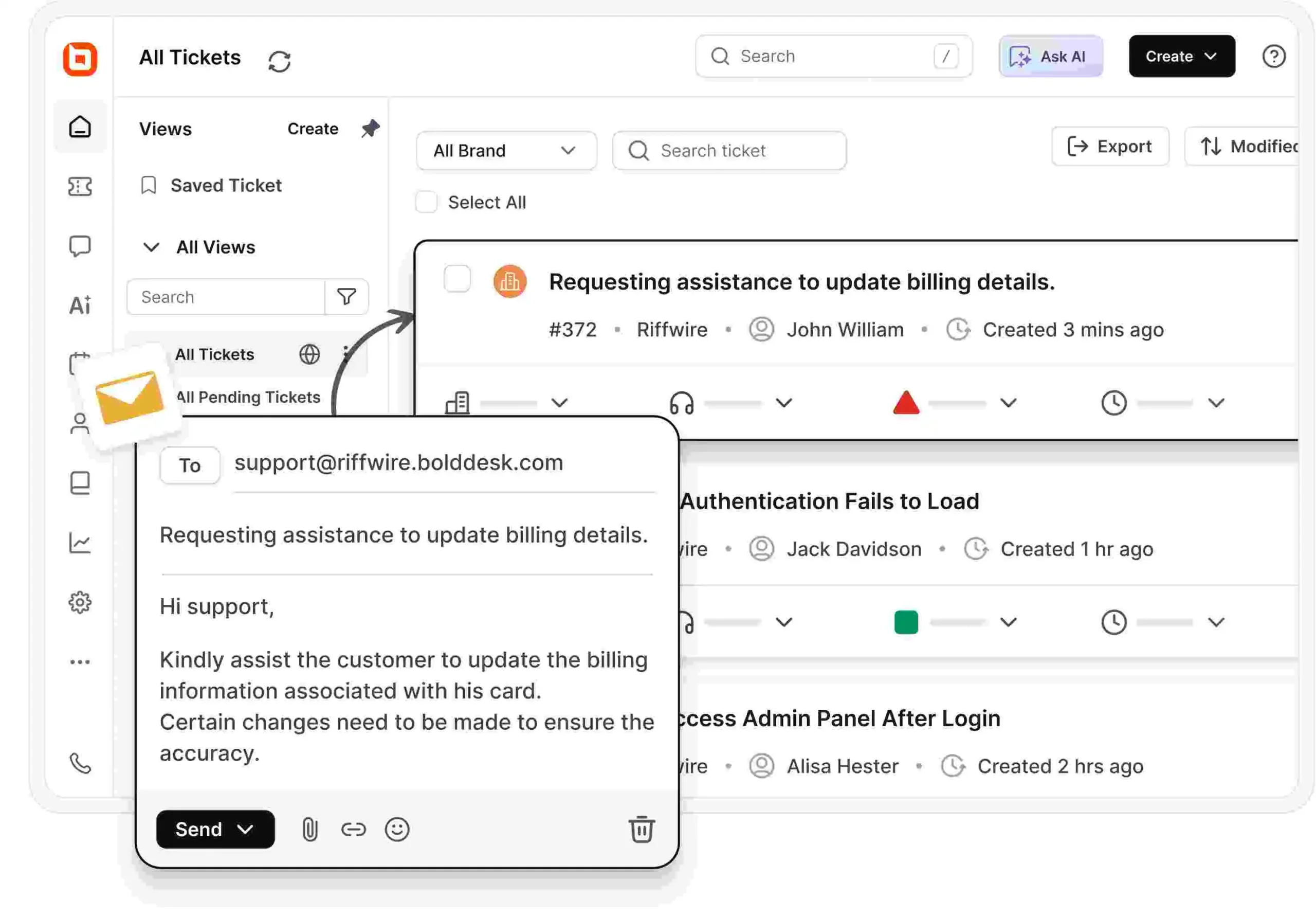
A finance help desk ticketing system ensures every customer request is captured and handled without delay.
By centralizing all inquiries in one platform, banks can categorize, prioritize, and route tickets for faster and more accurate resolutions.
This streamlines financial customer support processes and equips agents to work more efficiently, leading to quicker responses, fewer errors, and a better overall customer experience.
Omnichannel support
Banks can manage client engagement across multiple channels, including email, mobile, live chat, and social media. This creates a seamless and consistent experience for consumers, no matter how they choose to communicate.
SLA management for timely resolutions
SLA management ensures customer queries are handled within defined timelines, which is critical in banking.

By prioritizing requests, escalating delays, and tracking performance in real time, banks can maintain efficiency.
This improves accountability, speeds up resolutions, and ensures reliable customer service.
Automation for speed and accuracy
Automation capabilities make it easier to work on repetitive processes like assigning tickets, sending notifications, and raising important concerns.
Efficient automation procedures reduce human error and ensure timely responses, which is critical for maintaining trust in financial services.
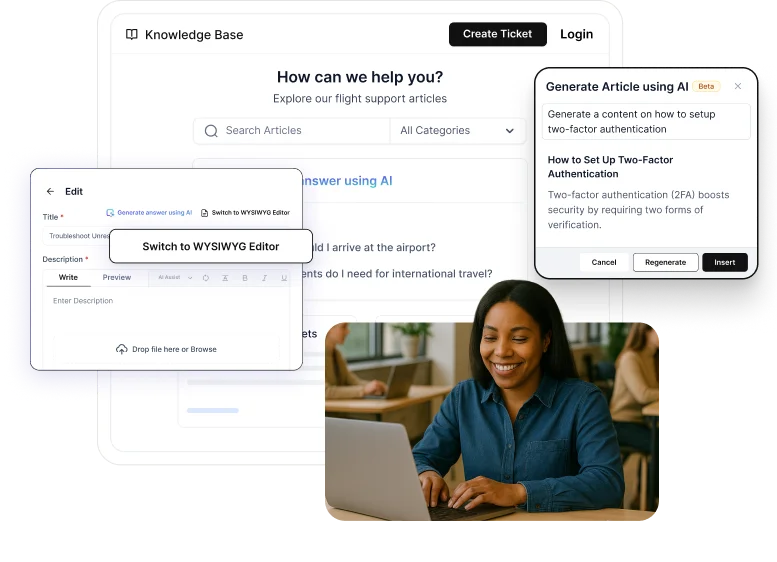
Knowledge base for self-service
Customer self-service portal and knowledge base empower banking clients to find answers to common questions, access policy details, and troubleshoot basic issues without needing direct assistance.
This reduces the workload for banking customer service teams and improves customer satisfaction.
Personalization through contact management
The contact management system allows banks to track and manage contacts and contact groups in one safe area, along with their associated information, such as customer profiles, transaction histories, and preferences.
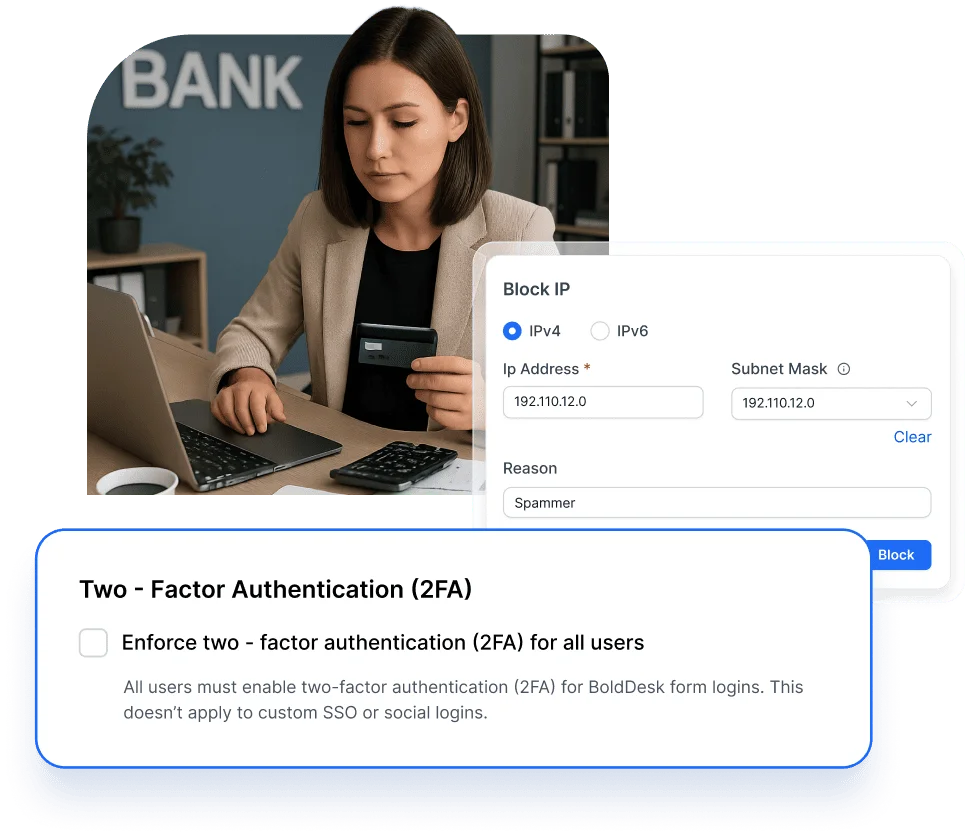
Robust security features
Given the sensitive nature of banking data, banks can incorporate advanced security measures, ensuring that all customer interactions and data remain private and secure.
These capabilities also support regulatory compliance standards and help customers feel confident about data security.
Analytics for continuous improvement
The analytics and reporting feature provides actionable insights, enabling banks to track service performance, identify trends, and make data‑driven decisions to strengthen customer support.
These insights can also highlight internal workflow gaps, such as processes handled through a help desk for accounting, allowing banks to optimize both customer‑facing and back‑office operations.

Scalability to handle growing demands
Banks can scale effortlessly to manage increased customer interactions as their operations expand.
With the ability to handle more agents while maintaining the same efficiency, they can deliver consistent banking customer service quality, even during peak periods
Elevate outstanding customer service in banking
Gone are the days when customer service in banking focused solely on resolving issues. Today, great service is about creating meaningful experiences that strengthen trust, loyalty, and long‑term relationships.
The future of banking belongs to institutions that prioritize customer needs, embrace innovation, and deliver excellence at every touchpoint.
Do you seek to meet the high expectations of today’s banking customers?
BoldDesk can help you streamline workflows, improve responsiveness, and deliver more consistent, personalized banking experiences.
Start a free trial to explore how we can support your banking customer service goals.
Schedule a live demo tailored to your banking operations. Don’t hesitate to get in touch with our support team for more information.
Feel free to leave your feedback in the comment section below.
Related articles
- Omnichannel Customer Engagement: Unifying Your Support Channels
- Customer Self-Service Portal: A Complete Guide for 2026
- What is an AI Knowledge Base? Features, Benefits, and Use Cases
Frequently Asked Questions
KYC, or “Know Your Customer,” is a mandatory process banks use to verify customer identities and prevent fraud, money laundering, and other financial crimes.
It ensures secure banking communication and helps financial support teams deliver a personalized, compliant banking experience.
Phishing attacks are fraudulent messages or websites designed to trick customers into revealing sensitive details like passwords or account numbers.
To stay safe, customers should verify messages, avoid suspicious links, rely on official bank channels, and use secure login methods like two-factor authentication.
Digital banking customer service enhances support by providing faster, more convenient help through tools like chatbots, mobile apps, and online service portals.
It also enables banks to deliver consistent, proactive, and 24/7 assistance, meeting modern customer expectations for speed and reliability.
Banks offer several types of customer service to support clients across different needs and channels. These include:
- In-branch service: Face-to-face help for transactions, account setup, or detailed inquiries.
- Phone support: Assistance with issues like card problems, disputes, or account questions.
- Digital support: Help through mobile apps, online banking, chat, or messaging.
- Self-service options: FAQs, knowledge bases, chatbots, and tutorials for quick answers.
- Advisory support: Guidance on loans, savings plans, and long-term financial decisions.
Key skills for banking customer service include clear communication, active listening, problem-solving, accuracy, and strong product knowledge.
These skills help service teams resolve issues quickly, maintain security and compliance, and provide consistent support across digital and in-branch channels.
If you lose your debit or credit card, immediately report it through your bank’s mobile app or customer support channel.
Banks typically block the card right away and issue a replacement to prevent unauthorized transactions.