

 In this page

TL;DR: After sales service is the support customers receive after a purchase, covering onboarding, troubleshooting, maintenance, repairs, warranties, returns, updates, and follow ups, to help customers use products effectively. It improves satisfaction, retention, and long term loyalty, making it a key driver of value for both businesses and customers.
Closing a sale does not mark the end of a transaction but the beginning of a long-term customer relationship.
After-sales service plays a critical role in this journey, because the support customers receive after the purchase often determines whether they stay loyal or switch to competitors.
PwC survey found 52% of consumers say they stopped using or buying from a brand because they had a bad experience with its products or services, while 29% stopped due to poor customer experience, either online or in-person.
Businesses must prioritize providing seamless after-sales service experiences to customers to show them their value continues well beyond the point of sale.
In this blog, we’ll explore what after-sales service entails, real-world examples, and actionable strategies to ensure customers feel valued long after their initial purchase.
What is after-sales service?
After‑sales service is the support a business provides to customers after they purchase a product.
It typically includes customer onboarding, troubleshooting, repairs or maintenance, warranties or returns, upgrades, and follow‑ups.
These services help ensure product performance, improve customer satisfaction, and build long‑term loyalty.
Why is post-sales support important for businesses and customers?
Successful businesses recognize that the customer journey doesn’t end at the point of sale; it continues well after the transaction is complete.
According to Dynamics 365 Community, 90% of customers consider customer service when deciding whether to do business with a company or not.
Below are some of the reasons why post-sales service is important for businesses and customers.
Benefits for businesses
- Higher loyalty and customer retention rates: When customers receive reliable after-sales support, helpful customer follow-ups, and continued value after purchase, they’re more likely to stay loyal and choose your brand again rather than switching to a competitor.
- Positive word-of-mouth: Good after-sales service transforms one-time customers into brand advocates, with word of mouth leading to 5 times more sales compared to paid advertisement (ElectroIQ).
- Reduces customer acquisition costs: When customers remain loyal due to excellent post-sales service, businesses can allocate more resources to product development and operational improvements rather than spending more on constant customer acquisition costs.
- Upsell and cross-sell opportunities: After-sales support opens the door for businesses to offer higher-value alternatives (upselling) or related products (cross-selling) that enhance the customer’s experience and align with their evolving needs.
Benefits for customers
- Customer empowerment: Onboarding and self-service resources like a knowledge base empower customers to resolve most problems independently, enhancing their experience.
- Cost savings: Customers avoid the higher costs associated with product failure and emergency services. Proactive customer service measures like scheduled maintenance and early problem detection after closing a sale prevent expensive costs associated with emergency repairs or premature replacement.
- Faster issue resolution: When customer problems are addressed quickly through timely troubleshooting, clear guidance, and responsive communication, they experience less frustration and regain product confidence sooner.
What are the types of after-sales services?
Customer support after purchase is customized to meet industry-specific customer needs.
In the SaaS sector, companies like BoldDesk offer installation guidance, technical support, and customer service training, while retail leaders like Amazon focus on streamlined returns, exchanges, and customer support.
These services vary by industry but generally aim to enhance customer satisfaction and product functionality.

Provide customer support
Customer support involves giving customers immediate help with setup, onboarding, troubleshooting, and general product questions across channels such as email, phone, live chat, community forums, and social media.
Real-life example: SecureNest’s after-sales support
A customer bought a smart home security camera from SecureNest but struggled to connect the device during setup.
An agent guides them through the installation in live chat and later sends a follow-up email with additional tips, turning a frustrating moment into a positive, confidence-building experience.
Maintenance and repairs
This after-sales support involves ongoing servicing or conducting functional product checks to ensure continued performance.
The post-sale support can be in the form of bug fixes, performance improvements, server maintenance, and regular security updates that keep the software stable and secure.
For physical products, this may include scheduled servicing, diagnostics, or component repairs to ensure the product continues functioning properly.
Warranties, guarantees, and returns
These types of after-sales support act as promises that protect customers by ensuring product reliability and performance for a certain period after purchase.
- Warranty: A commitment to repair, replace, or refund a product if it has defects within a set period (excluding user damage).
- Guarantee: A broader promise, like a money-back offer, ensuring customer satisfaction even without defects. For example, a 30-day money-back guarantee means that customers get their money back if they are unsatisfied with the product within 30 days after subscription.
- Returns: Provide additional security when a product doesn’t meet expectations.
Their after-sales support services aim to build customer trust, especially for high-value purchases.
Real-life example: Samsung’s warranty and guarantee
When customers buy a Samsung QLED TV, the warranty covers hardware defects that may appear during normal use.
If the television develops a display issue within the warranty period, Samsung provides repair or replacement services, ensuring customers can continue using the product without additional costs.
Training and educational resources
Effective after‑sales service often includes training that helps customers understand how to use the product correctly and confidently.
This involves guided customer onboarding sessions, tutorials, manuals, webinars, walkthroughs, or knowledge‑base articles.
Upgrades and updates
These after-sales services are improvements or new features added to a product to keep it current and valuable over time.
These can include interface improvements, new features, compatibility adjustments, or performance enhancements, many of which may be delivered automatically so customers benefit without needing to take action.
Customer loyalty programs
Customer loyalty programs are incentive-based programs that reward repeat customers and encourage long-term relationships.
These loyalty perks include using points, tiered benefits, exclusive access, anniversary rewards, or referral incentives.
In truth, a well-structured loyalty program is an extension of after-sales service that can be used to reward engagement, promote repeat business, and enhance brand perception.
Real-life example: Sephora’s loyalty program
Sephora’s Beauty Insider program is a retailer’s tiered loyalty program where customers earn points with each purchase, unlocking samples, early access to new products, and special services.
These rewards encourage repeat purchases and help maintain ongoing relationships with customers even after their initial purchase.
Customer appreciation and follow‑ups
Beyond structured programs, thoughtful gestures help reinforce that the relationship continues after the sale. These include:
- Customer thank-you notes.
- Follow‑up messages within 24–72 hours.
- Early‑use tips.
- Feedback requests.
Delight Customers After Every Purchase for Free!
Automate ticket routing, follow-ups, and updates to deliver fast after-sales support with less manual effort.
Best practices for effective after-sales support
Your customer’s journey doesn’t end at checkout; it evolves. Strong after-sales service isn’t just a nicety; it’s a competitive edge that deepens trust, builds advocacy, and extends customer lifetime value.
Here’s how to get it right.
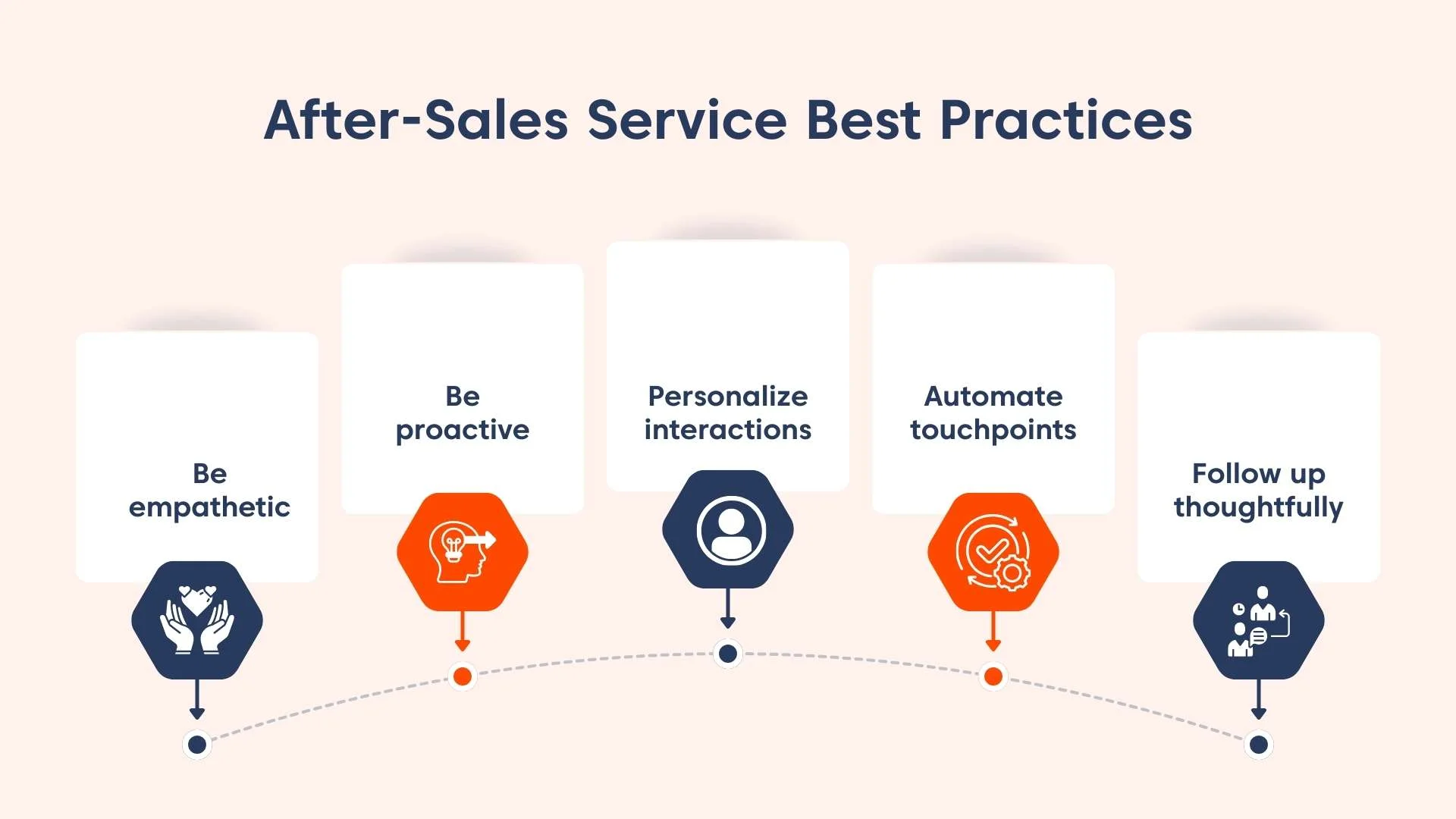
Be empathetic
Empathy is foundational to exceptional after‑sales support.
When customers face issues, big or small, they want to feel heard, understood, and respected.
Expressing patience, acknowledging their frustrations, and responding with clarity helps reduce tension and build emotional trust.
Even when you cannot provide an immediate solution, empathy reassures customers that you are committed to resolving the issue and supporting them through the process.
Deliver proactive after-sales support
Exceptional service is defined by how quickly and responsibly you handle post-purchase issues.
It’s about showing accountability, taking proactive measures before issues occur, and restoring trust when things go wrong. This can be through practices such as:
- Monitoring usage patterns to identify known product issues and resolve them early to avoid escalations.
- Reach out proactively to notify customers of scheduled maintenance or updates, apologize, and share updates on shipping delays, etc.
Customers remember how they were treated after something went wrong. Be sure to make that memory a positive one!
Personalize after-sales interactions
Personalizing after-sales services shows customers you understand their unique needs, creating a more meaningful and relevant support experience.
- Tailor after-sales support by addressing customers by name, referencing their purchase history, and sending check-in messages after delivery.
- Offer customized troubleshooting guides based on their product and recommend relevant upgrades or add-ons by analyzing usage patterns.
This level of personalization makes after-sales service support more meaningful and highly effective.
Automate key customer support workflows
Businesses can automate repetitive support tasks to reduce response times and maintain consistent communication with customers.
Automation rules can trigger alerts, reminders, and notifications automatically.
Some of the common repetitive tasks to automate post-purchase include:
- Automating ticket creation, prioritization, and routing when customers send messages through their preferred channels.
- Sending critical updates to customers, such as shipping notifications, delivery confirmations, and reminders for warranty renewals, service dates, or subscription cycles.
- Sharing automated prompts to request feedback and reviews.
Follow up thoughtfully
After closing any sale, the journey has just begun. A well-crafted follow-up message or phone call shows customers you sincerely care beyond the sale and presents an opportunity to transform a transaction into a relationship.
- Send a brief follow-up message within 24–72 hours after a purchase to check on how the client onboarding process is faring, address any concerns early, and guide usage.
- Additionally, systematically collect and act on the received customer feedback to create a continuous improvement loop that strengthens your after-sales service.
Here’s a sample message:
| Subject: Check-in on your installation experience
Hi [Name], We hope your installation went smoothly! We wanted to reach out and see how the system is working for you. If you have any questions or need help setting up, feel free to reply directly or schedule a quick support call. Thanks again for choosing us! Best regards, [Name/Company’s name] |
Transform your after-sales service into a competitive advantage
After‑sales service is where brand promises are either reinforced or forgotten, making it a critical part of the customer relationship.
When businesses invest in thoughtful, consistent post‑purchase care, they strengthen trust, deepen loyalty, and create experiences customers want to return to.
To deliver this level of post-sales support, businesses need tools that help teams manage inquiries, automate workflows, and collaborate efficiently across the customer journey.
BoldDesk provides these capabilities through a unified help desk platform designed to streamline after-sales support operations.
Start a 15-day free trial to explore how BoldDesk can support your after‑sales operations or schedule a live demo.
Feel free to reach out to our support team for guidance, and don’t forget to share your thoughts in the comments section below.
Related articles
- How Sales and Customer Service Teams Can Work Together for Success
- Best Customer Service Techniques to Enhance Experience
- B2B Customer Service: What It Is and How to Do It Right
Frequently Asked Questions
You can measure after-sales performance by tracking metrics such as first response time, time to resolution, customer satisfaction scores (CSAT), SLA compliance, ticket reopen rate, and self-service success rate.
These indicators show how quickly and effectively customer issues are handled and how well post-purchase support maintains product performance and customer satisfaction.
Customer service can occur before or after a purchase and covers general assistance across the entire customer journey.
After-sales service focuses specifically on the support customers receive after buying a product, such as troubleshooting, maintenance, warranties, updates, and follow-ups, to help them use the product successfully and maintain long-term value.
Consistent post-purchase experience reassures customers that the business stands behind its product, making them more confident in continuing to use it.
Warranties provide protection against defects for a set period, giving customers confidence that issues will be resolved without extra cost.
They help strengthen trust and reduce perceived risk when making a purchase.
Follow-ups allow businesses to check whether customers are using the product successfully, resolve early issues, and gather feedback.
This proactive approach improves satisfaction and prevents small problems from escalating.