

Imagine reaching out to a company for support, only to be left waiting endlessly with no clear resolution in sight. Frustrating, right? Now flip the scenario; what if your business is the one providing that experience?
That’s where service level agreements (SLAs) come in.
More than just formal documents, these are the backbone of trust between you and your customers. You get a clear outline of what’s promised, what’s expected, and how to measure success.
In this blog, we will look at the full guide of these SLAs to help you deliver consistently excellent customer service
What is a service level agreement (SLA)?
A service level agreement is a formal, documented agreement between a service provider and a client.
Generally, these agreements define the specific services to be provided, the standards of performance the client can expect, and the metrics to measure that performance.
In customer service, SLAs typically outline the expected level of service, including:
- How quickly will a support agent respond to a customer inquiry? (e.g., within 1 hour for urgent issues)
- What is the maximum time allowed to resolve the issue?
- Specific timeframe when support is available (e.g., 24/7, business hours, holidays).
- What steps should be taken if the agreement is not met?
Clearly defining all these aspects shows a business’s genuine customer-facing commitment to deliver outstanding support to customers.
What does this mean? Businesses will always meet customers’ expectations and in return, will win their customers’ trust in the brand or company as a whole.
What are the core components of SLAs?
Support agreements include a few key components that explain what service is being delivered and how performance will be measured.
These parts keep expectations clear for both the provider and the customer. They include:
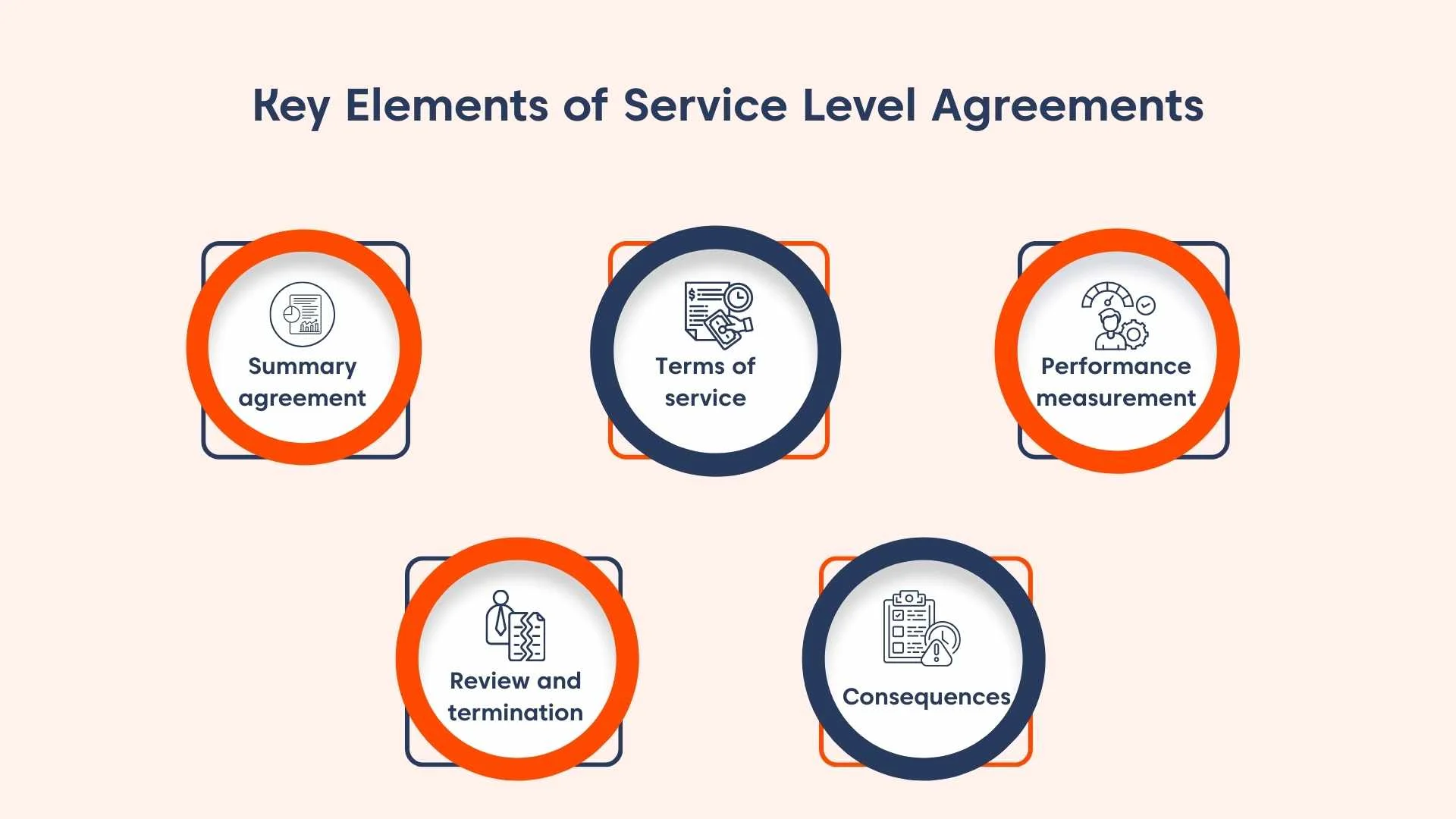
- Summary of the agreement: A brief overview that identifies the parties involved, the service covered, key dates, and the approvals needed to make the defined performance targets official.
- Terms of service: Defines what services are included, who receives them, how they will be delivered, and any exclusions or conditions both sides must follow.
- Performance measurement: Explains how service quality will be tracked, including metrics like response time, resolution time, and availability, plus how often reports will be shared.
- Consequences: States what happens if commitments aren’t met, including allowed exceptions and potential remedies (for example, service credits) or corrective actions.
- Review and termination: Outlines how often the agreement will be reviewed, how updates are approved, and the conditions for ending the agreement.
Why SLAs are crucial for modern customer service
When customers reach out with a problem, they want to know: “Will someone help me—and when?”
That’s where service-level agreements come in. These agreements aren’t just internal metrics.
They’re promises with clear, measurable commitments that define how quickly your support team will respond to and resolve customer issues. When used effectively, they can transform your customer support experience.

Sets clear expectations
A well-defined service agreement sets clear and precise targets that tell customers exactly what to expect, building their confidence while leaving no room for guesswork and confusion.
It replaces vague promises like “we offer fast support” with transparent, measurable commitments like “we will respond to all urgent requests within one hour.”
Improves agent productivity
Service-level agreements give support teams a clear structure for their workflow process for managing their workload.
This ensures they prioritize tickets more efficiently, based on urgency (e.g., Urgent, High, Normal), and impact, improving team productivity.
Helps in making data-driven decisions
The SLA metrics are a goldmine of data that highlight where your support process is thriving and where it’s falling short.
Managers can use these insights to optimize their workflows and allocate resources wisely to consistently improve service quality.
Builds customer trust and loyalty
These service level documents are a two-way street. They hold the service provider accountable for performance and outline the customer’s responsibilities (e.g., providing necessary information).
Meeting (or exceeding) service-level agreements consistently shows customers that you respect their time and take their concerns seriously. That’s how customer loyalty is earned.
What are the main considerations for creating an effective SLA?
Creating a well-defined and effective service level agreement is essential for delivering consistent and high-quality customer support.
A strong agreement sets clear expectations, improves accountability, and enhances customer satisfaction. Here are the key elements to include in your agreement:

- Response and resolution times – Specify the time it takes for support to respond to and resolve customer issues, based on their urgency.
- Ticket prioritization – Categorize issues by urgency and impact, from critical to low, with defined response time targets.
- Support availability hours – Specify the timeline when your support team is available to assist customers. This can include 24/7 support, business hours (e.g., 9 AM – 5 PM), or hybrid models. Make it clear whether support is available online, offline, or both.
- Escalation and breach handling – Outline the steps for escalating unresolved issues and define the process for handling SLA breaches. Include consequences, solutions, and compensations for if agreement terms are not met.
- Performance standards – Measures performance metrics and KPIs such as First Response Time, First Contact Resolution, SLA Compliance Rate, and CSAT Score, to assess service quality. Also, outline how often service-level agreements are reviewed and updated.
Key types of service level agreements
Service level agreements can be structured in different ways depending on your business model. The main types include:

- Customer-based: This is a type of agreement for a single customer or group that covers all the services they use. It is common for large enterprise clients with custom needs.
- Service-based: This service-level agreement defines a uniform service standard applicable to all customers utilizing a specific service.
For instance, a telecommunications provider may commit to delivering a consistent internet bandwidth to all users subscribed to a particular plan. - Multilevel: This agreement uses a hybrid approach that combines elements for different customer sets. It might include a corporate-level component that applies to all users, along with specific agreements for different customer tiers (e.g., Basic, Premium, Enterprise).
- Internal: Refers to a formal agreement between departments that defines how they’ll work together and their specific roles to support the expected customer commitments.
Example: If customer service promises 24-hour bug resolution, engineering may commit to responding within 4 hours. Without this internal support, the external service-level agreement may not hold.
9 Effective SLA best practices for quality support
Once you understand the importance of a Service Level Agreement, the next step is to focus on implementing it effectively.
To avoid the risks of overpromising and under-delivering, consider the following customer SLA strategies that drive customer satisfaction and enhance team performance.
Set realistic, data-driven SLA targets
Service agreement targets looking good on paper but don’t work in practice can lead to frustration. Instead, base your goals on real performance data. This helps your team stay consistent and builds trust by setting expectations you can actually meet.
How to set realistic SLA goals:
- Export historical data: Retrieve and analyze past ticket data from your customer service software to know your current status and identify trends in your key metrics.
- Know your objectives: Clearly define what your service-level agreement goals are intended to accomplish—whether it’s improving customer satisfaction, reducing resolution time, or increasing operational efficiency. Your objectives should guide every aspect of SLA design.
- Decide on the right SLA conditions: Choose condition fields for your agreement that reflect your service structure and priorities. The common condition fields include brand, contact & contact Group, category, type, assigned group, etc.
- Team capacity: Consider your team’s current capacity and ticket volumes.
- SMART goals: Create and align your service-level agreement goals with customer expectations and business priorities.
Pro-tip: Start with achievable goals and refine them as your team grows more efficient.
Involve all your support teams
Even the best service-level agreement strategy can fail if your support team doesn’t understand it. Involving them in the process makes the agreement terms actionable and more authentic with respect to customer priorities.
Additionally, customer-facing teams will prioritize objectives that hold real-time significance while maintaining a healthy work-life balance throughout the process.
How to get your team involved:
- Agent SLA awareness: Engage support agents while designing the agreement. Ensure you communicate SLA terms clearly to agents, so they know how the agreements work, how they’re measured, and what happens when they’re breached.
- Ask for feedback: Agents understand the clients’ needs and expectations so well because they are the first point of contact for clients. Therefore, request for their input and utilize their insights to determine and sensitize the service level standards.
- Support team SLA education: Provide SLA training during onboarding and regular refreshers to keep everyone aligned with the service-level agreements’ goals and accountable. Additionally, provide documentation and cheat sheets for quick reference.
Automate your SLA workflows
When deadlines are tight, automation is your best ally to ensure that service-level agreement targets are consistently met. SLA automation allows support teams to offer proactive customer service, improve team productivity, and minimize ticket forgetfulness.
How to automate workflows:
- Create workflow rules: Set up detailed service-level agreement automation rules in your customer support application to automatically assign the right SLA policy to each ticket.
- Reminders, notifications, and alerts: Use automation to trigger SLA alerts and notify agents when tickets are nearing agreement breaches, such as when response or resolution due is approaching, to keep the issue from being ignored.
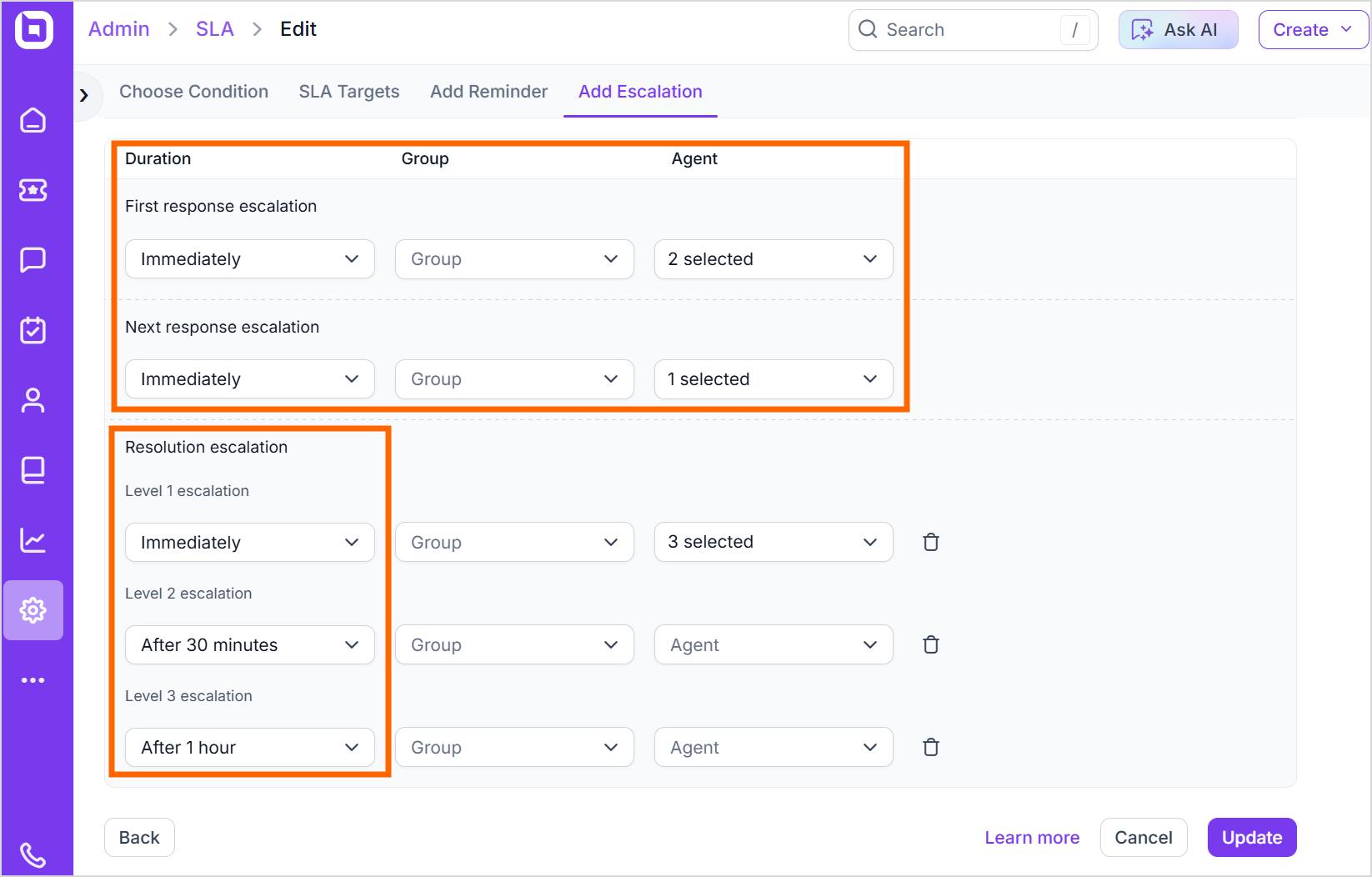
- Set up escalation paths: Create clear SLA escalation rules for when a ticket breach occurs. For instance, you can set an escalation rule to alert a manager or respective agent of overdue tickets. This ensures they give the issue immediate attention or move to a more experienced agent to handle it.
Real-life story
GMoney, a financial services provider, transformed its support operations after switching to BoldDesk, strengthening its SLA performance.
Automation features, such as automated ticket routing and status updates, helped remove manual follow-ups, reduce bottlenecks, and keep response times consistent.
The GMoney team also noted that BoldDesk’s quick and reliable support, via email and occasional calls, helped them troubleshoot issues promptly, further supporting their SLA targets.
Outline your procedure for SLA breaches
Things sometimes inevitably go wrong while offering customer service, like an outage, a website crash, or unexpected server maintenance, causing delays in delivering support on time.
With customers being 2.4 times likely to stay with a company if their issues are resolved fast, an effective escalation management plan can save the day.
If your SLA escalation process is clearly defined, your team can respond to or resolve unforeseen issues efficiently with minimal disruptions, to quickly restore the customer trust and confidence in your brand.
How to handle service agreement breaches effectively:
- Set out a clear SLA escalation process: First, define what qualifies as a breach (e.g., missed response or resolution time). Then, determine what steps to take in case resolution misses a service-level agreement target, such as escalating the ticket issue, informing the customer, or offering a goodwill small credit.
- Empower the team: Enable support agents to take the best service-level agreement breach measures according to the SLA breach process independently, with minimal approvals. Designate who will be handling SLA violations follow-ups, whether it’s an agent, team lead, manager, or escalation specialist.
- Automate SLA alerts: Use your help desk software to notify agents and escalate overdue tickets.
- Create and send SLA breach responses: Create prewritten and empathetic customer service email templates so that your team can quickly send SLA incident responses. Additionally, communicate with affected customers through timely updates explaining the delay and outlining next steps.
Customize SLAs to fit different needs
Generally, a service agreement can hardly be termed as a cut-and-paste agreement; for one reason, a single agreement cannot apply to all given situations.
The agreements should vary because the issues are not the same, and different clients or brands might have their own unique requests.
How to customize multiple service-level agreements:
- Implement tiered SLA structures – Set up customizable service-level agreement policies based on issue type, ticket prioritization (e.g., Critical, High, Normal, Low), type of customer or available channels, to ensure all issues are addressed efficiently.
- Create brand-specific SLAs – If your support team manages more than one brand, it’s important to create separate service-level agreements for each to reflect their unique workflows, expectations, and service commitments.

A multi-tier SLA framework ensures that customer issues are addressed according to their urgency. High-priority tickets receive immediate attention, while lower-priority requests are scheduled appropriately, resulting in faster resolution times and a more efficient support workflow.
Define your team’s roles and responsibilities
Prioritizing organizational readiness isn’t just smart—it’s strategic. A 2025 Gartner survey found that customer service leaders who focused on organizational readiness (rather than just technology selection) saw a 300% increase in the likelihood of meeting customer expectations.
Readiness to SLA includes well-defined responsibilities for support agents, other internal customer-facing teams, and even the customer.
When everyone understands their specific role, unnecessary delays are minimized, and it becomes easier to resolve issues without assigning blame, whether the problem is internal or external.
How to define the roles:
- Internal team roles: Clearly outline the expectations of your support team and other departments in service delivery. This ensures smooth collaboration and internal alignment.
- Access roles and permissions – Specify who has access to systems, tools, and data relevant to service operations. Assign permissions based on roles to control who can view, modify, or manage sensitive information, ensuring security and operational integrity.
- Decision-making authority – Identify who is responsible for making key decisions, such as handling escalations, approving changes, or resolving conflicts. Clear decision ownership helps streamline processes and ensures timely action.
Real-life story
Having evaluated different options, Down To Earth Landscape and Irrigation Company selected BoldDesk due to its ease of use and built-in tracking features.
By clearly defining team roles and responsibilities within BoldDesk, they were able to streamline who handles what, avoid duplicated work, and maintain predictable SLAs.
The company also shared that BoldDesk’s onboarding and support team provided quick, reliable assistance that helped them implement the system smoothly and align their internal processes faster.
Communicate your support availability clearly
If your SLA communication on your help desk schedule or operating customer service hours isn’t clearly stated, users might merely assume your team is available 24/7.
Prevent this misunderstanding through service-level agreement policy transparency on whether you offer 24/7 customer service or operate your support on specific business hours.
How to communicate your availability:
- Display support hours: Clearly expose your customer service hours and help desk schedule on your Contact Us page, website, help center pages, FAQs, and live chat software. Also, update availability during holidays or special events to avoid confusion.
- Alternative options: In case you are unavailable, consider including any alternative contact information or channels you have. You can also inform them when you will be next available so they can contact you again.
- Share in messages: Include availability in auto-replies and ticket confirmation emails. Reassure them that, even if they do not get an immediate response, their inquiry has reached the right level.
- Show available agents: Use live chat widgets, icons, or banners to show live agent availability in real time.
- Define time zones: Clarify the availability for each time zone if you serve customers across regions.
Track the right SLA metrics
To truly honor service commitments, it’s essential to monitor the right data. Move beyond basic customer service metrics and focus on help desk KPIs that accurately reflect support quality and operational efficiency.
What are the key SLA performance tracking metrics?
- Response time: Refers to the time it takes for an agent to respond to new and existing tickets, such as First Response Time and Time to Next Response.
- SLA achieved rate: Also known as SLA compliance rate. It is the percentage of tickets resolved within service-level agreement targets.
- Resolution time: How long it takes to resolve an issue. This can include metrics like First Contact Resolution or Total Time to Resolution.
- SLA breached rates: Percentage or number of tickets that missed agreement target deadlines.

By tracking meaningful metrics, you gain clear insights to evaluate performance, guide hiring or tool investments, and identify areas where your team may need additional support or training.
Regularly review and adjust your service agreements
Business needs, support team capacity, and customer expectations are not static; they keep changing over time.
Therefore, you should consider your service-level agreements as living documents and optimize to adapt accordingly through regular review and updates. Having updated agreements can help you stay competitive, responsive, and customer-focused.
How to do SLA optimization:
- Schedule regular SLA reviews: Have a timeline to revisit your service-level agreements formally and review each policy. Check the performance to note the service-level agreement achievement and breach rates. This can be done quarterly, annually, or at least once a year, depending on your preference.
- Seasonal improvement: Make any necessary changes to the service levels to fit different seasons, ticket volumes, team capacity, and varying levels of expectation from different customers.
- Keep updating policies: During your agreements’ review, drop any outdated policies and introduce new ones as needed.
Common SLA challenges and how to avoid them
Service level agreements are essential for setting clear expectations between support teams and customers. However, many organizations fall into common traps that reduce the effectiveness of their service-level agreements. Here are four frequent SLA mistakes and how to fix them.

The “Set It and Forget It” mindset
Mistake: Many teams create level of service agreements once and never revisit them, even as business needs and customer expectations evolve.
Solution: Treat your service-level agreement as a living document. Regularly review and update it to reflect current support goals, team capacity, and customer needs. This ensures your agreement stays relevant and achievable.
Overly complex or confusing language
Mistake: Overly technical or legal language can make your agreements on service levels hard to understand, for both customers and internal teams.
Solution: Write your service-level agreements in clear, simple language. Avoid jargon and focus on making expectations easy to understand and follow. A well-written agreement improves transparency and accountability.
Ignoring the customer preferences
Mistake: Service-level agreements that focus only on internal metrics (like first response time) may overlook what customers actually value—such as resolution time or communication quality.
Solution: Gather customer feedback and align your service level metrics with their priorities. This helps build trust and ensures your service goals match customer expectations.
Lack of stakeholder involvement
Mistake: When support agents, managers, or other teams aren’t involved in SLA planning, they may feel disconnected from the goals.
Solution: Involve all relevant stakeholders in the service-level agreement creation and review process. When everyone understands and supports the agreement, it’s easier to meet targets and improve service delivery.
Ready to level up your SLA strategy for quality support?
A service level agreement is your promise to deliver excellent, reliable service. It turns vague goals into clear commitments that build customer trust.
By following the service agreement strategies in this guide, like setting realistic targets, involving your team, and reviewing regularly, you ensure your promises are kept, improve team performance, and also earn lasting customer loyalty.
With BoldDesk, your customer-facing teams can easily and efficiently create or customize their SLA policies and track metrics for outstanding support efficiency, delivering on your every promise.
Feeling motivated to take a fresh look at how your service-level agreements are structured? Let us know what sparked your interest. Please share your thoughts in the comments!
Related articles
FAQs on service level agreements
SLA: Business agreement with the customer.
OLA (Operational Level Agreement): Internal agreement between departments.
UC (Underpinning Contract): Business agreement with other external vendors.
If a service agreement is breached, it means the service didn’t meet the agreed standard.
This can lead to internal escalations, performance reviews, or even penalties, depending on the agreement.
To handle a breach effectively:
- The issue is logged and reviewed to find out why it happened.
- It is then escalated to the appropriate team to take steps to fix the problem.
- If needed, the support team adjusts the service-level agreement targets or internal processes to prevent future breaches.