

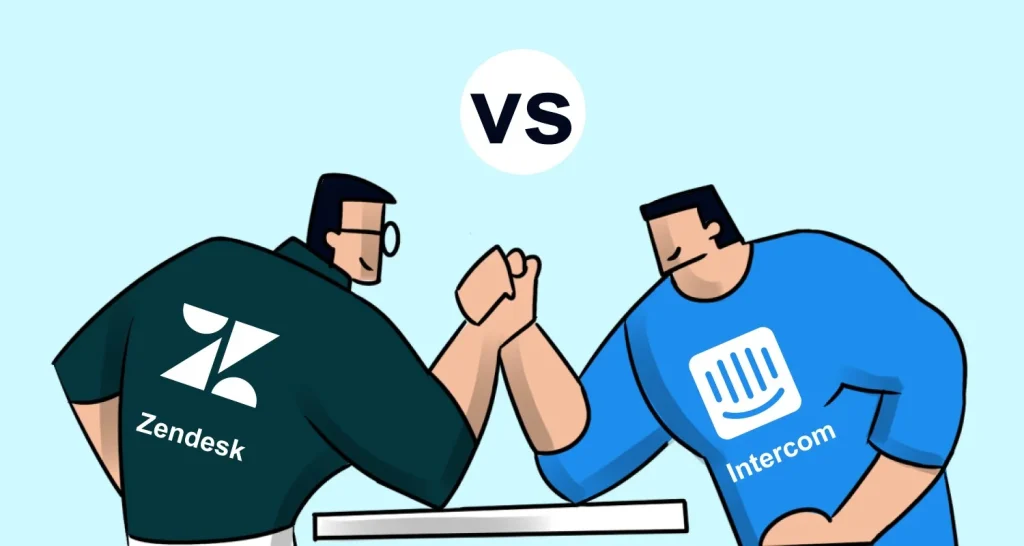



TL;DR: Intercom starts at $29 per seat/month, with Fin AI billed separately from $0.99 per Fin outcome. Zendesk starts at $19 per agent/month, with Suite plans from $55 to $115 plus optional AI add-ons. Intercom suits messaging-first teams, while Zendesk fits structured support operations with ticketing, SLAs, and reporting.
Customer service representatives always prefer user-friendly software that enables them to engage smoothly with consumers while providing fast and efficient support from anywhere.
Comparing Intercom vs Zendesk can be challenging, as both platforms are widely popular and offer distinct features and capabilities.
Ultimately, the best choice depends on your company’s goals, size, budget, and specific business needs.
According to Softwarepath, 29.46% of companies reported that their primary objective in implementing software is to enhance efficiency. This reason leads by nearly 10% compared to other objectives.
But how do you determine which platform is right for your organization?
In this article, we’ll compare these two online customer service platforms to help you decide which one best aligns with your business needs.
Intercom vs Zendesk: Overall overview
Intercom is an AI-driven customer messaging platform that enables businesses to connect with their clients in real-time, via personalized messages.
It offers live chat, email marketing, and customer engagement tracking features.
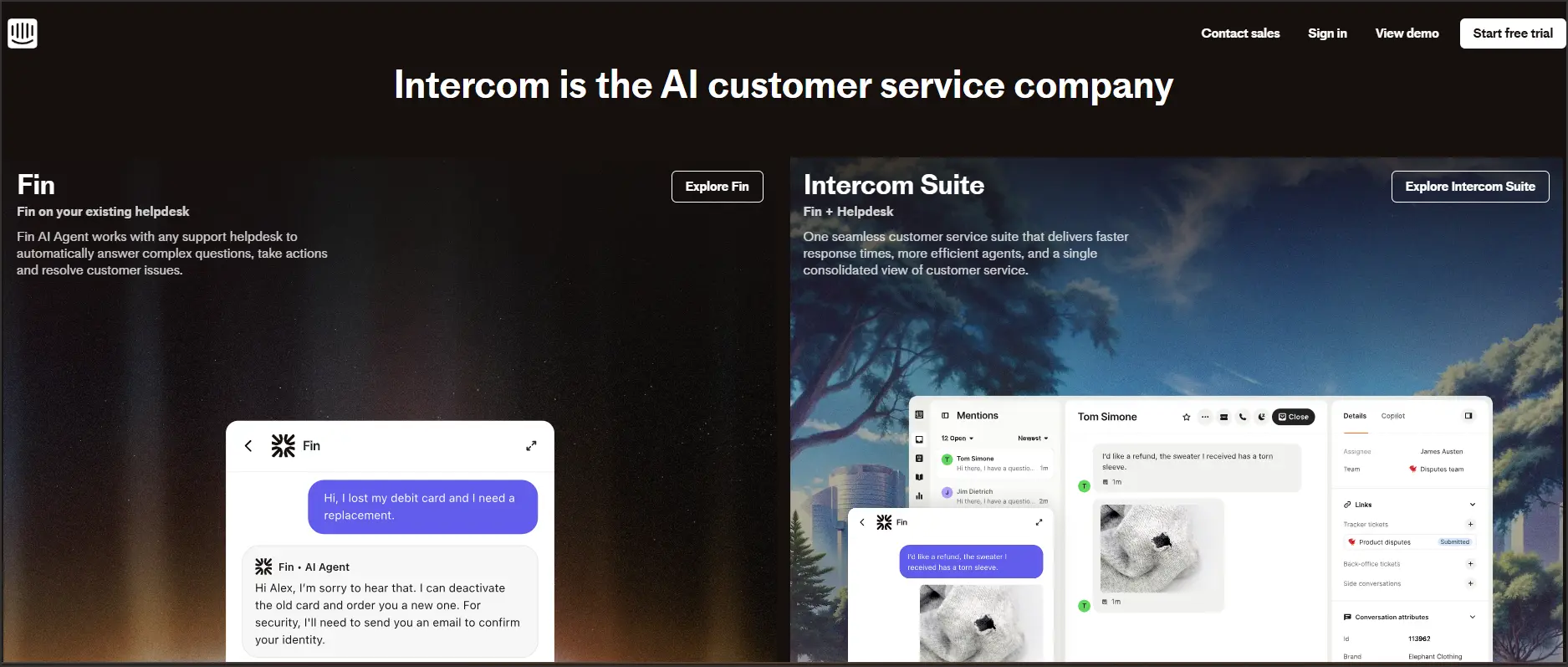
Businesses can use the Intercom platform that integrates with other tools, such as CRM, for better customer interaction and quick support.
Davis O., a Customer Support Team Lead and Capterra reviewer, highlighted Intercom’s live chat and proactive support experience:
“The live chat is fast and responsive, and the ability to see user activity in real time adds a layer of context that makes support feel proactive rather than reactive.”
Zendesk is a customer service software that assists businesses in managing customer interactions.
It offers a ticketing system to manage all customer requests from multiple communication channels within a centralized platform.
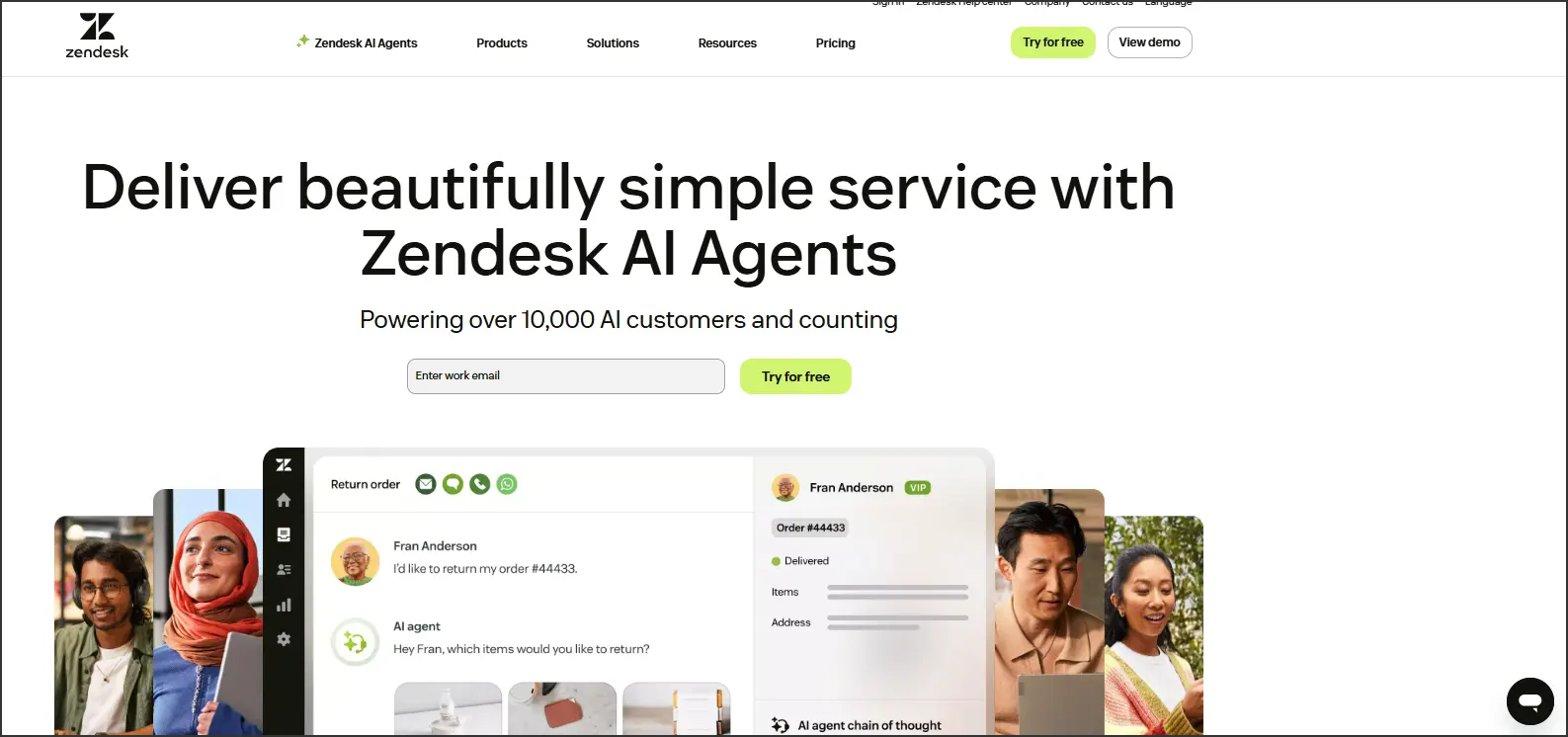
Zendesk also offers analytics and reporting tools that allow businesses to track customer inquiries, measure customer satisfaction, and identify trends or improvement areas.
Its integration with other business applications makes it an adaptable solution for customer service teams.
“What I like most about Zendesk for customer service is its ease of use. New employees typically have very little difficulty learning the platform, navigating its features, and understanding how to complete their tasks with minimal training.”
— Rolando F., IT Support Tech
How we evaluated Intercom and Zendesk
We evaluated both platforms across seven areas: pricing and total cost, AI capabilities and billing, ticketing, automation, reporting, integrations, and verified user ratings.
- Pricing: Sourced from Intercom’s and Zendesk’s public pricing pages in August 2026, using annual rates unless noted. AI costs may be billed separately, so verify current pricing before purchase.
- User ratings: Ratings were sourced from G2 and Capterra and are linked throughout the article. Scores may change as new reviews are published.
- Features: Feature comparisons are based on vendor documentation, product pages, help centers, and published user reviews.
Disclosure: BoldDesk is our product and is included in this comparison. We have aimed to assess all three platforms fairly using publicly available pricing, product documentation, and verified user reviews.
Comparison table of Intercom vs Zendesk
Here is a comparative table of Intercom vs Zendesk, focusing on several critical aspects of each platform.
| Aspects | Intercom | Zendesk |
| Primary use case | Focuses on customer engagement, in-app messaging, and support | Focuses on customer support and ticketing system |
| User interface | Modern chat-based interface | Traditional ticketing system layout |
| Automation | Workflow automation, macros, conditional triggers | Automation with triggers and macros for ticket handling |
| Omnichannel | In-app messaging, live chat, email, push notifications, and social channels | Email, live chat, social media, phone support, SMS, and additional business channels |
| Integration | Integrates with modern tech stacks, particularly SaaS tools | Integrations include legacy systems and broad enterprise software suites |
| Live chat support | Modern proactive messages and real-time communication options | Traditional user interface with live chat, chatbots, real-time responses, and integrations |
| AI Agents | Fin AI Agent excels in natural, conversational support for complex queries and intuitive interactions | Zendesk AI Agent is ideal for scalable, enterprise-grade support offering enhanced customization, analytics, and workflow automation |
| Ticketing system | Limited ticketing functionality for managing conversations and chats | Designed for managing customer inquiries, including multi-channel support and automation features |
| Knowledge base | Customizable help centers with search functionality and article recommendations | Dedicated help center, which allows for FAQs, articles, and community features |
| Report and analytics | Analytics on user behavior and conversation monitoring | Clear customer service KPI and tailored reporting |
| Pricing | Categorized pricing based on features, with additional costs for add-ons | Expensive per-agent pricing model with additional features in higher tiers |
| Free plan | Not available | Available (Startups get Zendesk free for 6 months) |
| Free trial | 14 Days | 14 Days |
Intercom vs Zendesk: A detailed feature breakdown
Although both platforms aim to improve customer service, Intercom and Zendesk take distinctly different approaches to achieving that goal. Let’s explore how they compare in detail.
Interface
One of the first things users notice when interacting with customer service software is the user interface (UI). Here’s how the UI of Intercom and Zendesk compare in terms of user experience.
Intercom’s interface is easy to navigate because of its clean layout and clear labels. Companies can customize this interface to fit their specific needs and branding.
Zendesk’s user interface prioritizes productivity on ticket management while offering practical and effective solutions. The UI allows businesses to smoothly change between conversations, helping them handle various interactions at once.
Note: Intercom has a more modern, approachable interface that new users can learn quickly. Zendesk is more structured and productivity-focused, which suits teams handling high ticket volumes.
Feature analysis
There are notable differences between the overall features of Intercom and Zendesk.
Intercom focuses more on functionalities related to customer messaging and engagement. It includes features like live chat, ticketing, a help center, reporting and analytics, and automation.
Their AI-driven chatbot can analyze previous exchanges and spot trends that it might utilize to enhance communication in the future.
Conversely, Zendesk features cover a broader range of customer support operations, including ticketing systems, live chat, reporting, and analytics.
The Zendesk chatbot may forward conversations to agents or answer simpler inquiries when needed.
Note: Intercom is stronger for messaging and customer engagement. Zendesk covers more of the support operation, making it a better fit for teams managing high volumes across multiple channels.
Knowledge base
When comparing Intercom vs Zendesk, it’s clear that both customer service platforms offer varying features in their knowledge base software.
Intercom knowledge base offers basic help center articles with features like multilingual support, search engine indexing, customization options, and analytics.
Zendesk knowledge base offers self-help solutions that are easily accessible. It includes features like advanced search, article management, and integration with other tools.
Its generative search AI offers users instant answers to search queries on its help center.
Zendesk also has the option to provide support content in multiple languages, ensuring accessibility for native language speakers worldwide.
Note: Zendesk offers a more capable knowledge base with AI-powered search, multilingual publishing, and community features. Intercom’s simpler knowledge base suits teams centered on chat-based support.
Automation
Zendesk vs Intercom both offer automated help desk features, but their approaches differ.
Intercom automation uses bots to automatically respond to customer inquiries, suggest relevant help articles, route issues to the respective support teams, and trigger follow-up actions.
Zendesk provides help desk automation capabilities in workflows, ticket assignments, rule-based triggers, and chatbot integration.
Note: Intercom focuses on conversational bots and message triggers. Zendesk emphasizes ticket workflows, assignment rules, and time-based escalations, which suit ticket-heavy teams.
Omnichannel support
Intercom offers an omnichannel customer service that allows integration of multiple communication channels like live chat, email, and social media platforms within a single inbox.
Zendesk provides strong multichannel options with features like live chat, social channels, email, SMS, and business channels.
Note: Intercom’s unified inbox brings channels together with less setup. Zendesk supports a wider range of channels, but may require more configuration to create the same consolidated workflow.
Live chat support
Intercom live chat software offers an intuitive and user-friendly instant help solution with features that allows real-time interactions with clients.
Zendesk live chat provides a more reliable real-time support solution with features like advanced routing, customization options, and integrations with other tools.
Note: Zendesk live chat offers more routing, configuration, and integration options. Intercom is quicker to launch and suits teams that use chat as their primary support channel.
Ticketing system
Intercom ticketing system offers basic features like ticket creation and assignment.
Zendesk help desk ticketing system provides features like advanced routing, customization options, and integrations with other tools.
Note: Zendesk is built around ticketing, with advanced routing, SLA management, and customization. Intercom handles essential ticketing but is better suited to conversation-led support.
Intercom vs. Zendesk: Reports and analytics
Intercom reporting and analytics suite offers features like customer engagement metrics and conversation history.
Zendesk reporting and analytics suite provides features like advanced reporting, customization options, and integrations with other tools.
Note: Zendesk Explore offers deeper support reporting, including custom dashboards, SLA tracking, and agent performance metrics. Intercom focuses more on conversation and engagement insights.
AI Agents
Intercom Fin AI agent focuses on conversational support, using machine learning to automate replies, triage tickets, and suggest help articles.
Zendesk AI agent provides more advanced AI capabilities, including intelligent ticket triage, sentiment analysis, and contextual routing. Its AI agent can handle complex queries, escalate issues appropriately, and integrate with broader enterprise systems.
Note: Both platforms offer capable AI agents. Intercom Fin suits conversational, chat-first support, while Zendesk’s AI is better for structured ticket workflows that require triage, sentiment analysis, and escalation.
Integration
When comparing Zendesk against Intercom, both offer integrations with other tools and software.
Intercom provides a variety of integrations with popular tools and platforms, including CRM systems, marketing automation tools, and e-commerce platforms.
Zendesk has a larger ecosystem of integrations to improve customer data management and to streamline workflows.
Note: Zendesk has a larger marketplace and broader coverage for enterprise and legacy systems. Intercom integrates well with modern SaaS tools but may offer fewer options for complex technology stacks.
Pricing
Both customer service tools offer a 14-day free trial, allowing teams to test their features before committing to a paid plan.
However, pricing structures vary significantly, particularly when AI usage and add-on costs are factored into the total cost of ownership.
Intercom pricing plans
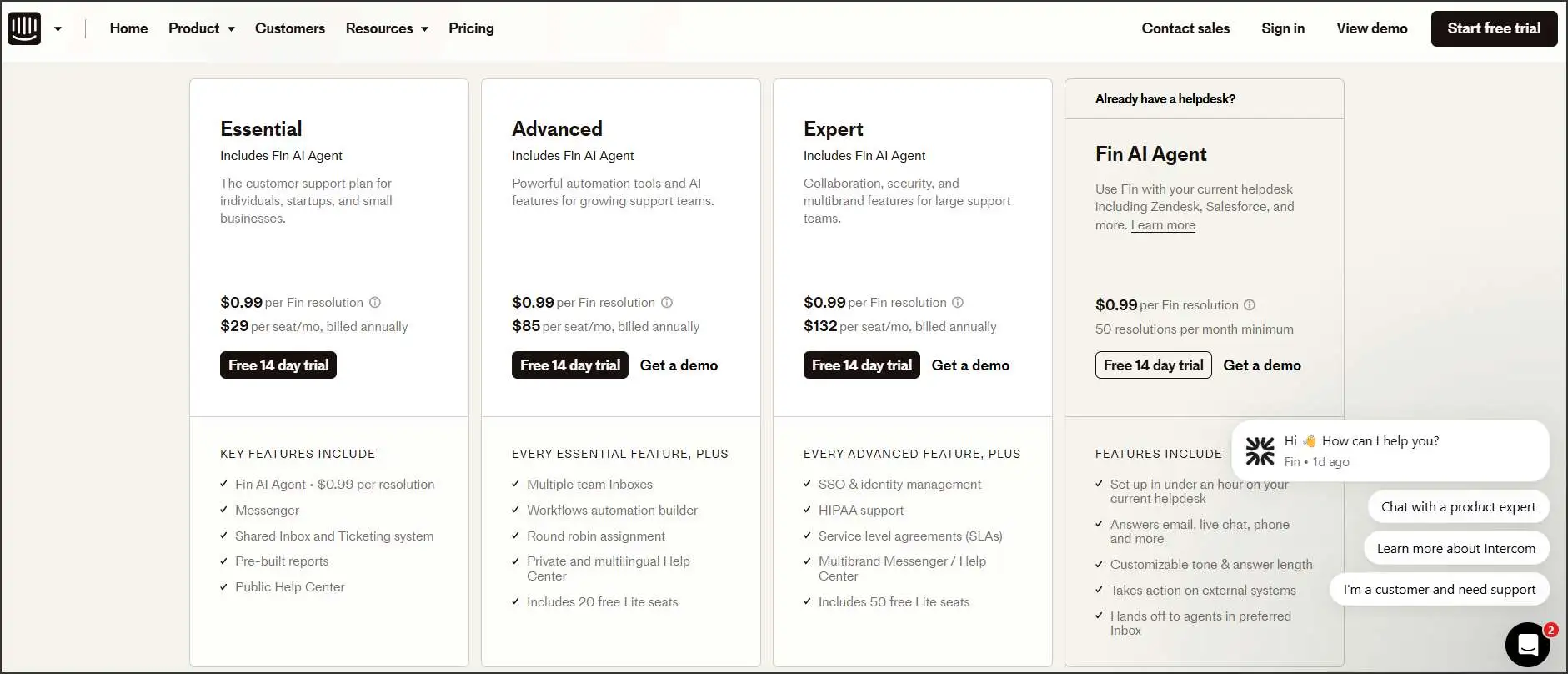
Intercom provides a range of pricing plans tailored to different feature sets.
Here is a summary of the starting prices for each plan:
- Essential: $29 per seat/month (annual billing) or $39 per seat/month (monthly billing)
- Advanced: $85 per seat/month (annual billing) or $99 per seat/month (monthly billing)
- Expert: $132 per seat/month (annual billing) or $139 per seat/month (monthly billing)
Additional AI costs
- Fin AI Agent: $0.99 per outcome, procedure handoff, or disqualification.
- Fin for Sales: $9.99 for each qualified prospect. Resolutions and disqualifications are charged at $0.99 each.
Note: Intercom’s AI costs are outcome-based. Total AI spend depends on the number and type of outcomes generated, in addition to seat licensing costs.
Cost example: A team with 20 seats on the Intercom Essential plan would pay $580/month for seat licenses alone. If Fin AI generated 100 outcomes during the month, AI costs would start at approximately $99/month, bringing the estimated monthly cost to about $679/month.
Zendesk pricing plans
Zendesk has various pricing plans to suit different business needs.
The basic options have limited options, and as you move up through higher tiers, additional features are included, which can make the overall plans quite expensive.
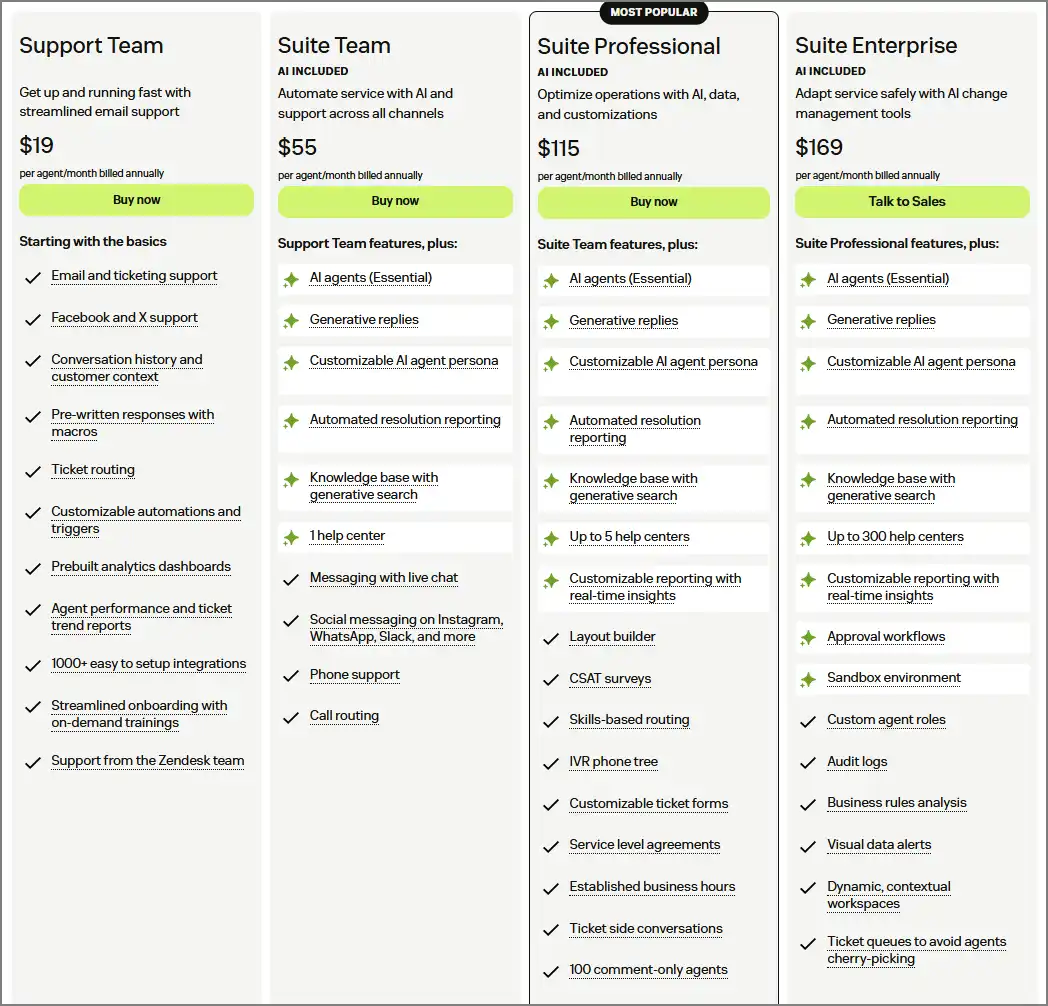
Below is a breakdown of Zendesk pricing plans:
- Zendesk Support Team: Starts at $19/agent/month (annual billing) or $25 per agent/month (monthly billing)
- Zendesk Suite Team: Starts at $55/agent/month (annual billing) or $69 per agent/month (monthly billing)
- Zendesk Suite Professional: Starts at $115/agent/month (annual billing) or $149 per agent/month (monthly billing)
- Zendesk Suite Enterprise: Zendesk does not publicly publish pricing. Contact sales for a quote.
Common Zendesk add-ons
- Copilot: $50/agent/month
- Workforce Engagement: $50/agent/month
- Contact Center: $83/agent/month (annual billing)
Note: Neither platform remains affordable once AI features and add-ons are factored in. Intercom charges for Fin AI per outcome, while Zendesk’s total cost can rise with Copilot, Workforce Engagement, Contact Center, and other usage-based services.
Support quality
Both Intercom and Zendesk offer excellent customer support in their own way.
Intercom has a reputation for excellent customer service. Its dedicated team provides timely and accurate solutions in a professional way, through features such as an extensive knowledge base, live chat, and automated canned responses.
Zendesk is known for its 24/7 support team, which is always available to help with any issues that may arise.
While it may not have the same emphasis on building customer relations as Intercom, Zendesk focuses on efficiency for businesses with complex needs.
Note: Both platforms offer solid support. Intercom suits proactive, engagement-led teams, while Zendesk is a stronger fit for organizations handling large volumes of structured inquiries and formal escalation paths.
User reviews
User reviews for Zendesk vs Intercom are generally positive, with users praising both platforms’ ease of use and effectiveness.
Intercom reviews
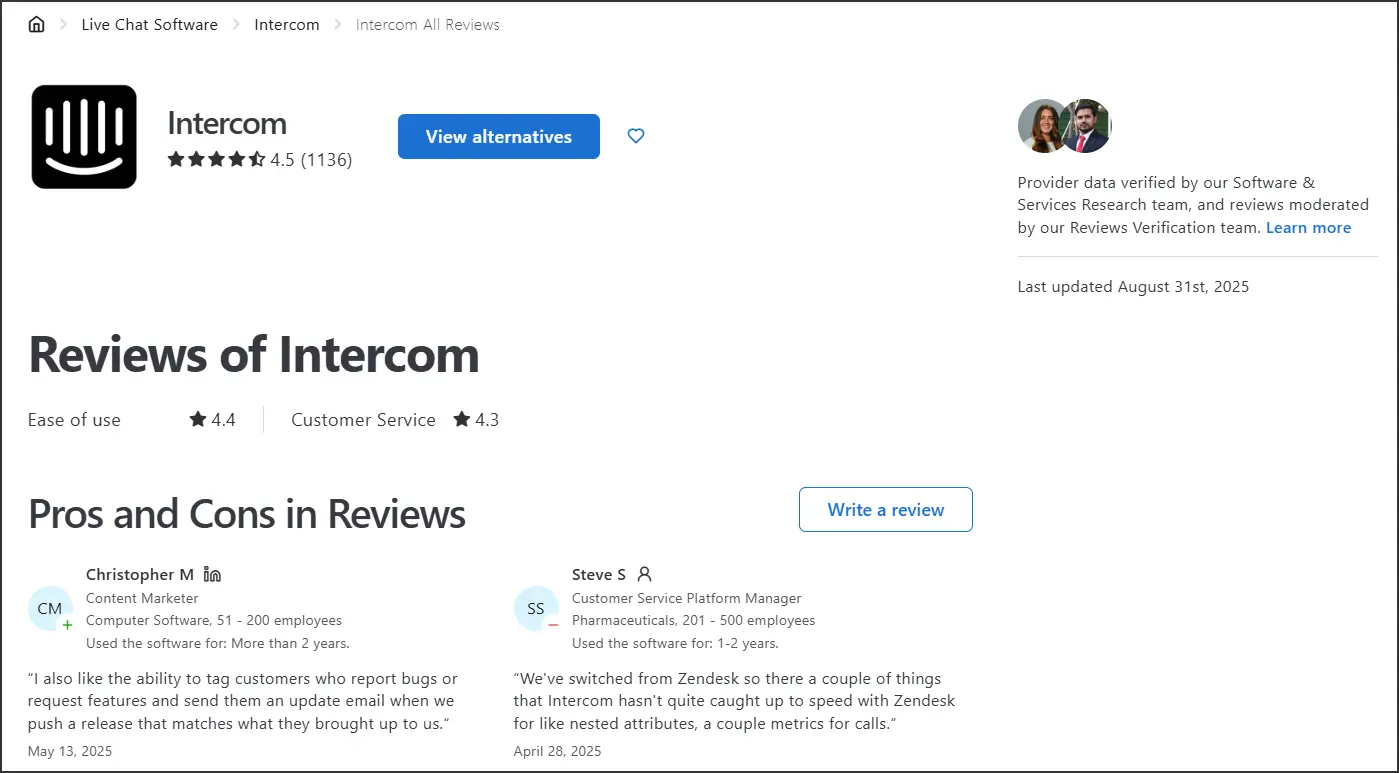
Capterra: Intercom help desk software has an overall rating of 4.5 out of 5.
Users commended the system as a great product. It constantly releases new features, provides excellent training materials, and offers great support.
One Capterra reviewer, AdityaA.,a customer service representative, praised Intercom’s real-time support experience:
“I like the live chat in Intercom, which allows me to respond to customer queries in real time and see their details in one spot.
However, it once had terrible customer service for a week and no fast reply. They don’t have many features, and the ones available are very expensive.
G2: The software has a rating of 4.5 out of 5.
Its user-friendly and straightforward design is simple to explore and manage several discussions simultaneously.
In addition, the tool is dependable and effective, almost never experiencing problems or downtime.
The reliable search feature helps users locate past chats quickly.
However, its chatbot usually fails to assign conversations to any of the available team members, leaving the conversation unassigned and unnoticed.
“The problem is that Intercom is not interested in providing customer service, so you will only get as far as their knowledge base and what their AI agent can offer.”
Zendesk reviews
Capterra: Zendesk help desk has an overall rating of 4.4 out of 5.
Users praised its excellent method of centralizing all customer support interactions in one space.
Jane F., a personal lines executive and Capterra reviewer, highlighted Zendesk’s ability to keep support operations organized:
“It streamlines customer support, keeps tickets and communications organized, and helps provide fast, consistent, and professional service.”
It also has a strong ability to integrate with other apps and tools.
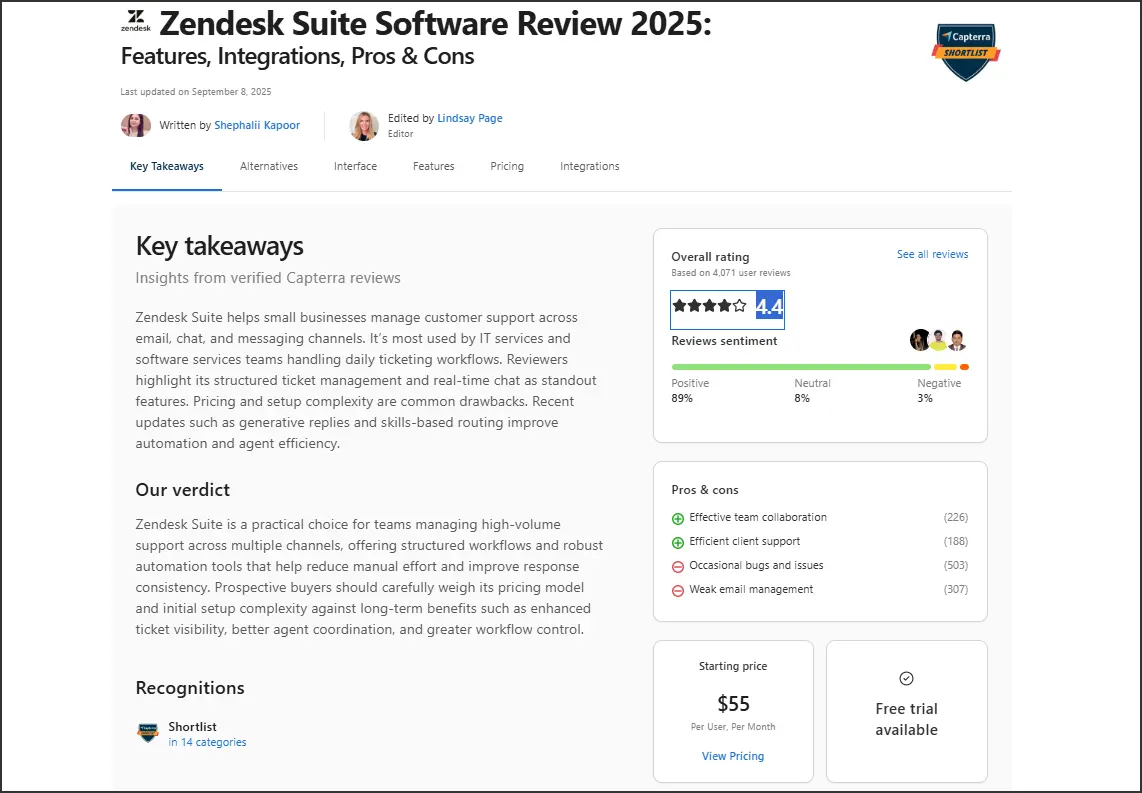
However, there are sometimes issues with exporting and uploading data. Occasionally, data disappears or is erased without explanation.
Some users also report challenges with email management. Christine B., a Capterra reviewer, shared:
“Major issues with spam and junk email not being filtered out, while real customer emails get lost in the mix.”
G2: It has a rating of 4.3 out of 5.
Moreover, you can handle email-based customer inquiries, guaranteeing that each client receives a response and maintaining a standard of service.
Additionally, monitoring the support team’s performance and identifying improvement areas is simple.
However, the timing of the breached tickets is sometimes displayed incorrectly. The email “Not sent; please try again” occasionally appears after sending.
Note: Both platforms receive strong ratings on G2 and Capterra. Intercom users often praise its ease of use and engagement tools, while Zendesk users value ticket management, scalability, and integrations.
BoldDesk: A scalable alternative to Zendesk and Intercom
For teams that find either platform too complex or too expensive, BoldDesk combines ticketing, AI, omnichannel support, automation, self-service, and reporting into one platform without distributing them across tiers or billing AI separately from seats.
Key capabilities include:
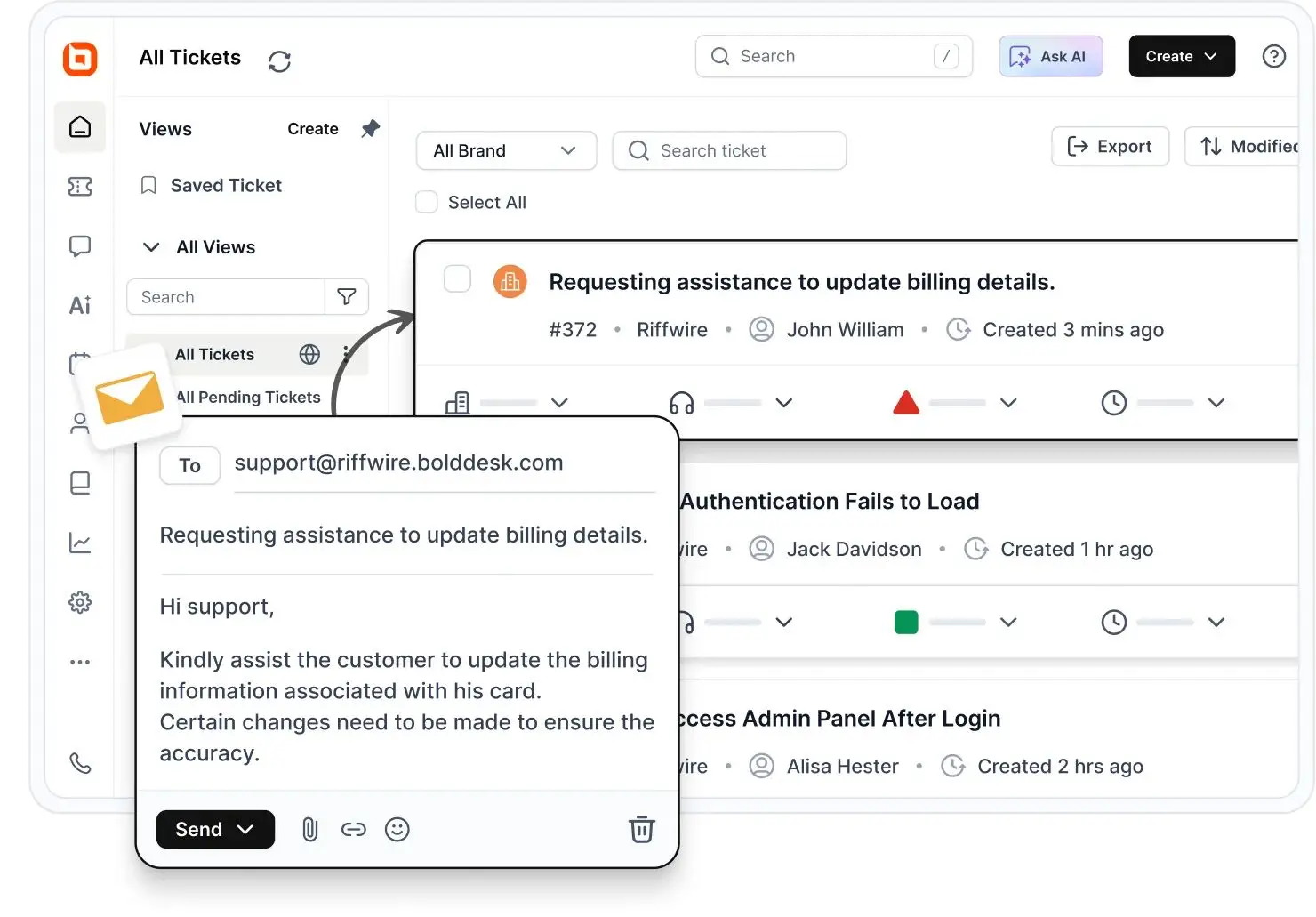
- Ticket management: Create, prioritize, assign, and track support requests using BoldDesk’s help desk ticketing system.
- AI-powered support: Use AI Agents to automate customer requests, AI Copilot to assist agents with replies and summaries, and AI Actions to execute workflows such as refunds, data updates, and license checks.
- Live chat: Support customers in real time across websites and apps with live chat software.
- Omnichannel support: Bring customer conversations from multiple channels into a unified inbox with omnichannel customer service.
- Knowledge base: Create self-service resources with knowledge base software to help customers find answers independently.
- Workflow automation: Automate ticket routing, tagging, notifications, and other repetitive processes with help desk automation.
- Reporting and analytics: Monitor support performance, response times, and other service metrics using reporting and analytics.
- Integrations: Connect BoldDesk with third-party business applications through its available integrations.
- User-friendly interface: Provides a straightforward workspace for managing customer conversations and support workflows.
- Flexible pricing: BoldDesk uses agent-based pricing and includes its features across plans rather than restricting them by tier.
BoldDesk reviews
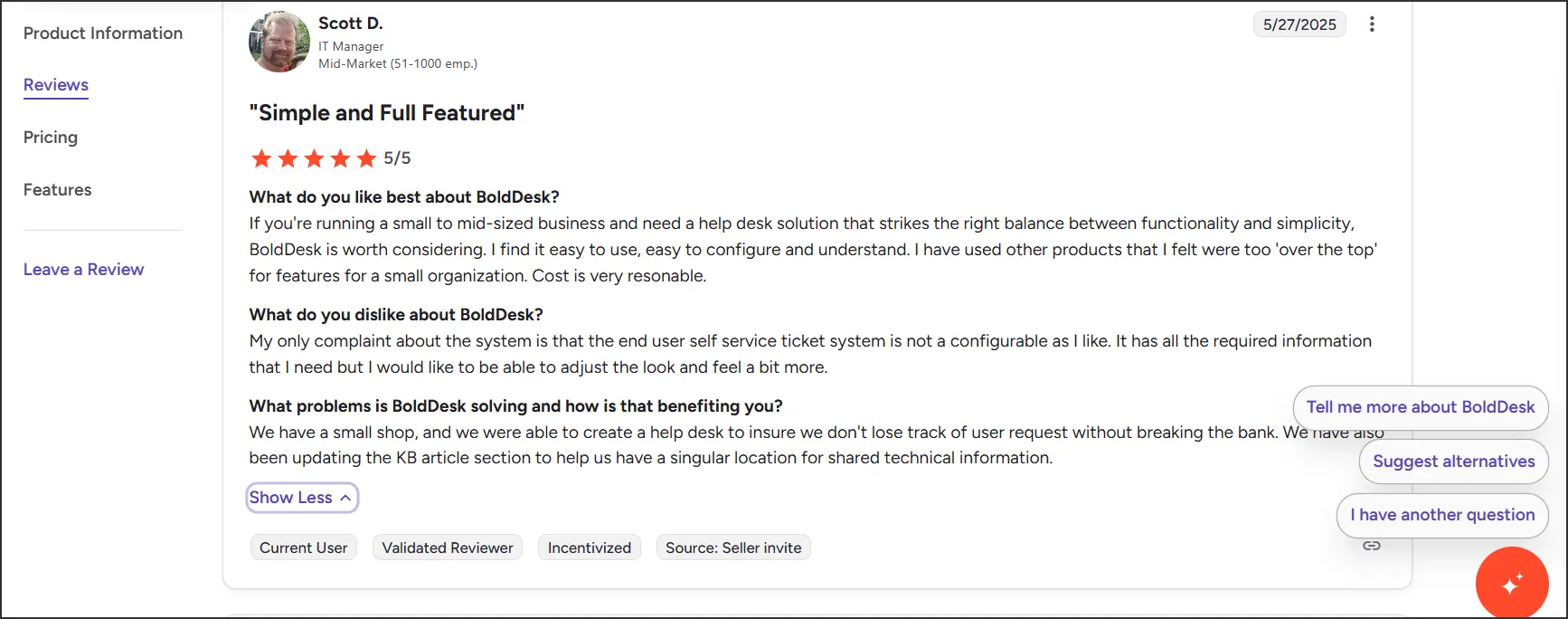
Boldesk reviews highlight it as a strong Intercom alternative and a superior choice compared to Zendesk, boasting an impressive overall rating of 4.5 out of 5 on G2.
Its users praise its comprehensive ticket management system and affordable pricing plans.
One G2 reviewer, Scott D., praised BoldDesk for its “right balance between functionality and simplicity,” highlighting how the platform helps support teams streamline workflows and deliver better customer experiences.
BoldDesk pricing plans
BoldDesk’s agent-based plans start at $99/month for 5 agents and scale based on team size, with free AI credits included within the first 3 months. All features are available across plans, and a 15-day free trial is offered.
For additional AI usage, AI Agent credits cost $20 per 1,000 credits, while AI Copilot costs $20 per agent/month. See the full details on the BoldDesk pricing page.
Looking to grow your team? We’ll guide you to the right solution — chat with our experts now!
Free trial duration: 15 days
Final verdict: Which is the best solution for your business?
In the end, the choice between Intercom versus Zendesk depends on your business’s specific needs.
| Platform | Choose if you |
| Intercom | You need a messaging-first support platform, your team primarily engages customers through live chat and in-app messaging, or you want Fin AI to automate customer conversations. |
| Zendesk | You need advanced ticket management, SLA tracking, voice support, and detailed reporting across multiple support channels. |
| BoldDesk | You want predictable pricing, AI-powered support, robust ticketing capabilities, and access to key features without purchasing multiple add-ons. |
Choose the best Intercom vs Zendesk alternative for your business
When comparing Intercom vs Zendesk for building customer engagement, you must base your selection on your needs and requirements. Both Intercom and Zendesk are very effective customer support solutions, each with benefits and drawbacks of its own.
If you’re looking for the best alternative to Zendesk and Intercom, BoldDesk has everything you need in one platform with straightforward pricing and no feature gating across tiers.
Sign up for BoldDesk’s 15-day free trial and see how it handles your team’s workflows.
Was this article helpful to you? Please comment below.
Related articles
FAQs on Zendesk vs Intercom
Intercom focuses on customer messaging, live chat, proactive customer service, helping teams engage customers through real-time conversations.
Zendesk focuses on ticket management, automation, reporting, and omnichannel support, making it better suited for structured support operations and larger service teams.
For small businesses, Intercom may have a lower starting cost, but expenses can increase as seats, AI features, and usage-based services are added. Zendesk offers stronger ticketing and reporting capabilities, though growing teams may need higher-tier plans and add-ons.
The best choice depends on whether your business prioritizes conversational support, structured ticket management, or long-term scalability.
BoldDesk stands out as a strong alternative to Intercom. It’s a help desk-centric customer service platform known for its seamless integration with multiple communication channels.
BoldDesk offers an affordable, scalable, and user-friendly solution for businesses of different sizes.
Intercom focuses on conversation-based support and messaging workflows, making it a strong choice for chat-focused teams.
Zendesk is built around ticket management, offering advanced routing, SLA tracking, automation, and reporting capabilities that are better suited for high-volume support operations.
Intercom is often easier to deploy for teams that primarily use live chat and customer messaging.
Zendesk provides more extensive customization and workflow capabilities, but it can require additional setup, configuration, and ongoing administration.
Zendesk provides more mature voice-support capabilities through Zendesk Talk and Zendesk Contact Center, including IVR, call routing, monitoring, and contact-center functionality.
Intercom supports phone conversations, but Zendesk is typically a stronger choice for organizations with dedicated voice-support requirements.
Yes. Both platforms provide tools, APIs, and partner-supported migration options to help organizations move customer conversations, contacts, knowledge-base content, and historical data.
The complexity of migration depends on the amount of data, workflows, integrations, and custom configurations involved.
Zendesk is generally better suited for organizations with larger support teams, complex workflows, advanced reporting requirements, and multi-channel customer service operations. Intercom is often a stronger fit for businesses focused on conversational support, customer engagement, and proactive messaging.