

 In this page

TL;DR: Zendesk and BoldDesk both support modern customer service operations, but they take different approaches to helping organizations manage growth, customer interactions, and support workflows. The right choice depends on your team’s operational priorities, support complexity, and long-term business requirements.
Choosing between Zendesk and BoldDesk can significantly impact your customer support operations, team productivity, and long-term costs.
However, they are designed for different needs. BoldDesk is an AI-powered omnichannel help desk that combines ticketing, automation, knowledge base, live chat, customer self-service, and workflow management in one platform.
Zendesk supports advanced workflow orchestration, custom ticket routing, multi-team service management, and complex approval processes.
This guide compares Zendesk vs BoldDesk across pricing, features, AI, security, integrations, and scalability to help you determine which solution is the best fit for your business.
This comparison is published by our team from BoldDesk and includes information gathered from publicly available vendor resources, documentation, and review platforms.
Readers should evaluate each solution based on their specific operational and support requirements.
If you’re searching for a Zendesk alternative, this comparison highlights the key differences between the two platforms and where each solution stands out.
Zendesk vs BoldDesk at a glance
Zendesk and BoldDesk are both comprehensive customer support platforms, but they cater to different business needs.
Both provide the core capabilities required for modern customer support, including ticketing, AI, automation, omnichannel support, reporting, self-service, and integrations. The key differences lie in their pricing, implementation, scalability, and how these capabilities are packaged.
Here’s a quick side-by-side comparison of how the two solutions stack up across key areas.
| Category | BoldDesk | Zendesk |
| Best Suited For | SMBs, startups, SaaS companies, and growing support teams | Mid-market and enterprise organizations |
| Pricing Model | Bundled team pricing | Per-agent, tier-based pricing |
| Starting Price | $99/month for 5 agents along with 500 AI credits/month | $19/agent/month (Support Team) |
| Ticketing and Automation | Ticketing, SLAs, approvals, automation | Advanced ticketing and workflow customization |
| Omnichannel Support | Included in core plans | Suite plans only |
| AI Capabilities | AI Agents, AI Copilot, AI Actions for workflow automation, API-driven integrations, and advanced process orchestration | AI Agents, Copilot, Resolution Platform |
| Reporting | Prebuilt dashboards and analytics | Advanced reporting and custom dashboards |
| Integrations | Popular business and CRM integrations | Large marketplace ecosystem |
| Security and Compliance | HIPAA compliance, SSO, GDPR, audit logs | Enterprise governance, granular permissions, multi-brand admin |
| Implementation and Migration | Free migration and onboarding support | Migration tools, APIs, and partner ecosystem |
| Main Advantage | Simplified administration and predictable pricing | Deep customization, broad integrations |
| Main Trade-Off | Smaller partner and integration ecosystem | Greater administrative complexity and tier-based feature packaging |
This comparison is based on publicly available product documentation, pricing pages, feature information, and vendor resources available at the time of writing.
Because feature availability and pricing can vary by plan, Zendesk and BoldDesk were evaluated based on comparable capabilities rather than entry-level pricing alone.
Organizations should verify current plans and product details directly with Zendesk and BoldDesk before making a purchasing decision.
Common reasons businesses compare Zendesk and BoldDesk
Organizations usually begin evaluating alternatives when they encounter one or more of the following challenges:
- Rising support software costs as teams grow – Organizations often reassess their support platform when licensing, usage, or operational costs increase alongside team expansion.
- Features available only in higher-priced plans – Some businesses compare platforms when key capabilities require plan upgrades or additional subscriptions.
- Additional AI or add-on expenses – AI features, advanced reporting, voice support, and other add-ons can significantly influence total platform costs.
- Longer implementation timelines – Deployment speed, onboarding requirements, and migration effort can impact how quickly teams realize value from a new platform.
- Administrative complexity for workflow management – As support operations scale, organizations may evaluate how easily workflows, automations, permissions, and routing rules can be managed.
- Evolving support requirements that require a different platform approach – Changes in team size, customer volume, channel strategy, or governance needs can lead businesses to reevaluate their existing support solution.
While these concerns may affect some organizations, the impact depends on company size, support volume, and operational requirements.
Customer ratings and reviews
Customer ratings provide an additional perspective on product usability, support quality, ease of implementation, and overall customer satisfaction.
While ratings should not be the sole factor in a purchasing decision, they can help validate real-world user experiences.
| Review Platform | BoldDesk | Zendesk |
|---|---|---|
| G2 Rating | 4.5/5 (as of July 2026) | 4.3/5 (as of July 2026) |
| Capterra Rating | 5/5 | 4.4/5 |
Customer sentiment overview
BoldDesk
- Frequently praised for ease of use, responsive customer support, streamlined onboarding, and value for money.
- Customers often highlight the platform’s straightforward administration and quick setup experience.
Zendesk
- Frequently praised for flexibility, extensive integrations, customization capabilities, and enterprise-scale functionality.
- Some customers note a steeper learning curve and additional costs associated with higher-tier plans and add-ons.
Note: Ratings and review counts may change over time. Refer to G2 and Capterra for the latest customer feedback and scores.
Zendesk vs BoldDesk features comparison
Both platforms offer extensive customer support functionality, but they differ in how they balance usability, flexibility, and operational scale.
The following sections compare the core areas that typically have the greatest impact on support efficiency, customer experience, and long-term platform adoption.
Ticketing and customer inquiry management
Effective ticket management helps support teams organize customer requests and maintain visibility throughout the support lifecycle.
It also enables teams to automate assignments, prioritize issues, and track service-level commitments to improve response efficiency and service quality.
A robust help desk ticketing system centralizes and streamlines these processes, enabling faster resolutions, improved agent productivity, and a better customer support experience.
BoldDesk
BoldDesk is designed to simplify day-to-day ticket management for growing support teams. It centralizes customer requests, service-level tracking, and team collaboration within a unified support environment.
This helps organizations maintain visibility and consistency throughout the support process while emphasizing ease of administration, faster setup, and operational efficiency.
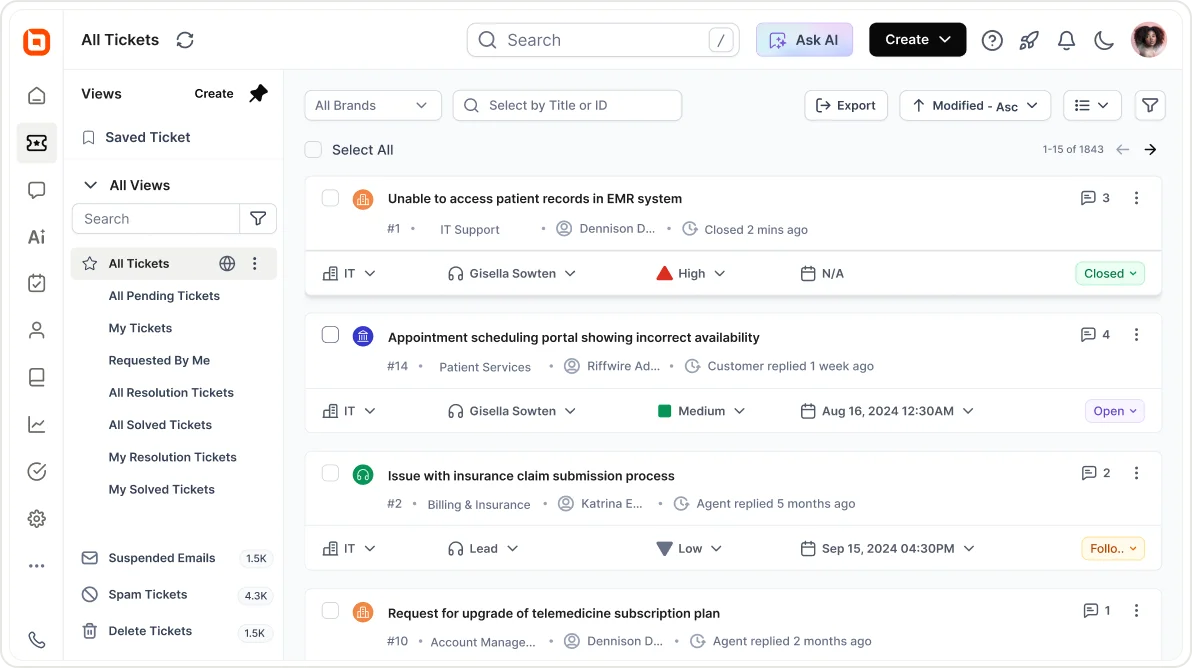
What users say: One G2 reviewer described BoldDesk as “making support smooth with easy ticketing, automation, and helpful support.” This feedback reflects the reviewer’s experience with the platform’s ticketing and automation capabilities.
Zendesk
Zendesk takes a more configurable approach to its ticketing system, helping organizations structure and manage support operations across teams and departments.
Its flexibility allows businesses to adapt support processes as requirements evolve, making it well suited for organizations with larger teams or more complex service environments.
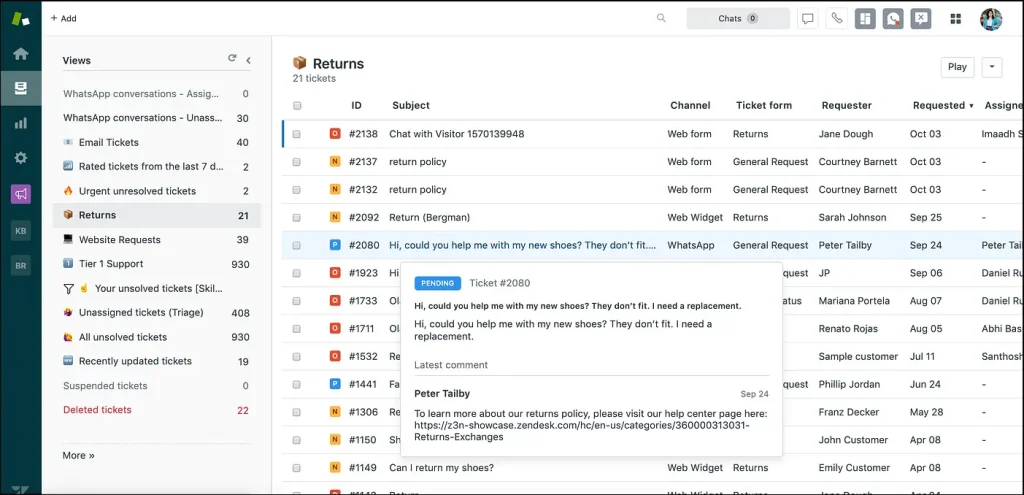
Customer perspective: A verified Capterra reviewer, Jane F., noted that Zendesk “streamlines customer support, keeps tickets and communications organized, and helps provide fast, consistent, and professional service.” This feedback highlights the reviewer’s experience with Zendesk’s ticket management and communication workflows.
Key takeaway: The primary difference lies in operational complexity. BoldDesk emphasizes simplicity and faster administration.
Zendesk offers greater flexibility for organizations managing larger teams, more advanced workflows, or evolving service requirements.
Omnichannel customer service
Modern support teams engage customers across email, chat, social media, messaging apps, and mobile channels.
Effective omnichannel support helps organizations maintain context, reduce channel switching, and deliver a more consistent customer experience.
BoldDesk
BoldDesk focuses on simplifying support by bringing customer conversations from multiple channels into a unified workspace.
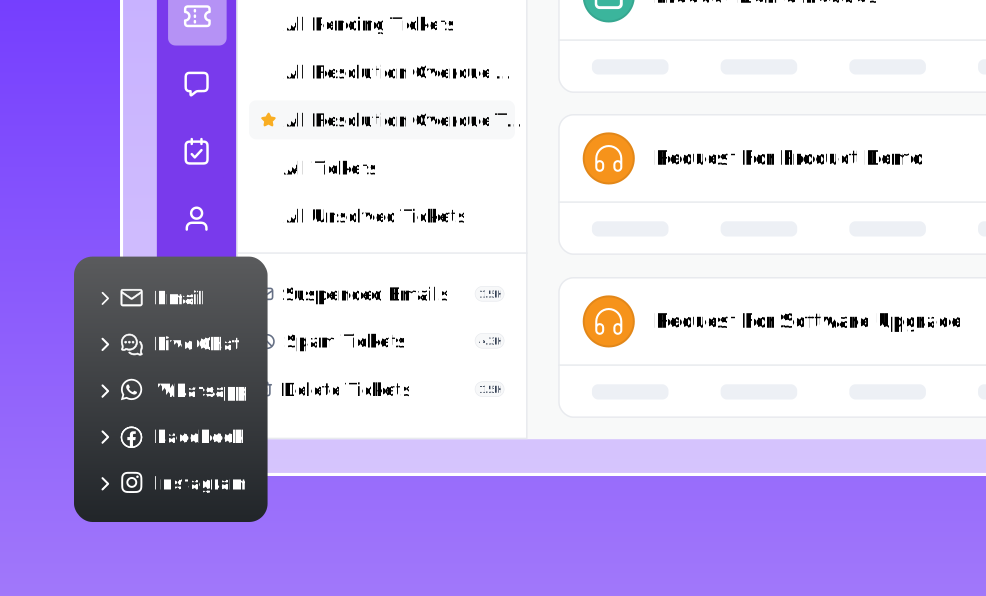
Through its omnichannel customer service capabilities, the platform supports interactions across email, live chat, social media, messaging platforms, and voice integrations.
This approach helps agents maintain customer context, reduce channel switching, and deliver a more consistent support experience across customer touchpoints.
Zendesk
Zendesk approaches omnichannel support from a broader service-management perspective.
It combines email, messaging, social, and voice support with unified customer profiles, conversation history, and operational data.
This approach helps organizations manage customer interactions across larger and more complex service environments.
Key takeaway: BoldDesk focuses on centralized conversation management, while Zendesk emphasizes unified customer data and cross-channel visibility.
Organizations should evaluate which approach best supports their communication channels, customer context requirements, and service operations.
Workflow automation and routing
Workflow automation helps support teams reduce manual effort, improve response consistency, and ensure requests are routed to the right teams.
As support operations grow, automation becomes increasingly important for maintaining efficiency and service quality.
BoldDesk
BoldDesk is designed to make automation accessible for growing support teams. By combining automatic ticket routing, SLA-driven workflows, and escalation management, the platform helps organizations streamline repetitive processes. It also supports consistent service delivery across support operations.
Its approach emphasizes ease of configuration and manageability, making automation easier to adopt without significant administrative effort.
Customer result: Syncfusion, the parent company behind BoldDesk, reported a 50% reduction in ticket handling time after adopting BoldDesk, citing workflow simplification, reduced manual steps, and a more efficient support process.
Zendesk
Zendesk takes a more extensible approach to automation by combining business rules, workflow orchestration, and advanced routing capabilities.
Organizations with complex service operations may benefit from its ability to support cross-functional workflows, larger-scale processes, and evolving operational requirements.
Key takeaway: BoldDesk focuses on making automation easy to implement and manage, while Zendesk provides greater flexibility for complex workflows and service processes.
The right choice depends on how much automation customization and process control your organization requires.
Knowledge base and self-service
Self-service resources help customers find answers independently, reduce ticket volume, and improve support efficiency.
As customer expectations for immediate support continue to grow, knowledge management plays an increasingly important role in customer service.
BoldDesk
BoldDesk combines a multilingual knowledge base, customer portals, AI-powered assistance, and customer self-service capabilities.
These features help customers resolve common issues without requiring agent involvement.
Its approach focuses on making information easy to discover while improving support efficiency.
Zendesk
Zendesk extends self-service through AI-powered knowledge management and connected content sources.
This approach may appeal to organizations that need to surface information from multiple systems and deliver more contextual support experiences.
Key takeaway: BoldDesk focuses on helping customers quickly find answers through self-service resources, while Zendesk emphasizes connected knowledge and AI-powered content discovery.
Organizations should consider how customers access information and where knowledge content is stored across systems.
Reporting and analytics
Reporting and analytics help support leaders measure performance, monitor service quality, identify trends, and make operational decisions based on data.
BoldDesk
BoldDesk focuses on operational reporting that helps teams monitor service performance through dashboards covering ticket trends, SLA compliance, agent productivity, AI activity, and customer satisfaction (CSAT).
These insights help organizations track support efficiency and identify areas for improvement. Its reporting experience is designed to provide actionable visibility into day-to-day support operations without extensive setup.
Zendesk
Zendesk offers analytics capabilities including workforce management insights, quality assurance metrics, cross-channel reporting, and advanced dashboard customization.
Organizations managing larger support operations may benefit from its more extensive reporting capabilities.
Key takeaway: BoldDesk focuses on operational reporting that supports everyday support management, while Zendesk provides broader analytics and workforce management capabilities.
The right choice depends on whether teams need day-to-day visibility or deeper analytical insights for larger service operations.
Integrations and extensibility
Integrations play an important role in connecting customer support operations with CRM platforms, collaboration tools, ecommerce systems, and business applications.
BoldDesk
BoldDesk supports integrations with commonly used business applications while providing APIs and webhooks for custom connections.
Its approach focuses on helping organizations connect essential support workflows without introducing unnecessary complexity.
Zendesk
Zendesk offers a larger marketplace ecosystem with more than 2,000 applications, helping organizations extend customer service workflows across a wide range of business systems.
Its APIs, SDKs, and developer tools provide additional flexibility for custom integrations and platform extensibility. Organizations with extensive technology stacks may benefit from its broader extensibility.
Key takeaway: BoldDesk focuses on connecting the systems most support teams commonly use, while Zendesk offers a larger integration ecosystem and greater extensibility.
Organizations should prioritize the integrations they depend on rather than marketplace size alone.
Implementation and adoption
A support platform creates value more quickly when teams can deploy, learn, and adopt it efficiently. Implementation effort, onboarding requirements, and ongoing administration can all affect time-to-value.
BoldDesk
BoldDesk emphasizes faster onboarding through guided implementation assistance, migration support, and streamlined administration.
Its approach is designed to help organizations reduce deployment effort and begin realizing value sooner.
Customer perspective: In a verified G2 review, a customer highlighted the onboarding experience and support provided during implementation, noting that the BoldDesk team helped ensure a smooth transition to the platform.
Zendesk
Zendesk supports implementation through documentation, training resources, professional services, APIs, and partner networks.
While this flexibility can support highly customized deployments, implementation requirements may vary depending on organizational complexity.
Key takeaway: BoldDesk emphasizes faster onboarding and streamlined implementation, while Zendesk supports more customized deployment scenarios.
Organizations should evaluate how implementation effort, training requirements, and long-term administration align with their operational goals.
Migration considerations: When moving from one help desk platform to another, organizations typically need to migrate tickets, contacts, agents, knowledge base content, custom fields, and workflows.
The effort involved depends on the complexity of existing configurations, integrations, and data volume.
BoldDesk offers free migration assistance for eligible plans to help organizations transfer support data, configure workflows, and reduce disruption during the transition process.
Security, compliance, and administration
Security, compliance, and governance become increasingly important as support operations scale.
Organizations must balance operational flexibility with appropriate controls to protect customer data and support regulatory obligations.
Access management, auditability, and compliance requirements often play an important role when evaluating customer support platforms.
BoldDesk
BoldDesk provides security and compliance capabilities such as SSO, audit logs, role-based access controls.
The platform also supports standards and requirements including ISO 27001, SOC 2, GDPR, and HIPAA compliance.
Its approach is geared toward organizations that need governance controls while maintaining a straightforward administrative experience.
Zendesk
Zendesk extends governance capabilities through granular permissions, advanced audit controls, multi-brand administration, and customer data privacy protection measures.
According to the Zendesk trust center, the platform maintains compliance certifications and standards including SOC 2 Type II, ISO 27001, ISO 27701, ISO 27017, and ISO 27018.
These capabilities may be particularly valuable for organizations operating in highly regulated or complex environments.
Key takeaway: BoldDesk focuses on balancing governance requirements with straightforward administration, while Zendesk provides more extensive governance and compliance capabilities.
Organizations should evaluate which controls, certifications, and oversight requirements best align with their regulatory obligations and operational needs.
AI capabilities comparison: Zendesk vs BoldDesk
AI is now central to customer support, helping teams automate routine inquiries, assist agents, and scale service without adding headcount.
Both BoldDesk and Zendesk focus their AI on two goals: resolving customer questions automatically and making agents more productive, but they differ in depth and how the capabilities are packaged.
BoldDesk AI
BoldDesk focuses on automating both customer interactions and agent workflows. Its AI capabilities are designed to reduce repetitive work, improve response times, and help support teams operate more efficiently.
- AI Agents: Resolve common customer questions, support multiple languages, and hand off conversations to agents when needed.
- AI Copilot: Assists agents with reply generation, ticket summaries, and knowledge recommendations.
- AI Actions: Automates operational tasks such as order lookups, refunds, and workflow execution.
AI availability: AI capabilities are available starting with BoldDesk’s entry-level plans and can also be explored during the free trial.
AI credits are included for the first three months, after which additional credits can be purchased based on usage requirements.
Zendesk AI
Zendesk focuses on using AI to automate customer interactions, support agent productivity, and help organizations manage more complex service operations.
Its AI capabilities are designed to improve efficiency, provide more contextual assistance, and connect service experiences across teams and systems.
- AI Agents: Help resolve customer inquiries, support multi-step interactions, and automate actions across connected systems.
- AI Copilot: Assists agents with contextual recommendations, response guidance, and workflow support.
- Knowledge Graph and AI Insights: Improve response relevance through connected content sources. AI-powered quality assurance scores help teams identify coaching opportunities and continuously improve support quality.
AI availability: Core AI capabilities are included within Zendesk Suite plans, while more advanced AI functionality may require higher-tier plans or additional add-ons.
Both platforms provide AI capabilities that can improve service efficiency and reduce manual effort.
The better fit depends on your support requirements, how AI is expected to interact with customers and agents, and the overall cost and operational impact of the AI features you plan to use.
Zendesk vs BoldDesk pricing comparison and total cost of ownership
Pricing is often one of the most important factors when choosing customer support software, but comparing subscription fees alone does not provide a complete picture.
Feature availability, AI offerings, implementation requirements, and plan packaging can all affect the overall value organizations receive from their investment.
When comparing Zendesk pricing vs BoldDesk pricing, it’s important to look beyond the starting price and evaluate what each platform includes as your support team grows.
| Pricing factor | BoldDesk | Zendesk |
| Entry-level pricing | Starts at $99/month for 5 agents ($19.80 per agent) with annual billing. | Starts at $19/agent/month with annual billing. |
| Pricing structure | Uses bundled pricing based on agent ranges. | Uses per-agent pricing across multiple plan tiers. |
| AI pricing | Includes AI credits with every plan and charges $20 per 1,000 additional AI credits. Optional AI Agent and AI Copilot add-ons are available. | Includes AI features in plans, with advanced AI capabilities available through higher-tier plans and add-ons. |
| Feature availability | Includes ticketing, automation, AI workflows, reporting, knowledge base, and other core capabilities in a single plan structure. | Advanced features become available as plan levels increase. |
| Scalability | Pricing increases based on agent bands and usage requirements. | Multiple plan tiers, add-ons, and enterprise options support larger deployments. |
| Cost predictability | Transparent pricing structure designed to help organizations forecast support costs. | Costs can increase with higher-tier plans, add-ons, and usage-based services. |
Note: Pricing, ratings, and product capabilities referenced in this article were reviewed as of July 2026. Product packaging, AI functionality, pricing structures, and customer ratings may change over time.
Readers should verify current information directly with the vendor before making a purchasing decision
Both solutions offer multiple pricing tiers, but the overall cost can vary depending on required features, AI usage, support channels, and organizational requirements.
Compare equivalent plans rather than entry-level pricing alone to evaluate overall value more accurately.
For a more tailored estimate, costs can also be modeled based on team size, ticket volume, and AI usage requirements using the BoldDesk AI ROI calculator.
Key takeaway: Pricing is only one part of the evaluation process. Implementation effort, training requirements, and ongoing administration can influence how quickly teams adopt a platform and begin realizing value.
These factors can also affect the time, resources, and operational investment needed to support the platform over the long term.
Organizations should also consider AI usage, third-party services, and long-term operational costs when assessing overall value and total cost of ownership.
Which platform is right for your industry?
Support requirements vary across industries. Organizations often evaluate customer support platforms based on compliance, workflow complexity, customer volume, communication channels, and integration needs.
The importance of each factor depends on the organization’s operational goals and service environment.
SaaS and technology companies
SaaS businesses often prioritize automation, self-service resources, developer integrations, SLA management, and scalable support operations.
- BoldDesk: Enables growing SaaS teams to launch quickly with automation, self-service, omnichannel support, and integrations that connect support workflows with development and business tools.
- Zendesk: Supports SaaS organizations that need to tailor customer service around complex product workflows through extensive customization, API-driven workflows, and a broad integration ecosystem.
Key consideration: Support volume, integration requirements, and workflow complexity often have a greater impact on platform selection than company size alone.
E-commerce and retail
Retail organizations typically manage large volumes of inquiries related to orders, returns, shipping updates, and product information across multiple channels.
- BoldDesk: Streamlines high-volume retail support by consolidating customer conversations across channels and automating repetitive requests. Integrations with platforms such as Shopify can further simplify order-related support workflows.
- Zendesk: Supports high-volume retail operations through advanced routing, omnichannel engagement, and integrations that connect customer support with ecommerce, marketing, and fulfillment systems.
Key consideration: Evaluate channel requirements, AI automation needs, and ecommerce integrations rather than focusing solely on agent pricing.
Healthcare and healthcare technology
Healthcare organizations generally require secure communication, auditability, access controls, and compliance-related capabilities.
- BoldDesk: Delivers compliance-focused security controls, auditability, and access management capabilities that support governance and regulatory requirements.
- Zendesk: Provides advanced governance capabilities that support complex compliance, oversight, and operational requirements.
Key consideration: Compliance obligations, governance needs, and administrative responsibilities should be evaluated alongside feature considerations.
IT service and internal help desks
Internal IT teams often require structured ticketing, SLA management, automation, approvals, and escalation workflows.
- BoldDesk:Standardizes internal service delivery through automation, SLA management, approvals, and structured ticket workflows.
- Zendesk: Supports complex IT service management environments with flexible workflows, routing controls, and configurable service processes.
Key consideration: Consider workflow complexity, reporting requirements, and long-term administration needs when comparing platforms.
Zendesk vs BoldDesk: Choosing the right customer support platform
Both platforms support a wide range of customer service requirements but are designed for different operational priorities.
BoldDesk is aimed at organizations seeking predictable pricing, streamlined administration, and faster implementation.
As well Zendesk is aimed at organizations seeking advanced customization, governance controls, and a broader integration ecosystem.
Organizations should evaluate their workflow complexity, growth plans, integration requirements, and budget before selecting a platform.
If you’re narrowing down your options, the best way to evaluate fit is to see how the platform supports your specific workflows, team structure, and support requirements.
You can explore BoldDesk through a free trial or schedule a personalized demo to assess how it aligns with your customer service goals.
Related articles
- Freshdesk vs Zendesk: A Comparison Guide for 2026
- Intercom vs Zendesk: Find the Best Solution for Your Customer Support
- 16 Best Help Desk Software in the Market (2026)
Frequently asked questions
Migration typically involves transferring tickets, contacts, agents, knowledge base content, custom fields, and workflows. The effort required depends on data volume, integrations, and customization needs. Organizations should evaluate migration support, onboarding resources, and implementation timelines before making a switch.
BoldDesk includes enterprise-oriented capabilities such as workflow automation, omnichannel support, audit logs, security controls, and reporting. Organizations with advanced governance or highly specialized requirements should evaluate whether these capabilities align with their needs.
Migration complexity varies based on ticket volume, integrations, custom fields, workflows, and historical data requirements. BoldDesk provides migration assistance intended to simplify the transition process.
Both Zendesk and BoldDesk integrate with popular CRM, collaboration, productivity, and customer support tools. BoldDesk is generally easier to set up and manage, while Zendesk offers a broader integration ecosystem for organizations with more complex workflows and enterprise requirements.
Training requirements depend on workflow complexity and organizational processes. The platform is positioned as being easy to adopt, but administrators and agents may still require onboarding and configuration training depending on deployment scope.