

 AI Agents
 AI Copilot
 AI Actions
 AI ROI Calculator


 SaaS
SaaS Insurance
 Telecom
 Healthcare
 Startups
 Fintech
 Email Ticketing System
 Shared Inbox Software
 Multi Brand Help Desk
 Internal Help Desk Software
 Trouble Ticketing Software
 Mobile Help Desk


 Blog
Blog



TL;DR: Shopify support spikes can overwhelm teams, leading to slower replies and frustrated customers. These spikes are often triggered by sales events, process gaps, or shipping issues. With the right workflows and tools, support teams can stay consistent and protect customer trust.
When customer inquiry volume doubles, support teams get overloaded, customers face delays, and revenue risk increases, especially during sales events or shipping disruptions.
With better automation, self-service, and centralized tools, Shopify store support operations can reduce bottlenecks and manage spikes effectively.
According to Edesk, 38% of online shoppers expect support immediately, and one‑third expect a response within one hour.
This blog breaks down why sudden store volume spikes happen, how they create Shopify support bottlenecks, and what modern Shopify store support teams can do to stay consistent even as demand rises.
Why Shopify support volume spikes
Shopify support volume refers to the total number of customer inquiries a store receives across email, chat, social media, in-app messaging, and other channels during a given period.
In practice, Shopify store support volume spikes create immediate support challenges, such as repeat “Where is my order?” (WISMO) requests and fast-growing customer inquiry queues. 
For many growing Shopify stores, support volume doesn’t increase gradually it spikes suddenly. The most common triggers include:
Flash sales and promotions
Flash sales and promotional bursts can trigger sudden traffic spikes that overwhelm support teams. Slower order updates raise concerns about payments and delivery, leading to a surge in “Where is my order?” messages.
When systems aren’t built for peak demand, teams face confusion, repetitive inquiries, and heightened customer urgency within a short, intense window.
New product launches
New product releases can spike unfamiliar questions as customers explore new features. Teams must respond quickly to adders customer needs when information is still emerging.
Clear coordination helps ensure accurate and consistent answers from the start.
Shipping delays during peak seasons
Peak-season slowdowns can make delivery timelines unpredictable, increasing customer anxiety. Shoppers frequently check tracking updates and seek reassurance about their orders.
Smooth cross-team collaboration with fulfillment helps provide timely and reliable updates.
Policy changes
Updates to returns, refunds, or payment rules often create confusion for customers. Support teams must clarify what’s changed and how it affects existing orders.
Fast and accessible real-time support ensures customers get answers without delay.
Rising real-time expectations
Customers now expect faster communication across all channels. Even small delays can feel frustrating as expectations rise.
Teams must maintain accuracy and stay consistent while managing increasing volume and speed.
First 24‑hour action plan for a sudden Shopify support volume surge
During Shopify support surges, focus on stabilizing response times, reducing repeat inquiries, and protecting customer trust. Here are a few steps to regain control quickly:
- Set expectations: Update auto‑replies and add a help‑center banner noting higher volume and longer response times.
- Cut WISMO tickets: Post one shipping/status update across the help center, social media, and storefront with timelines and clear next steps.
- Triage fast: Sort tickets into five queues such as address changes, payment issues, cancellations/refunds, damaged items, and shipping/WISMO and handle them in that order.
- Use templates: Apply one approved response template per queue outlining order status, next action, and a specific timeframe.
- One escalation path: Route all approval‑required cases (lost packages, reshipments, fraud/chargebacks, VIP orders) to a single owner for faster decisions.
When higher volume reveals hidden weaknesses
When Shopify support bottlenecks, small inefficiencies that once felt harmless quickly become major blockers. Even well-structured workflows begin to strain, exposing friction points that only appear under pressure.
Here are the gaps that form the foundation of most Shopify store support bottlenecks:
- Inbox overload and lost context: Shared inboxes and disconnected tools make it hard to track ownership, history, and priority. Agents spend more time searching than resolving.
- Manual triage slows everything down: Without automation, tickets pile up faster than teams can categorize or assign them, delaying urgent issues.
- Inconsistent customer communication: Different agents answering the same question in different ways erodes trust and creates confusion.
- No clear ownership: When it’s unclear who owns what, issues bounce between people, or worse, stall completely.
The impact of e-commerce support surges on operations, customers, and revenue
Support surges slow down responses, increase customer frustration, and strain internal teams. These delays directly affect revenue, trust, and long‑term customer value.
Even small communication gaps can shift how customers perceive your brand’s reliability.
Customer experience impact
Longer wait times create uncertainty and raise anxiety around ongoing orders. Repeating issues across channels can lead customers to doubt consistency and efficiency.
According to a Salesmate report, 74% of consumers are more likely to make a purchase based solely on their service experience.
When updates are delayed, they often rely on customer reviews to judge whether the store can be trusted.
Business impact
When responses slow, customers frequently cancel orders, request refunds, or escalate concerns. This behavior reduces conversions and increases churn risk across your entire customer base.
Disputes and negative feedback rise quickly when reassurance is missing at critical moments.
Early warning signs include:
- Pre-shipment cancellations are increasing
- More “Item not received” messages
- Spikes in returns and refund requests
Operational impact
Support surges affect every channel like email, chat, social, and in-app customer support at once. Backlogs form quickly, especially around shipping updates and post-purchase uncertainties.
Without proper processes, small customer service mistakes can compound and create bigger bottlenecks.
Stabilize these issues quickly by using channel-based surge queues with smart routing, publishing proactive status updates to cut repeat inquiries, and maintaining a rotating social escalation owner.
Brand perception impact
Slow or inconsistent communication can erode trust and make customers question your reliability. Every missed update feels amplified during high-stress moments.
Clear, consistent messaging strengthens confidence even when delays occur.
Customer lifetime value (CLV) impact
Long-term retention relies heavily on dependable post-purchase support. When service quality drops, customers are less likely to return, directly lowering lifetime value.
Stores that deliver reliable help after checkout consistently outperform those that struggle during surges.
How high-growth Shopify stores prepare for support surges
Shopify stores can handle support surges by deploying scalable help desk tools, automating repetitive queries, strengthening self‑service, centralizing systems, and tracking key support metrics.
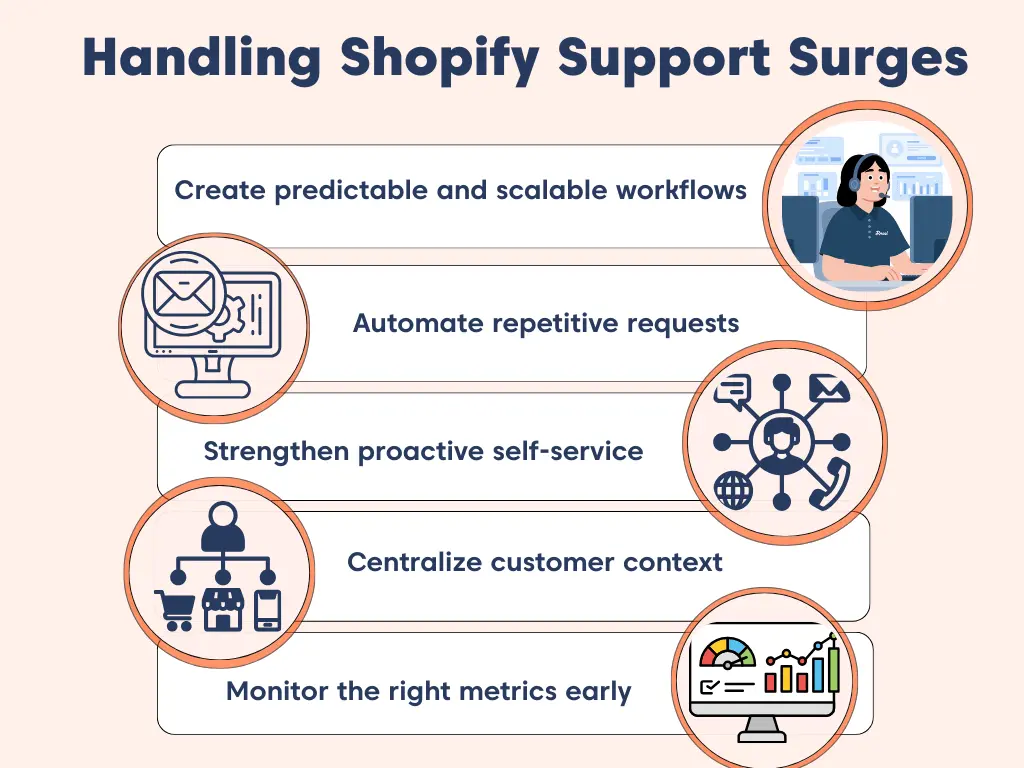
The goal is to replace reactive work with predictable workflows that support teams can trust, even during busy periods. Below are the core ways to turn chaos into control.
Build predictable, scalable workflows
Basic tools struggle as conversations rise. A purpose-built e-commerce help desk adds structure, visibility, and alignment when workloads spike.
Put these in place:
- Ticket ownership so every issue has a clear owner
- Prioritization so urgent requests are handled first
- SLA‑driven expectations for consistent response quality
- Unified customer context (orders, history, channel behavior) in one view
These foundations reduce confusion and prevent repeated work at peak times.
Automate repetitive requests
High‑volume questions (order status, shipping delays, address changes, returns) shouldn’t need manual replies every time.
According to Opensend, 82% of customers expect an immediate live‑chat response, and many define “immediate” as under 10 minutes.
Automations, templates, and triggers deliver automated customer service that scales.
Automation helps you respond faster during peaks, prevents backlogs from compounding, reduces agent burnout, and maintains quality without immediately adding headcount.
Real-life example: Apexa iQ scaling customer support with customizable workflows
Apexa iQ switched from an outdated help desk to BoldDesk to streamline customer support. Customizable ticket forms helped them capture the right details upfront and reduce back‑and‑forth. A simple, seamless customer portal improved how customers submitted and tracked their requests.
Result: Better data capture and a frictionless support portal reduced handling delays and helped the team scale support efficiently as their customer base grew.
Strengthen self-service before customers reach out
A strong help center reduces avoidable tickets and speeds up resolution. When paired with knowledge base software, customers can quickly find answers without repeating their questions.
Offer resources such as:
- Searchable, up‑to‑date articles
- Clear step‑by‑step instructions with visuals
- Troubleshooting guides for shipping, returns, billing, and common product issues
This approach lowers inquiry volume and minimizes customer service problems before agents even get involved.
Centralize customer context
When customer conversations, order details, and history live in one workspace, agents can give accurate answers without switching tools.
This streamlines handoffs and reduces manual sorting, so responses stay consistent and timely during high-volume periods.
Real-life example: Dynavics eliminating confusion by centralizing ticket management
Dynavics turned to BoldDesk after struggling with fragmented support channels. BoldDesk gave them a single, structured system to manage all tickets and customer interactions. Their case study notes that it “found an answer” to their support challenges by centralizing everything in one place.
Result: With one source of truth for customer conversations and order‑related issues, the team reduced manual searching, sped up response times, and delivered more consistent service.
Monitor the right metrics early
Tracking the right metrics early helps teams stay proactive and resolve issues before they escalate. Track first response time, resolution time, backlog size, ticket deflection rate, channel mix, and CSAT weekly to spot issues early and stay consistent during demand peaks.
Turning Shopify customer support surges into opportunities
Shopify flash‑sale surges may be intense, but they reveal what customers expect and where your processes can improve.
With the right workflows and tools like BoldDesk, teams stay organized, consistent, and confident, no matter how high the volume gets.
Strong support during peak moments doesn’t just solve problems, it builds trust and long‑term loyalty.
When customers feel heard quickly, they’re more likely to return. What challenges have you faced during support spikes? Share your experience in the comments.
Frequently Asked Questions
Support spikes are mainly caused by flash sales, shipping delays, product launches, or internal workflow gaps that confuse customers.
Automation, self‑service knowledge bases, optimized workflows, and predefined macros lessen repetitive inquiries in flash sales and keep agents focused on higher‑value interactions.
Long wait times, inconsistent responses, slow ticket resolution, and rising customer frustration signal an emerging bottleneck.
Delayed or unclear responses increase customer anxiety and reduce trust, while transparent updates help maintain confidence.
In most cases, yes. A dedicated e-commerce help desk improves speed, accountability, and consistency as support volume scales.



 In this page