

 In this page

TL;DR: AI agents and chatbots serve different support needs. Chatbots handle simple, scripted conversations like FAQs and order tracking. AI agents go further by understanding intent, reasoning across systems, and autonomously resolving complex, multi‑step issues. Choosing the right option depends on your support complexity, personalization needs, and long‑term automation goals.
You’ve probably interacted with conversational AI for customer service more often than you think. Maybe it was a chatbot that kept repeating the same generic replies or a voice assistant that anticipated what you needed with surprising accuracy.
Whether you’re asking Google Assistant for directions or messaging a support bot outside business hours, AI is changing how we communicate and solve everyday problems.
With over 90% of organizations investing in AI technologies (McKinsey Global Survey), understanding the difference between an AI agent vs chatbot matters more than ever.
Both are designed to streamline operations and improve customer experience, but they’re built for fundamentally different roles.
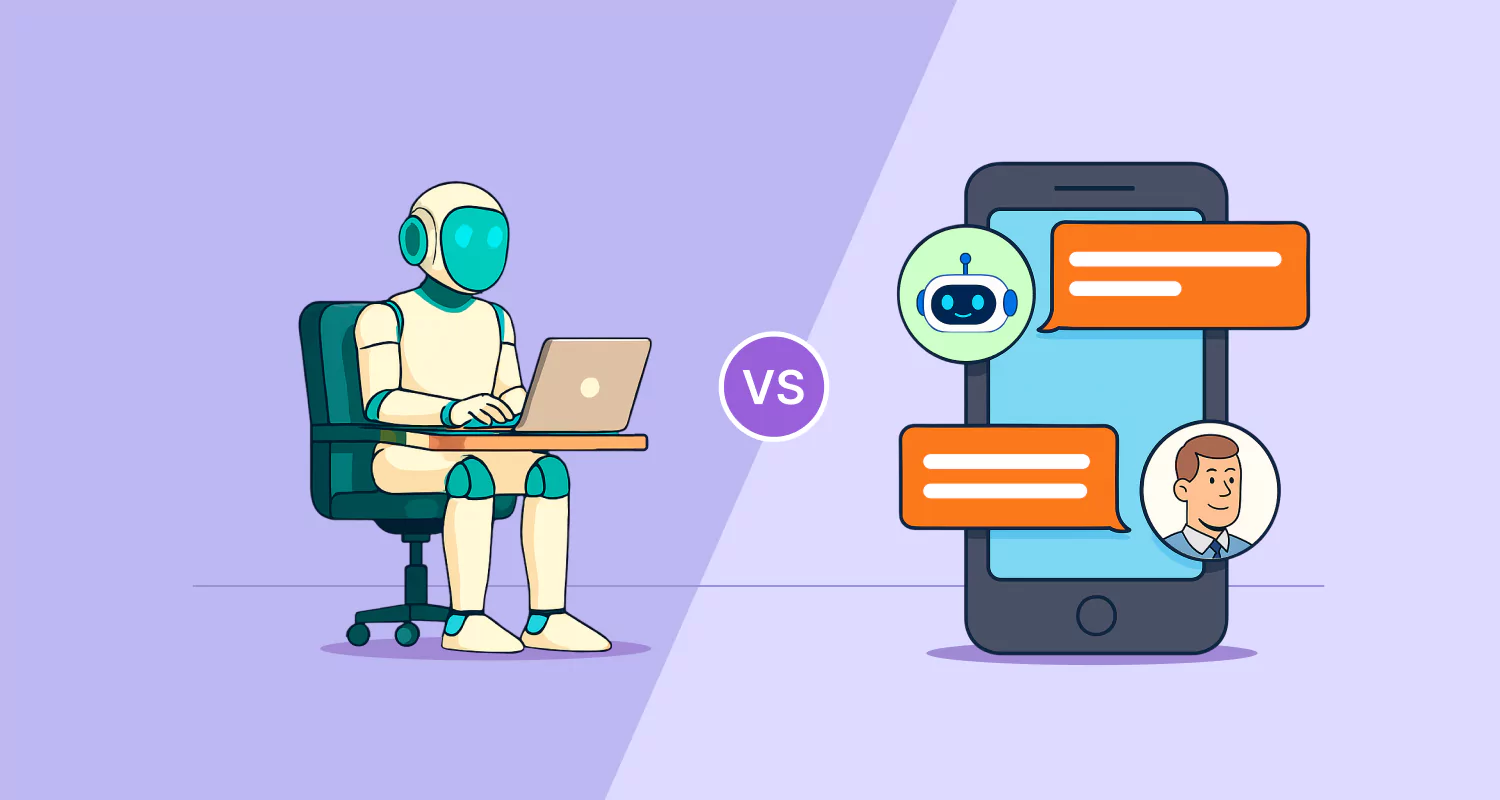
At the core, the main difference between an AI agent and a chatbot is autonomy: chatbots respond to predefined inputs, while AI agents can plan, decide, and execute tasks independently across systems.
In this blog, we’ll break down the key differences between an AI agent vs chatbot, walk through practical examples, and help you choose the right approach for your customer support needs.
What is an AI agent?
An AI agent is an intelligent system that uses advanced AI technologies such as machine learning and large language models (LLMs) to understand user intent, plan actions, and autonomously execute tasks.
Unlike rule-based chatbots that rely on scripted responses, autonomous AI agents can learn from past interactions, adapt to new information, and access external data sources to solve complex, multi-step tasks.
With the ability to make decisions and take independent actions to achieve specific goals, AI agents are ideal for dynamic environments like customer support, supply chain management, manufacturing, and workflow automation.
What is a chatbot?
A chatbot is a conversational tool designed to respond to user questions through text or voice interfaces.
Most chatbots are built to handle predictable, repetitive interactions, such as answering FAQs, sharing order updates, or routing users to the right resource.
Chatbots can be rule-based or AI-powered, often using natural language processing (NLP), but they primarily focus on responding to conversations rather than executing actions across systems.
Differences between an AI agent vs chatbot
Although AI agents and chatbots are often grouped together, they differ significantly in intelligence, capabilities, and the roles they play in automation.
Understanding these differences helps you choose the right solution for customer support, automation, and long-term scalability.
Let’s explore AI agent vs chatbot differences and why it matters.
| Feature | Chatbots | AI agents |
| Intelligence level | Confined to predefined responses | Predictive, autonomous decision-making |
| Learning capabilities | Limited learning from interactions | Continuous learning and improvement |
| Autonomy and decision-making | Reactive, only responds when prompted | Proactive, can initiate conversations |
| Personalization | Basic personalization, like username and preferences | Dynamic and adaptive personalization based on user behavior and data |
| Tooling and integrations | Works with basic messaging platforms | Extensive integration across advanced tools and APIs |
| Best for | Ideal for businesses with straightforward tasks | Businesses with complex needs and a focus on long-term automation |
Intelligence level
Chatbots are typically designed for conversational responses within defined flows or limited scopes and often fall back on generic replies when queries go off script. This limits their accuracy in real‑world, unpredictable scenarios.
In contrast, AI agents deliver more reliable outcomes by understanding context and pulling the right information in real-time, enabling them to resolve complex issues and provide more accurate, situation‑aware responses.
Learning capabilities
Chatbots remain largely static and require manual updates to stay relevant, which slows improvement over time.
Gartner highlights that AI agents are evolving from embedded assistants into task-specific, goal-driven systems.
AI agents continuously improve by learning from past interactions and outcomes, allowing them to adapt as products, policies, and customer needs evolve.
Autonomy and decision making
Chatbots react only when prompted and are suited for simple, repetitive requests. They can’t make decisions autonomously.
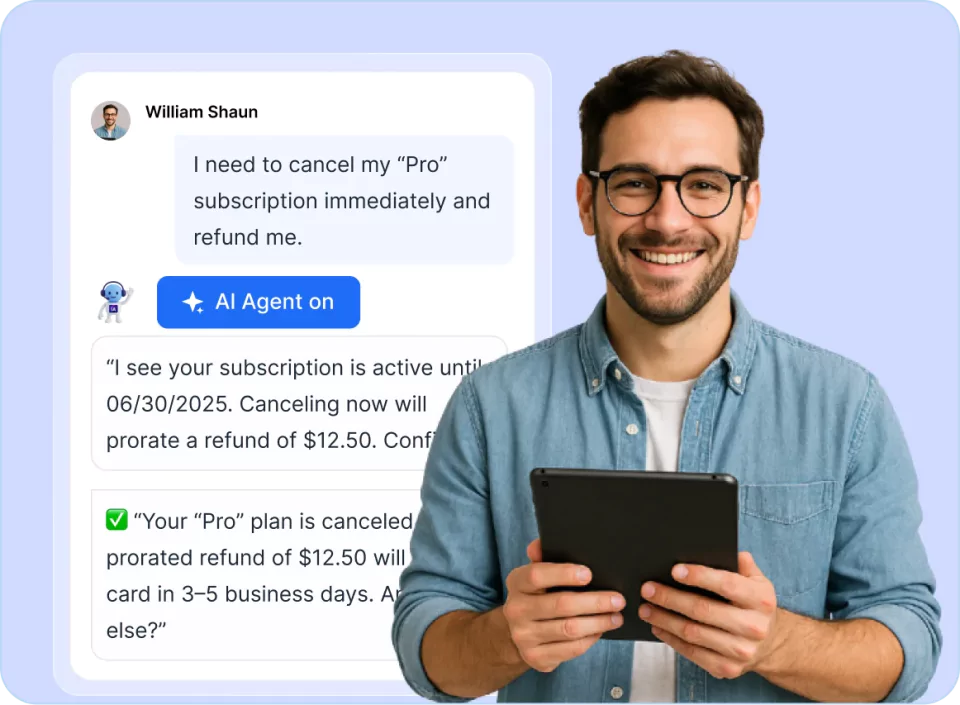
Autonomous AI agents, by contrast, operate proactively. They can initiate conversations, assess situations in real-time, and act across systems without human involvement.
According to ControlHippo, this level of autonomy can increase task automation efficiency by 45%, while resolving complex requests with minimal handoffs.
When confidence is low or policies require approval, they intelligently escalate to human agents.
Personalization and context-awareness
Chatbots offer basic personalization, such as using your name or remembering your last question within a session, and often feel scripted when conversations deviate from expected paths.
AI agents deliver deeper personalization by adapting responses based on user history, preferences, and behavior, creating more natural and engaging support experiences.
Tooling and integrations
Chatbots usually have limited integration capabilities, often connecting to just one or two systems, restricting what they can resolve end‑to‑end.
AI agents integrate across multiple platforms such as CRMs, ticketing systems, and knowledge bases, allowing them to complete complex workflows and drive faster resolutions.
How to choose between an AI agent vs chatbot
Choosing between an AI agent and a chatbot starts with your end goal: do you need straightforward conversational support, or do you want intelligent, autonomous task execution?
As Ginni Rometty, former CEO of IBM, put it: “Artificial intelligence will not replace humans, but those who use AI will replace those who don’t.”
In customer support, that means the winners won’t be the teams that replace agents; they’ll be the teams that augment them with the right automation for the job.
Here’s a practical way to evaluate both options and choose what fits your business needs.

Consider task complexity and scope
Assess the complexity of the tasks that you want to automate. If your daily interactions mostly involve repetitive tasks such as FAQs, appointment booking, or simple guided workflows, a chatbot is usually enough.
Chatbots resolve 90% of queries in under 11 messages, but are often limited to scripted or FAQ-based interactions (Tidio).
If your needs involve multi-step reasoning, decision-making, or actions across systems—such as processing returns, troubleshooting technical issues, or analyzing real-time data, an AI agent is better suited.
Evaluate your user requirements
Think about the experience your customers expect. If speed and consistency are key, like getting quick answers to FAQs or navigating a support menu, a chatbot delivers reliable, fast responses.
When users need personalized, adaptive conversations in which the AI remembers past interactions, adjusts tone, and handles complex or emotional queries, an AI agent provides a more human-like experience.
If your goal is to deliver a smooth, personalized, and engaging experience, especially for more complex or emotional customer needs, AI agents are a better choice.
Assess your budget
Be realistic about what you can invest both upfront and over time. Your financial capacity is key in choosing between an AI chatbot and an AI agent.
AI chatbots are typically faster and cheaper to build and maintain. They work well with limited data and don’t require complex integrations.
AI agents demand more investment in development, training, and infrastructure. They often need access to multiple data sources and ongoing tuning.
Think of scalability and growth
Consider how your customer needs might evolve. Chatbots are great at handling large volumes of simple, repetitive tasks. However, they often struggle to adapt or scale effectively as your business grows and customer needs become more complex.
AI agents are built to learn through feedback loops, improve over time, and scale with your organization. They’re ideal if you’re planning long-term automation or digital transformation.
Data privacy and security considerations
Protecting user data is non-negotiable, no matter which tool you choose.
AI chatbots are generally easier to secure since they handle limited, low-risk data such as appointment scheduling. This makes them suitable for organizations with basic privacy needs.
However, they must still comply with regulations like GDPR or local data protection laws, depending on your region.
AI agents often access more sensitive data across multiple systems, such as billing details, making them more vulnerable to threats like phishing attacks and data leaks.
To mitigate these risks, businesses should implement strong security measures, such as encryption, role-based access controls, and regular audit trails.
In summary:
• Use a chatbot when support tasks are predictable, FAQ‑driven, and require minimal system integration.
• Use an AI agent when workflows involve tool access, multi‑step resolution, personalization, or proactive engagement across systems.
AI agent vs AI chatbot use cases in customer service
AI agents and chatbots are both used in customer service, but they serve very different purposes.
Chatbots are ideal for quick, repetitive interactions, while AI agents handle complex, goal‑driven workflows that require autonomy and system integration.
Each tool delivers value in different support scenarios depending on task complexity, system access, and required level of automation.
Chatbot use cases
Chatbots operate based on scripted responses and decision trees, making them reliable for straightforward queries.
The following are some of the AI chatbot use cases:
Answering FAQs
A retail brand could use a chatbot to answer common questions like “Is there a free plan available?” or “What’s your return policy?” instantly.
The chatbot matches customer queries to scripted responses, providing prompt replies to basic support inquiries, reducing wait times, and improving customer satisfaction.
Basic lead qualification
Businesses can use chatbots to qualify leads by identifying which visitors are genuinely interested in their products or services.
Chatbots engage users in conversation, ask relevant questions, and collect basic information, such as their needs or intent.
Typical AI chatbot online prompts include:
- “Would you like to book a demo?”
- “Can I get your email to send more details?”
Order status inquiries
An online store could use a chatbot for ecommerce to help customers track their orders, check estimated delivery dates, and report missing items.
Real-life example:
Sephora’s bot provides customers with real-time updates on shipping, delivery timelines, and order history, providing 24/7 automated support.
First-level IT support
A business could use a chatbot to guide customers through simple troubleshooting steps for basic technical support issues. The bot could help customers solve common issues without waiting for a human agent.
Examples include:
- “Send me a password reset link.”
- “How do I install the VPN?”
Employee self-service
An organization could use a chatbot to assist employees with checking leave balances, downloading pay slips, updating personal details, and finding company policies.
Examples include:
- “How many leave days do I have left?”
- “Where can I find the travel reimbursement policy?”
AI agent use cases
AI agents are designed for complex, multi-step tasks that require autonomy, context awareness, and integration with external systems.
According to McKinsey, AI agents powered by large language models could contribute up to $4.4 trillion in productivity growth across corporate use cases.
Here’s where a business might use AI agent automation:
Refund automation
AI agents in customer service can help ecommerce businesses handle end-to-end refund processes, all without human intervention.
AI agents can:
- Validate purchase history
- Apply refund policies
- Trigger refund transactions
- Send confirmation emails
Real-life example:
An AI agent in ecommerce customer service could verify order status, check refund eligibility, initiate the request, and notify the customer without requiring manual support agent intervention.
Scheduling and coordination
A consulting firm could deploy an AI agent as a virtual executive assistant.
The agent can coordinate meetings across time zones, resolve conflicts, prioritize urgent appointments, and suggest optimal times based on participants’ availability and workload.
Intelligent customer journey mapping
A telecom company could use an AI agent to analyze customer behavior across channels, such as phone, chat, and app usage.
The agent could then trigger retention workflows like personalized offers or proactive outreach.
Billing issue resolution
A subscription-based SaaS company could build an AI agent to handle billing-related inquiries.
The agent can access billing systems to verify transactions, apply company policies to determine refund eligibility, and generate and send updated invoices or receipts autonomously.
Building powerful AI agents with BoldDesk
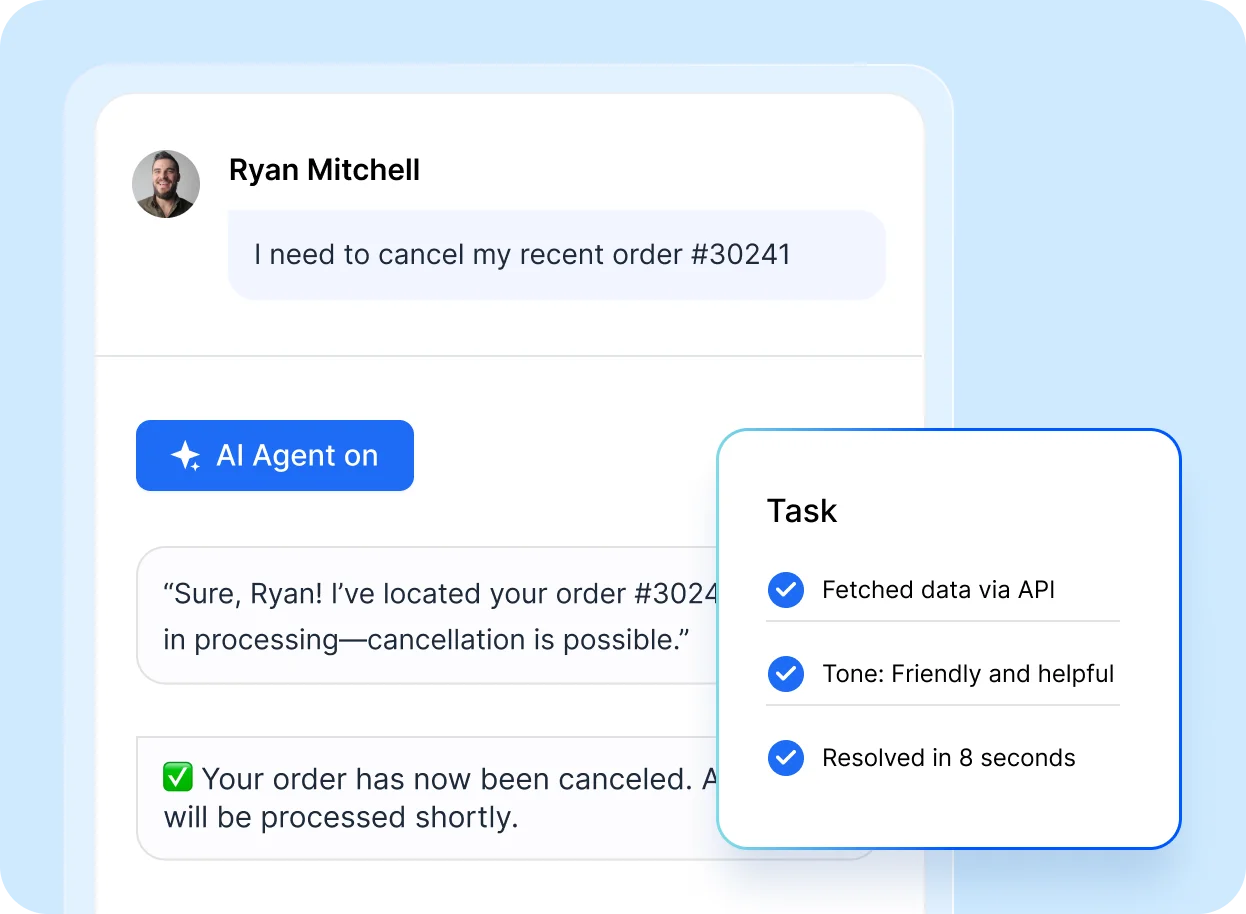
BoldDesk’s AI Agent is a fully autonomous support assistant designed to think, act, and resolve issues like a human, but with the speed and accuracy of AI.
Unlike traditional chatbots that rely primarily on scripted flows and decision trees, BoldDesk’s AI Agent understands context, adapts to customer intent, and can trigger real-time actions and escalate to a human agent when needed.
Key features of BoldDesk’s AI Agent
- AI Actions: Enables AI agents to integrate with external APIs to perform real-time, automated tasks, such as canceling orders, updating customer information, or retrieving shipment statuses, without human intervention.
- Customizable tone: Allows you to adjust the communication style (friendly, professional, casual) and response length to match your brand.
- Knowledge-based responses: Pulls accurate answers from your knowledge base, custom replies, and uploaded documents.
- Multilingual support: Translates and responds in multiple languages for global customer engagement.
- Sentiment and intent detection: The context-aware AI understands customer emotions and intent to prioritize and personalize interactions.
- Fast deployment: Easily integrates with live chat or support portals with quick, no-code setup.
- Robust reporting and analytics: Monitors real-time performance with live dashboards that track AI usage by features and agents. Instantly reviews what the AI successfully handled and what it escalated to human agents.
AI agent vs chatbot: Aligning the right tool with your workflows
The real distinction between AI agents and chatbots lies in how much responsibility you want automation to take on.
Chatbots are ideal for handling predictable, high‑volume requests, while AI agents are better suited for resolving complex issues that require context, continuity, and action across systems.
Platforms like BoldDesk support more advanced, outcome‑driven automation by combining autonomous AI agents with flexible workflows and human oversight.
If you need automation that resolves issues end-to-end, BoldDesk AI Agent helps deliver faster, more intelligent support. Request a live demo to see it in action.
We hope this blog helped clarify the differences between AI agents vs chatbots in customer service. Have any thoughts or questions? Please share them in the comments below!
Related articles
- Chatbot vs Live Chat in 2026: Which is Best?
- Smarter Support: New Fall 2024 BoldDesk AI Updates
- 7 Best Ways to Utilize AI for Customer Experience
Frequently asked questions
The main difference is autonomy. A traditional chatbot follows predefined scripts to answer simple questions, while an AI agent understands intent, reasons across systems, and autonomously completes multi‑step tasks. Chatbots primarily respond; AI agents act and resolve issues end‑to‑end.
Yes. Chatbots and AI agents are often used together. Chatbots handle high‑volume, simple requests such as FAQs, while AI agents take over complex, multi‑step tasks that require decision‑making, system access, or personalization. This combination improves efficiency and resolution rates.
No. AI agents do not replace human agents. They complement them by handling repetitive, routine, or system‑heavy tasks. This allows human agents to focus on empathy‑driven conversations, complex problem‑solving, and high‑value customer interactions.
Deploying AI agents and chatbots involves several challenges:
- Data quality: Poor or incomplete data leads to inaccurate responses.
- System integration: Connecting AI to CRMs, ERPs, and databases requires technical effort.
- Human oversight: Clear escalation to humans is essential for edge cases.
- Performance and latency: Real-time responses require optimized infrastructure.
- Governance and compliance: Accuracy, security, and regulatory compliance, such as GDPR or HIPAA, must be maintained to avoid errors or hallucinations.
Use a chatbot for simple, repetitive tasks like FAQs, order tracking, or appointment booking. Use an AI agent when you need intelligent automation, such as resolving customer support issues, handling billing or refunds, qualifying leads, or managing internal workflows across multiple systems.