



TL;DR: Knowledge‑centered service (KCS) is a support methodology where teams create, update, and reuse knowledge as part of solving customer issues. By capturing insights in real-time and improving articles based on demand, organizations build a continuously evolving knowledge base that speeds up resolution and enhances both customer and employee experience.
Imagine this: a customer reaches out to your customer service with a product issue or a bug and finds your team busy with higher-priority tasks, yet they have a lot of questions and insist on being helped immediately.
Instead of directing customers to a generic FAQ page or leaving them waiting in frustration, your knowledge-centered service-trained team is prepared to deliver fast, accurate help right when they need it.
With a step-by-step knowledge-centered service guide and tips, your customer service team uses relevant articles and guides to transform the customer from frustrated to highly satisfied.
In this blog, we’ll discuss the key concepts, benefits, challenges, and step‑by‑step process for implementing knowledge‑centered service (KCS) in your organization.
What is knowledge-centered service?
Knowledge‑centered service (KCS) is a support methodology where teams create, structure, and share knowledge in a central repository system as part of their everyday workflow.
It helps agents resolve issues faster, improves customer and employee satisfaction, and treats knowledge as a core service asset.
Customers benefit from quick self‑service support, new employees learn faster from existing content, and businesses gain smoother workflows and more efficient support operations.
How does knowledge-centered service (KCS) work?
KCS integrates a knowledge management system directly into support workflow, so teams solve customer issues and build the knowledge base at the same time.
Instead of treating documentation as an extra task, agents continuously search, reuse, update, and create articles as part of their day‑to‑day work.
The workflow:
- Search before solving: Agents start every interaction by checking the knowledge base for an existing article that matches the issue. If one exists, they use it and update it if the steps have changed.
- Solve and document: If no article exists, the agent resolves the issue and immediately creates a simple, structured article describing the solution.
- Review and reuse: Articles may be quickly reviewed by a team lead to ensure accuracy before being published internally or externally for future reference.
- Improve over time: With each reuse, articles get refined, forming a continuously improving library of reliable answers.
Example:
A customer reports a duplicate charge on their invoice. The agent fixes the billing issue and creates a quick article explaining the steps. Later, other support agents use that article to resolve similar cases faster, and it eventually becomes a self‑service resource for customers.
Why knowledge-centered service matters in modern customer support
Knowledge-centered service provides numerous advantages to not only your support team, but your entire organization.
Here are the key benefits of KCS:
Speeds up knowledge creation
As agents solve customer issues, their solutions are captured and added to the knowledge base in real time. This means new solutions are constantly being added, without agents having to spend extra time documenting them.
Reduces issue handling time
With a robust knowledge base and effective customer service portals, agents don’t have to spend time researching solutions or asking other team members for help. They can find answers in just a few clicks and provide customers with quick resolutions.
This decreases the time spent resolving each ticket, allowing agents to handle more tickets.
Improves customer satisfaction
With knowledge-centered service, customers get faster and more accurate responses because agents have the information they need at their fingertips. As a result, customers are happier and more loyal.
Reduces training time for new agents
Knowledge-centered service gives new agents the ability to tap into the collective knowledge of more experienced agents and get up to speed quickly. This enhances onboarding, thus minimizing agent training time and reducing costs.
Improves first contact resolution
According to ITSM, organizations using KCS report a 30%–50% increase in first‑contact resolution.
When agents have the knowledge they need at their fingertips, they’re able to resolve more customer issues on the first contact. This means fewer escalated tickets, less back-and-forth communication, and fewer repeat contacts from frustrated customers, reducing burnout.
More scalable support
Having effective knowledge-centered service also allows support teams to scale without compromising quality.
As the volume of customer inquiries increases, agents can continue to provide fast, accurate service by leveraging the collective knowledge of the team.
This allows support teams to scale smoothly without long onboarding periods or heavy training demands for new agents.
Best practices for knowledge-centered service
According to Gartner, improving self-service is a top priority for 64% of customer service managers across all major industries.
The key to a successful knowledge-centered service team is establishing best practices and sticking to them. Here are some tips to get you started:

Document knowledge from every interaction
Make it a habit to document every interaction with customers, not just the ones dealing with complex issues. The small details matter and may come in handy down the road. Keep records of:
- Common questions and problems
- Known issues and workarounds
- Time-consuming or frustrating topics for customers
Embrace knowledge sharing among teammates
Knowledge management process isn’t a one-person job. Encourage your team members to work together by:
- Reviewing and improving each other’s content
- Sharing effective responses or solutions they’ve discovered
- Discussing trends in customer questions or feedback
Fostering an environment of openness and teamwork will lead to a robust and useful knowledge base.
Organize the articles for easy access
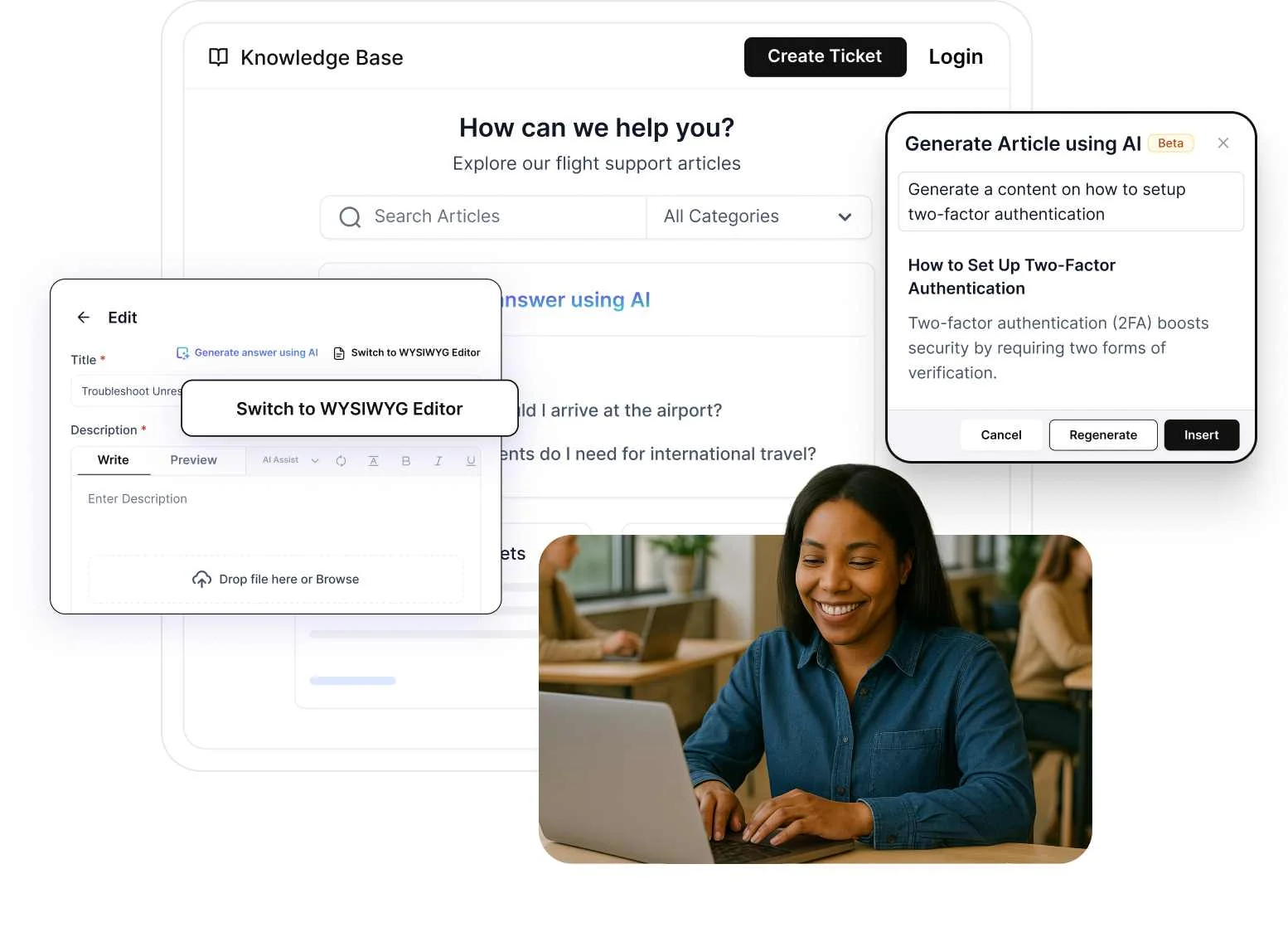
Structure knowledge in a searchable online knowledge base, using clear categories, meaningful titles, helpful tags, and concise summaries so agents and customers can quickly find the information they need.
Analyze and track your knowledge base data
The only way to improve is to understand what’s working and what’s not. Analyze things like:
- Article views and search trends to see popular topics
- Escalation rates and handle times to find knowledge gaps
- Customer satisfaction scores to determine overall effectiveness
- Agent feedback on what they need to do their jobs well
Use insights from your knowledge base metrics to guide improvements and continue measuring regularly to refine your KB over time.
Review and improve the knowledge base continuously
Regularly review, verify, and update knowledge articles to keep information accurate and helpful. Monitor search trends and feedback to see what’s working and make improvements.
Establish clear processes for creating, organizing, and maintaining your knowledge base content. Things like:
- Using templates for different content types (FAQs, troubleshooting guides, etc.)
- A consistent taxonomy or categorization system
- Regularly reviewing and updating older content
- Archiving or removing outdated, irrelevant information
Standardizing your approach will make life easier for both customers and agents. Focus on consistency and efficiency.
Common challenges of KCS methodology and solutions
Implementing knowledge-centered service comes with its fair share of challenges. Some of them are:
| Challenge | Overview | Solution |
| Knowledge hoarding | Agents hesitate to share what they know. | Promote a culture where sharing knowledge is valued, recognized, and rewarded. |
| Lack of ownership | Teams see knowledge management as “extra work.” | Assign clear roles and accountability for creating and maintaining knowledge. |
| Outdated tools | Manual processes slow down knowledge contribution and discovery. | Invest in modern tools that streamline searching, updating, and contributing knowledge within daily workflows. |
| Limited collaboration | Teams operate in silos instead of learning from one another. | Gradually build an “all teach, all learn” culture where everyone contributes and learns regardless of role or experience. |
With the right mix of people, process, and technology, you’ll be providing knowledge-centered service in no time.
How to evaluate KCS performance
Measuring the success of a knowledge‑centered service (KCS) program involves evaluating how effectively knowledge is being captured, reused, and improved as part of the support workflow.
A strong KCS measurement framework ensures that your knowledge base remains accurate, contributes to faster resolutions, and drives operational efficiency.
The key performance indicators include:
- Knowledge article usage: Measures how often agents or customers access and reuse knowledge articles. High usage indicates strong trust and relevance of the knowledge base.
- First‑contact resolution (FCR): Tracks the percentage of issues resolved on the first interaction. Effective KCS practices typically improve FCR by making solutions easier to find and apply.
- Average handle time (AHT) reduction: Evaluates how much faster agents can resolve issues when they have quick access to accurate, updated knowledge.
- Customer and employee satisfaction scores: Reflect how well KCS supports a better experience for both customers (through faster, more consistent answers) and agents (through reduced effort and clearer processes).
- Knowledge base growth and quality metrics: Assesses not just the number of articles created, but their accuracy, structure, freshness, and alignment with KCS content standards.
- Deflection rate: Shows how many customer issues are solved through self‑service instead of reaching support, an indicator of how effective your knowledge base is.
- Time‑to‑publish: Measures how quickly new solutions are documented and published, reflecting how fresh, up‑to‑date, and useful your knowledge base remains.
Empower your agents with knowledge-centered service
Knowledge-centered support should be a top priority for any company focused on delivering amazing customer experiences.
When agents have the knowledge and tools to quickly resolve issues, customers win with fast and accurate solutions. On the other hand, support teams win with improved efficiency and scalability.
Looking to level up your KCS program? Try BoldDesk’s powerful knowledge base software designed to streamline self-service, improve collaboration, and enhance your KCS with easy article creation, seamless workflows, and built‑in reporting for smarter decision‑making.
Schedule a 30-minute live demo or start a 15-day free trial to experience its operational knowledge centered support features.
To learn more and get started with BoldDesk, contact us today!
Share your experiences with knowledge-centered service and ask questions in the comment section below.
Related articles
- 7 Techniques to Improve Your Knowledge Base Design
- 7 Important Tips to Creating a Knowledge Base Effectively
- 7 Essential Knowledge Base Metrics for Enhancing Self-Service
Frequently asked questions
The core principles of KCS include:
- Capture knowledge from each interaction
- Organize information in a centralized, searchable repository
- Continuously update and improve the knowledge base
- Track performance metrics like CSAT, failed searches, and article views
These principles guide consistent knowledge creation and reuse.