



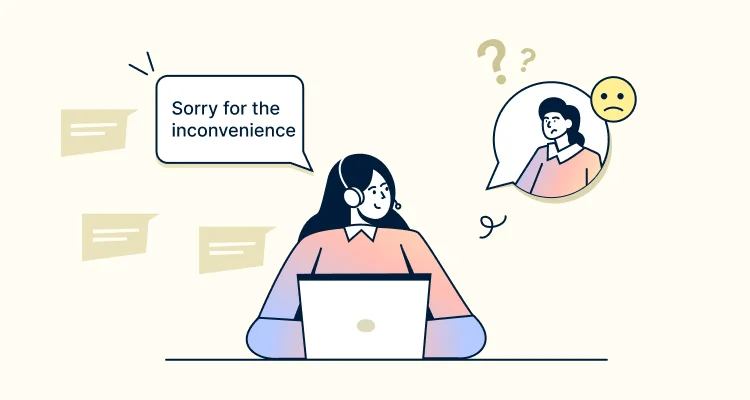


TL;DR: Replace “sorry for the inconvenience” with three things: Name what went wrong, take responsibility for it, and say what happens next. “I’m sorry for the inconvenience” becomes “Your order shipped to the wrong address. That was our error. A replacement is going out, and you’ll have tracking within two hours.”
Have you ever said “sorry for the inconvenience” to an unhappy customer? It is a common response in customer service, but when used too often, it can sound generic or insincere and may do little to reduce customer churn.
A thoughtful apology can do more than acknowledge a mistake. It can show customers that you understand what went wrong, take responsibility, and are actively working to make things right.
This guide shows how to handle 10 real support scenarios with practical apology examples agents can adapt without sounding scripted.
Quick reference: What to say instead of “Sorry for the inconvenience”
What you say should change with the situation. If you are looking for a sorry for the inconvenience alternative, choose wording that reflects what actually happened.
A late reply requires a different response from a billing error or repeat technical problem.
Here is a quick reference:
| Situation | Instead of this | Try this |
| Service outage | “Sorry for the inconvenience.” | “The service is restored. Here’s what happened and what we changed.” |
| Billing error | “Apologies for any inconvenience caused.” | “We charged you twice. The duplicate charge has been reversed.” |
| Late reply | “Sorry for the delay.” | “You waited longer than our response target. We should have replied sooner.” |
| Wrong or damaged order | “We regret any inconvenience.” | “We sent the wrong item. A replacement is going out today.” |
| Repeat problem | “Sorry for the inconvenience again.” | “This issue has happened before. I’m taking ownership until it is resolved.” |
| Saying no | “Sorry, but that’s our policy.” | “I can’t approve that request, but here are the options available.” |
| Escalating | “Sorry to transfer you.” | “I’m bringing in the right specialist, and they’ll have the context from this conversation.” |
| Your team’s mistake | “Sorry for any confusion.” | “I gave you the wrong information. That was my mistake. Here’s the correct answer.” |
| Asking for details again | “Sorry to trouble you again.” | “I need one more detail to complete this: your invoice number.” |
| Closing a difficult ticket | “Sorry for the inconvenience. Closing this ticket.” | “This took longer than it should have. Here’s what we changed as a result.” |
For other common support conversations, these customer service phrases can help agents communicate clearly without falling back on stock responses.
Why “sorry for the inconvenience” stops working
The phrase is not rude. It is empty. Customers have read it so many times that it reads as a form letter, and a form letter tells them nobody looked at their problem.
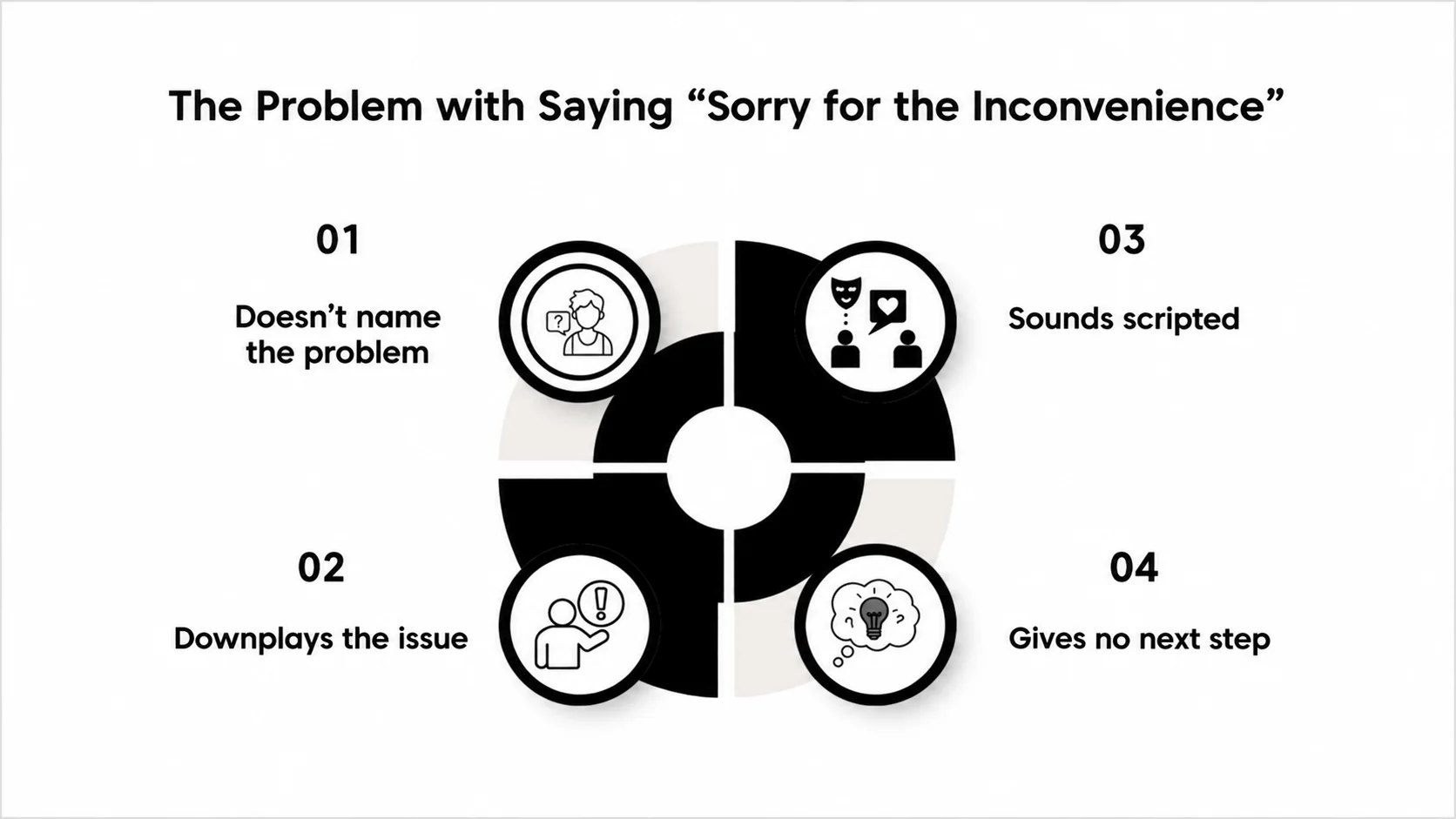
It names nothing
“Inconvenience” is a placeholder. It could mean a two-minute delay or a lost week of work. When you do not name the actual problem, the customer cannot tell whether you understood it.
It shrinks the problem
Calling a failed payment or a missed deadline an “inconvenience” makes it sound small. To the customer, it was not small. Using a word that undersells their experience reads as dismissive, even when you did not mean it that way.
It sounds automated
The phrase appears in autoresponders, error pages, and shipping notifications. Customers associate it with machines.
Opening a human reply with it throws away the one advantage a human agent has.
It stops before the useful part
An apology without a next step leaves the customer exactly where they started. They still do not know when the problem gets fixed or what they should do now.
“If we use ‘I’m sorry,’ what comes after that needs to be part of the apology, not a ‘too bad’ explanation.” – Shep Hyken, Customer Service Expert.
The three parts of an apology that works
You do not need dozens of alternative apology phrases. A more practical approach is to shape the response around three elements:
- Name it: Be specific enough that the customer can tell you understood the issue. Instead of “An issue occurred,” try “Your invoice was sent to the wrong email address.”
- Own it: Say whose fault it was. If it was yours, say so without hedging. If it was not anyone’s fault, say what happened instead of assigning blame to the customer.
- Move it forward: Say what happens next, who is doing it, and by when. This is the part most apologies skip, and it is the part customers actually want.
Where appropriate, you can add a fourth step: make it right. A refund, a credit, an extension. Offer it when the customer lost real time or money, not as a reflex.
For situations that need more than a short reply, these apology email templates provide useful formats to follow.
Struggling with Customer Emails? Try This—100% Free!
Enhance customer support by streamlining tickets and scaling your business. As a startup, use free software to grow your business!

10 Situations and what to say instead of “sorry for the inconvenience”
Even well-run businesses sometimes fall short of customer expectations. When that happens, a sincere apology can acknowledge the frustration, show accountability, and help move the conversation toward a resolution.
Here are 10 common support situations and clearer ways agents can respond without relying on a generic apology.
1. A service outage or downtime
Customers hit by an outage usually want to know whether it is fixed and whether it will happen again. Vague reassurance makes both questions louder.
Say this:
“Our ticket portal was unavailable from 9:14 to 10:02 this morning. A database migration ran during business hours, which it should not have. Everything is back up, and your data is intact. We have moved all migrations to a maintenance window, so this does not repeat.”
Why it works: The response provides the current status first, then explains the problem and corrective action. That gives customers information they can act on or share with their own teams.
With BoldDesk: When one incident generates fifty tickets, you do not want fifty agents writing fifty versions of the same message. Group the affected tickets and send one bulk update to all of them.
Automation rules can also close the loop once the incident is marked resolved, so nobody gets a stale status.
2. A billing or invoice error
Money mistakes make customers anxious fast. Speed and precision matter more than warmth here.
Say this:
It should appear in your account within three to five business days, depending on your bank. Your next invoice is unaffected. If it has not landed by Monday, reply here and I will chase it directly.”
Why it works: It contains the exact amount, exact date, exact timeline, and a named fallback. No apology theater, just resolution.
3. A late reply or missed SLA
Do not pretend the delay did not happen. The customer already knows how long they waited.
Say this:
Here is your answer, and I have flagged the queue issue that caused it.”
Why it works: It names the gap between what you promised and what you delivered. That is more credible than an apology, because it shows you know your own standard.
With BoldDesk: Most missed replies are queue problems, not people problems. SLA policies and escalation rules surface a ticket before it breaches, and workflow automation can route it to a second agent instead of letting it sit. Fixing the queue is better than getting good at apologizing for it.
4. A wrong, damaged, or missing order
The customer wants the right item. Everything else is secondary.
Say this:
express delivery, and you’ll receive tracking by 5 p.m. Keep the small one. There is no return to arrange.”
Why it works: It removes work from the customer instead of adding it. Not making them send the wrong item back is worth more than any apology sentence.
5. The same problem, again
A repeat issue is where most apology language collapses. Saying sorry a third time confirms the customer’s fear that nobody is tracking this.
Say this:
I have escalated this to our engineering team as a recurring fault, and I am owning it personally until it is closed. I will update you every Tuesday whether or not there is news.”
Why it works: It drops the apology and replaces it with ownership and a rhythm of contact.
Before responding to a repeat complaint, review previous tickets and notes. An apology loses credibility quickly if the customer has to remind the next agent what happened last time.
With BoldDesk: Agents can view a customer’s previous tickets from their customer profile, making recurring issues easier to recognize instead of treating every report as a first-time issue.
6. You have to say no
Refusals get wrapped in apology language because saying no feels harsh. The wrapping makes it worse, because it sounds like you might change your mind.
Say this:
Why it works: It gives a clear no, an honest reason, and two real alternatives. The customer gets a decision to make instead of a wall.
7. Transferring or escalating a ticket
“Sorry to pass you around” tells the customer they are about to repeat themselves. Usually they are right, and that is the real problem.
Salesforce research found that 56% of customers say they often have to repeat or re-explain information to different representatives.
That makes context an important part of any escalation.
Say this:
access. She has read this thread, so you will not need to explain it again. She will reply within two hours.”
Why it works: It names the person, the reason, and the timeline, and promises the one thing customers most want during a handoff.
With BoldDesk: That promise only holds if the next agent actually has the context. AI Copilot can summarize the thread and attached files for the receiving agent, so the handoff carries the history instead of dropping it.
8. A mistake your team made
When it is clearly your fault, ownership works better than apology volume.
Say this:
afternoon. Here are the correct steps, and I have fixed the help article so nobody else follows the old version.”
Why it works: It acknowledges the cost to the customer, not just the error, and shows a fix that goes beyond this one ticket.
9. Asking the customer for information again
Every “sorry to bother you” adds friction to a request that is already annoying.
Say this:
of the PDF? That is all I need.”
Why it works:It sets an endpoint, asks for one specific thing, and tells them exactly where to find it. No apology needed because you have made the task small.
10. Closing a ticket after a bad experience
The closing message is the one the customer remembers. Do not waste it on a form sentence.
Say this:
“This took nine days to resolve, and that is not the experience we want you to have. The delay came from a handoff between two teams that was not tracked properly.
We have changed how those handoffs are logged. Thank you for staying with it. If anything about this resurfaces, reply here and it comes straight back to me.”
Why it works: It is honest about the failure, specific about the fix, and leaves an open door. This is the message that protects customer trust and reduces customer churn after a bad ticket.
Send these replies in one click
Knowing what to say is half the job. The other half is saying it consistently when there are forty tickets in the queue and three of them are angry.
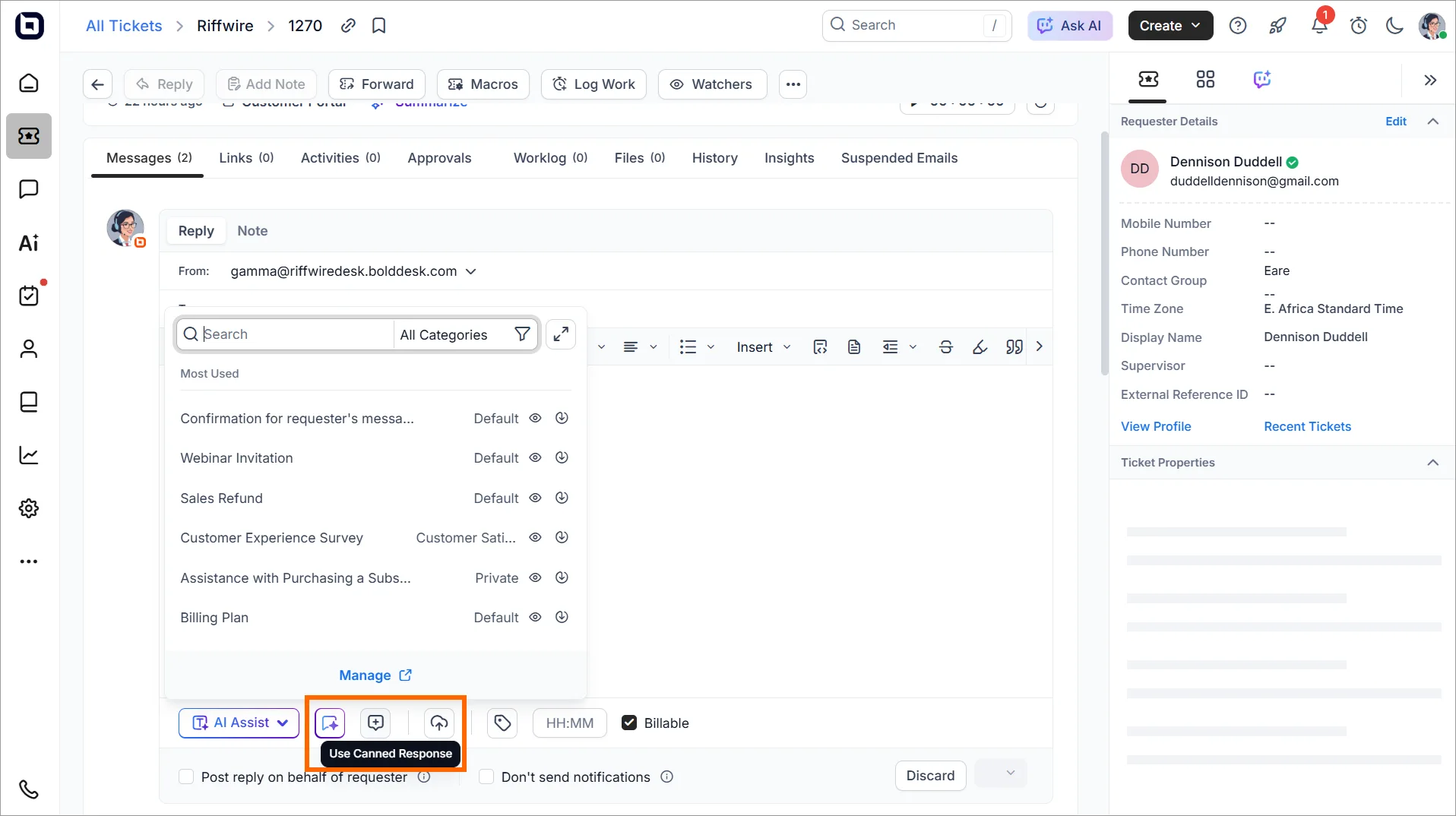
That is what saved replies are for. Your best apology wording gets stored once, then any agent can drop it into a ticket and personalize the details.
New agents write like your senior agents from day one, and nobody falls back on “sorry for the inconvenience” because it was the fastest thing to type.
Two things make this work in practice:
- Write them from real tickets, not from a template site: The wording that lands is the wording your customers already respond to. Pull it from resolved tickets that ended well. If you need a starting set, our canned response examples library covers apologies, escalations, refusals, and closings.
- Keep the placeholders honest: A saved reply with five blanks in it will get sent with the blanks still in it. Two or three is the limit.
For situations a saved reply cannot cover, AI Copilot can draft a response based on your knowledge base and similar resolved tickets, including an empathetic version that still follows your refund policy.
The agent reviews and edits before anything sends.
Situations when an apology is not the answer
Sometimes the wording is not the problem. If your team is apologizing for the same thing every week, that is a product or process signal, not a writing one.
Watch for these:
- The same apology reason appearing in more than 10% of your tickets
- Apologies clustered around one feature, one integration, or one billing flow
- Agents apologizing for slow replies rather than for the issue itself
The first two are product feedback. Send them to your product team instead of writing better apologies around them. The third is a capacity or routing problem inside your help desk software, and no phrasing change will fix it.
For serious failures where an apology alone will not hold the account, use a structured service recovery approach instead.
Give your team better words and a faster way to send them
Good apology wording only helps if every agent can reach it under pressure. BoldDesk keeps your best replies, your ticket history, and your escalation rules in one place, so the right words are the fastest words.
Book a live demo or sign up for a 15-day free trial today. No credit card is required. If you are moving from Zendesk or Freshdesk, migration is free and handled by our team.
Related articles
- 12 Customer Service Scenarios: Role-Play Examples and Tips
- How to Deal with Angry Customers: Tips and Templates
- 50 Customer Service Email Templates for Fast, Consistent Responses
Frequently Asked Questions
It is not unprofessional; it is ineffective. The phrase is grammatically correct and polite. The problem is that it is so common that customers read past it. A specific apology that names the problem does the same job better.
Name what went wrong, say who is responsible, and state what happens next. For example: “Your report did not generate on Monday because of a queue error on our side. It is running now and will be in your inbox within the hour.”
Lead with acknowledgement instead of apology. “You are right. That should not have happened.” Or: “I understand why that is frustrating.” Both recognize the problem without the word sorry. Follow with the fix.
No. One clear apology is more credible than three. Repeating it makes the reply sound anxious and pushes the useful information further down.
It is grammatically correct, but it is more formal and more distant than “apologies for the inconvenience.” Both have the same weakness: they do not name the problem.
Give the exact start and end time, the cause in plain language, the current status, and the change you have made to prevent a repeat. Customers forward outage updates to their own teams, so precision matters more than tone.
State the actual wait and compare it to your own target. “You waited four days, and our target is 24 hours” is more credible than “sorry for the delay” because it shows you know your standard.


