

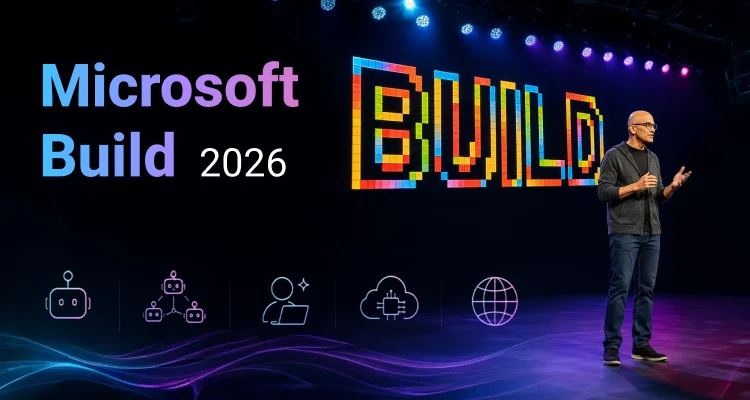



TL;DR: Microsoft Build 2026 highlighted a major shift in enterprise AI: from tools that assist users to agents that execute work. Key themes included AI agents, multi-agent systems, Copilot’s evolution, Microsoft Foundry (formerly Azure AI Foundry), hybrid AI, interoperability, and enterprise governance.
If recent Microsoft Build events introduced copilots and accelerated enterprise AI experimentation, Microsoft Build 2026 pushed the conversation further: toward agentic AI systems that can execute work.
Build 2026 showcased a future where AI goes beyond answering questions to understanding goals, coordinating workflows, integrating with business systems, and actively helping get work done.
For developers and enterprise leaders the message is clear: competitive advantage will come not from access to AI, but from how effectively it is deployed through agents.
For customer support and CX leaders, Microsoft Build 2026 highlights how AI agents are transforming support operations, shifting tasks like triage, knowledge retrieval, and customer communication from manual to AI-assisted execution.
In this article, we’ll explore the most important Microsoft Build 2026 AI announcements, why they matter, and what they reveal about the future of software, enterprise AI, and business operations.
Microsoft Build 2026 AI announcements at a glance
Microsoft Build 2026, held in San Francisco and online, emphasized the rise of agentic AI across Microsoft’s developer and enterprise ecosystem.
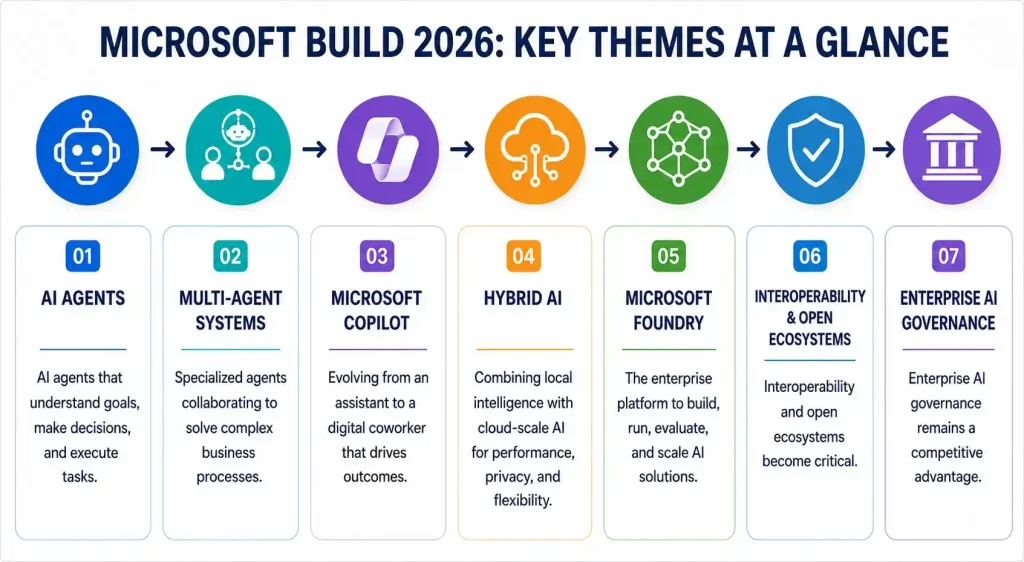
The biggest AI themes from Microsoft Build 2026 were agentic AI, multi-agent orchestration, Copilot’s evolution, Microsoft Foundry, hybrid local-and-cloud AI, interoperability, and enterprise governance.
Rather than focusing solely on AI assistants and content generation, Microsoft showcased how AI can become an active participant in business processes.
| Announcement | Why it matters |
| AI Agents | Move from assistance to execution |
| Multi-agent systems | Enable collaboration between specialized AI systems |
| Microsoft Copilot evolution | Expands from assistant to digital coworker |
| Microsoft Foundry | Provides infrastructure for enterprise-scale AI |
| Open standards and interoperability | Reduces vendor lock-in and increases flexibility |
| Hybrid AI architectures | Combine local and cloud intelligence for better performance and control |
| Enterprise governance | Ensures responsible and secure AI adoption |
These announcements collectively signal a future where AI becomes deeply embedded in how organizations operate.
Microsoft Build 2026 highlighted the shift from AI assistants to AI agents
For the past few years, AI conversations have focused heavily on copilots, chatbots, and content generation.
Microsoft Build 2026 highlighted the shift from AI assistants to agentic AI systems: AI tools that can understand goals, use context, coordinate workflows, and execute approved actions across enterprise systems.
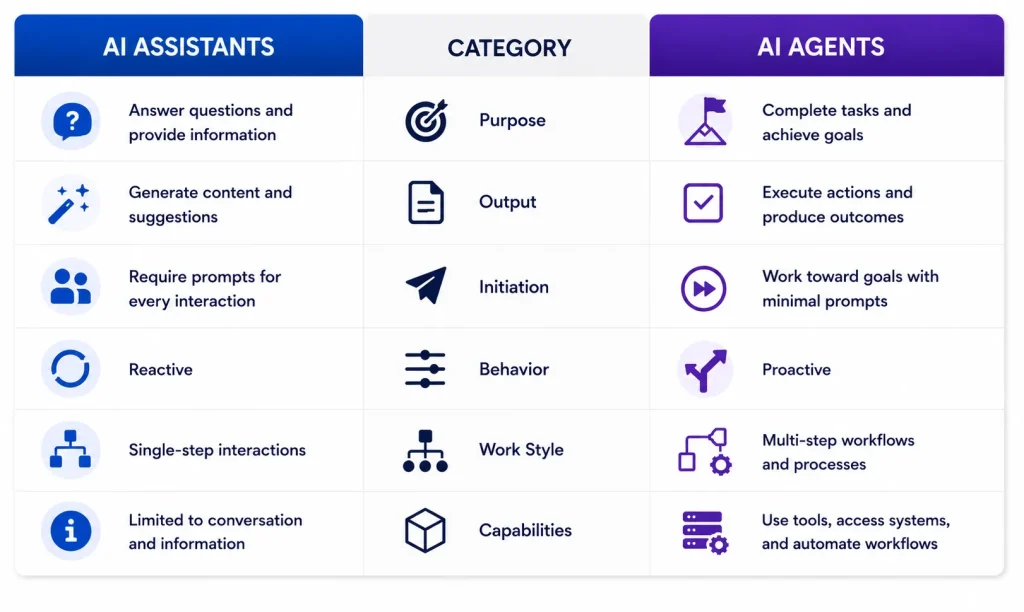
From software development and customer support to business operations and enterprise automation, Microsoft demonstrated how AI is evolving from an assistant into an active participant in work.
This shift represents a fundamental change in how AI systems operate, as illustrated below:
| AI Assistant | AI Agent |
| Responds to prompts | Works toward goals |
| Generates content | Executes approved actions |
| Requires frequent user direction | Plans and coordinates steps |
| Helps with tasks | Completes parts of workflows |
| Limited autonomy | Governed autonomy with controls |
7 Microsoft Build 2026 announcements that matter most
As AI continues to redefine how software is built and used, a few standout announcements captured this shift.
Here are 7 key AI announcements that are set to shape the future of software:
1. AI agents are becoming the new building blocks of software
One of the biggest themes at Build 2026 was Microsoft’s continued investment in AI agents.
Unlike traditional AI assistants that wait for instructions and generate responses, AI agents are designed to:
- Understand objectives
- Plan actions
- Use external tools
- Access approved business systems
- Retrieve relevant information
- Complete approved tasks with varying levels of human oversight
Instead of helping users perform work, agents are increasingly capable of performing portions of that work themselves.
This shift could become one of the most significant changes in software architecture since the rise of cloud computing.
In the future, many business applications may consist of networks of specialized agents working together to achieve outcomes rather than traditional software interfaces requiring constant user input.
Microsoft’s Project Solara reinforces an agent-first platform where AI agents become the primary way users interact, handling goals, coordination, and actions.
The initiative also reflects Microsoft’s broader ambition to extend AI agents beyond software into new device experiences and workplace environments, reshaping how work gets done.
Why it matters
Organizations are increasingly looking beyond AI-generated content and focusing on measurable business outcomes.
According to Salesforce research, 94% of sales leaders say AI agents are critical for meeting business demands.
The ability to automate multi-step workflows can unlock significant productivity gains across departments such as, customer service, sales, marketing, human resources, IT operations, and software engineering.
Build 2026 reinforced the idea that AI’s greatest value may come from execution rather than assistance.
2. Multi-agent systems are moving into the enterprise
One of the most important trends highlighted during the conference was the rise of multi-agent systems.
Rather than relying on a single AI model, organizations are beginning to deploy teams of specialized agents that collaborate to solve business problems.
For example, a customer support workflow could involve:
- A triage agent that classifies incoming requests
- A knowledge agent that retrieves relevant information
- A resolution agent that drafts or executes actions
- A communication agent that updates customers
Similarly, software development teams can leverage specialized agents across different stages of the lifecycle, from requirements analysis and code generation to testing, security validation, and ongoing deployment monitoring.
This mirrors how real-world teams collaborate, where each role handles a specific task.
Why it matters
Multi-agent systems enable organizations to automate increasingly sophisticated processes without relying on a single monolithic AI system.
As enterprise adoption grows, businesses will need strategies for orchestrating, monitoring, and governing networks of AI agents.
3. Microsoft Copilot is evolving into a digital coworker
Microsoft continued expanding the capabilities of Copilot across its ecosystem. While early AI assistants focused on helping users write emails, summarize meetings, or generate content, Microsoft’s long-term vision is considerably broader.
Copilot is increasingly being positioned as a system that can:
- Manage multi-step tasks
- Coordinate activities across applications
- Surface insights proactively
- Support business processes
- Work alongside employees to achieve outcomes
The shift reflects a broader evolution occurring across the AI industry.
Instead of interacting with AI one prompt at a time, users will increasingly assign goals and allow intelligent systems to determine how those goals should be achieved.
Why it matters
For businesses, Copilot’s evolution means AI will increasingly live inside daily work tools rather than separate chat interfaces.
Employees may move from asking AI for help to assigning goals that Copilot-supported agents can coordinate across apps, data, and workflows.
4. Hybrid intelligence through local and cloud AI
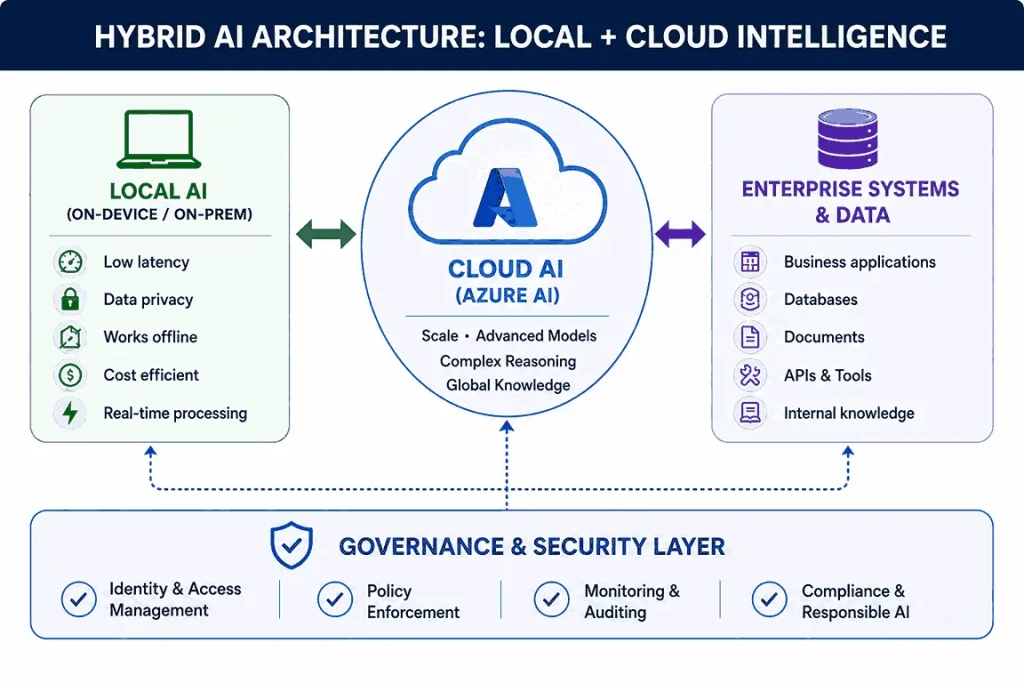
One important theme from Build 2026 was hybrid intelligence. Organizations increasingly want the flexibility to run AI workloads where they make the most sense.
Some tasks benefit from local execution because of:
- Privacy requirements
- Reduced latency
- Offline capabilities
- Cost optimization
Other workloads require the scale and computational power of cloud-based AI systems.
Microsoft’s approach suggests a future where local and cloud AI work together seamlessly.
Why it matters
Hybrid AI architectures give organizations greater control by enabling stronger data governance, improved performance, enhanced security, and more efficient management of operational costs.
As enterprise AI adoption grows, flexibility will become a competitive advantage.
Businesses are unlikely to rely on a single deployment model. Instead, they will adopt AI architectures that combine local intelligence with cloud-scale reasoning.
Microsoft also introduced Aion 1.0, a new generation of on-device AI models designed to bring agentic capabilities directly to Windows devices.
These models support Microsoft’s broader vision of hybrid AI, where local intelligence and cloud-scale reasoning work together to deliver faster, more private, and cost-effective AI experiences.
5. Microsoft Foundry strengthens enterprise AI
Build 2026 reinforced Microsoft’s commitment to providing enterprises with the infrastructure required to build, deploy, evaluate, and govern AI systems at scale.
Microsoft Foundry continues to serve as a foundation for organizations developing production-grade AI solutions.
Key capabilities include:
- Agent development
- Model evaluation
- Monitoring and observability
- Security controls
- Governance frameworks
- Workflow orchestration
This infrastructure enables organizations to operationalize AI effectively, ensuring reliability, scalability, and compliance across the AI lifecycle.
6. Interoperability and open ecosystems become critical
Microsoft emphasized the growing importance of interoperability as organizations deploy increasing numbers of agents, models, and tools.
This includes:
- Agent interoperability
- Seamless tool integration
- Support for multi-model architectures
- Access to open, flexible ecosystems
Why it matters
Organizations are increasingly prioritizing flexibility as they scale their AI efforts.
Businesses want architectures that can evolve with them, enabling easy adoption of new models, smooth integration with external systems, and the freedom to operate without being tied to a single vendor ecosystem.
Interoperability is emerging as a defining requirement for enterprise AI, enabling scalable, adaptable, and future-proof AI ecosystems.
7. Enterprise AI governance remains a competitive advantage
While innovation dominated the conference, Microsoft strongly emphasized the importance of Microsoft AI governance as a foundation for sustainable AI adoption.
As AI agents gain greater autonomy and deeper access to business systems, organizations must carefully address critical areas such as security, compliance, transparency, auditability, and effective access management.
Without strong governance, organizations face risks such as hallucinated outputs, unauthorized actions, data exposure, compliance violations, weak audit trails, and loss of customer trust.
Enterprise leaders are increasingly recognizing that trust is becoming just as important as intelligence.
The organizations that establish strong governance frameworks today will be better positioned to scale AI initiatives tomorrow.
What Microsoft Build 2026 means for software development
Build has always been a developer-focused conference, and this year’s announcements highlighted how AI is transforming software engineering itself.
Developers are increasingly moving from implementation-heavy work toward:
- System design
- Architecture decisions
- Validation and testing
- Security reviews
- AI oversight
Rather than replacing developers, AI is changing the nature of software development. The most successful engineering teams will learn how to combine human expertise with AI-driven productivity.
What this means for customer support teams
Although many announcements targeted developers and enterprises, the impact extends directly to customer support organizations.
For support leaders, the shift toward agentic AI is particularly significant. Many capabilities highlighted at Build 2026, including ticket triage, knowledge retrieval, workflow orchestration, customer updates, and intelligent escalation, already align closely with the direction modern help desk platforms are taking.
As AI agents become more capable, customer support organizations will increasingly rely on AI to handle repetitive work while human agents focus on complex, high-value interactions.
This shift highlights an important reality: The future of customer support isn’t simply about adding AI. It’s about integrating AI into the entire support operation.
Platforms like BoldDesk are already helping support teams prepare for this shift by combining AI-powered assistance, knowledge management, workflow automation, reporting, and omnichannel support within a unified environment.
The future of AI is about execution, not assistance
Microsoft Build 2026 made one message clear: AI is moving from assistance to execution.
The rise of AI agents, multi-agent workflows, Copilot evolution, hybrid AI, and enterprise governance points to a new software model where intelligent systems help achieve business outcomes, not just answer questions.
If the first wave of AI was about generating content and the second wave was about copilots, Microsoft Build 2026 suggests the next wave will be defined by AI agents working alongside human teams under appropriate governance and oversight.
Organizations that combine human expertise, strong governance, and agent-driven workflows will be best positioned to thrive in an AI-first future.
For customer-focused organizations, the opportunity is already here. The challenge is no longer deciding whether to adopt AI. It is determining how to apply it responsibly, strategically, and at scale.
Related articles
- AI Agent Examples: 21 Real-World Use Cases Across Industries (2026)
- Top 12 Chatbase Alternatives for AI Customer Service Agents in 2026
- AI Customer Service Software: 12 Best Options for Support Teams
Frequently Asked Questions
Microsoft Build 2026 focused on agentic AI systems that can plan, act, collaborate, and execute tasks rather than simply assist users.
Agentic AI refers to AI systems that can understand goals, make decisions, use tools, and complete workflows with varying levels of autonomy.
AI assistants primarily answer questions and generate content. AI agents can take actions, execute workflows, and work toward defined goals.
Multi-agent systems consist of multiple specialized AI agents working together to solve complex business problems, similar to human teams.
The conference highlighted the technologies and strategies enterprises need to scale AI successfully, including AI agents, governance frameworks, interoperability, hybrid AI architectures, and operational platforms such as Microsoft Foundry.