



TL;DR: AI and a well-organized knowledge base help reduce support tickets by making self-service faster and more effective. AI understands what users are asking, retrieves reliable information from your knowledge base, and helps resolve routine issues before they become support tickets.
Most support tickets aren’t complex, they’re preventable. Password resets, account access issues, and billing inquiries often make up a large share of incoming tickets, even though many customers would rather solve these problems themselves than wait for an agent.
That’s why how to reduce support tickets has become less about responding faster and more about preventing unnecessary requests in the first place.
In 2026, AI enhances traditional ticket deflection by understanding customer intent and delivering accurate answers from a connected knowledge base. When paired with well-maintained support content, it can instantly resolve routine issues.
The result is a self-service experience that solves problems quickly, cuts repetitive tickets, and frees support teams to focus on the complex cases that need human expertise.
In this article, you’ll learn why AI alone isn’t enough to reduce support tickets, how AI and knowledge bases reduce support ticket volume, and how combining AI with a knowledge base creates a more scalable support experience.
Why AI alone isn’t enough to reduce support tickets
Many organizations adopt AI-powered support hoping it will reduce support tickets, but AI is only as effective as the information behind it.
Without a reliable knowledge base, AI can generate inconsistent, outdated, or incomplete responses that frustrate customers and increase support demand.
Gartner reports that only 14% of customer service issues are fully resolved through self-service, highlighting the need for both intelligent automation and high-quality support content.
The following are the key reasons AI needs a well-maintained knowledge base to reduce support tickets effectively:
- AI agents retrieve knowledge in real time: Instead of relying on scripted responses, AI agents understand customer intent and retrieve relevant information directly from the knowledge base, helping customers find accurate answers faster without navigating multiple articles.
- Knowledge bases improve through support interactions: Every resolved ticket contains valuable insights. AI can identify recurring issues, uncover documentation gaps, and generate article drafts from successful support interactions, allowing knowledge bases to evolve alongside customer needs.
- AI alone rarely succeeds without a strong knowledge base: Without accurate, current information to draw from, AI can produce inconsistent answers, increase hallucinations, erode customer trust, and create more escalations, not fewer.
A well-maintained knowledge base gives AI access to accurate, approved information, allowing it to deliver consistent answers and guide clients to the right solution faster.
5 Ways to reduce ticket volume using AI and a knowledge base
To successfully reduce support tickets requires more than publishing help articles or deploying AI. Organizations need a continuous self-service strategy that combines trusted knowledge with intelligent discovery. The following five strategies help make that possible.
Build a well-structured knowledge base
A knowledge base is most effective when it reflects how customers think, not how your product is organized internally.
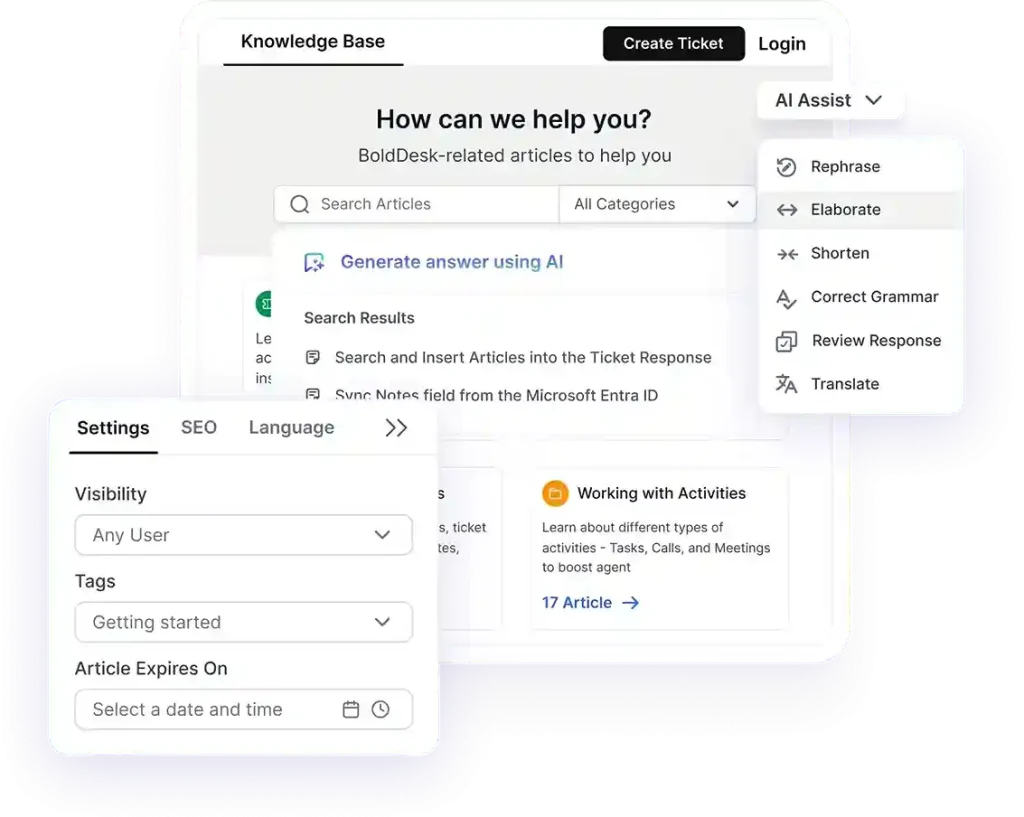
To maximize self-service success and AI accuracy, structure content around common customer tasks, use clear and descriptive article titles, include visuals where they enhance understanding, and link related resources so customers can navigate naturally.
When combined with AI-powered search and intelligent recommendations, a well-organized knowledge base makes information easier to find and increases the likelihood of customers resolving issues independently.
Prioritize automation for repetitive support requests
Not every support request should be automated. High-frequency, low-complexity requests consume agent time, making them ideal candidates for automation.
Start by identifying your five highest-volume ticket categories, such as password resets, billing questions, order status requests, account access issues, and basic troubleshooting.
Resolving repetitive requests through AI-powered support can reduce ticket volume quickly while allowing support teams to dedicate more time to complex customer issues.
Make self-service easier to use with AI
Even comprehensive documentation has limited value if customers can’t find the right information.
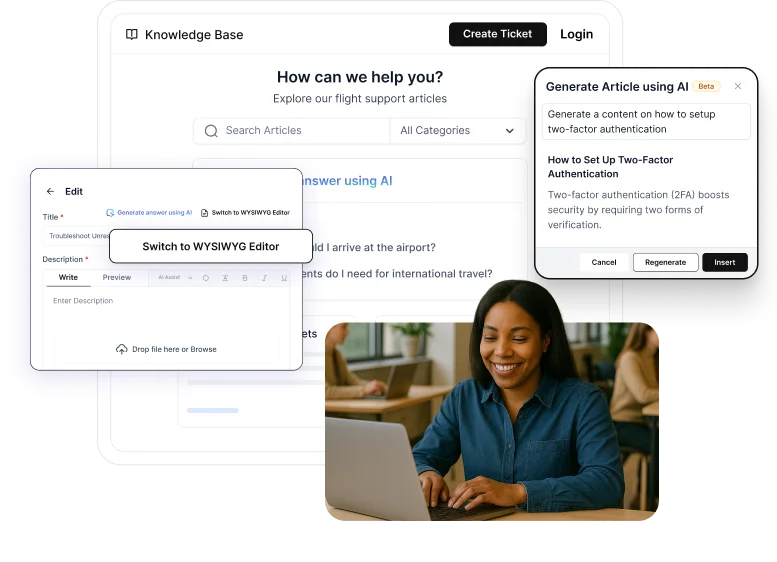
Use agentic AI in customer experience to understand customer intent, recommend relevant knowledge articles, and surface answers in a clear, contextual format.
Reducing the effort required to locate information encourages more customers to resolve issues independently instead of submitting a ticket.
Prevent support demand proactively
Many issues can be identified and resolved before they ever become a support request.
Providing timely guidance when customers need it reduces friction and prevents common issues from escalating into tickets.
Leverage support data for continuous improvement
Review failed searches, repeated ticket topics, and customer feedback to identify missing or outdated documentation.
This data helps organizations strengthen knowledge resources, improve automation accuracy, and solve the underlying causes of repeat inquiries rather than addressing the same issues many times.
Real-world examples of how to reduce support tickets
Many companies receive a high number of support tickets because customers struggle to find quick answers on their own.
The following examples show how improving self-service and knowledge accessibility can reduce support tickets that are repetitive.
IIC Lakshya: Improving support speed with automation and visibility
Challenge: As support ticket volume grew, IIC Lakshya’s previous system lacked the visibility and efficiency needed to manage requests at scale.
How automation helped:
With BoldDesk, IIC Lakshya centralized support operations and automated ticket management, reducing manual effort, improving workload distribution, and enabling faster response times. As a result, the team reduced its average ticket resolution time by approximately 35%, from around 24 hours to 15 hours.
AdmissionPros: Improved self-service with AI and knowledge base
Challenge: Customers struggled to resolve issues in a difficult-to-navigate knowledge base, resulting in a high volume of repetitive support requests.
How AI and a knowledge base helped:
AdmissionPros implemented BoldDesk’s AI-powered knowledge base, making it easier for customers to find answers on their own. This reduced repetitive inquiries and allowed agents to focus on more complex issues.
Mistakes that undermine AI-driven ticket reduction
Reducing support tickets requires more than implementing AI or expanding self-service options.
Organizations often invest in help desk automation technologies but overlook the foundational practices needed to make those initiatives successful.
The following are some of the most common mistakes to avoid to effectively reduce support ticket volume.
- Launching AI on top of poor documentation: AI cannot compensate for inaccurate, incomplete, or outdated information. Strengthen your knowledge base before expanding automation.
- Ignoring low-confidence AI responses: When AI is uncertain, it should escalate automatically. Customers lose trust when AI guesses instead of acknowledging its limitations.
- Treating the knowledge base as a one-time project: Documentation requires ongoing updates to reflect product changes, customer needs, and emerging support trends.
- Measuring success by ticket count alone: A drop in support ticket volume only matters if customers are still reaching successful outcomes. Track resolution quality and self-service success alongside volume, not instead of it.
Measuring success beyond support ticket volume
It is important to reduce support tickets, but the real goal is helping customers resolve issues quickly and independently.
To understand whether your AI and knowledge base strategy is truly working, track metrics that measure successful resolution, not just ticket avoidance.
- AI resolution coverage: Measures the percentage of customer inquiries that AI fully resolves without requiring agent intervention. Higher resolution coverage means more routine issues are solved instantly. This can reduce support ticket creation and lower support workload.
- First-contact resolution (FCR): Tracks how often customers get the answer they need in their first interaction. Strong first-contact resolution rates reduce repeat contacts, prevent ticket escalations, and improve the overall customer experience.
- Self-service success and failed search analysis: Evaluates how effectively customers find answers on their own while identifying searches that produce poor or no results. Improving these gaps helps customers resolve more issues independently and prevents future support tickets.
Collectively, these metrics show how well AI and knowledge bases work together to resolve issues before they become support tickets while delivering a seamless customer experience.
How to reduce support tickets while elevating customer experience
Combining AI with centralized knowledge base software helps organizations move from reactive support to proactive self-service. By delivering accurate answers instantly, businesses can help customers resolve issues before they become support tickets.
The result is lower support demand, improved agent productivity, higher customer satisfaction, and more time for support teams to focus on high-value issues.
Organizations that achieve the best results pair AI with a credible knowledge base, continuously refine self-service experiences, and track metrics such as customer satisfaction and service efficiency to improve support performance over time.
Related articles
- How AI Email Automation Helps Reduce Customer Support Tickets
- What is an AI Knowledge Base? Features, Benefits, and Use Cases
- The 2026 AI Customer Support Playbook for Modern Teams
FAQs
AI reduces support tickets by automatically answering common questions and presenting relevant knowledge base content, enabling customers to find help faster and independently.
Track metrics such as knowledge base usage, search success rates, and customer satisfaction. Higher adoption and positive feedback indicate that customers are quickly accessing relevant information and resolving issues independently.
A knowledge base acts as a centralized source of truth where customers can find answers quickly.
When structured properly and powered by AI search, it enables users to solve problems on their own, eliminating the need to raise support tickets for common questions.
Yes. AI agents and a structured knowledge base help small businesses automate routine support, reduce ticket volume, and improve customer experience without expanding support teams.
AI can reduce some support tickets, but it works best when connected to a reliable knowledge base. The knowledge base provides accurate information, while AI helps customers access the right information quickly.
Without it, AI-powered support may deliver inconsistent responses and struggle to resolve issues effectively.