


 In this page

TL;DR: Customer service scenarios are common customer support situations, including angry customers, refund requests, long wait times, defective products, service outages, and product availability issues. Resolving these scenarios requires empathy, active listening, clear communication, and problem-solving to improve customer satisfaction, trust, and customer loyalty.
CM research shows that 92% of consumers expect customer service teams to respond quickly when issues arise.
Excellent customer service is the foundation of strong customer relationships. Yet even the most customer-focused brands encounter moments when things don’t go as planned.
A service disruption, an unavailable product, or delayed support can quickly turn a routine interaction into a frustrating experience.
These situations create customer service scenarios, real-life moments that test how effectively support teams respond under pressure.
Understanding common scenarios in customer service and knowing how to handle them professionally helps support agents resolve issues faster, reduce escalation, and improve customer satisfaction.
In this article, we examine various customer service scenarios and share tips on how to handle them professionally. If you are a support agent, you might encounter one or more of these situations.
What are customer service scenarios?
Customer service scenarios are real-life situations where support teams respond to customer questions, complaints, or service issues.
These scenarios help teams standardize responses, improve communication, and deliver consistent customer service experiences.
In your line of business, the way you deal with a support issue can contribute positively or negatively to the satisfaction of the customer.
For example, imagine answering a customer’s call, and they immediately start shouting, angry, frustrated, and demanding a solution. This is a difficult customer service scenario that requires empathy, problem-solving skills, and professionalism.
Scale Customer Support at No Cost!
From missed emails to rising ticket volumes, keep every request organized with ticketing, automation, and collaboration tools.
Common customer service scenarios
A research study by KPMG shows that around 90% of customers find that resolving problems is their top customer service issue.
Customer service role-playing scenarios often involve unpredictable customer expectations and service challenges.
From handling difficult customer service cases like long wait times and refund requests to resolving customer complaints and service disruptions, support agents must rely on empathy, active listening, and problem‑solving skills to manage customer interactions effectively.
Below are some common customer service situations and tips on how to resolve them:
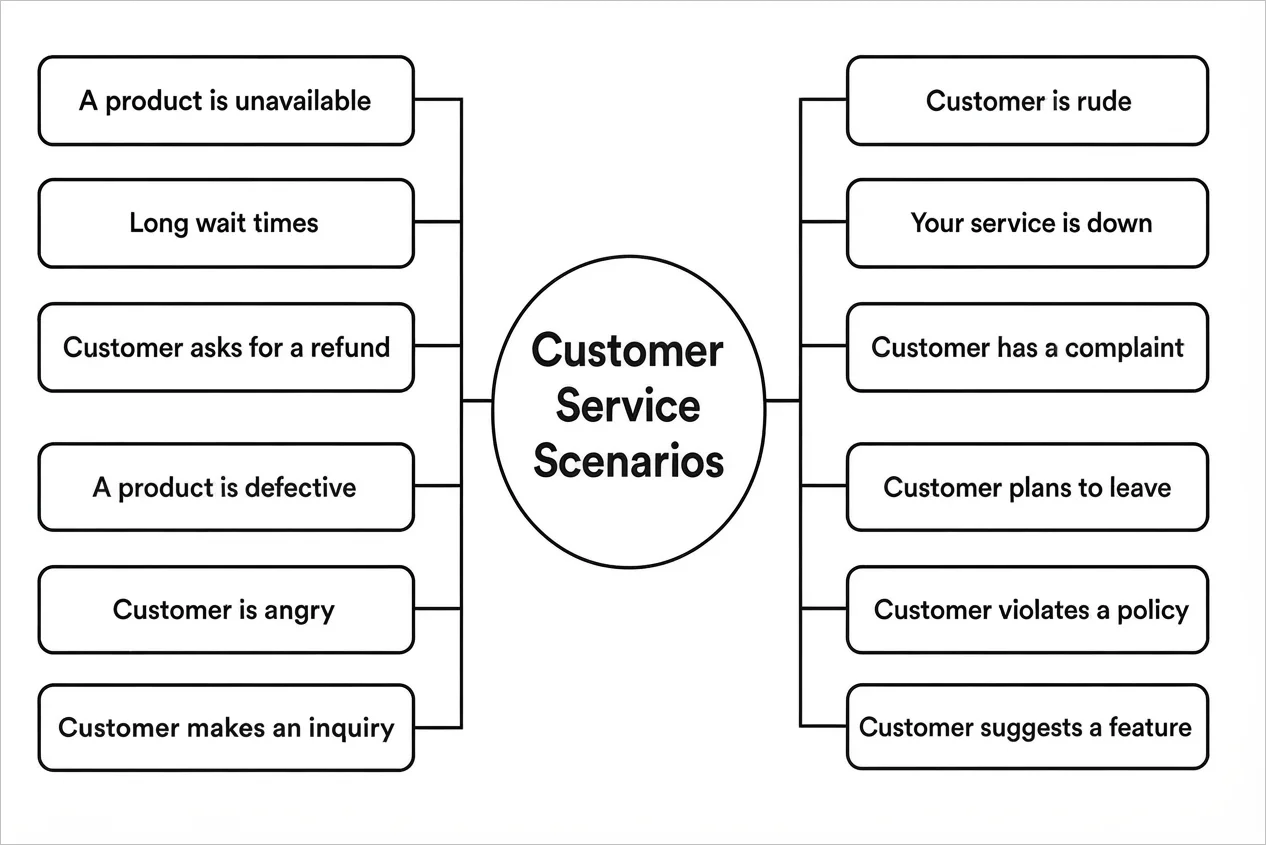
A product is unavailable
A customer contacts support to purchase a product, only to find that it is out of stock or temporarily unavailable.
Product unavailability often occurs at the peak of customer buying intent. Poor communication at this stage can lead to frustration, lost sales, and reduced trust, while transparency can preserve the relationship and keep the customer engaged.
How to handle this situation
- Acknowledge the customer’s disappointment and show empathy.
- Clearly explain the availability status and expected restock timeline, if known.
- Offer to notify the customer when the product becomes available.
- Suggest suitable alternative products when possible.
A good customer service response would be:
Sample response
“Hi Eli, I understand how frustrating this can be. Due to high demand, the product is currently out of stock. I can check when it’s expected back or help you explore similar options that might work for you.”
Long wait times for service
A customer experiences delays in receiving support and becomes frustrated after waiting longer than expected for a response.
Slow response times directly affect customer satisfaction. Research by SproutSocial shows that many customers expect brands to respond within an hour on social media, making speed a baseline expectation rather than a competitive advantage.
Best practices
- Acknowledge the delay and apologize for the inconvenience.
- Briefly explain the reason for the longer wait.
- Reassure the customer that their time is valued.
- Offer immediate assistance or suggest alternative support channels if available.
The following is an ideal response you can give:
Sample response
“I’m sorry for the inconvenience. I know how frustrating waiting can be. We’re experiencing a higher-than-usual volume of requests today, and I appreciate your patience. How can I help you now?”
Customer asks for a refund
A customer requests a refund because they are dissatisfied with a product or service, or feel their expectations were not met.
Refund requests are high‑emotion moments that can determine whether a customer leaves or stays. How the request is handled, especially when a refund isn’t possible, directly affects trust, retention, and brand perception.
How to handle this customer service scenario
- Listen carefully to understand the reason behind the request.
- Clearly explain the refund policy in simple, transparent terms.
- Process the refund promptly when policy allows.
- When a refund isn’t applicable, offer fair alternatives such as store credit, exchanges, or discounts.
For instance, in the case where a refund is not applicable, you can give the following response:
Sample response
“I understand your disappointment, and I appreciate you sharing your concerns. While we’re unable to process a refund under our policy, we value your business and would be happy to offer an exchange or a discount on your next purchase.”
A product is defective
Customer contacts support after receiving a product that is damaged, faulty, or not functioning as expected.
A defective product can quickly erode customer trust. In these moments, the quality of the support experience often has a greater impact on customer loyalty than the defect itself.
Tips to resolve this customer service scenario
- Listen carefully without interruption to understand the issue fully.
- Ask clarifying questions to gather the necessary details.
- Clearly explain the available resolution options, such as replacement, repair, or refund.
- Follow up after the issue is resolved to confirm customer satisfaction.
Below is an example of a customer service email template to write:
Subject: Help with Your Recent Purchase
Dear Jane,
Thank you for reaching out. I’m sorry to hear that the item you received was defective. I understand how frustrating that can be.
We’d be happy to assist you in one of the following ways:
- Send a replacement at no cost and arrange the return of the defective item
- Issue a full refund
Please let us know how you’d like to proceed. Your satisfaction is our priority.
Best regards,
John Doe
Customer support team
Customer is angry
Research commissioned by NICE shows that 99% of customers report experiencing frustrations when interacting with customer service agents.
A customer contacts support feeling angry or upset due to unresolved issues, service delays, or unmet expectations.
Angry customers are often reacting to repeated frustrations rather than a single issue. How support agents respond in these moments can either escalate the situation or rebuild trust and salvage the customer relationship.
How to handle
- Start with a sincere apology to acknowledge the customer’s experience.
- Show empathy and reassure the customer that you are there to help.
- Take ownership of resolving the issue, even if the problem wasn’t directly caused by you.
- Calmly guide the customer through possible solutions until the issue is resolved.
A good response to an angry customer would be:
Sample response
“I understand how upsetting that must have been, and I’m sorry for the frustration this has caused. Let’s work together to get this resolved.”
Customer asks a question you don’t know the answer to
This customer service role-play scenario occurs when a customer seeks specific information that the support agent cannot immediately provide.
Not having an instant answer can affect customer confidence. However, honest communication and clear next steps can reinforce trust and show professionalism, even when answers require additional time or expertise.
Solutions to this customer service scenario
- Clarify exactly what information the customer is looking for.
- Share any relevant general information you can provide immediately.
- Explain why additional time or assistance is needed.
- Connect the customer with the right expert or resource when necessary.
You can offer the following response:
Sample response
“Thank you for reaching out. I don’t have the full details on that specific aspect right now, but I can share some general information and connect you with a specialist who can help further.”
Customer is verbally abusive
A customer uses inappropriate or disrespectful language while interacting with a support agent.
Verbal abuse can negatively affect an agent’s well-being and derail productive problem-solving. Setting clear boundaries while remaining professional helps protect support agents and keeps the conversation focused on resolving the issue.
How to handle
- Stay calm and avoid taking the behavior personally.
- Acknowledge the customer’s frustration without validating abusive language.
- Clearly set boundaries around acceptable communication.
- Redirect the conversation toward resolving the underlying issue.
One possible reaction is as follows:
Sample response
“I’m sorry to hear about your situation, and I want to help. However, I won’t be able to continue the conversation if inappropriate language is used. Please explain the issue, and I’ll do my best to resolve it.”
Your service is down
A system outage or service disruption prevents customers from accessing your product or service.
Service outages create high‑pressure situations that can quickly damage customer trust. Clear, timely, and proactive communication reassures customers that the issue is being addressed and helps reduce frustration and inbound support volume.
Tips to resolve this customer service scenario
- Proactively inform customers and internal teams about the outage and progress updates.
- Share updates across multiple channels, such as email, social media, and in‑app notifications.
- Use automated messages to acknowledge customer concerns and set expectations.
- Allocate support resources across channels to handle increased inquiries.
An ideal response to customers would be:
Sample response
“We’re truly sorry for the inconvenience caused by this service outage. We understand how important our service is to you and are actively working to restore it.Thank you for your patience, and please reach out if you need immediate assistance.”
Customer asks to speak to the manager
A customer requests to speak with a manager because they feel their issue hasn’t been resolved or taken seriously.
Requests for escalation often signal frustration or a lack of confidence in the current interaction. How this moment is handled can either reassure the customer or further escalate the issue.
How to handle
- Listen carefully and summarize the issue to confirm understanding.
- Attempt resolution by explaining available options or constraints clearly.
- Be transparent about next steps if escalation is necessary.
- Set expectations by communicating potential wait times before connecting the customer to a manager.
For instance, you can give the following response:
Sample response
“I understand you’re frustrated and would like to speak with a manager. Please explain the issue to me, and I’ll do my best to help.
If needed, I can connect you with my supervisor; there may be a short wait.”
Customer says they are switching to a competitor
This scenario occurs when a customer informs support that they plan to leave and switch to a competitor due to dissatisfaction with the service or overall experience.
When customers express intent to leave, it represents a critical moment to understand what went wrong. A thoughtful response can sometimes prevent customer churn or, at the very least, provide valuable insights to improve future customer experiences.
Tips to handle this scenario in customer service
- Thank the customers for their time and for sharing honest feedback.
- Ask questions to understand the root cause of their dissatisfaction.
- Highlight relevant benefits or offer reasonable alternatives, such as discounts or service adjustments.
- Respect the customer’s decision if they choose to leave and capture feedback through an exit survey.
An excellent customer service response to this scenario would be:
Sample response
“I understand you’re considering other providers, and I’m sorry we didn’t meet your expectations. Your feedback is important to us. If there’s an opportunity to make this right, we’d appreciate the chance to improve your experience.”
Customer commits a breach of the product’s terms of use
A customer violates the agreed terms or policies governing the use of a product or service.
Policy violations require careful handling. Support teams must enforce rules consistently while preserving trust and maintaining a professional, respectful customer relationship.
Tips to resolve this customer service scenario
- Clearly explain which policy has been violated and how.
- Share the reason behind the policy and how it protects customers and the service.
- Offer compliant alternatives or solutions when possible.
- Explain potential consequences if the violation continues and provide resources for further clarification.
Below is a good response to the situation:
Sample response
“I need to address a violation of our terms of service related to password sharing. This policy is in place to protect the security of our service, and continued violations could lead to account suspension. To avoid this, we recommend upgrading to a multiple‑device plan. For more details, please review our terms of service on our website.”
Customer suggests a feature
Customer shares feedback or proposes a new feature they believe would improve the product or service.
Feature suggestions offer direct insight into customer needs and expectations. Even when ideas aren’t immediately actionable, how customer feedback is acknowledged influences customer engagement, trust, and long-term loyalty.
How to handle this customer service situation
- Thank the customer and acknowledge the value of the idea.
- Be transparent about whether the suggestion is feasible in the short term.
- Explain how feedback is reviewed or shared internally.
- Set expectations by offering updates if the suggestion leads to future improvements.
You can respond as follows:
Sample response
“That’s a great suggestion, thank you for sharing it with us. While we don’t have immediate plans to implement it, I’ll pass your feedback on to our product team. We’ll be sure to keep you updated if anything changes.”
General tips to handle role-playing scenarios in customer service
Effectively handling customer service scenarios requires clear communication, empathy, and the right customer support tools.
Applying proven customer service tips helps teams manage real‑life customer service situations, improve response times, and deliver better customer experiences.
- Maintain a positive attitude: A positive attitude creates a good environment for resolving customer service issues.
- Use customer service software: Customer service software helps track interactions and preferences for better service delivery and improves response times.
- Train your team: Provide effective customer service training for your agents. Training gives them the skills to manage different customer service scenarios effectively.
- Ask for feedback: Requesting feedback shows customers you are committed to their satisfaction. Always express gratitude to the customers for their responses.
- Provide customer onboarding: Ensure your clients understand how to use your offerings to minimize customer frustration.
- Know your company policies: Understanding company policies helps you provide accurate information to customers and better assist them.
Enhance customer satisfaction and foster positive relationships by approaching each role-playing scenario for customer service with empathy and focusing on solutions.
Transform customer service scenarios into success stories
Every customer interaction is a moment that shapes trust, loyalty, and long-term retention. With the right approach and tools, even difficult situations can become opportunities to strengthen relationships and improve customer experience.
BoldDesk provides a suite of tools that handle high-pressure customer situations with speed, clarity, and consistency, enabling you to resolve issues and maintain robust customer relationships.
Contact us to get a free trial of BoldDesk today and discover how it can help you handle particular role-play customer service scenarios effectively.
We hope this blog was insightful. Would you like to add any customer service scenarios or ideas? Feel free to share them in the comments section below.
Related articles
- Customer Care: Why It’s Important for Business Success [+ Examples]
- What is Good Customer Service? 9 Tips & Examples
- “The Customer Is Always Right”: Fact or Fiction