






TL;DR: A customer service policy defines how employees should handle customer interactions. It improves consistency, clarifies service expectations, and guides issue resolution. Effective policies cover communication standards, response-time targets, escalation procedures, and channel-specific support guidelines.
Customers should receive the same standard of service regardless of the employee or channel involved. Without clear policies, teams may handle similar situations differently, leading to inconsistent responses, delayed resolutions, and customer frustration.
According to Salesforce, 69% of consumers expect consistent interactions across departments.
A defined customer service policy supports this consistency by giving employees clear procedures for communicating with customers and resolving issues.
In this guide, you’ll learn how to write a customer service policy, which elements to include, and how to apply practical examples. You’ll also get a free template that you can customize for your business
What is a customer service policy?
A customer service policy is a set of guidelines that defines how employees should handle customer inquiries, complaints, escalations, and other interactions. It establishes clear expectations and procedures that help teams deliver consistent support.
Customer service standards support these policies by translating their principles into measurable performance goals and service benchmarks.
Why are customer service policies important?
Customer service policies align employees and customers around what good customer service should look like. Key benefits include:
- Build agent confidence and productivity: Clear guidelines help agents make decisions faster and handle common situations with greater certainty. They also reduce time lost to procedural questions and avoidable customer complaints.
- Keep support teams aligned: Defined workflows ensure agents follow the same steps when handling requests, escalations, and exceptions. This improves collaboration and reduces conflicting responses.
- Create consistent customer experiences: Customers receive the same standard of support across different agents and communication channels. Consistency helps strengthen trust in the organization.
- Set clear service expectations: Policies explain what support customers can expect, including communication standards, response procedures, and service limitations. Clear expectations help prevent misunderstandings and frustration.
- Improve customer satisfaction and loyalty: Reliable service makes customers more confident in the business. Satisfied customers are more likely to return, renew, and recommend the brand to others.
What should you include in your customer service policy?
The proper approach to customer service issues and the attitude with which to handle your customers varies from one company to the next, depending on the clients and nature of your relationship with them.
However, there are some guidelines that can serve as a broad baseline. The following are the main components of a consumer service policy.
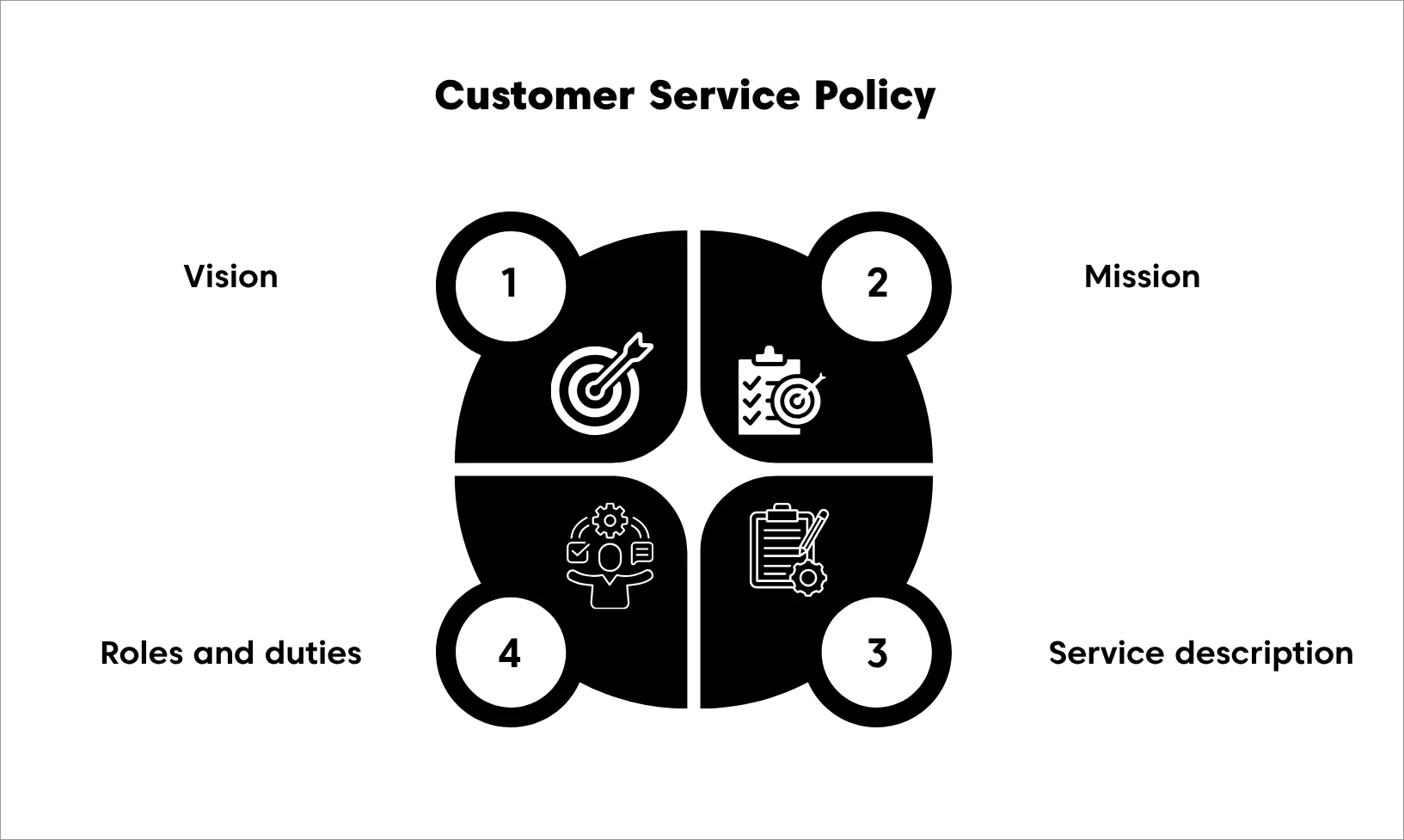
Customer service mission and vision statement
Clearly define your company’s mission and vision, and how your customer service should align with these values. This will set the tone for your policy.
Product and service description
Provide clear, updated descriptions of what your customers can expect from your company’s products, services, and customer support team.
Customer support team standards
The company should outline the duties and responsibilities of each employee in various departments. The standard of professionalism should be considered.
Support agents should know how to relate and interact with each other and with clients.
Organizations should review and update these standards regularly to improve customer support and adapt to changing customer expectations.
Communication guidelines
The company needs to outline the expectations for communication with customers, including the channels available (phone, email, chat, and social media) and any necessary escalation procedures.
Rules on team collaboration
The collaboration among agents across different departments should be defined. There should be a clear hierarchy for escalation.
Both primary and secondary contacts should be listed for departments that the support team may have to contact.
If particular types of issues need to be seen by particular people or sub-teams, that needs to be clear.
Customer service promises
Build a strong relationship of trust with your customers and be transparent about the products and services you deliver. With this, you can boost customer satisfaction.
Customer service expectations can vary across industries. For example, accounting firms must ensure accuracy, maintain client confidentiality, and communicate complex financial information clearly while delivering timely support.
Explore these accounting help desk do’s and don’ts to learn how accounting support teams can provide professional and trustworthy customer service.
Customer service policy template
Use the following customer service policy template as a starting point for creating a policy that aligns with your organization’s goals, service standards, and customer expectations.
Purpose
This customer service policy establishes the standards, expectations, and procedures employees should follow when interacting with customers. Its purpose is to ensure consistent, professional, and high-quality service across all customer touchpoints.
Our mission [Provide Company’s Mission Statement]
Example: At [Company Name], our mission is to deliver unparalleled customer service that goes above and beyond expectations, fostering lasting connections with every interaction.
Our vision [Provide Company’s Vision Statement]
Example: Our vision is to become the premier destination for our customers’ needs, creating enriching and gratifying experiences at every touchpoint.
Our commitment: We at [Company Name] are committed to providing exceptional customer service to our valued customers. We strive to ensure every customer interaction is positive and professional.
Scope: This customer service policy is applicable to all team members at [Company Name], governing interactions with customers across all channels, whether face-to-face, over the phone, or online.
Service standards
Employees are expected to:
- Treat all customers with courtesy and respect.
- Provide accurate and consistent information.
- Take ownership of customer issues until resolution.
- Follow established support procedures and company policies.
- Maintain professionalism across all communication channels.
Response time expectations
| Request type | Target response time |
| General inquiries | Within 1 business day |
| Customer complaints | Within 1 business day |
| Urgent issues | Within 2 hours |
| Escalated requests | Within 4 business hours |
Ready to create a customer service policy for your business? Download our free template and customize it to fit your organization’s goals, service standards, and support processes.
Guidelines
The following guidelines help ensure that all employees deliver consistent, professional, and customer-focused service across every interaction.
| Guideline Area | Expectation |
| Professional Communication | Maintain a friendly, professional tone and a positive attitude. Use appropriate language and represent the company professionally across all customer interactions. |
| Response Times | Respond to customer inquiries within established service standards and resolve complaints promptly to support customer satisfaction. |
| Active Listening | Listen carefully to customer concerns, ask clarifying questions, and confirm understanding before proposing a solution. |
| Problem Resolution | Take ownership of customer issues and explore all reasonable options to provide effective and timely solutions. |
| Escalation | Escalate issues to the appropriate team member or department when additional expertise, authority, or support is required. |
| Respect and Empathy | Treat all customers with courtesy, dignity, patience, and professionalism, regardless of the situation. |
| Data Privacy and Security | Protect customer information and follow all applicable privacy, security, and data protection requirements. |
| Continuous Improvement | Encourage customer feedback, identify service gaps, and seek opportunities to improve the customer experience and support processes. |
We firmly believe that by adhering to these guidelines, we can fulfill our mission and vision of delivering exceptional customer service experiences that exceed expectations and cultivate enduring relationships with our valued customers.
How to develop customer service policies
Building an effective customer service policy requires an entire process from before the policy is created, to after it has been implemented. You can create your customer service policy using the strategies outlined.
1. Create and implement the company’s vision and mission statements
When drafting a customer service policy, it is important for a company to identify and consider its core values as well as define the long-term objectives that it hopes or aspires to achieve with its customer service. These include:
- Company vision: Defines the goals that a company intends or hopes to achieve in the long run.
- Company mission: It should clearly state the key values for which a company stands.
All company employees should know the company’s vision and mission. They should be included in the policy and kept in mind during its creation.
They’ll set the tone for the customer service standards and expectations.
2. Identify and understand your customers’ needs and preferences
According to Salesforce, 66% of clients expect companies to understand their needs and fulfil their expectations.
Knowing what works for your target clientele helps determine how to serve them. You can consider clients’ behavior, demographics, and industry feedback.
You can also directly research what your customers prefer or need from your customer service. Ask your support team for input. Ask your customers through community forums or by sending them surveys.
Using analytical insights to determine factors humans may not think to articulate. Use the findings to tailor your support policies to suit their requirements.
3. Define service goals and performance standards
When developing customer service policies, ask yourself if the goals you are setting can be achieved. How realistic are they? Do they meet the expected standards?
Set goals on important aspects such as resolution speed, communication channels to use, follow-up strategies, customer retention, and complaint resolution.

Identify ways to balance speed and quality of service. For example, utilize canned responses for the quick reply. Find ways to resolve issues on time, all while maintaining good customer relationships.
Consider creating varying rules for different situations in order to achieve the best end results.
4. Establish customer service standards and employee responsibilities
The customer service team acts as the face of a company. They are in direct contact with the customers.
It is therefore important to establish clear expectations for how employees should act in different situations.
Clearly outline how the employees should carry themselves professionally, how they should interact with customers, handle different situations, conflict resolution procedures, and when training should occur on these policies.
5. Create and implement customer feedback loops
Collecting the customers’ input through real-time reviews, comments, or complaints about your customer service will help you identify your strengths and weaknesses.

Forbes statistics show that businesses that prioritize their clients’ experience are 66% more successful than those that don’t.
Asking for clients’ feedback regularly will help in refining and improving the customer support policies and procedures over time, thus best serving your clients.
6. Communicate the policy across the organization
Communicate with employees and customers alike on any newly implemented or updated policies. This encourages policy adoption.
You can enlighten them through conducting meetings with employees or sending notifications to clients that include links to the policy.
Informing them ensures that everyone is aware of the updates and that they consent to the policy being passed.
7. Train and empower your employees
It is important for team members to have a clear understanding of the policies in place. You can consider the following options to empower them with the right skills to properly carry out your policies:
- Hold policy-training programs and workshops to discuss the guidelines in depth.
- Include the policies in the internal knowledge base for reference.
Additionally, you can also give them acknowledgement or rewards for good performance and handling difficult situations well, using them as teaching opportunities.
8. Strive to continuously improve customer service policies
As your company and technology keep evolving, customer expectations change, new situations arise, and your support team grows or shrinks, the policies in place should adjust accordingly.
Update the policies alongside the changes witnessed in the business. This will ensure your support team always knows what to do, and clients are guaranteed good experiences.
Customer service policy examples
Customer service policies should reflect the organization’s industry, customer needs, service model, and regulatory requirements.
The following examples show how policies may differ across businesses.
Retail customer service policy
Retail policies typically cover returns, refunds, exchanges, product questions, and in-store interactions.
SaaS customer service policy
SaaS policies often define response targets, technical support procedures, outage communication, onboarding assistance, and escalation paths.
Healthcare customer service policy
Healthcare policies should prioritize patient privacy, regulatory compliance, timely communication, accessibility, and compassionate service.
E-commerce customer service policy
E-commerce policies commonly address order tracking, shipping delays, cancellations, returns, refunds, and online support.
Related policies that support customer service
Several company policies complement customer service policies but serve different purposes:
- Privacy and cookie policy: Explains what customer information the company collects, why it is collected, and how it is used and protected.
- Return and refund policy: Defines the conditions, timeframes, and procedures for returning products and receiving refunds.
- Security policy: Outlines measures for protecting customer and company data from unauthorized access, misuse, loss, or destruction.
- Ethics policy: Establishes the behavioral and ethical standards employees, vendors, and other representatives must follow.
- Terms of use: Defines the rights, responsibilities, and restrictions associated with accessing or using the company’s products and services.
These policies should work together to set clear expectations, protect customers, and help employees make consistent service decisions.
Each organization should adapt them to its customers, operations, industry requirements, and legal obligations.
Customer service policy best practices
A well-written customer service policy should be easy to follow, regularly updated, and aligned with customer expectations.
The following best practices can help ensure your policy remains effective:
| Best practice | Why it matters |
| Keep policies simple and easy to understand | Clear, concise language helps employees quickly find and apply the right guidance during customer interactions. |
| Align policies with customer expectations | Policies should reflect customer needs, preferences, and feedback to support positive service experiences. |
| Define measurable service standards | Establish clear expectations for response times, resolution times, communication quality, and escalation procedures. |
| Train employees regularly | Ongoing training ensures employees understand the policy and can apply it consistently across all customer interactions. |
| Review and update policies frequently | Regular reviews help keep policies relevant as customer expectations, business goals, and technologies evolve. |
| Use customer feedback to improve policies | Surveys, reviews, and support interactions can reveal gaps and opportunities for continuous improvement. |
Treat your customer service policy as a working document rather than a one-time project.
Assign someone to oversee it, review performance against its standards, and update the guidance when customer needs or business processes change.
Turn customer service policies into consistent action
Clear customer service policies help teams make consistent decisions and deliver reliable support. They should reflect your organization’s service goals while giving employees practical guidance for handling customer requests, complaints, escalations, and exceptions.
The right customer service software helps teams apply these policies through ticket management, automated workflows, collaboration tools, role-based access, and structured escalations.
BoldDesk brings these capabilities into one platform, helping teams turn written policies into repeatable service processes. Start a free trial to explore the platform.
Related articles
- Strategies to Provide Efficient Customer Service
- Techniques for Reducing Customer Service Response Time
FAQs on customer service policy
A customer service policy should be detailed enough to set clear expectations while remaining easy for employees to understand and follow. Most policies range from one to several pages, depending on the size and complexity of the organization.
Customer service leaders, support agents, operations teams, and other stakeholders should contribute to the policy to ensure it reflects both customer expectations and business goals.
Issues should be escalated when they require specialized expertise, involve sensitive situations, exceed an agent’s authority, or cannot be resolved within the established service standards.
Organizations can measure effectiveness using metrics such as customer satisfaction (CSAT), response times, resolution times, complaint volumes, customer retention rates, and customer feedback.
Common mistakes include using unclear language, failing to update policies regularly, setting unrealistic service expectations, and not providing employees with adequate training.
Yes. Consistent service, clear communication, and predictable support experiences help build trust, increase customer satisfaction, and encourage long-term customer loyalty.