

 AI Agents
 AI Copilot
 AI Actions
 AI ROI Calculator


 SaaS
SaaS Insurance
 Telecom
 Healthcare
 Startups
 Fintech
 Email Ticketing System
 Shared Inbox Software
 Multi Brand Help Desk
 Internal Help Desk Software
 Trouble Ticketing Software
 Mobile Help Desk


 Blog
Blog



TL;DR: As support teams grow past five agents, tagging becomes inconsistent, causing tag overload, misrouting, and unreliable reporting. A structured 3‑layer tagging model using category, intent, and context keeps triage fast and automation accurate, preventing tag chaos and maintaining scalable, trustworthy support operations.
Most support teams adopt tags early, and at first, it works: everyone shares the same mental model, and tickets are easy to find.
However, as your support team grows, tagging naturally becomes harder to keep consistent, and small differences in how agents label tickets start to create bigger operational issues.
Without clear ticket tagging conventions, teams run into misrouted tickets and slower triage.
This guide explains how to design ticket tagging conventions that scale, so your support team can grow without losing control.
What are ticket tagging conventions?
Ticket tagging conventions are the rules your support team uses to label conversations and cases in a clear and consistent way.
They define how issues are categorized, how customer intent is captured, and how handling context is recorded.
These conventions are essential for accurate automation, routing, SLA management, and reliable reporting across your support tools.
What good ticket tagging looks like:
- Clear: Agents know exactly which tags to apply in common scenarios.
- Consistent: The same scenario always yields the same tags across agents or channels.
- Actionable: Tags map cleanly to automation, routing, and reporting.
- Minimal but complete: No unnecessary synonyms; just enough precision to power decisions.
- Governed: There’s a process for creating, approving, merging, and retiring tags.
Why tagging breaks when support teams grow beyond five agents
Tagging works smoothly when a small team handles all tickets. Communication is direct, and agents share the same understanding of tag usage.
But once you cross five support agents, tagging becomes inconsistent.
Common breakdowns include:
- Multiple tags describing the same issue
- Agents choosing tags based on personal judgment
- Lack of clarity during automated ticket routing
This increases manual ticket triage effort and creates inbox confusion.
The 3-layer ticket tagging model for scalable support teams
The easiest way to prevent tag chaos is to avoid putting everything into one catch-all “tags” bucket.
A scalable model separates what the issue is, why the customer is contacting you, and the context that influences how it should be handled.
With 81% of customers expecting more self-service options, a structured tagging system becomes essential for enabling accurate automation and powering reliable knowledge discovery (Source: NICE).
And when viewing an article in the self-service portal, you can also see all the relevant tags linked to it, helping customers instantly understand the article’s topics and themes.
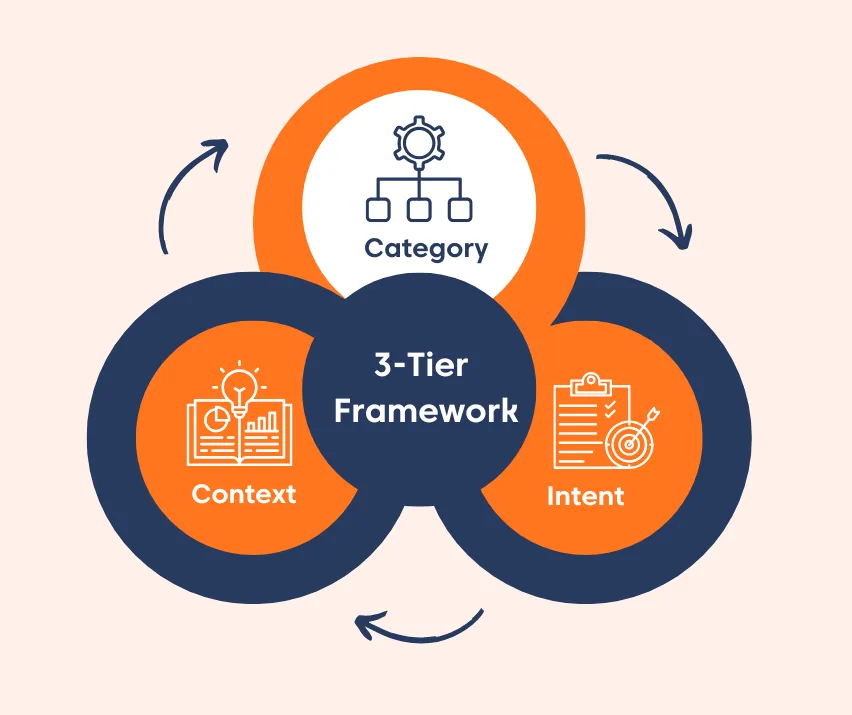
Quick rules for 3-layer ticket tagging
- “Every ticket gets exactly 1 category tag.”
- “Add 0–1 intent tag when it changes workflow or routing.”
- “Add 0–2 context tags for handling modifiers only.”
Layer 1: Category tags (Issue type or domain)
Category tags are the foundation of your reporting structure. Every ticket should have one primary category.
Examples:
- billing
- account_access
- login_auth
- product_bug
- integrations
Category tags power your most important dashboards and are the cleanest trigger for routing rules.
Layer 2: Intent tags (Why the customer contacted support)
Intent tags describe what the customer is trying to achieve or what outcome they want. They guide workflow and escalation logic based on customer goals, not urgency or SLAs handled by context tags.
Examples:
- cancel_subscription
- invoice_request
- reset_password
- troubleshoot_error
- how_to_setup
Utilizing intent tags enhances the ticket categorization framework and improves the accuracy of request routing.
Layer 3: Context tags (Additional operational information)
Context tags provide situational details that influence handling but do not redefine the issue. They often represent urgency, customer tier, or risk signals, helping refine routing accuracy and SLA management.
Examples:
- vip_customer
- new_customer
- security_risk
- reproducible_issue
- at_risk_churn
Context tags enable differentiated SLAs and handling rules without fragmenting your core taxonomy.
Use the table below as a quick reference for each layer’s purpose, ideal tag count, and naming pattern.
| Layer | Purpose | Recommended Count | Naming Pattern | Examples |
| Category | Issue type or domain (reporting backbone) | 5–10 | singular_noun | billing, account_access, integrations |
| Intent | Customer goal or workflow trigger | 15–25 | verb_noun | request_refund, report_bug, upgrade_plan |
| Context | Handling modifier (priority, tier, risk) | 10–15 | descriptor_noun | vip_customer, trial_user, urgent, at_risk_churn |
How to apply the 3‑layer tagging model in real support scenarios
Seeing tags applied to realistic ticket text helps teams use the 3‑layer model consistently, and shows how the same ticket can drive routing, SLA behavior, and clean reporting and analytics.
Here are examples of how the model works in real cases:
Billing refund request from a high‑value customer
Billing‑related tickets often require precise handling because they affect payments and customer trust.
Even when agents respond quickly, proper resolution depends on correct routing and SLA triggers. For example, a long-term customer reports a billing error and requests a refund.
Tags applied:
- Category: billing
- Intent: request_refund
- Context: vip_customer
What happens with correct tagging:
- Routing sends the ticket straight to the billing or accounts receivable queue
- SLA or priority and escalation rules apply automatically
- Reporting tracks refund volume while keeping VIP cases separate from general billing trends (so one large account doesn’t distort analytics)
Login issue during customer onboarding
Access issues receive fast replies but often require coordination between onboarding, support, and sometimes engineering.
Without clear tagging, these cases can remain unresolved longer than expected. For example, a new customer cannot log in during their onboarding week.
Tags applied:
- Category: account_access
- Intent: reset_password
- Context: onboarding_week
What happens with correct tagging:
- Routing sends the ticket to onboarding‑trained agents or the onboarding pod
- SLA or priority triggers the time‑sensitive onboarding SLA automatically, even if the customer is not VIP
- Reporting includes the case in onboarding friction analytics (login blockers, time‑to‑first‑value risks)
Tags vs custom fields vs categories (when to use which)
Not everything should be classified as a tag. While tags offer flexibility for categorization, structured reporting and mandatory fields are better suited for specific inputs.
The table below will assist you in making more informed decisions.
| Best tool | Use case | Why |
| Category (or category tag layer) | High-level issue grouping for dashboards | Stable taxonomy; easy reporting |
| Intent tag | Customer goal/workflow trigger | Lightweight, automation-friendly |
| Context tag | Urgency, customer tier, risk markers | Modifies handling without changing the issue |
| Custom field is required (cannot be blank) | Anything that must be required (cannot be blank) | Custom field |
| Custom field | Anything with controlled values (dropdown list) | Prevents synonyms and duplicates |
| Tag (with audit date) | Temporary or experimental labels | Fast iteration, easy cleanup |
| Custom field or multi-level taxonomy | Detailed product area breakdown (many values) | Tags can sprawl too fast |
Simple rule of thumb:
- Use tags when you need speed and flexibility.
- Use fields when you need control, consistency, and clean insight.
- Use categories (or the category layer) as your non-negotiable backbone.
Early warning signs that your ticket tagging system is losing control
When your ticket tagging system starts losing control, the first warning sign is tags multiplying without clear rules or structure.
Left unchecked, this inconsistency slowly disrupts triage, routing accuracy, and reporting reliability across your customer support operations.
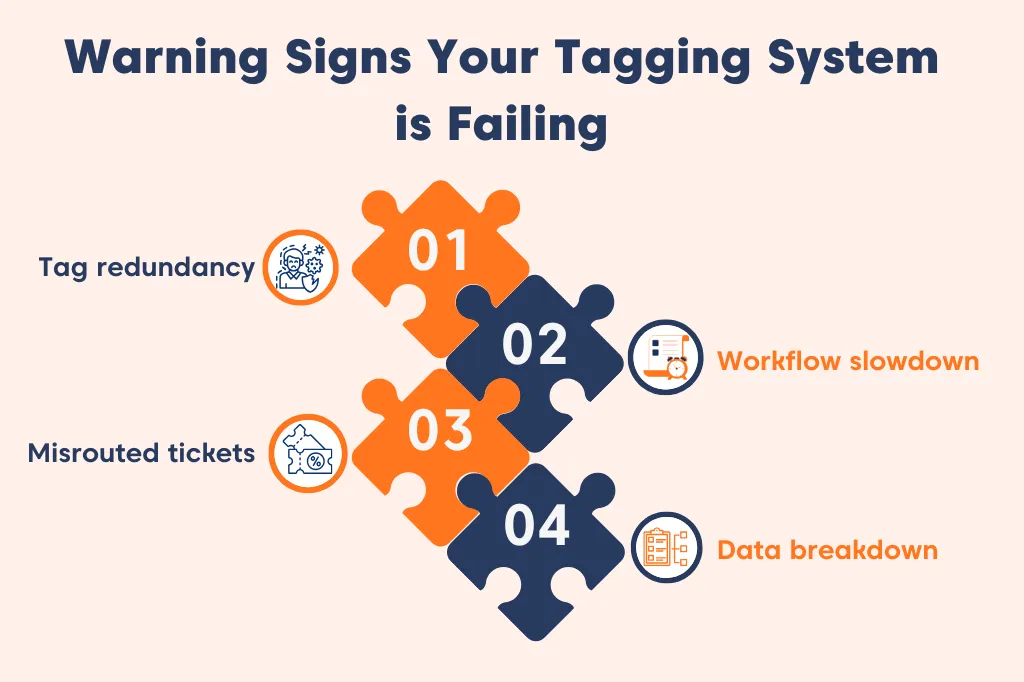
Duplicate tags reduce classification accuracy
Multiple tags often describe the same issue in different ways. This data inconsistency makes it challenging to accurately analyze trends.
The most common failure mode is accidental duplication.
- “billing”
- “billing_issue”
- “invoice”
- “payment”
- “payments_problem”
Over time, when similar tags exist, filtering tickets and routing become unreliable.
Tickets reach the wrong support teams
Without established standards, agents create tags based on their personal preferences for phrasing.
While each tag may seem appropriate on its own, together they create a lack of consistency.
The result is a tagging system that reflects individual preferences instead of a standardized operational process. Inconsistent tags hinder automation rules from properly assigning tickets.
According to Business Wire research, 57% of customers abandon a brand after just one or two negative service interactions, underscoring the need for clean, consistent ticket tagging that prevents delays.
Support data becomes difficult to trust
Automation only works when similar tickets use the same tags. If agents tag things differently, the system can’t trigger the right actions.
If your workflow says:
If tag = refund_request, route to Billing Queue
But half of the refund tickets are tagged refund, refunds, or cancel_and_refund, you’ve just turned routing into a manual process again.
What breaks next:
- SLA handling becomes inconsistent
- Escalations get missed
- Triage speed slows because managers must intervene
Increased ticket misrouting and manual corrections
Poor ticket tagging leads to incorrect routing and delayed escalations.
Ask yourself these questions:
- “Are refunds increasing, or are we just tagging differently?”
- “Why did ‘billing’ drop but ‘payments’ spike?”
- “Is this trend real or a tagging artifact?”
When leaders can’t trust support analytics, support loses leverage in product discussions, staffing decisions, and roadmap prioritization.
Key ways governance and audits keep ticket tagging consistent
Strong governance and regular audits work together to keep your ticket tagging system accurate, predictable, and easy for support teams to use.
Without these guidelines tags quickly drift, multiply, or become inconsistent, leading to routing issues, unreliable reports, and slower triage.
Clear rules prevent tagging drift
Governance starts with setting simple rules for how tags are created, named, and used. Assigning ownership ensures new tags are added intentionally rather than randomly.
Documented standards help agents know which tags exist, when to use them, and what each one means.
This keeps your tagging structure organized and prevents duplicate or unnecessary tags from slipping in.
Merging or removing tags improves clarity
When multiple tags describe the same issue, merging them into one clear label reduces confusion for agents and improves the accuracy of automation rules. Removing outdated or unused tags keeps your system focused and easier to navigate.
Audits keep your system clean and up to date
Regular customer service audits help you confirm that your tags still support your current metrics, workflows, and priorities. As your product or processes evolve, your tagging structure should evolve with them.
Start by looking at how tags are actually used and where inconsistencies may be affecting triage, routing, automation, or reporting.
What to check during an audit:
- Duplicate or rarely used tags
- Inconsistent naming patterns
- Tags that no longer match your workflows or product structure
Quarterly reviews keep your tagging system clean, accurate, and aligned with your operations.
How structured ticket tagging improves triage speed and workflow efficiency
Tagging conventions form the foundation of scalable automation and analytics. Without consistent and structured inputs, even advanced systems can struggle to operate reliably.
Predictability in tagging is key to achieving operational scale.
- Faster routing to the right team: Clear category and context tags enable automation to assign tickets instantly, minimizing delays caused by manual sorting.
- More accurate ticket prioritization: Intent and impact tags highlight urgency, ensuring that high-risk tickets receive attention first.
- Improved inbox efficiency: Standardized tags help maintain organized inboxes as ticket volume increases, reducing the need for manager corrections and ultimately increasing overall triage throughput.
- Strengthen operational decision-making: Accurate tagging helps you plan staffing, improve processes, and guide product changes.
Build tagging conventions before growth breaks your support system
Tagging feels simple in smaller teams, but as ticket volume and agent count increase, you need clear structure and governance to keep your system reliable and scalable.
Start by implementing the 3-layer model, documenting the tag registry, and then mapping your category, intent, or context rules into your routing and workflow setup.
With the right help desk platform, such as BoldDesk, businesses can transform ticket tagging conventions into a scalable triage engine that grows with your team.
Ready to escape tag chaos? Start a 15-day free trial of BoldDesk, or contact our support team to set up a governed tagging system before growth breaks your triage process.
Was this article helpful? Share your thoughts or experiences in the comments section. We’d love to hear from you.
Related articles
- Time to Resolution: A Key Metric for Support Success
- 10 Help Desk Automation Ideas to Improve Team Productivity
- Top 7 SLA Best Practices to Improve Customer Service
Frequently Asked Questions
Categories are a controlled top-level classification, while tags are flexible labels. If you’re using tags as categories, you need governance so “billing” doesn’t become 12 variants.
Keep it constrained. A practical rule is 1 category tag, 0–1 intent tag, and 0–2 context tags, enough for routing and reporting without noise.
Yes, automation rules can apply tags based on conditions. Consistent tag naming is what makes automation predictable.
Use fields when you need controlled values, reporting reliability, or required inputs such as product area and plan type. Tags are better for lightweight labels and routing triggers.
Most tagging failures come from poor implementation, not from having too many tags. When teams don’t roll out changes gradually, assign ownership, or audit tags regularly, inconsistency builds up quickly.
Strong execution keeps the tagging system reliable even as tag volume and ticket volume grow.
Tag overload is caused by unrestricted tag creation, unclear definitions, and the absence of regular audits. As teams grow, the tagging structure doesn’t scale, leading to multiplying synonyms and duplicate tags.



 In this page