




TL;DR: Fintech leaders can deliver secure, compliant customer service at scale by combining strong data protection, compliance‑ready help desk systems, and continuous monitoring. With clear audits, security controls, and well‑trained teams, you can reduce breach risks, build lasting customer trust, and turn compliance into a competitive advantage.
Every fintech company competes on trust, and every support interaction asks customers to share sensitive parts of their financial identity.
A single weak verification step or mishandled attachment can create risks that extend far beyond simple frustration, making secure and compliant fintech customer service a mandatory foundation.
With strict regulations, rising fraud, and evolving security threats, customer service has become one of the most sensitive and scrutinized parts of fintech operations.
This guide breaks down why compliance and security are non‑negotiable in fintech customer service, and the best practices fintech leaders can use to scale support safely.
What a secure and compliant fintech support really means
What is secure fintech customer service? Secure fintech customer service refers to support operations that protect sensitive financial data, meet regulatory requirements, and maintain auditability across every customer interaction.
Secure and compliant support goes far beyond encryption or ticking boxes on a regulatory checklist.
In fintech, it means embedding compliance into everyday workflows so that every customer interaction is both safe and trustworthy.
According to PwC, 85% of consumers say they will stop doing business with a company if they feel it mishandles their data, making systematic compliance a non‑negotiable.
A secure fintech support operation ensures:
- Controlled access to customer data: Support agents should only view the minimum information needed to resolve a ticket. Tight role‑based permissions prevent oversharing, unauthorized browsing, and accidental exposure.
- Clear accountability across all actions: Every action, like a click, update, or export, should be logged, traceable, and reviewable. Good audit trails meet rules like SOC 2 (System and Organization Controls), GDPR (General Data Protection Regulation), and PCI DSS (Payment Card Industry Data Security Standard). They also help stop misuse and make investigations quicker and clearer.
- Consistent execution of policies: Regulatory rules cannot rely on agent discretion. Instead, workflows should enforce things like redaction, authentication, data retention, and deletion automatically. This reduces human error and ensures fintech compliance at scale.
- Safe communication across all channels: Whether a customer reaches out through email, live chat, forms, or a self‑service portal, sensitive details must remain protected. This includes preventing unencrypted attachments, redacting financial identifiers, and ensuring internal notes are handled with the same rigor as customer-facing messages.
Key takeaway: Secure and compliant fintech customer service is built on structured processes rather than manual effort, and it delivers consistent results instead of reactive fixes. It’s the difference between hoping your processes hold up under pressure and knowing they will.
Secure fintech support is not built by policies alone; it depends on how consistently agents verify users, handle sensitive data, and communicate during high-stakes financial conversations.
Applying the right dos and don’ts for fintech help desk teams helps turn compliance from a checklist into a daily support habit that protects customers and strengthens trust.
Common security and compliance risks in fintech support operations
Even the most advanced fintech support systems face unique risks that can undermine compliance and customer trust if not addressed directly.
Below are the most critical risks support leaders must anticipate and mitigate.
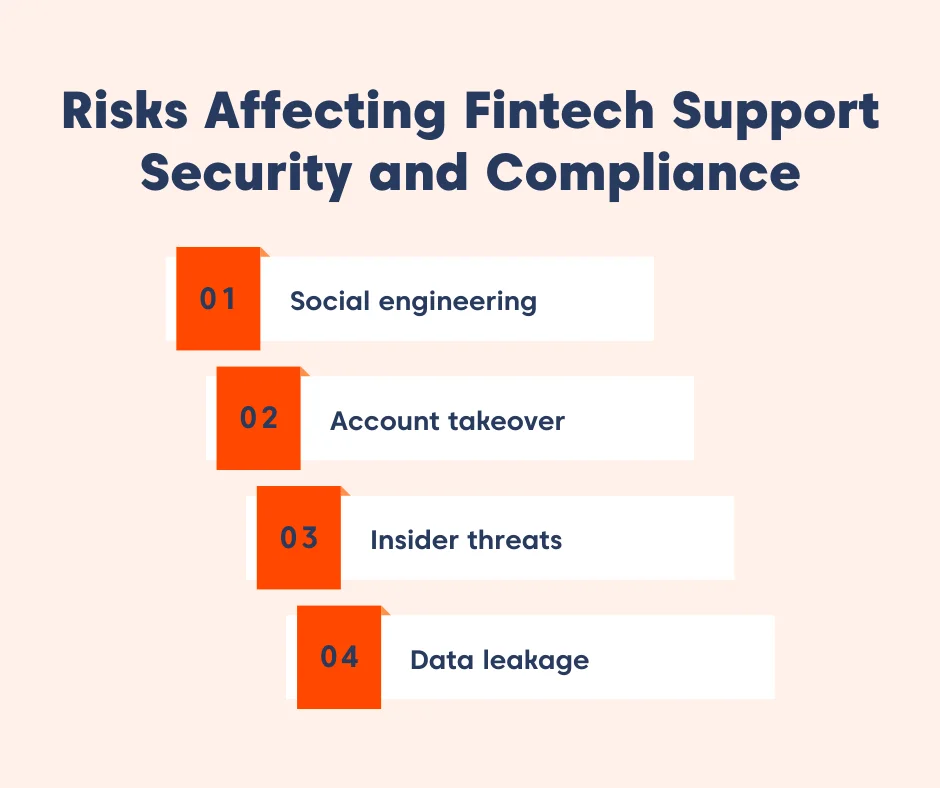
Social engineering via support tickets
Support desks are a prime target for phishing and social engineering attacks. Fraudsters often impersonate customers, requesting password resets or account changes through tickets.
Without strict identity verification protocols, support teams can unintentionally open the door to fraud.
Real-life example
In 2021, Robinhood reported a breach where attackers tricked support staff into granting access, compromising millions of accounts.
The incident underscored how even well‑resourced fintech companies can be vulnerable, highlighting the importance of continuous training, strict verification procedures, and layered security controls to prevent similar exploits.
Insider misuse of support access
Not all risks come from outside. Insider threats, whether malicious or accidental, pose significant compliance challenges.
Agents with broad access can misuse customer data, export sensitive logs, or override security settings. The SOC 2 and PCI DSS frameworks emphasize limiting access strictly to job roles and monitoring agent activity to detect anomalies.
Account takeover through agent actions
Support agents have elevated privileges that, if misused or manipulated, can lead to account takeovers.
Attackers may pressure or deceive agents into bypassing security checks or exploit weak internal controls to gain unauthorized access.
Real-life example
In September 2022, Revolut, a global fintech, confirmed a cyberattack that exposed the personal data of about 50,000 customers. The company acted quickly to isolate the breach and notify affected users, but the incident highlighted how fragile customer trust can be when compliance and security controls are tested.
Data leakage via attachments, logs, and exports
Support operations generate large volumes of attachments, chat logs, and ticket exports. If these are not encrypted, redacted, or properly retained, they can leak sensitive financial data.
Common leakage points include agents downloading attachments to unsecured devices or exporting ticket histories without redaction.
5 Ways to scale fintech support without compromising compliance
When companies grow their support teams, they often have to choose between speed and being careful.
In fintech, you can’t make that choice; you need to grow while keeping fintech customer safety rules in place at every step.
To scale safely, teams need to:
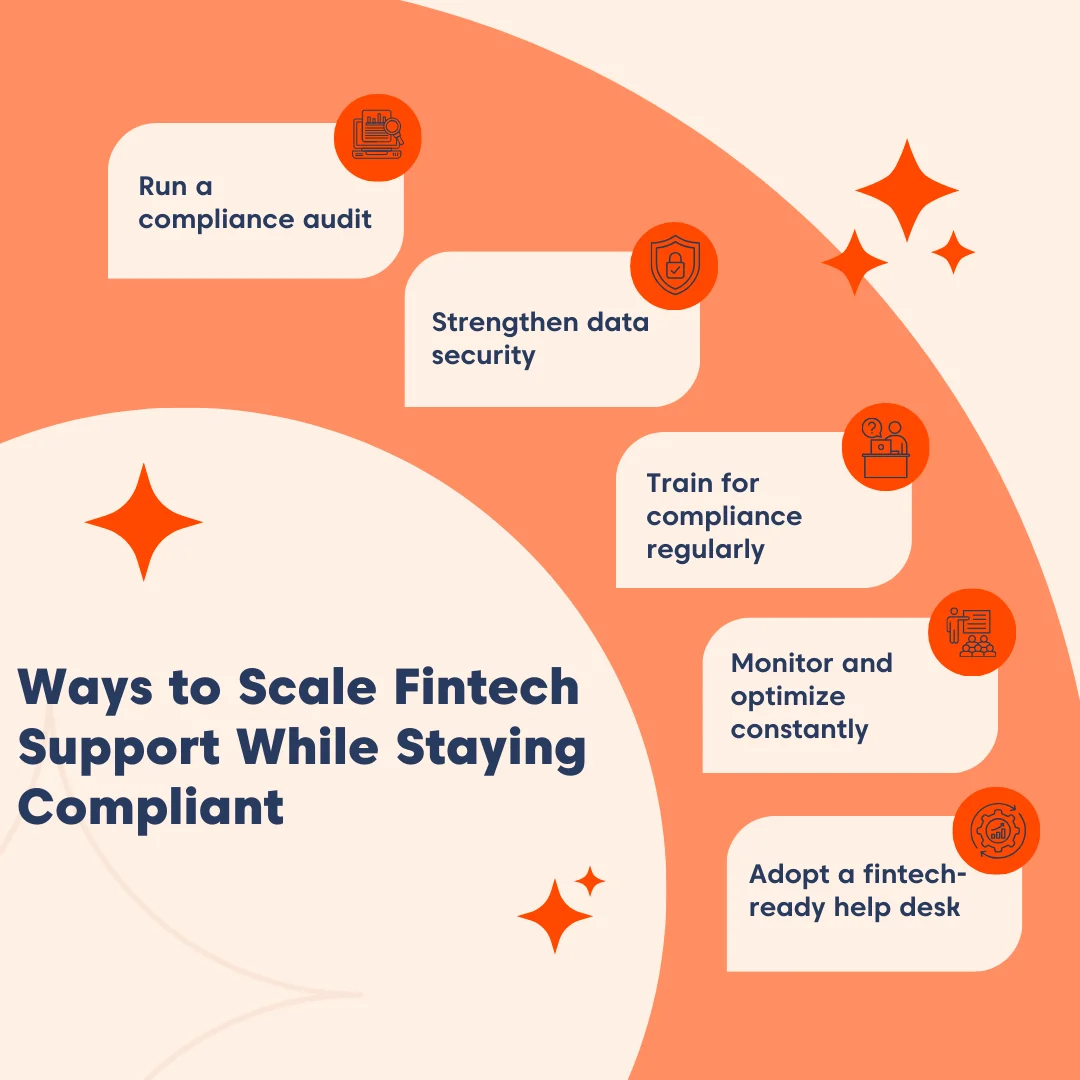
Run a compliance audit and gap analysis
Scaling a fintech support team isn’t just about hiring more agents; it starts with knowing whether your current processes can stand up to strict regulations. A compliance audit helps you uncover risks before they become costly problems.
Here’s how fintechs typically approach it:
- Identify the rules: Map every regulation that applies to your business and customers, such as GDPR, CCPA (California Consumer Privacy Act), PCI DSS, SOC 2, and more. These frameworks define exactly how customer data must be protected, stored, and accessed, and form the unbreakable baseline for secure fintech support.
- Spot the gaps: Examine how tickets flow through your system, what agents can access, and how actions are recorded. Common weaknesses include overly broad permissions, missing audit logs, or manual steps that expose sensitive data. Audit workflows, access rights, and trails to catch leaks or misuse early, before they turn into compliance violations.
- Close the gaps with tools: Once risks are identified, the right platform makes fixes effortless. A secure fintech help desk auto-logs every action, enforces role-based access, and applies retention policies, slashing human error, simplifying compliance, and giving regulators clear proof of responsible data handling.
Note: Regulations vary by region; fintech companies must comply with the rules governing where they operate and store customer data.
Implement robust data security measures
In fintech customer service, every interaction involves sensitive financial data. That means compliance and security aren’t optional; it’s the foundation of trust.
Without strong safeguards, even the best support team risks exposing customer information.
Here are the essential security measures that make a real difference:
- Multi‑Factor Authentication (MFA): Stops unauthorized entry attempts even if credentials are stolen.
- Data encryption: Keeps customer details unreadable to outsiders.
- Role‑based access control (RBAC): Assigns permissions, ensuring only the authorized staff can view or edit sensitive data.
- IP allowlisting: Restricts access to trusted networks, reducing external attack risks.
- Audit logs: Track every activity for transparency and compliance.
Train teams regularly on compliance protocols
Regulations and cyber threats evolve constantly, so training must be ongoing, not a one‑time event.
Ongoing sessions, usually after every quarter, ensure agents know how to handle sensitive financial data correctly and spot risks before they escalate.
Key areas to cover include:
- Handling PII securely: Teach agents how to protect customer data in tickets and chats.
- Identity verification: Reinforce KYC (Know Your Customer) and AML (Anti‑Money Laundering) practices.
- Phishing awareness: Run simulations to help agents recognize and report suspicious requests.
- Platform training: Use a knowledge base and internal guides to create, update, and store security content that keeps teams aligned with compliance workflows.
Enable continuous monitoring and optimization
Compliance isn’t something you set up once and forget. It requires ongoing oversight to catch new risks, adapt to evolving regulations, and fine‑tune processes so they remain both effective and efficient over time.
Here’s how to keep your fintech support system secure and efficient for the long term:
- Use dashboards for visibility: Implement reporting and analytics tools that track both customer service KPIs and security logs to catch unusual logins, data access patterns, or ticket spikes early.
- Schedule regular audits: Confirm if encryption is active, sensitive data isn’t stored in plain text, and every agent action is logged for traceability.
- Act on insights: Use monitoring and audit findings to refine workflows, tighten controls, and eliminate inefficiencies.
- Stay proactive: Adjust processes regularly so your help desk stays lean, secure, and compliant as your fintech operations scale.
Adopt a fintech-ready help desk
If your team is still handling customer issues through a generic shared mailbox, you’re exposing your operations to unnecessary risk.
Traditional inboxes simply weren’t designed for the security, auditability, or access‑control demands of fintech support.
To stay compliant as you scale, support leaders need platforms built with fintech realities in mind; tools that enforce policies, protect data, and provide the oversight regulators expect.
Key features of a secure, compliance-ready help desk include:
- Role-based access control to enforce least-privilege principles.
- End-to-end audit logs for every ticket action and data access event.
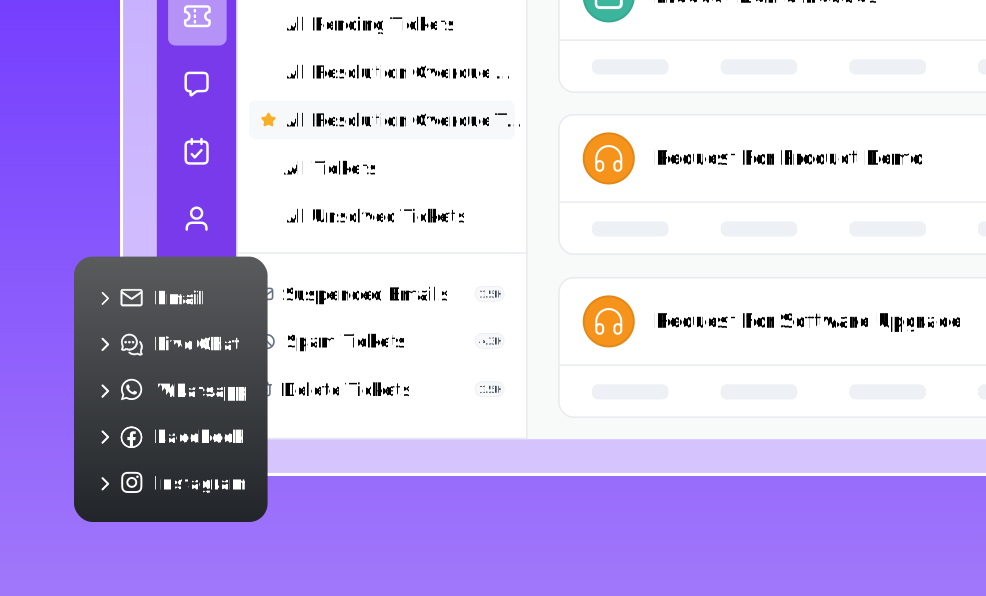
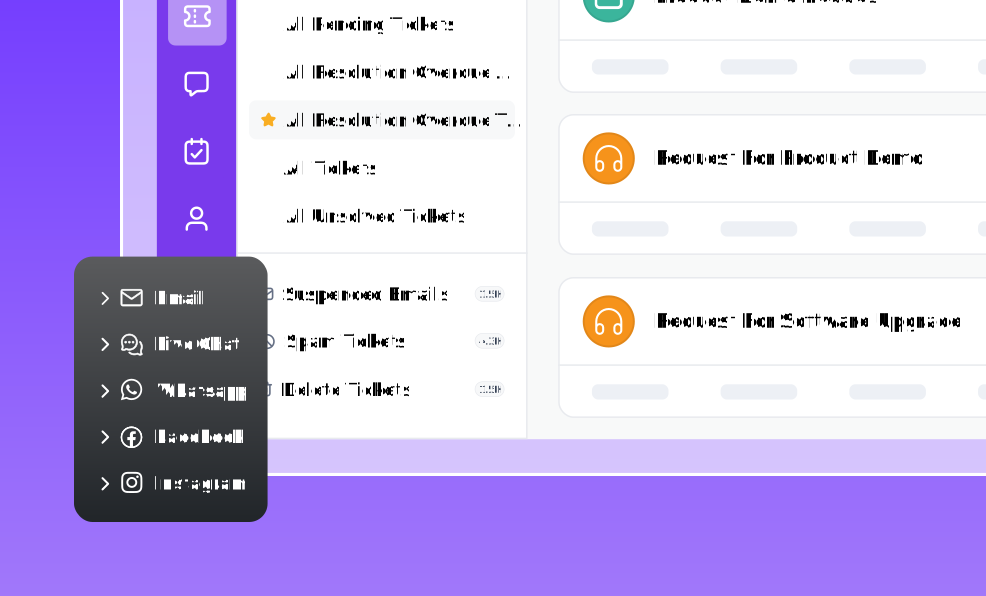
- Secure omnichannel customer service with consistent controls across email, chat, and forms.
- Custom workflows and automation for regulated support scenarios.
- Data protection features such as masking, retention controls, and secure storage.
- Scalable reporting to support internal reviews and external audits.
Key takeaway: Fintech customer service becomes compliant when every interaction is encrypted, auditable, role-restricted, and continuously monitored.
Ready to strengthen your fintech support?
Secure, compliant customer service is the lifeline of every fintech, protecting data, building trust, and promoting growth in a market where one error can put loyalty at risk.
The companies that win are those that treat compliance not as a burden, but as a competitive edge.
If you’re exploring ways to build a more compliant and resilient fintech support operations, start with a dedicated help desk software for fintech, designed specifically for secure data handling and reliable auditability.
Platforms like BoldDesk provide the structure and controls that make it easier to scale your support team with confidence.
Book a live demo and see how BoldDesk’s compliance-ready help desk can safeguard your fintech customer service operations.
Related articles
- 4 Types of Phishing Attacks & Prevention Tips for BoldDesk Users
- Customer Service Audit for Top-Quality Support
- Best Tips to Enhance Customer Service in Banking
Frequently Asked Questions
A dedicated system provides an audit trail for every interaction, ensures data is encrypted, and uses automation to remove human error in data handling.
This makes it easier to prove compliance during regulatory audits.
Depending on the region, common regulations include GDPR (Europe), CCPA (California), PCI DSS (for payment card data), and SOC 2 (for data privacy and security).
AI can be used safely in fintech customer service by enforcing strict data encryption, monitoring interactions for compliance, and limiting access through role-based permissions.
Companies must also conduct regular audits, train staff on responsible AI use, and integrate human oversight to ensure accountability.
To reduce social‑engineering risk at a fintech help desk, enforce Multi‑Factor Authentication (MFA) and Single Sign‑On (SSO) to block unauthorized access.
Always verify customer identity before sensitive actions, monitor and audit data export events, and run quarterly phishing simulations to train agents against evolving threats.