

- Blogs Explore Blogs Blogs
Future of Customer Service Webinar Recap: From Emails to Conversations
-
by Susan Wairimu Mwangi
- Updated on: October 22, 2026
TL;DR: Watch the future of customer service webinar recording to see why email alone no longer meets customer expectations. Learn how a unified inbox, AI, and automation help support teams connect conversations across email, WhatsApp, Instagram, and live chat.
Customer service is undergoing a major transformation. While customer service trends continue to shape the future of customer service, organizations are increasingly adopting conversational customer service to create connected, customer-centric experiences.
In this webinar, Kanimozhi Bharathi, Product Expert at BoldDesk, explained how customer service has evolved. She demonstrated AI-powered omnichannel support and shared the benefits teams gain from a connected customer service approach.
Watch the webinar
Watch the recording to discover how modern support teams are transforming customer interactions into connected conversations that improve both efficiency and customer satisfaction.
Who should watch this webinar recording?
This webinar is ideal for:
- Customer support leaders improving service quality and operational efficiency.
- IT leaders evaluating customer service technology.
- Business owners building scalable support operations.
- Customer experience teams focused on satisfaction and retention.
- Online businesses supporting customers on social and messaging apps.
Why email alone is no longer enough
A decade ago, most customer inquiries arrived through email. Today, customers connect through chat, messaging apps, social media, and self-service portals.
As channels expanded, customer expectations grew. People now expect support on the platforms they already use.
The webinar highlighted three challenges with email-only support:
- Fragmented conversations: Customers switch between channels, but support teams often see separate interactions.
- Slower responses: Email is less effective when customers expect immediate assistance.
- Manual overhead: Teams spend time tracking history, managing inboxes, and routing requests.
The goal is not to replace email, but to connect it with other channels and create a unified customer experience.
Live demo: Managing every channel from one inbox
Using an online store as the example, the demo showed omnichannel customer service in BoldDesk, following customers across WhatsApp, Instagram, and website chat.
WhatsApp: AI and human agents working together
Emma asked a product question on WhatsApp, received an instant AI response, and checked the status of an issue emailed earlier.
When she requested a refund or replacement, the AI transferred the conversation and routed it to the right team.
The agent continued without asking Emma to repeat information, using:
- An AI summary of the conversation.
- The customer profile with past tickets and conversations.
- Connected e-commerce or CRM apps for order and warranty checks.
- AI writing assistance to improve responses.
After resolution, Emma received a customer feedback survey, and her response stayed in the same conversation.
Instagram and website chat
An Instagram DM about product details arrived in the same inbox, and the AI answered it without anyone opening Instagram.
On the website, a shopper asked live chat for product recommendations and got an AI answer in seconds. A “Talk to a person” option let them switch to an agent. As the demo showed, AI can also help customers make purchase decisions, not just solve problems.
One inbox and trackable tickets
Any chat can become a ticket with one click. AI fills in the ticket form from the conversation, and the ticket stays linked to the chat.
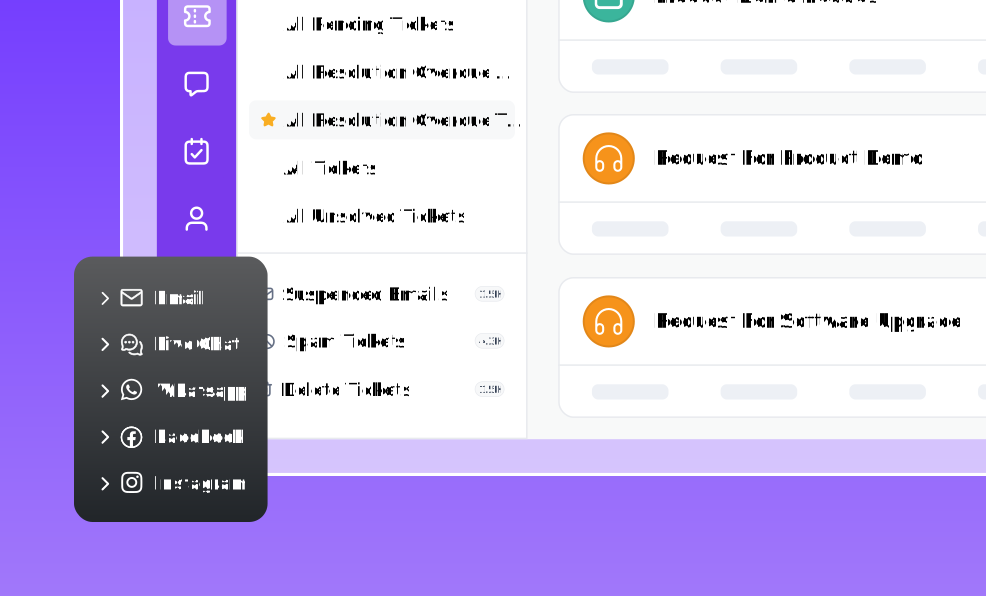
Email, WhatsApp, Instagram, Facebook, and live chat conversations all appear in one unified inbox. Agents reply from there, and customers receive the replies on their own channel.
How AI and automation support agents
Handling large volumes of conversations becomes difficult when teams rely on manual processes and repetitive tasks.
The webinar showed how AI can:
- Answer common questions as the first point of contact.
- Understand customer intent and recommend relevant knowledge base articles.
- Help agents draft replies and summarize conversations.
Teams can deploy multiple AI agents for 24/7 support across different channels and services. Help desk automation reduces manual work by routing requests, sending follow-ups, and triggering workflows.
The session emphasized that AI and automation support, rather than replace, human agents.
Benefits of conversational customer service
Conversational customer service treats support as one ongoing relationship across channels, rather than a series of separate tickets. The webinar outlined five benefits:
- Meet customers on their preferred channels
- View the complete customer journey
- Resolve issues faster
- Deliver consistent service across channels
- Build stronger customer relationships
Audience polls
Attendees answered two polls during the session:
- Which channel generates the highest volume of customer inquiries in your organization? (Email, live chat, WhatsApp, or social apps)
- Which capability would have the biggest impact on your support team? (Omnichannel support, workflow automation, AI-powered assistance, or customer self-service)
Questions from the live Q&A
Here are the answers to the questions attendees asked during the session.
Can this work for inquiries that come in by phone?
Yes. BoldDesk integrates with several cloud telephony and VoIP providers, so agents can make and receive calls directly in the help desk. Calls are logged as tickets, so phone conversations sit in the same history as email and chat.
Learn more: Calling tools available for integration with BoldDesk
Are translations available for Swahili and other African languages?
BoldDesk supports 42 languages. Swahili isn’t available yet, but language requests are reviewed regularly, and we’re happy to share your requirements with the product team.
Learn more: BoldDesk supported languages
How are customer surveys handled for phone interactions?
BoldDesk doesn’t offer native voice surveys. Instead, CSAT surveys can be sent automatically after a ticket is resolved, and responses are stored and analyzed in built-in reports.
Learn more: CSAT survey settings | Customer satisfaction report
Can I track how my support team is performing?
Yes. BoldDesk dashboards and reports track ticket trends, agent productivity, SLA compliance, and customer satisfaction over time.
Learn more: Support monitoring dashboard | Ticket metrics report
Key takeaways from the webinar
The webinar concluded with several important recommendations:
- Complement email, don’t replace it: Email remains important, but it shouldn’t be the only channel.
- Bring every channel into one inbox: Agents handle email, WhatsApp, Instagram, and chat without switching tools.
- Keep context with the customer: A shared history means customers never have to repeat themselves.
- Let AI handle the first response: AI answers common questions and hands complex ones to agents with full context.
- Automate repetitive work: Routing, assignment, and follow-ups run in the background.
- Keep people at the center: AI removes friction, while empathy and judgment still come from agents.
The future of customer service is conversational
The future of customer service isn’t about abandoning email. It’s about moving beyond disconnected interactions by bringing the right information, people, and processes together, so every conversation is easier to manage, understand, and resolve.
BoldDesk supports this with a unified inbox, AI support agents, help desk automation, and app integrations.
Ready to modernize customer service? Start a free trial or book a personalized demo to see BoldDesk in action.
Related articles
- Webinar Recap: Cut Ticket Reassignments with Clear Ownership
- Webinar Recap: Build Scalable Customer Support Without Agent Overload
- Webinar: Support Metrics Revealing Real Customer Experience
FAQs
What is conversational customer service?
Conversational customer service focuses on continuous, connected interactions across channels rather than treating each customer inquiry as an isolated request.
Why is omnichannel customer service important?
Omnichannel support helps organizations maintain context across email, chat, phone, and self-service channels, creating a more seamless customer experience.
Where can I watch the webinar recording?
The full recording is embedded in this recap. You can also find it and other on-demand sessions on the BoldDesk webinars page.
ABOUT THE AUTHOR

Susan Wairimu Mwangi 
Susan is a creative content strategist at Syncfusion, crafting engaging stories that connect brands with audiences. She blends insight, clarity, and creativity to bring ideas to life while elevating content that enhances customer support and overall customer experience.
Read more articles by this author Be the first to get updates