

12 Best AI Agents for Scalable Customer Support
- by Flavian Atieno Odongo
- November 3, 2026

 by Susan Wairimu Mwangi
TL;DR: BoldDesk, Zendesk, Freshdesk, and Helply combine AI with ticket management. Sierra, Decagon, Ada, Forethought, Yellow.ai, eesel AI, and Yuma AI integrate with existing support systems. Chatbase supports both approaches. Compare pricing, support channels, and automation capabilities when choosing a Fin alternative.
Fin is an AI customer support agent developed by the company formerly known as Intercom. The company rebranded as Fin in May 2026, while its customer service platform retained the Intercom name. Salesforce completed its acquisition of Fin in September 2026.
With pricing starting at $0.99 per outcome, Fin’s AI costs increase as the number of billable outcomes grows.
As your support operations scale, you may need a different pricing model or more flexible AI workflows. Some teams also want industry-specific capabilities or a platform with built-in AI.
You can replace Fin without changing your help desk, or move to an entirely new customer service platform. Several options are worth considering.
This guide compares the 12 best Fin alternatives in 2026. Each profile covers key features, pros, cons, pricing, and ideal use cases.
If you’re looking to replace the entire Intercom platform rather than just its AI agent, explore our guide to the best Intercom alternatives.
Fin offers extensive AI customer support capabilities, but its pricing model, workflow controls, and overall platform fit may not suit every business.
Here are some reasons support teams consider alternatives:
What Fin users say: G2 reviewers praise Fin’s ease of setup and its ability to resolve routine inquiries. Some report challenges with complex questions, workflow flexibility, answer accuracy, and human handoffs.
In a Reddit discussion, a one-person support team called Fin “super helpful” for routine product questions. They also raised concerns about unpredictable costs, escalation behavior, and knowledge base gaps.
Before comparing Fin alternatives, identify what you need to improve. A lower-priced AI agent may offer little value if it cannot integrate with your business systems or handle your customers’ support requests effectively.
We compared these platforms using publicly available product documentation, pricing information, and G2 customer reviews. Our evaluation focused on the following factors:
Editorial disclosure: BoldDesk is our own product and appears first for that reason. The remaining products are not ranked by performance. This comparison is based on published product information and customer feedback rather than a controlled hands-on test of all 12 platforms.
The table below compares Fin with 12 alternatives based on pricing, deployment type, ideal use cases, and G2 ratings.
Some solutions integrate with your existing help desk, while others offer a complete customer service platform with built-in AI.
| Alternative | Best for | Starting price | Pricing model | Keep your help desk? | G2 rating (reviews) |
|---|---|---|---|---|---|
| Fin (baseline) | Teams that prefer outcome-based AI pricing | $0.99 per outcome; Intercom seats from $19/month | Per outcome, plus seats on Intercom | Yes | 4.5/5 (3,985) |
| BoldDesk | Teams that want built-in AI without per-agent fees | $99/month (billed annually) | Monthly AI credits, unlimited human agents (subject to fair usage policy) | No (replaces it) | 4.5/5 (157) |
| Sierra | Large consumer brands that need customized AI agents | Custom quote | Outcome-based, negotiated per contract | Yes | 4.5/5 (146) |
| Decagon | Enterprises that need natural-language workflow customization | Custom quote | Custom contract-based pricing | Yes | 4.4/5 (159) |
| Ada | Enterprises running voice, chat, email, and social AI | Custom quote | Conversation-based or resolution-based pricing | Yes | 4.6/5 (183) |
| Forethought (by Zendesk) | Teams adding autonomous AI to an existing help desk | Custom quote (sold by Zendesk) | Custom enterprise contract | Yes | 4.3/5 (166) |
| Zendesk | Large teams that need advanced ticketing and AI | $19/agent/month | Seats plus $1.50 to $2.00 per automated resolution | No (replaces it) | 4.3/5 (7,131) |
| Yellow.ai | Global enterprises that need multilingual voice AI | Custom quote | Custom enterprise contract | Yes | 4.4/5 (107) |
| Freshdesk | Budget-conscious teams that want affordable AI-powered ticketing | $19/agent/month (billed annually) | Seats plus $49 per 100 Freddy AI Agent sessions | No (replaces it) | 4.4/5 (4,027) |
| eesel AI | Teams adding AI to Zendesk, Freshdesk, or Intercom | Free seven-day trial; paid from $299/month | Monthly credits (one ticket or chat per credit) | Yes | 4.6/5 (20) |
| Helply | Small teams that want a help desk with built-in AI | $99/month (billed annually) | Plans with pooled AI credits | No (replaces it) | 4.6/5 (195) |
| Chatbase | Small teams that want AI agents trained on existing content | $120/month (billed annually) | Monthly message credits | Yes (optional built-in help desk) | 4.7/5 (41) |
| Yuma AI | Shopify and ecommerce brands | $14,400/year | Per fully resolved ticket, 12-month commitment | Yes | 4.8/5 (24) |
Note: Pricing and G2 ratings were reviewed on November 22, 2026. Prices are in USD and may exclude additional AI usage, agent seats, integrations, and implementation costs. AI credits, sessions, conversations, and outcomes are different billing units.
Here’s where each Fin alternative stands out and what to consider before choosing one. For a wider view of the category, see our guide to the best AI agents for customer support.
Best for: Teams that need AI agents, ticketing, and knowledge management with unlimited human agent seats.
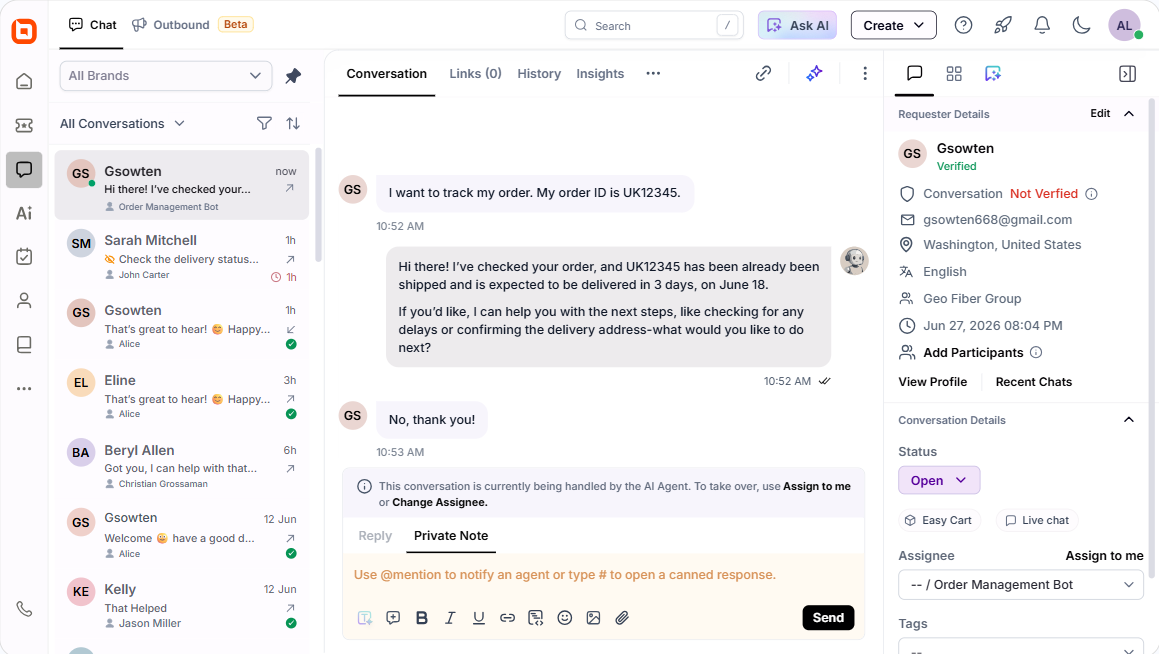
BoldDesk is an AI-first customer service platform that combines AI agents, ticketing, knowledge management, and omnichannel support.
Its Support Agent resolves customer requests, automates workflows, performs actions in connected systems, and escalates complex issues to human agents.
Key features
Pros
Cons
Note: HIPAA enablement is available on the Enterprise AI plan with a signed business associate agreement (BAA). AI services are disabled in HIPAA mode, while supported non-AI customer service features remain available.
Pricing: BoldDesk Scale AI starts at $99/month with 500 AI credits for email and self-service support. Momentum AI starts at $499/month with 1,000 credits and adds live chat and messaging AI. Both prices are billed annually. Additional credits cost $40 per 1,000.
Why choose BoldDesk over Fin?
BoldDesk combines AI agents and ticket management without charging separately for human agent seats on its AI plans. Unlike per-outcome billing, its AI costs depend on credit consumption. Teams with growing headcounts can benefit from this pricing structure.
Best for: Large consumer brands that need customized, vendor-assisted AI agent deployments.
Sierra is an enterprise AI customer experience platform that automates customer conversations across chat, voice, email, and messaging.
Its AI agents connect with business systems to retrieve information, perform actions, and resolve customer requests.

Key features
Pros
Cons
Pricing: Custom quotes based on an agreed outcome-based pricing model.
Why choose Sierra over Fin?
Sierra suits enterprises that want a guided AI agent setup and more customization. Its negotiated outcome-based contracts allow businesses to define billing arrangements around their specific support objectives.
Best for: Enterprises that need customizable AI agents for complex support workflows.
Decagon is a conversational AI platform that automates enterprise customer support across chat, email, and voice.
Its Agent Operating Procedures (AOPs) allow support teams to define how AI agents handle customer requests using plain-language instructions.
Key features
Pros
Cons
Pricing: Custom quotes based on enterprise requirements.
Why choose Decagon over Fin?
Decagon’s Agent Operating Procedures let support teams define steps, rules, and exceptions in plain language. Teams can use them to automate requests such as refunds and subscription cancellations without writing every instruction in code.
Best for: Enterprises that need multilingual AI customer support across voice and digital channels.
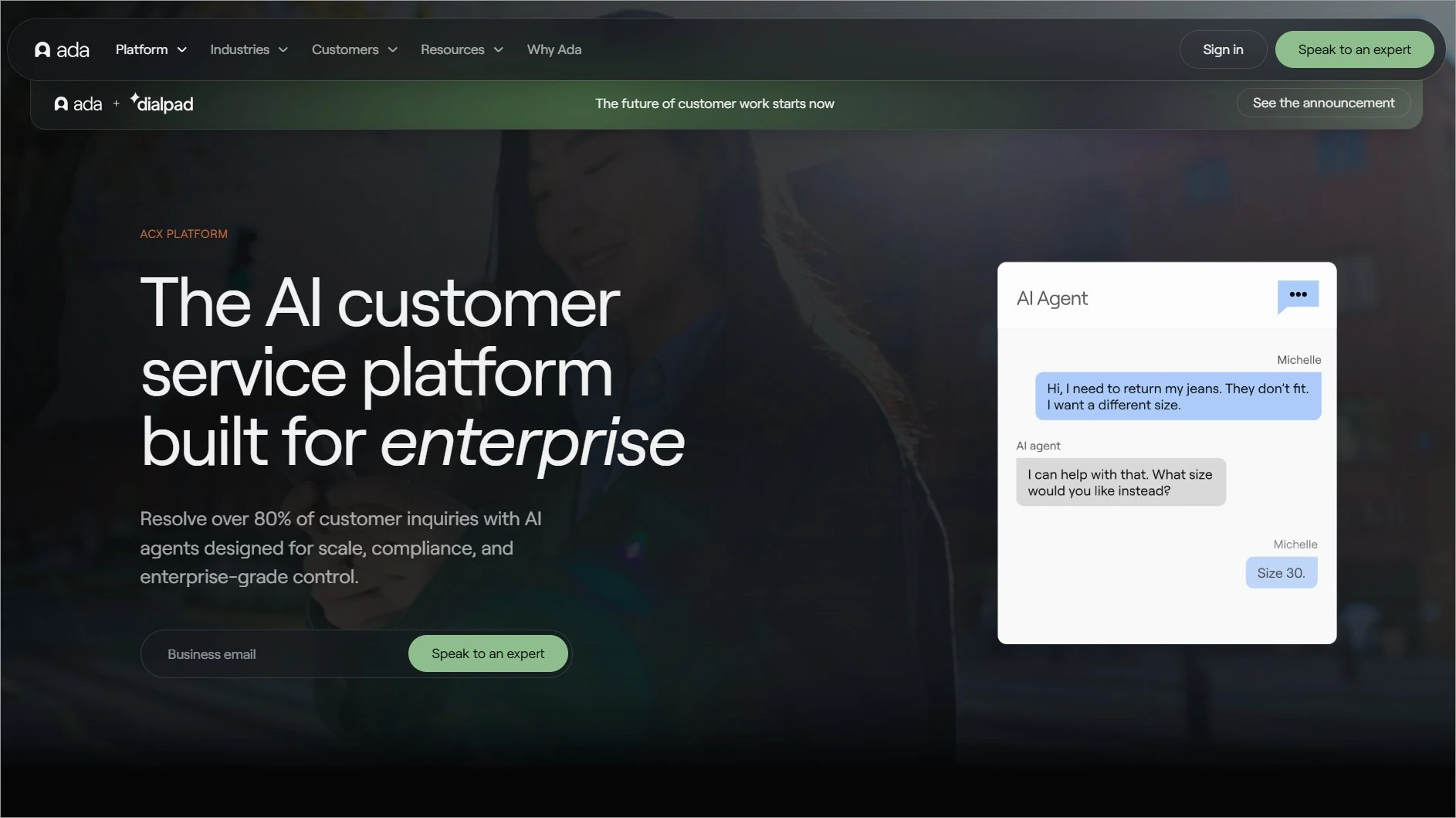
Ada is an AI-powered customer experience platform that helps businesses automate complex support requests across voice, chat, email, and social channels.
Its Reasoning Engine allows teams to manage AI agent behavior centrally, maintaining consistent responses, business policies, and brand standards across channels.
In November 2026, Ada and Dialpad announced plans to combine their AI agent, business communication, and contact center capabilities.
Key features
Pros
Cons
Pricing: Custom quotes with conversation-based pricing. Resolution-based pricing is also available for enterprises with specific requirements.
Why choose Ada over Fin?
Ada supports multiple languages across voice, chat, email, and social messaging. It is worth considering if your business needs to manage AI support across multiple languages and channels using shared knowledge and policies.
Best for: Teams that want autonomous AI agents without replacing their existing help desk.
Forethought automates customer requests, ticket routing, and agent assistance. Following its acquisition by Zendesk in March 2026, it remains available as a standalone solution under the name Forethought AI agents by Zendesk.
Key features
Pros
Cons
Pricing: Custom quotes through Zendesk.
Why choose Forethought over Fin?
Forethought adds autonomous AI to the help desk you already run. Fin can also run on other help desks, but Forethought adds dedicated triage, agent-assist and quality assurance tools in the same product.
Best for: Large support teams that need integrated AI agents, advanced ticket management, and reporting.
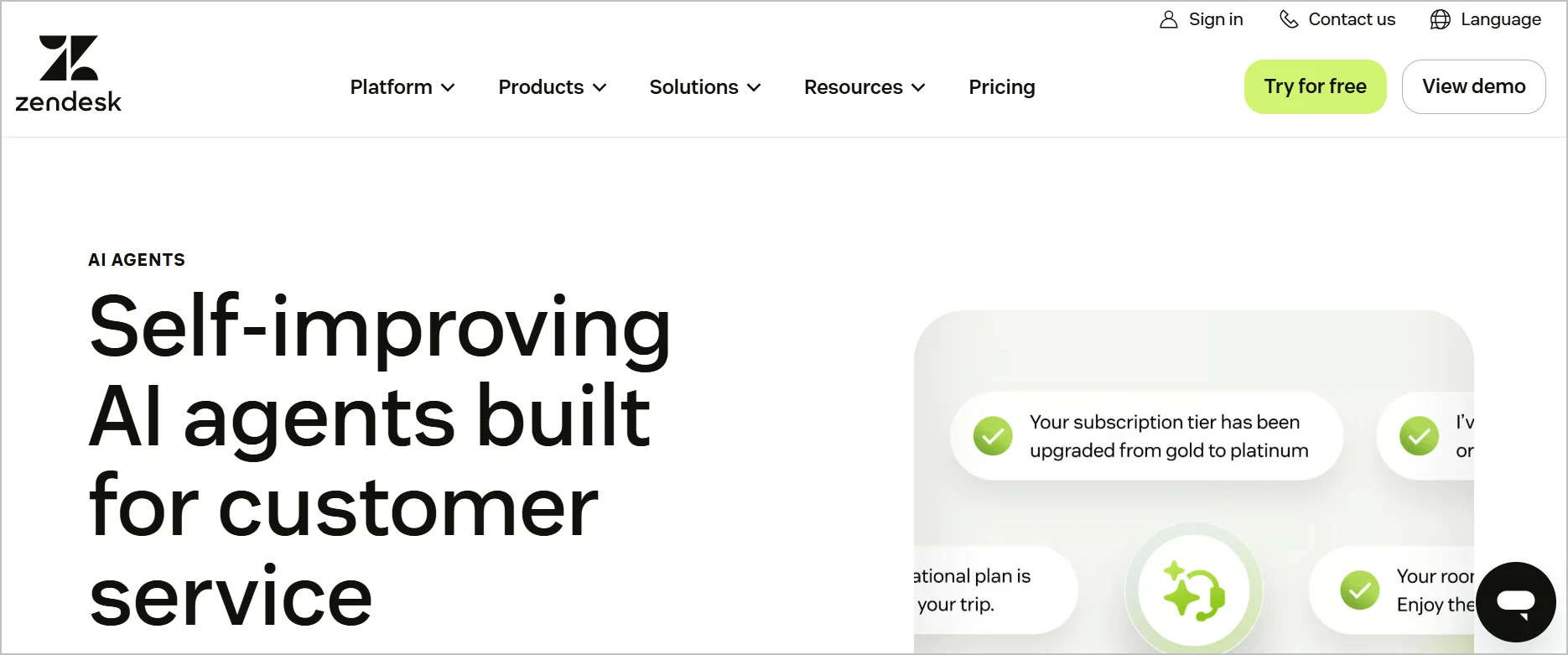
Zendesk combines ticket management, messaging, voice, and self-service with AI agents that automate customer requests.
Its AI-powered capabilities also assist human agents with responses, routing, and routine support tasks.
Key features
Pros
Cons
Note: Zendesk is retiring AI agents – Essential and legacy AI agent functionality. Check Zendesk’s removal notice for current migration dates.
Pricing: Plans start at $19 per agent/month. AI agents cost $1.50 per automated resolution on committed plans or $2 on a pay-as-you-go basis.
Why choose Zendesk over Fin?
Zendesk is worth considering if you want to replace both Intercom and Fin with a single customer service platform that combines AI agents, advanced ticket management, reporting, and an extensive integration marketplace.
To compare similar AI-powered support solutions, explore our guide to the best Zendesk AI alternatives.
Best for: Global enterprises that need multilingual voice AI for large-scale customer support.
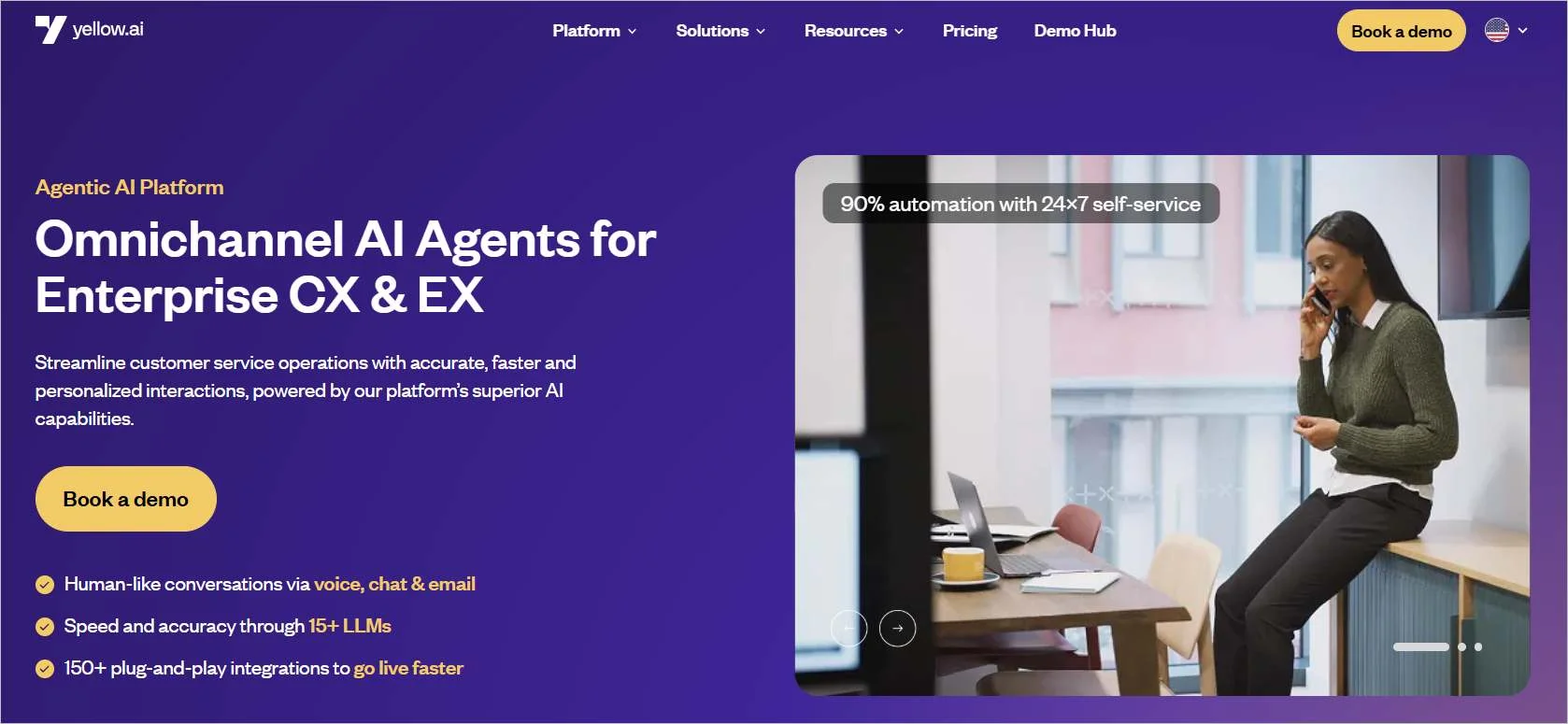
Yellow.ai is an enterprise AI platform that automates customer interactions across voice and digital channels.
Its Nexus Vox technology supports natural voice interactions, multilingual conversations, and automated actions across business systems.
Key features
Pros
Cons
Pricing: Custom quotes based on business requirements.
Why choose Yellow.ai over Fin?
Yellow.ai is worth considering if phone support is a priority. Its Nexus Vox voice AI technology supports more than 500 languages and dialects, according to the vendor, and connects with business systems to complete customer requests.
Best for: Budget-conscious teams that need AI-powered customer support within a help desk.
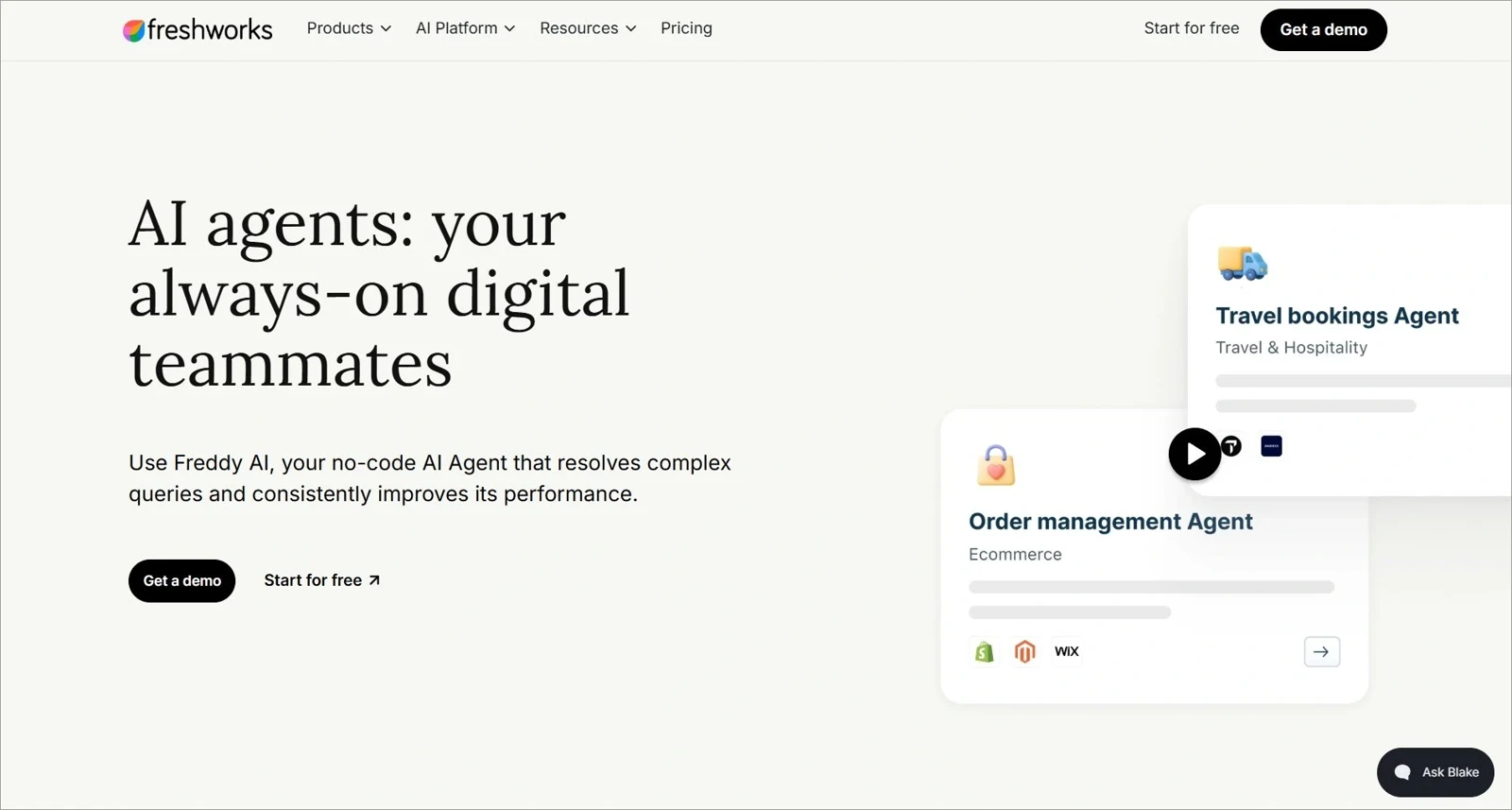
Freshdesk combines ticket management, self-service, and workflow automation with Freddy AI. Its AI agents respond to customer inquiries automatically, while Freddy AI Copilot assists human agents with their daily support tasks.
Key features
Pros
Cons
Pricing: Plans start at $19 per agent/month, billed annually. Eligible new customers receive 500 one-time AI sessions. Additional sessions cost $49 per 100.
Why choose Freshdesk over Fin?
Freshdesk combines ticket management, self-service, and Freddy AI Agent in one platform. Its session-based AI pricing offers an alternative to Fin’s outcome-based billing, making it worth considering for teams that prefer to budget based on AI session volume.
Best for: Teams adding AI automation to existing customer support platforms.
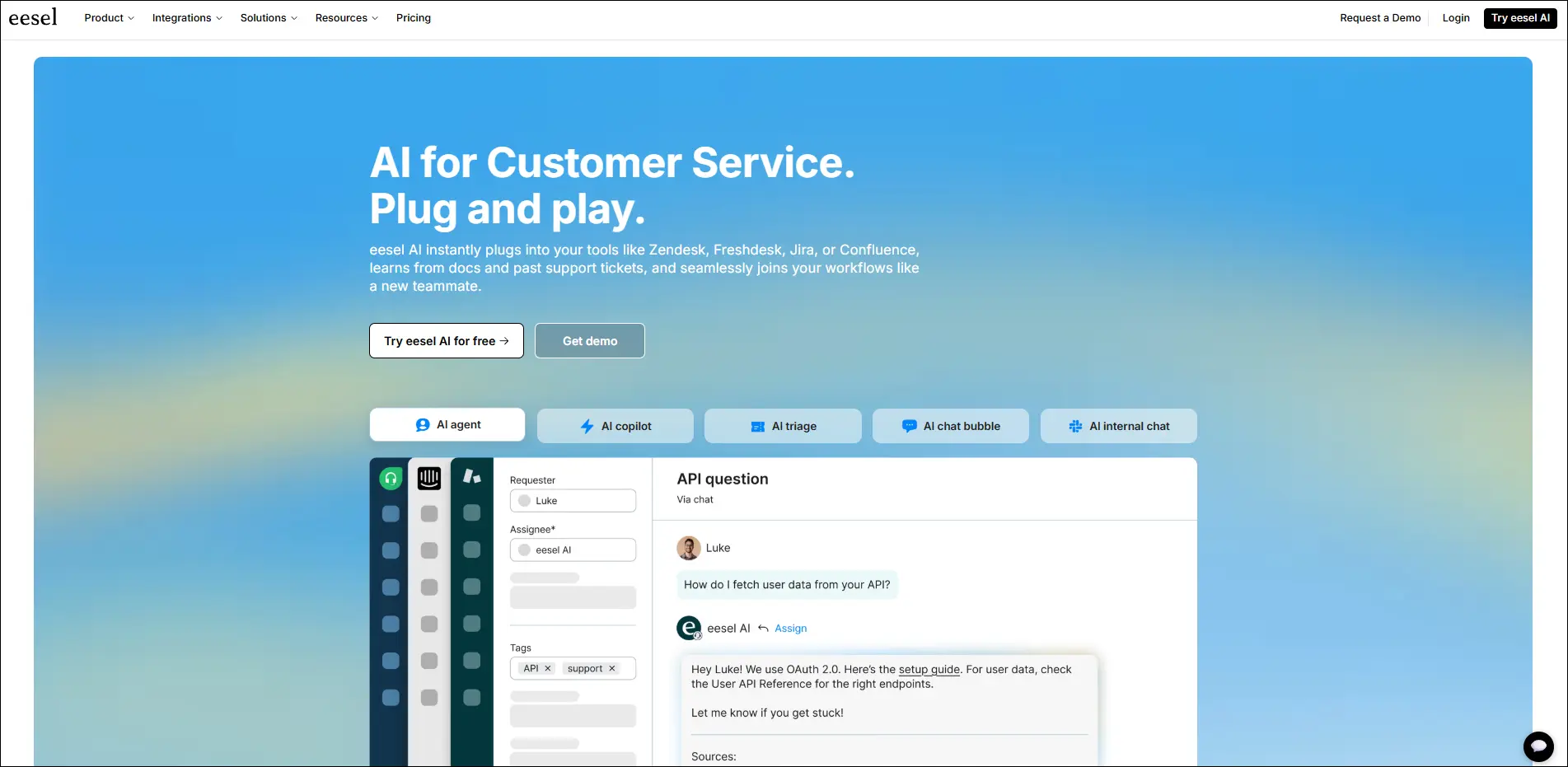
eesel AI integrates with existing help desks and learns from past tickets, help center articles, and internal documentation.
Its AI agents can resolve requests, draft responses, and automate routine ticket management tasks.
Key features
Pros
Cons
Pricing: Starts at $299/month for 500 credits, where one ticket or chat uses one credit. A seven-day free trial with 100 credits is available.
Why choose eesel AI over Fin?
eesel AI offers ticket-based and chat-based credits rather than outcome-based billing. Its historical ticket simulations also allow teams to evaluate AI responses before introducing automation to customers.
Best for: Small teams that want a help desk with built-in AI agents and pooled credit pricing.
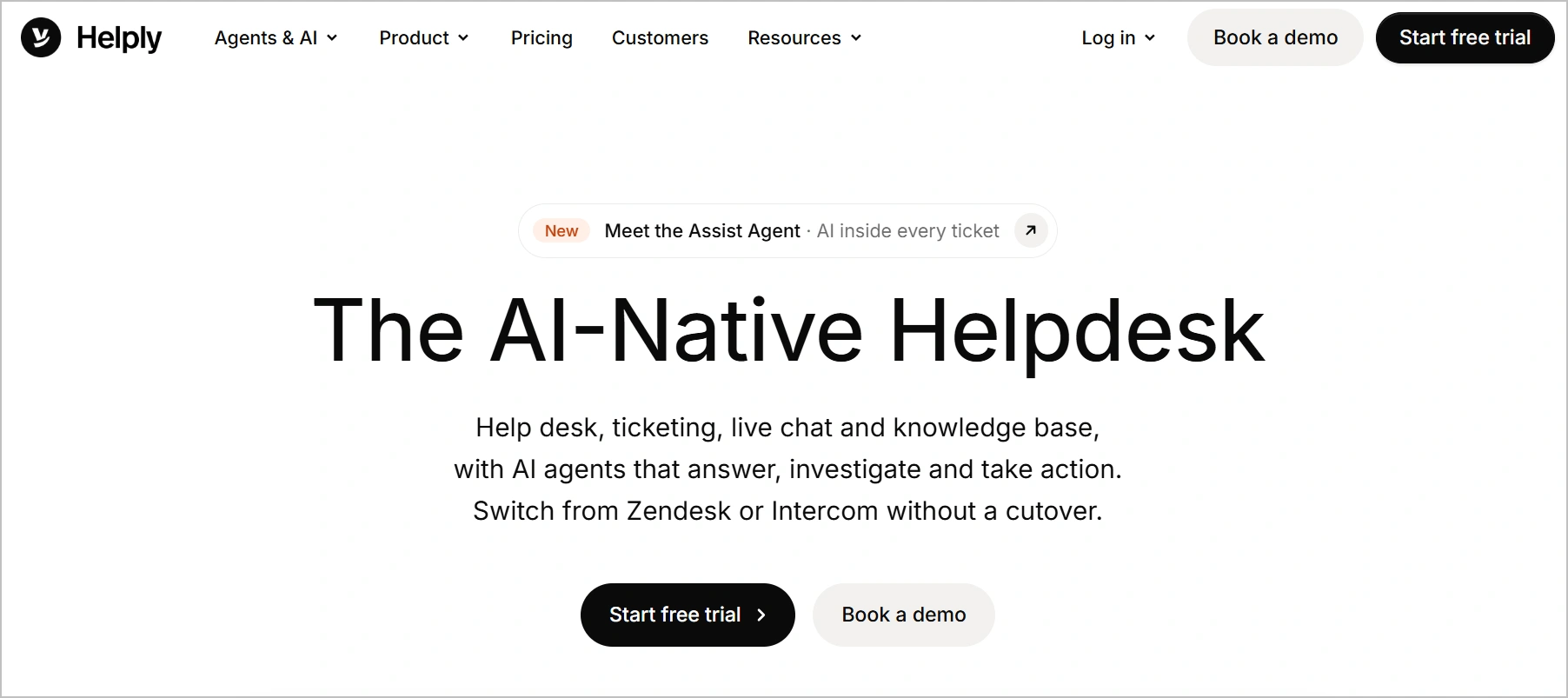
Helply is an AI-native help desk from the team behind Groove, which rebranded as Helply in May 2026.
Its Support Agent handles customer requests, while its Assist Agent helps human agents draft responses, summarize conversations, and complete support tasks.
Key features
Pros
Cons
Pricing: Plans start at $99/month, billed annually, with 2,500 AI credits and up to two human agents. The Team plan costs $499/month with 15,000 AI credits and 10 human agents. Additional credits cost $40 per 1,000.
Why choose Helply over Fin?
Helply suits teams that want customer-facing AI, agent assistance, and a help desk under a shared credit-based subscription rather than paying separately for AI outcomes.
Best for: Teams that need self-service AI agent creation and flexible help desk deployment.
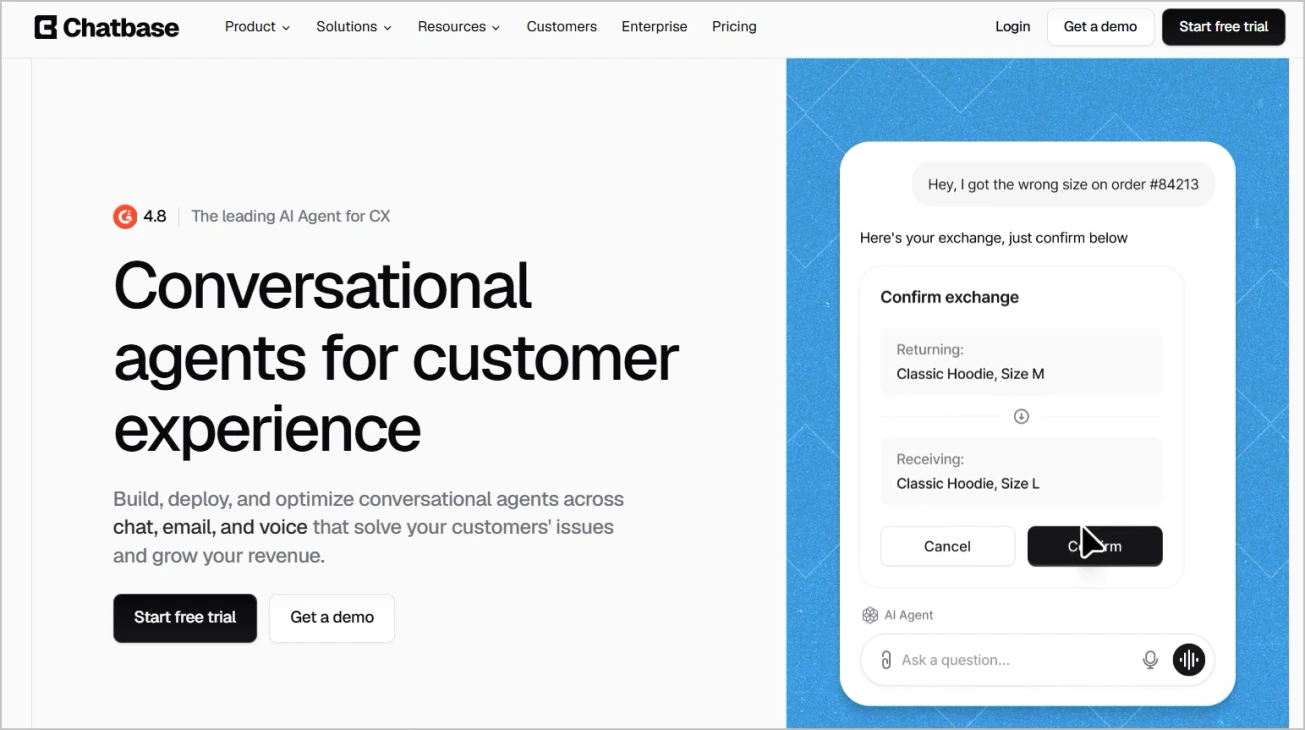
Chatbase allows businesses to build AI agents using their websites, documents, and support content.
Its agents can answer customer questions, perform actions in connected systems, and escalate requests to human agents.
Key features
Pros
Cons
Pricing: Chatbase’s Basic plan starts at $120/month, with 4,000 message credits. The Business plan costs $400/month with 15,000 message credits. Both prices are billed annually. Additional credits cost $40 per 1,000.
Why choose Chatbase over Fin?
Chatbase provides flexible deployment options for teams that want to integrate AI with an existing help desk or use its built-in support platform. Its subscription-based message credits offer a different billing model from Fin’s outcome-based pricing.
Compare more options in our Chatbase alternatives guide.
Best for: Ecommerce businesses automating order inquiries, returns, and refunds.
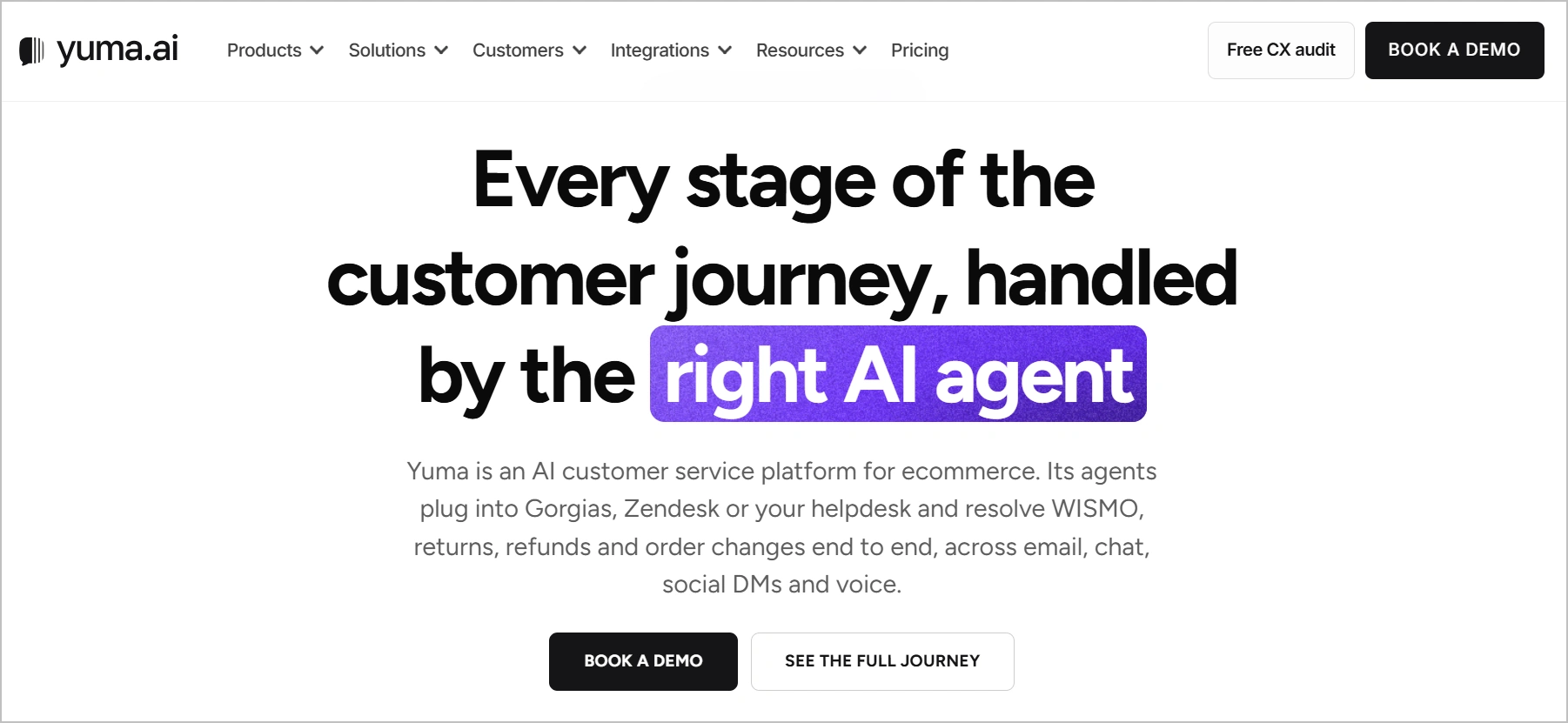
Yuma AI is a customer support automation platform designed for ecommerce brands.
It integrates with help desks and commerce systems to resolve requests such as order tracking, exchanges, subscription changes, and refunds.
Key features
Pros
Cons
Pricing: Starter plan costs $14,400/year for approximately 12,000 fully resolved tickets. Monthly payment options are available, but all plans require a 12-month commitment. Actual pricing depends on expected resolution volume.
Why choose Yuma AI over Fin?
Yuma AI charges only when it resolves a ticket with no human involved. For ecommerce teams, that pricing and its Shopify depth can make it a better fit than Fin.
Starting prices do not always reflect what you will pay for AI customer support. Some platforms charge per outcome, while others use AI credits, sessions, or agent-based pricing.
Consider a support team with 10 human agents handling either 1,000 or 3,000 customer conversations through AI each month. Assuming a 50% AI resolution rate, the following comparison shows how monthly software costs could vary across different platforms.
Illustrative monthly costs at 1,000 and 3,000 AI-handled conversations
| Platform and plan | 1,000 conversations | 3,000 conversations | Calculation basis |
|---|---|---|---|
| Fin with Intercom | $685 | $1,675 | 10 agent seats and $0.99 per outcome |
| Fin with an existing help desk | $495 | $1,485 | Outcome fees only |
| BoldDesk Scale AI | $279 | $679 | Email and self-service AI, assuming five credits per conversation |
| BoldDesk Momentum AI | $659 | $1,059 | Live chat and messaging AI, assuming five credits per conversation |
| Zendesk Support Team | $865 | $2,365 | 10 seats at $19 each, 50 included resolutions, and $1.50 per additional committed resolution |
| Zendesk Suite Team | $1,225 | $2,725 | 10 seats at $55 each, 50 included resolutions, and $1.50 per additional committed resolution |
| Freshdesk Growth | $680 | $1,660 | 10 agent seats and one AI session per conversation |
| eesel AI | $699 | $2,299 | 500 included credits and $0.80 per additional credit |
| Helply Team | $499 | $619 | 10 human agents and six credits per conversation |
| Chatbase Basic / Business | $120 | $400 | Four message credits per conversation |
| Yuma AI Starter | $1,200 | Custom quote | Illustrative annual package of 12,000 resolutions |
Note: These estimates use published subscription rates and illustrative usage assumptions. Annual billing rates apply where available in the modeled plans. Existing third-party help desk costs, taxes, implementation fees, and optional add-ons are excluded. Freshdesk’s one-time complimentary sessions are excluded from recurring monthly cost estimates.
Sierra, Decagon, Ada, Forethought, and Yellow.ai are excluded from the calculations because they do not publish comparable pricing rates.
What the pricing comparison tells you
When evaluating Fin alternatives, consider both AI usage and the cost of supporting your human agents. Test each platform using your actual customer requests to estimate monthly expenses and cost per successful resolution.
Start by identifying the main reason you want to replace Fin. Use the table below to narrow your options based on your business needs before evaluating individual platforms.
| Your business needs | Solutions to consider | Why |
|---|---|---|
| Replace both Intercom and Fin | BoldDesk, Helply, Zendesk, or Freshdesk | AI agents and help desk capabilities in one platform |
| Replace Fin without migrating your help desk | eesel AI, Forethought, or Chatbase | AI automation that integrates with existing support systems |
| Customize complex enterprise AI workflows | Sierra, Decagon, or Ada | Advanced workflow configuration and enterprise integrations |
| Automate multilingual voice support at scale | Yellow.ai or Ada | Voice AI capabilities across multiple languages |
| Automate ecommerce customer support | Yuma AI | Automation for order inquiries, returns, and refunds |
| Choose a platform with published subscription plans | BoldDesk, Helply, or Chatbase | Published pricing tiers that provide a starting point for budgeting |
Once you have a shortlist, evaluate each solution against the following criteria:
Before committing, run a pilot using the same real-world support scenarios across your shortlisted platforms. Measure resolution accuracy, successful task completion, escalation quality, and cost per resolved request to determine which solution delivers the best value.
Switching AI platforms is not always necessary. Fin may remain a suitable choice if:
According to Salesforce’s acquisition announcement in September 2026, Fin achieves an average resolution rate of 76%. Individual results may vary depending on request complexity, knowledge quality, and AI configuration.
Use your own resolution rates, customer feedback, and AI costs to determine whether switching would deliver better results.
The right Fin alternative should resolve customer requests accurately, automate routine tasks, and ensure smooth AI-to-human handoffs when human intervention is needed.
If you’re looking to simplify your support operations, BoldDesk combines AI agents, ticket management, knowledge management, and workflow automation in one platform.
Your team can automate customer requests and manage human-assisted support without juggling multiple tools.
Start your 15-day free trial of BoldDesk to see how well its AI capabilities fit your support workflows. No credit card required.
Related articles
Not exactly. Fin is the AI customer agent and the name of the company formerly known as Intercom. Intercom remains the name of its customer service platform. Businesses can use Fin with Intercom or integrate it with other supported help desks.
Intercom renamed its company Fin in May 2026, while its customer service platform retained the Intercom name. Salesforce completed its acquisition of Fin on September 10, 2026. Both the Fin AI agent and Intercom platform remain available.
Yes. Fin continues to serve customers following Salesforce’s acquisition in September 2026. Businesses can use Fin with Intercom or supported third-party help desks.
Fin charges from $0.99 per outcome, including successful resolutions and qualifying procedure handoffs. Intercom help desk seats start at $19 per seat/month, billed annually. Businesses using Fin with an external help desk face a minimum monthly commitment of 50 outcomes.
Yes. Fin integrates with platforms such as Zendesk, Salesforce, Freshdesk, and HubSpot. Businesses can deploy Fin without migrating to Intercom, although available integrations and implementation requirements vary by platform.
BoldDesk, Zendesk, Freshdesk, and Helply combine AI with ticket management. Sierra, Decagon, Ada, and Forethought suit enterprise AI deployments, while Yuma AI focuses on ecommerce support. The best choice depends on your support channels, existing systems, and budget.
Yes. Platforms such as BoldDesk, Helply, Chatbase, and eesel AI offer published subscription plans. Small businesses should compare included AI usage, human agent seats, support channels, and additional charges before selecting a platform.
It depends on usage. At 1,000 AI-handled conversations, assuming 50% resolution and five BoldDesk credits per conversation, BoldDesk Scale AI costs approximately $279, compared with Fin’s $495 in outcome fees alone. Actual savings depend on support channels, credit consumption, and additional platform costs.
Yes. If you use Fin with Intercom, you can export conversation data through Intercom. If Fin runs on another help desk, use that platform’s export tools. Fin-specific instructions, workflows, and integrations may need to be recreated in your new AI platform.
Migration timelines vary based on the size of your support operation and the complexity of your integrations. Small teams can often complete setup within a few days, while larger organizations may require several weeks for migration, testing, training, and workflow configuration.
ABOUT THE AUTHOR


Be the first to get updates