

- Blogs Explore Blogs Blogs
AI Customer Service Pricing Models: Costs for 5–40 Agent Teams
-
by Gibson Amisi Kashi
- Updated on: November 20, 2026
TL;DR: AI customer service pricing models charge by the resolution, by the AI credit, or by the agent seat. To compare costs, use the same ticket volume, AI resolution rate, and handoff rate. In our 20-agent example, monthly software costs range from $1,459 to $5,660 at a 50% AI resolution rate.
Two AI support quotes can look alike at first. The difference shows up when the AI answers a customer and then hands the conversation to your team.
One vendor may charge for that handoff. Another may deduct credits for the work the AI already did. Those differences matter once you’re handling thousands of requests a month.
This guide explains what each of the three most common AI customer service pricing models charges for, then compares them side by side. It runs the numbers for 5-, 20-, and 40-agent teams and lists the costs pricing pages leave out.
How AI customer service pricing models charge you
Every pricing model answers the same question: what does the vendor count? To see the answer clearly, sort your conversations by how they end. Each conversation ends in one of three ways:
- AI resolution: The AI answers, and the customer needs no further help. No human agent is involved.
- AI handoff: The AI answers or takes an action first, then passes the conversation to a human agent.
- Human only: The conversation goes straight to a human agent, and the AI never responds.
Your AI resolution rate is the share of all conversations that end in an AI resolution. A billable outcome is the event a vendor counts and charges for. It’s usually a resolution, but some vendors also bill certain handoffs. Human-only conversations add no AI cost under any model.
What each model charges for
Per-resolution pricing charges a set fee for each billable outcome, usually on top of a platform or seat fee. The bill rises as the AI resolves more conversations.
Seat-based pricing charges a set fee for each human agent with access to AI features. The bill rises with headcount, not with how much the AI does.
Credit-based pricing measures AI work in credits. A simple answer uses fewer credits than a multi-step task. The bill rises with the volume and complexity of AI work, including AI work on conversations that end in a handoff.
The formula behind each bill
Use these formulas to turn any vendor quote into a monthly estimate:
- Per-resolution: Platform and seat fees + (billable outcomes × price per outcome)
- Seat-based: Paid seats × price per seat, including any AI add-on
- Credit-based: Plan fee + (extra credit packs × pack price). To find extra credits, multiply AI resolutions plus AI handoffs by your average credits per conversation, then subtract the credits your plan includes.
The worked example later in this guide applies these formulas to one support team.
The three AI customer service pricing models at a glance
Before you compare quotes, look at what triggers a charge, who pays when AI falls short, and which costs are hardest to predict.
| What to compare | Per-resolution | Seat-based | Credit-based |
|---|---|---|---|
| What you pay for | Each billable resolution or outcome, plus any base fees | Each paid seat with AI bundled or added on | AI work measured in credits |
| When AI resolves more tickets | Costs rise when billable outcomes increase | The seat fee stays fixed at the same headcount | Costs rise if the AI uses more credits |
| When you add human agents | Costs can rise if the base plan bills by seat | Costs rise with each paid seat | Costs stay flat on plans with unlimited seats if AI usage stays the same |
| Who pays if an AI answer falls short? | The vendor absorbs the AI cost if no billable outcome is recorded. Some handoffs can still count | Your team pays for the seat either way | Your team can spend credits on an answer even if a human finishes the ticket |
| Main budgeting challenge | Forecasting how many outcomes the vendor will bill | Deciding which agents need paid AI access | Estimating average credit use across simple and complex requests |
| Vendor examples | Intercom Fin and Zendesk AI agents | AI add-ons sold per agent, such as agent-assist copilots | BoldDesk AI plans |
Some vendors also bill per conversation or session. That charge can apply when the AI handles the interaction, regardless of how it ends.
No model is cheaper in every case. The right one depends on your volume, your expected automation rate, and whether your team is growing.
For a broader look at billing units, vendor plans, and implementation costs, see our AI chatbot pricing guide for customer service.
Worked example: What AI support costs for a 20-agent team
Say you run a B2B SaaS company with 20 support agents handling 8,000 conversations a month across email and chat. You’re budgeting for three scenarios in which AI resolves 30%, 50%, or 70% of all conversations.
In each scenario, AI also answers 1,000 conversations that end in a human handoff. The remaining conversations go directly to human agents.
- Per-resolution example: Intercom Advanced costs $85 per full seat per month, plus $0.99 per Fin outcome. We model 20 full seats and one billable outcome per AI resolution. The example assumes the 1,000 handoffs generate zero billable Fin outcomes. That follows Intercom’s Fin outcome rules: Intercom doesn’t bill a handoff when Fin can’t answer or when the customer asks for a person. It does bill a handoff that ends a Procedure you configure. Our Intercom pricing breakdown covers the other plan tiers and add-ons.
- Seat-based benchmark: We use an illustrative $115 platform fee and $50 AI add-on per paid seat, for a total of $165 per seat. Use this as a fixed-cost budgeting benchmark. Check whether your vendor quote includes autonomous resolutions on the channels you need.
- Credit-based example: BoldDesk Momentum AI costs $499 a month with 1,000 included credits. Extra credits cost $40 per 1,000. The model assumes an average of 5 credits per AI-handled conversation, including conversations the AI answers before handing off. We use 5 as a planning midpoint between a simple knowledge base answer (1 to 2 credits) and a multi-step workflow (8 to 12 credits).
Methodology: We used US dollars and show monthly equivalents for annual subscriptions. Prices are list prices as of 23rd November 2026, taken from each vendor’s public pricing page. The estimates cover software and modeled usage. Taxes, implementation, internal staffing, and ongoing administration are outside the estimate. The credit estimates cover Support Agent (BoldDesk’s AI agent) conversations only. If your agents also use the Assist Agent copilot for drafts or summaries, those tasks draw on the same credit pool and raise the total.
Monthly software cost at 30%, 50%, and 70% AI resolution rates
Here’s what the same 8,000 conversations cost as the AI resolution rate improves. Each total includes the platform fees.
| AI resolution rate | AI resolutions | Per-resolution (20 seats + Fin) | Seat-based benchmark ($165 × 20) | Credit-based (BoldDesk Momentum AI) |
|---|---|---|---|---|
| 30% | 2,400 | $4,076 | $3,300 | $1,139 |
| 50% | 4,000 | $5,660 | $3,300 | $1,459 |
| 70% | 5,600 | $7,244 | $3,300 | $1,779 |
Here’s how the monthly costs add up at 50% AI resolution:
- Per-resolution (Intercom Fin): 20 seats × $85 = $1,700. Fin charges $0.99 for each of the 4,000 modeled outcomes, adding $3,960. Total: $5,660.
- Seat-based (illustrative): 20 seats × $165 = $3,300. The bill stays the same as long as the team keeps 20 paid seats.
- Credit-based (BoldDesk): The AI handles 4,000 resolved conversations and 1,000 handoffs. At 5 credits each, that’s 25,000 credits. The $499 plan includes 1,000 credits. The remaining 24,000 credits cost $960 (24 packs × $40). Total: $1,459.
The Fin estimate assumes zero billable handoffs. If 250 of the 1,000 handoffs qualify as billable outcomes, add $247.50 (250 × $0.99).
We modeled Intercom Advanced because it includes the workflow automation builder. On Intercom Essential at $29 per seat, the same 50% scenario totals $4,540 (20 × $29 + $3,960). Fin outcome fees, not seat fees, drive most of the per-resolution bill.
Why per-resolution costs grow as AI resolves more tickets
Moving from 30% to 70% AI resolution adds $3,168 a month to the per-resolution AI bill, a 2.3x increase. The credit-based AI bill rises by $640 over the same range. The seat-based bill doesn’t move.
The chart below shows how far the three bills move apart as the AI resolution rate rises.
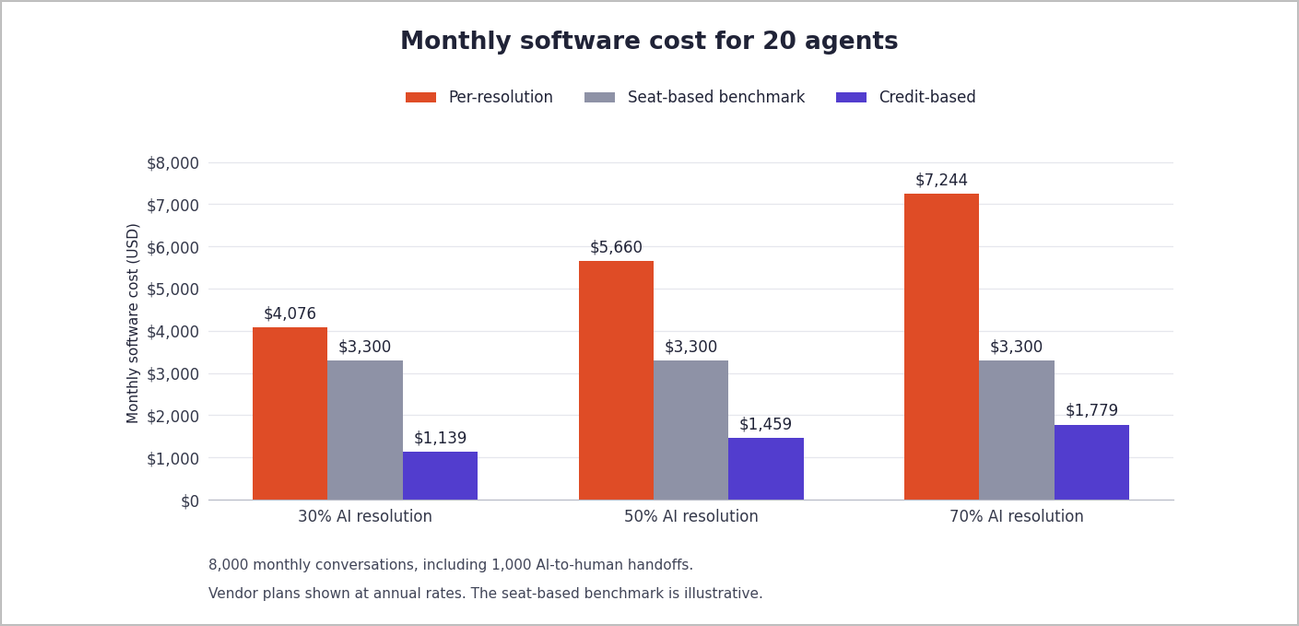
Per-resolution pricing ties your cost directly to the AI’s success. Every improvement you make to your knowledge base, every new workflow you automate, and every extra channel you open adds $0.99 per conversation.
That’s a fair trade at low volume. In this example, Fin fees exceed the $1,700 in seat fees once AI resolutions pass about 1,700 a month.
How credit usage changes with conversation complexity
The credit model depends on how many credits an average conversation uses. BoldDesk prices credits by task complexity. For example, the Support Agent uses 1 to 2 credits for a knowledge base answer.
One lookup in a connected system through AI Actions uses 3 to 5, and multi-step workflows use 8 to 12.
At a 50% AI resolution rate, the same team would pay:
| Average credits per AI-handled conversation | Monthly credits | BoldDesk Momentum AI total |
|---|---|---|
| 3 (mostly FAQs) | 15,000 | $1,059 |
| 5 (typical) | 25,000 | $1,459 |
| 8 (complex workflows) | 40,000 | $2,059 |
Even at 8 credits, the credit-based total stays below both other models in this example. Measure your own credits per conversation during a trial before you rely on any estimate, including ours.
You can also compare the models by AI cost per resolution. At a 50% AI resolution rate, Fin costs $0.99 per resolution. BoldDesk’s $960 in extra credits works out to about $0.24 per resolution, even though those credits also cover the 1,000 handoffs. Including platform and seat fees, total software cost per AI resolution is about $1.42 for Intercom Advanced with Fin ($5,660 ÷ 4,000) and about $0.36 for BoldDesk Momentum AI ($1,459 ÷ 4,000).
What changes for 5-, 20-, and 40-agent teams?
Keep the AI resolution rate at 50% and scale monthly volume to 400 conversations per human agent. Handoffs after an AI answer represent 12.5% of total volume in every scenario. The same prices and billing assumptions apply.
The chart shows how each bill scales with team size. The table below it lists the exact figures, including the number of AI handoffs.
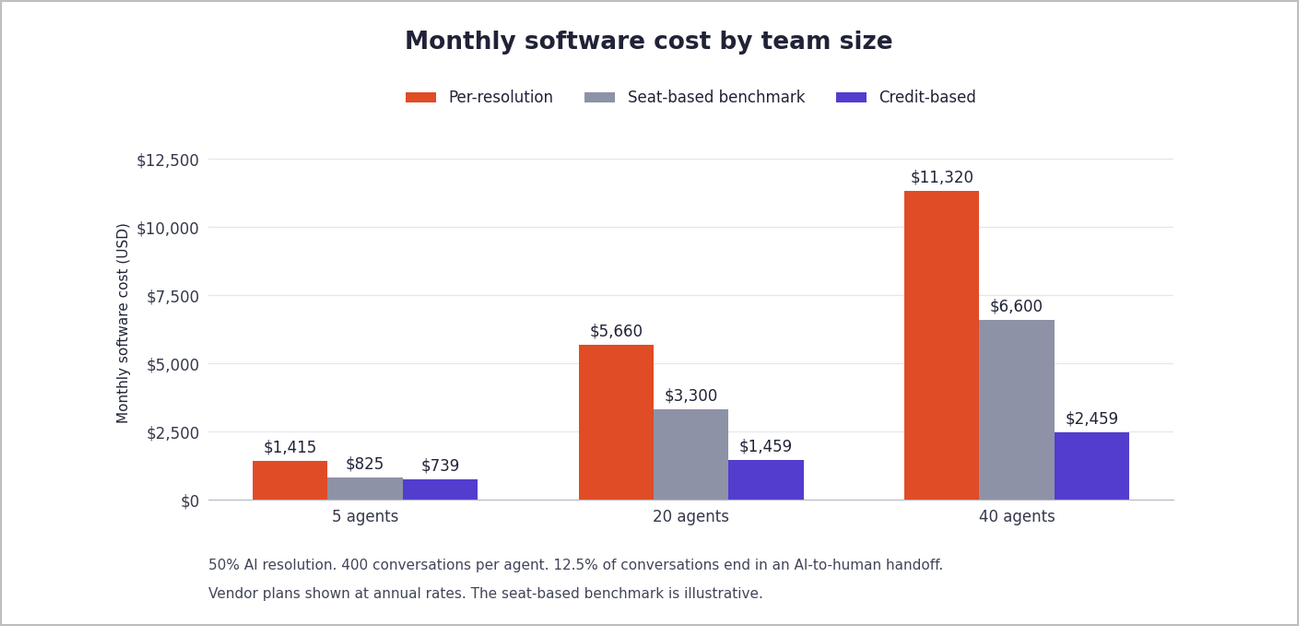
| Human agents | Monthly conversations | AI handoffs | Intercom Advanced + Fin | Seat-based benchmark | BoldDesk Momentum AI |
|---|---|---|---|---|---|
| 5 | 2,000 | 250 | $1,415 | $825 | $739 |
| 20 | 8,000 | 1,000 | $5,660 | $3,300 | $1,459 |
| 40 | 16,000 | 2,000 | $11,320 | $6,600 | $2,459 |
For the five-agent team, the credit-based estimate is only $86 below the seat-based benchmark, so handoffs can change the result. If that team has 1,000 AI handoffs a month instead of 250, the credit-based estimate rises to $859. At that volume, the seat-based benchmark is $34 cheaper. Small teams with frequent handoffs should price both models before choosing.
For the 40-agent team, the BoldDesk base subscription remains $499. The higher modeled total comes from buying more credits to cover the larger workload.
Which AI pricing model fits your team?
Four inputs decide which model fits: monthly AI resolutions, monthly handoffs to agents, expected headcount changes, and whether AI will mainly serve customers or help agents.
Per-resolution pricing may fit teams that:
- Expect a few hundred AI resolutions a month, so per-outcome fees stay a small part of the bill.
- Are piloting AI and want to pay only when it resolves a conversation.
- Can get a clear definition of billable outcomes, including assumed resolutions and handoffs.
Seat-based pricing may fit teams that:
- Use AI mainly as a copilot that drafts replies, summarizes tickets, or translates messages, rather than to resolve conversations on its own.
- Have stable headcount and want a fixed monthly AI cost.
Credit-based pricing may fit teams that:
- Expect AI to handle thousands of conversations a month at a 50% or higher resolution rate.
- Plan to hire more agents and want unlimited human seats, so new hires don’t raise the software bill.
- Can measure average credits per conversation in a pilot and track usage against a monthly budget.
If the estimates are close, rerun them at 70% AI resolution. Use the higher-resolution scenario to see how each bill could change as AI resolves more conversations.
How to compare AI agent pricing with your own numbers
Pick a typical support month and a busy one. Use your pilot’s resolution and handoff rates if you have them.
- Estimate what each vendor bills. Count billable outcomes for per-resolution plans and paid seats for seat-based plans. For credit-based plans, estimate credits for AI-handled conversations and any separately measured agent-assist tasks.
- Calculate the full monthly bill. Add platform fees, minimum commitments, and paid add-ons. Deduct included usage before pricing any extra usage. If the vendor sells credits in packs, round up to the next whole pack.
- Compare both months. Use the same workload and billing term for every quote. Check how much each bill increases in the busy month. To compare AI cost per resolution, divide each vendor’s AI charges by the number of conversations the AI resolves.
To estimate BoldDesk costs without doing the math by hand, enter your monthly conversations, team size, AI share, and credits per conversation in the AI ROI calculator.
Hidden costs in AI customer service pricing
To estimate your monthly bill, look beyond the advertised AI rate. Account for platform fees, required seats, and how the vendor bills for AI usage.
Platform fees, seats, and minimum commitments
Count the paid seats your team needs and check what you’ll owe in a low-volume month. Intercom charges for seats and Fin outcomes when you use both on an Intercom plan.
If you use Fin with an existing help desk, Fin costs $0.99 per outcome, with no seat or platform fees, and Intercom applies a minimum monthly commitment (it lists 50 outcomes as an example). Include your existing help desk subscription in the total.
What counts as a billable resolution or handoff
A vendor’s billing rules determine how many outcomes you pay for. Fin can count a conversation as resolved if the customer stops responding for 24 hours after an answer.
A successfully completed procedure that ends in a configured handoff can also count as a billable outcome. Fin charges at most once per conversation.
Zendesk introduced automated resolution tiers on May 18, 2026. It sorts AI conversations into assisted escalations, contained resolutions, and verified resolutions. Only verified resolutions count against your plan’s included allowance. Confirm the allowance and the rate for additional resolutions before you budget.
AI add-ons billed per agent
Check whether agent-assist tools are included in the plan. If the vendor charges per seat, budget for the teammates who need features such as reply drafting, ticket summaries, or suggested answers.
Overages, credit expiry, and spending limits
Check what happens when you reach your usage limit. The vendor may charge for extra usage, pause AI, or let you set up automatic top-ups. Find out when your allowance resets and whether unused credits carry over or expire.
Include AI work performed before a human takes over. In our BoldDesk example, 1,000 monthly handoffs use 5,000 credits at an assumed 5 credits per conversation.
Monthly rates, annual commitments, and promotions
Annual billing usually lowers the monthly rate, but you may need to pay for the full year upfront. Compare quotes on the same billing term and record any upfront payment.
If a quote includes a promotion, check how long the discount lasts and what you’ll pay when it ends. Use the regular rate to estimate costs beyond the promotional period.
Implementation and ongoing management
Budget for setup, integrations, knowledge base maintenance, and time spent reviewing AI answers. These costs can continue after the initial deployment.
How BoldDesk charges for AI usage
BoldDesk uses credit-based pricing for AI usage. Its AI plans include monthly credits shared across the Support Agent (BoldDesk’s AI agent) and the Assist Agent (its AI copilot). Each plan also includes unlimited tickets and unlimited human agents, subject to BoldDesk’s fair usage policy.
The table below compares the plans, included credits, and key features.
| BoldDesk AI plan | Monthly price, billed annually | AI credits per month | Key features |
|---|---|---|---|
| Scale AI | $99 | 500 | Support Agent for email and self-service support |
| Momentum AI | $499 | 1,000 | Adds Support Agent on chat, WhatsApp, social media, and SMS |
| Enterprise AI | $999 | 2,500 | Adds multi-brand support, HIPAA compliance, and custom dashboards and scheduled reports |
Prices are billed annually and current as of November 2026. See the BoldDesk pricing page for more details.
How BoldDesk AI credits work
Credit usage varies with the type and complexity of the AI task. A straightforward knowledge base answer can use 1–2 credits, while a multi-step workflow can use 8–12 credits. A conversation sent directly to a human without an AI answer uses no credits.
Additional credits cost $40 per 1,000. Subscription credits reset each billing month and don’t roll over. Purchased credits are used after the subscription balance runs out, and they never expire.
You can monitor subscription and paid credit balances, set alerts, and purchase more credits. Auto-recharge is optional and stays off unless you turn it on, so BoldDesk buys extra credits only when you choose to.
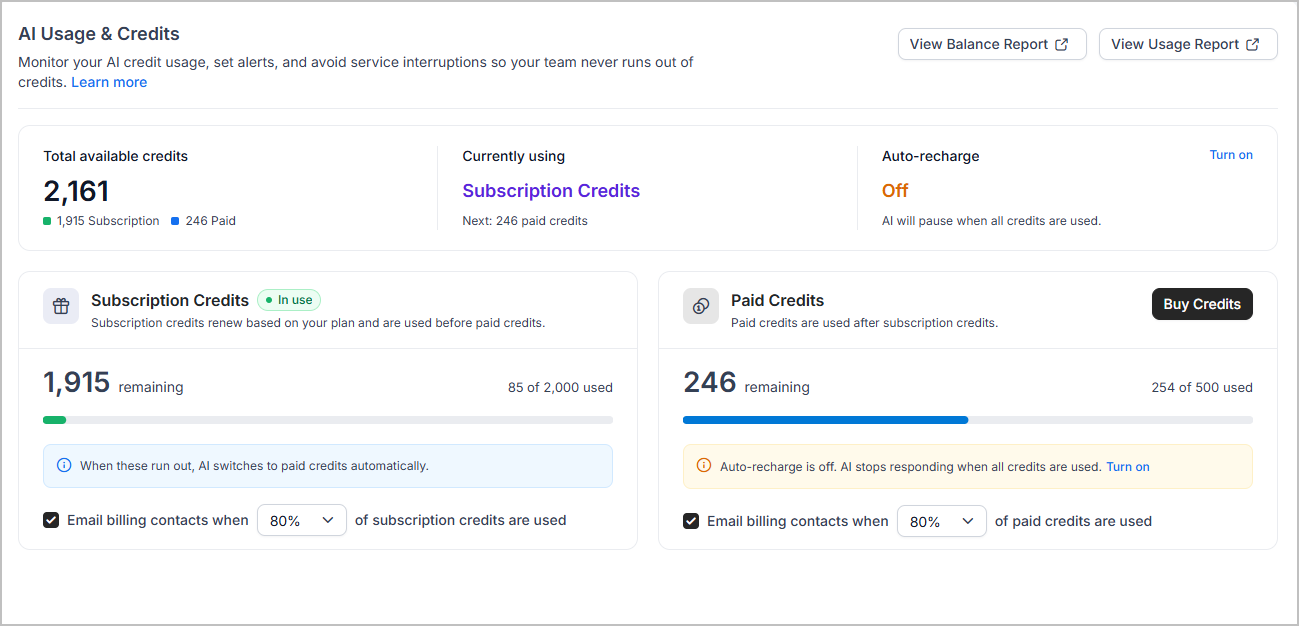
BoldDesk alerts you at 80% and 100% of your credits. If credits run out and auto-recharge is off, AI responses pause until you add more, so you aren’t billed for overages. You can buy more credits, upgrade your plan, or route new conversations to human agents.
For teams that don’t need AI, the BoldDesk Enterprise Without AI plan costs $35 per agent per month, billed annually.
Eligible startups can use BoldDesk free for 12 months with up to five agents and 1,000 AI credits a month through the startup program. Teams switching from another platform can also migrate for free.
Choose AI pricing that fits your support needs
The right AI pricing model depends on your ticket volume, team size, and how you plan to use AI. Before you sign, run your own volumes through each model at your current AI resolution rate and at 70%. Ask each vendor how it bills handoffs, overages, and unused credits.
BoldDesk’s credit-based AI plans include unlimited human agents, so you pay for AI usage, not headcount.
Start your 15-day free trial with no credit card required, and measure your own credits per conversation.
Related articles
- Affordable Pricing: How BoldDesk Delivers Premium Value
- How Support Teams Cut Costs by Up to 25% Using BoldDesk
- Why Your Support Costs Keep Increasing (And How to Fix Them in 2026)
FAQs on AI agent pricing models
What is per-resolution pricing for AI customer service?
Per-resolution pricing charges for each conversation that meets the vendor’s billing definition of a resolution. Some vendors also charge for other outcomes, such as qualifying handoffs. Include platform fees and seat charges when estimating your total cost.
What is an AI credit?
An AI credit is a unit that measures AI work. Each AI task, such as answering from a knowledge base or looking up an order in a connected system, uses credits based on its complexity. In BoldDesk, a simple answer uses 1 to 2 credits, and a multi-step workflow uses 8 to 12.
What is the AI resolution rate?
The AI resolution rate is the share of all support conversations that the AI resolves without a human agent. If AI resolves 4,000 of 8,000 monthly conversations, your rate is 50%. Conversations the AI answers before a handoff don’t count as resolutions, but they can still use credits or count as billable outcomes.
Is per-resolution or credit-based pricing cheaper?
In our worked example, credit-based pricing costs less than per-resolution pricing at every AI resolution rate we tested. For a 20-agent team with 8,000 monthly conversations and a 50% AI resolution rate, estimated monthly costs are $5,660 for Intercom Advanced with Fin and $1,459 for BoldDesk Momentum AI. Your result depends on platform fees, billable outcomes, and average credits per conversation.
How should I budget for AI-to-human handoffs?
Estimate how many conversations AI will handle before handing them to a human agent. Include any credits the AI uses before the handoff. If your vendor charges for qualifying handoffs, include them in your billable outcome estimate.
How many AI credits does my team need?
Multiply your expected AI conversation volume by the average credits used per conversation during your pilot. Include conversations where AI responds before handing off. Budget separately for tasks outside those conversations, such as standalone Assist Agent summaries.
What is the difference between seat-based and credit-based AI pricing?
Seat-based pricing charges for each paid human agent seat, whether or not the AI resolves any conversations. Credit-based pricing charges for AI work measured in credits, so cost follows AI usage rather than headcount. Some plans combine a seat fee with AI usage charges, so check what your subscription covers.
ABOUT THE AUTHOR

Gibson Amisi Kashi 
Gibson specializes in customer service and customer experience topics at Syncfusion, where he examines trends, tools, and strategies that help teams deliver faster, more connected support.
Read more articles by this author Connect with the author on LinkedIn.
Be the first to get updates